Dänikenitis – Part Two: Human Chauvinism

Erich von Däniken’s thesis, that extraterrestrials have visited Earth in the distant past and interacted with human cultures, is not in and of itself a ridiculous prospect. It should not be rejected based on any preconceptions or prejudices about such a theory, but rather on the basis of its weak, erroneous, and misrepresented evidence. The fact is that there is a long history to the scientific search for extraterrestrial intelligence, much estimable work has been done in this field, and there remains strong reason to believe in the possibility of alien life, theoretically, and out there, in the cosmos, rather than down here on Earth. Inventor and electrical genius Nikola Tesla believed at the end of the 19th century that radio communication could be established with extraterrestrial civilizations, and throughout the 20th century, this line of reasoning has developed into numerous SETI projects, SETI standing for Seach for Extra-Terrestrial Intelligence, and radio searches have long been a focus of such projects. Indeed, when such searches find anything unusual in our galaxy, the presence of extra-terrestrial life or technology is often the first conjecture that astronomers and scientists consider. Tesla himself mistakenly believed he had detected a radio signal from Mars, and similarly, in the 1960s, when the regular radio signals of a pulsar were first detected, astronomers labeled it LGM-1, for “Little Green Men.” Many noteworthy astronomers in the 1960s were preoccupied with SETI. In 1962, a Soviet astronomer, I.S. Shklovsky, wrote a major work on the topic, titled Universe, Life, Intelligence, and in 1966, Harvard astronomer Carl Sagan, a champion of science and skeptical thought, collaborated with Schklovsky on a revision and translation of his work, expanding the scope of the study, and publishing it for English-speaking readers under the title Intelligent Life in the Universe. This book introduced the concept to the public that intelligent life not only may exist but actually seems statistically probable, given the size and complexity of our galaxy. More than this, it suggested that there may be civilizations more advanced than our own, which have already achieved interstellar spaceflight. This notion had been around for a long time by then, and had been debated by scientists already, most notably by Enrico Fermi, among his fellow physicists at Los Alamos National Laboratory, where it is said that Fermi, during one such conversation, blurted out something to the effect of “Where is everybody?” Fermi set forth a paradox through the following chain of reasoning. If, considering the billions of stars in the galaxy and the likelihood that other planets could be found within the habitable zones of their solar systems, and therefore extra-terrestrial intelligent life is likely, it follows that, since many stars are far older than our own, and thus many of these civilizations would have developed interstellar travel in the distant past. Therefore, Earth should logically have been visited before by these ETs. On the surface, this reasoning seems like a slam dunk scientific theory to help support the ancient astronauts theory, but Fermi’s entire point was that there is no convincing evidence for such visitation, which is what makes it paradoxical. This is not something that is taken lightly by scientists and mathematicians. Paradoxes beg to be resolved, so many have since examined Fermi’s logic and even developed various equations and solutions to the problem. Much of Fermi’s reasoning was based on assumptions about the likelihood of multiple developments, not just the likelihood of habitable planets, but the likelihood of the evolution of intelligent life on them and the likelihood of their achievements in spaceflight. In 1961, astrophysicist Frank Drake developed an equation to better discern these likelihoods, taking into account most of these variables. Not only was the development of interstellar travel considered, but also the development of deep space probes. In 1972, Drake and Sagan had designed a message to be included on the Pioneer space probes that could potentially communicate something about humanity to extra-terrestrials who might encounter the probes after they left the solar system. They came up with a plaque of aluminum dipped in gold, representing humanity’s mastery of metallurgy. On it was etched a diagram of two hydrogen atoms, the math related to which would serve as the key for all further measurements, as the plaque also included a sort of map. A representation of our solar system was given, with the probe’s path shown, and a series of radiating lines was depicted that should allow for the triangulation of our Sun in relation to a number of pulsars. Lastly, two nude human figures were depicted, male and female and unfortunately both very white looking. Rather ridiculously, NASA insisted on erasing the line that depicted the woman’s vulva before the creation of plaque. So it really did end up representing humanity in that it reflects our numerous prejudices and small-minded hangups. A few years after the plaque was launched, astrophysicist Michael Hart proposed the Hart-Tipler conjecture, based on the idea that, if other intelligent civilizations had developed, then similar such probes, or more advanced, self-replicating probes, would have been encountered. His solution to the Fermi paradox is that no intelligent life exists other than humanity. An alternative theory that has developed is the firstborn hypothesis, that humanity just happens to be the first to develop intelligence and thus is the most advanced of all such civilizations. More recently, in the 1990s, another concept was proposed by one Robin Hanson, an economist, of the Great Filter, some obstacle to the development of intelligent life that has not been taken into account by the probabilities previously put forward. The most commonly agreed upon filter is abiogenesis, the emergence of life from non-life on a molecular, chemical level. Other potential filters include the development of high technology, which may not be as likely as assumed, and the potential that other intelligent civilizations simply depleted their resources and destroyed themselves. I think the last of these is very telling, since humanity itself, having never achieved interstellar travel, seems bound on a path toward resource depletion and self-destruction. But of course, ancient astronaut theorists don’t get this deep into the weeds in the scientific considerations of extra-terrestrial life. Erich von Däniken and all the talking heads on Ancient Aliens will just say there is evidence that aliens have been here, so there is no paradox. But in order to be actual evidence, and not mere talking points, it must be reliable and reproducible. And such evidence has never been provided. This is Historical Blindness.

In the Oscar-nominated documentary In Search of Ancient Astronauts, based entirely on the work of Erich von Däniken, host Rod Serling described New Guinea natives searching the skies for the return of WWII pilots, whom they worshipped as gods. What the film describes is what are called “cargo cults,” a term that is not really used anymore because it presupposes the confusion and primitiveness of the native peoples who developed the beliefs. The fact is that these beliefs typically revolved around the relative abundance of life when colonial powers arrived, bringing with them additional resources as gifts, or in the case of WWII, when outside forces, both Japanese and Allied, distributed and airdropped goods to the native islanders in order to gain their favor, since they were using their islands as airbases. What’s important here is that, the film suggests this is a parallel to the ancient aliens claim, but in reality, likely just off camera, abandoned airstrips and control towers, empty barracks and even actual planes, not straw models, were left behind on these islands. For this to serve as an analogy for ancient astronauts, it begs the question, where are the remains of the visitors’ technology, such as that left behind for Melanesian islanders to remember their visitors? This would be the reliable evidence that would make the Fermi paradox less paradoxical. What is von Däniken’s answer? It is just what you would expect. The pyramids, or other ancient monuments, all of which need no extra-terrestrial technology to explain. I just wrapped a 6-episode arc on pyramid nonsense, so I won’t spend much time on that. Von Däniken, predictably, claims that pyramids just appeared out of nowhere, with no historical precedent, which is just a lie, denying all archaeological evidence for the development of pyramid building from mounds to mastabas to step pyramids and the Bent pyramid to true pyramids and finally the massive Giza pyramids, built over natural rock outcroppings to aid in their construction. He repeats the often-repeated pyramidology nonsense of Charles Piazzi Smyth about pyramid measurements reflecting pi, which, of course, if it were true—which it’s not—would still not mean aliens were involved. And like many another pyramid huckster even today, he claims that it would not have been possible to move such large stones into place, or even to cut them. The simple truth, cutting through all the BS with Occam’s Razor and subscribed to by any Egyptologist and archaeologist who has studied the evidence is that the soft limestone blocks, which we know were quarried in Aswan, were cut using copper tools, including drills, chisels, and saws. Others protest that the hard granite used in the King’s chamber could not have been quarried with copper tools, and that’s true. Evidence suggests these materials were quarried using simple sand abrasion techniques, using quartz sand, and took far longer. And this is why only about one tenth of one percent of the materials used were granite. Again, no alien technology needed. Von Däniken protests that plentiful food would have been needed to feed all the workers, and this is true, but so what? Egypt was the bread basket of the Mediterranean, producing plenty of grain, and if we recall, even the earliest reports about the pyramid’s construction, told to Herodotus, were focused on how much food Khufu provided to feed his laborers. Von Däniken also suggests that wood was not plentiful enough to provide the rollers and sledges needed to move the stone blocks. First of all, hieroglyphic texts record that Egypt engaged in regular trade with Lebanon, importing a great deal of cedarwood. Good evidence for the commonality of wood was found in Tutankhamen’s tomb, wherein most of the artifacts were wooden. And second, it seems to me that if von Däniken protests that they didn’t have the wood they would need to move the blocks, then he is tacitly admitting that they could have moved the blocks if they had the wood, which they did.

Not only does von Däniken underestimate the ingenuity of ancient people, he also does not seem to understand exactly what modern technology is capable of. He says, “Today, in the twentieth century, no architect could build a copy of the pyramid of Cheops, even if the technical resources of every continent were at his disposal.” Yet in 1972, the Transamerica Pyramid in San Francisco was completed, towering almost 400 feet higher than the Great Pyramid of Giza. And starting in the 1990s, many other pyramids have been built, in Las Vegas; Memphis, Tennessee; and Long Beach, California. There’s even a Pyramid Shopping Mall in Malaysia. It begins to seem like everything appears to von Däniken to be ancient alien technology because he simply doesn’t understand technology generally. This is abundantly clear when he starts talking about Egyptian mummification as evidence of alien tech. He suggests, quite stupidly, that Egyptian mummification was a kind of suspended animation technology, that ancient Egyptians were preserving themselves so that they could be revived when the alien founders of their civilization returned. If von Däniken had really read up on Egyptian mummification, he would have realized that it’s not a high-tech practice at all, and no one could be revived from a mummified state. Egyptians removed the brains of those they mummified and filled their skulls with resin. They removed all their internal organs and put them in jars. And then they saturated the entire corpse in embalming fluid that solidified, such that mummies often had to be chiseled out of their sarcophagi. The resin mummifying King Tut had to be melted using paraffin lamps, bringing him to an astonishing 932 degrees Fahrenheit just to remove him from his coffin. Mummification was not an advanced technology based on any clear understanding of biology or life, and it’s unclear how aliens would have revived corpses with no brain, heart or lungs that were essentially filled with glue. But von Däniken himself clearly has little working understanding of biology, as much of his theory is predicated on the idea that humanity was somehow born of these alien visitors. Sometimes he suggests that aliens genetically engineered humanity, using terminology that betrays a rather poor understanding of genetics, though perhaps he may be forgiven, writing in the sixties. Modern genetic data going back 800,000 years as well as mass spectrometry techniques that allow the sequencing of ancient proteins from tooth enamel, has helped to rather thoroughly map out human lineage, which split gradually from chimpanzees some 9-7 million years ago, evolving slowly, branching from common ancestors, ever since. With this information, added to archaeological evidence that reveals the slow progression of stone toolmaking and the gradual domestication of plants and animals, there is simply no genetic or archaeological evidence to support a kind of sudden “artificial mutation” producing Homo sapiens, as von Däniken suggests. Ridiculously, though, he also suggests that it was accomplished more naturally, through good old-fashioned sexual intercourse. And I think it should be obvious that alien life forms, who evolved according to very different conditions, are extremely unlikely to be biologically similar at all, let alone that we’d be compatible enough reproduce. When von Däniken makes these mistakes, he is demonstrating what Carl Sagan called “human chauvinism.” As he explains, “The most likely circumstance is that extra-terrestrial beings will look nothing like any organisms or machines familiar to us.” But as Star Trek and Star Wars attest, we tend to think about all alien life as being humanoid, because it’s hard to imagine something intelligent that is unlike ourselves. Or as 17th-century Dutch physicist Christiaan Huygens put it, in a quote that Sagan and Shklovsky included in their book, “’tis a very ridiculous Opinion, that the common People have got, that ’tis impossible a rational Soul should dwell in any other Shape than ours . . . This can proceed from nothing but the Weakness, Ignorance, and Prejudice of Men.”

Among the monuments that von Däniken claims are evidence of his ancient and very humanoid astronauts are the Olmec colossal stone heads. I have discussed these before, in my series on Pre-Columbian Trans Oceanic Contact theories, since some suggest their facial features indicate that ancient Black Africans colonized the Americas, while others argue that their features suggest ancient Chinese contact with the Americas. Von Däniken looks at them and sees extra-terrestrials, though not so much because of their features. Rather, he is focused on their headwear, which he calls helmets in an effort to draw a comparison with helmeted astronauts. It’s as if he has never heard of headdresses. He does this quite a lot, pointing to the Tassili site in the Sahara desert, for example, where during a specific period, figures in prehistoric rock art are depicted with “round heads,” and calling them spacemen with a kind of quintessentially human astronaut’s helmet on. And one of the central pieces of “evidence” in his book, the monolithic mo’ai statues depicting humanoid figures that stare out to sea enigmatically from the shores of Easter Island, he also calls helmeted because some used to feature additional stones on their head, which again were not space helmets, as von Däniken imagines, but rather represented the topknots worn by chieftains of the Rapa Nui people. As he did with the pyramids, von Däniken denies the possibility that monuments such as the Olmec heads and the Easter Island mo’ai could possibly have been moved and erected by mere human beings. Of the Olmec colossal heads, he even says, “they will never be on show in a museum. No bridge in the country could stand their weight.” In fact, pretty much every Olmec head has been moved and displayed in museums—all four La Ventana heads, all 10 San Lorenzo heads, and others. Even when von Däniken was writing his book, several were on display in museums, so this is just another example of him blowing hot air. Likewise, he claims, much as he did with the pyramids, that first of all, the carving and moving of the mo’ai statues on Easter Island was impossible, and that they didn’t have the wood they would need to move them—yet another tacit admission that, if they had the wood, they could have moved them. And the British explorer James Cook, who first landed on the island in 1774, reported the presence of forests there. Regardless, all claims, by von Däniken or any other pseudoarchaeologist, that the Rapa Nui people could not themselves have quarried, carved, moved and erected the statues are outright lies. In the mid-1950s, during Thor Heyerdahl’s expedition to the island, the islanders explained exactly how it was done and even demonstrated it for him. They wetted the volcanic tuff to soften it, and carved it using teardrop-shaped hand axes. They moved it easily a hundred yards using a wooden sledge and walking the statue, as we might today walk a heavy piece of furniture or major appliance to move it. And they erected it by levering and rocking the statue and pulling on it with rope, so that they could place more and more rocks beneath it, forcing it slowly up and into position. It was a remarkable display of ancestral memory, megalithic monument building, and the ingenuity of ancient man. Von Däniken dismissed it by saying “archaeologists all over the world protested against this example,” which was strictly untrue. While some archaeologists suggested that damage to the base of the statue from walking it indicated this wasn’t the way it had originally been done, more recent experiments have brought the academic community around to the technique. Regardless, even if some slight variation was required to get it just right, the demonstration proved beyond any doubt that it could be done without extra-terrestrial intervention.

We see similar slipshod scholarship—and you can’t really even call it scholarship, since it’s more like anti-scholarship—in his other major pieces of “evidence” that he sees as working together to demonstrate the credibility of his thesis. One is the Palenque astronaut, a relief carved onto the sarcophagus lid of Pacal the Great, the Mayan governor of that region. I mentioned Pacal the Great and his sarcophagus before, since it was claimed by Ivan van Sertima that his even having a coffin was evidence of a cultural connection with Egypt, even though Pacal himself was not mummified. Well, nor was he an alien. The relief on his sarcophagus, according to von Däniken, is an unmistakable depiction of a man piloting a rocket, and by his description, it certainly does sound convincing. But of course, seeing it is a little different. What von Däniken fails to emphasize is that the “helmet” he says the pilot is wearing is an elaborate headdress that does not cover his face at all, that he is otherwise unclothed, save for a loincloth, that the only vaguely rocketlike shape, or rather tapering columnar outline within which this rocketeer is featured, is not aerodynamic at all, with numerous perpendicular appendages shown and various animal forms, serpents and birds, adorning it at awkward angles, even at its tip, where it would need to be more pointed. Nor is it even enclosed, with numerous gaps in its supposed hull, and the pilot himself even extending his head from it. If it were a rocket, then the astronaut rode it like a motorcycle, but with no helmet and no shoes on. All of this can be waved away as the result of Mayans simply not understanding the rocket technology, but the fact is that, when you compare this relief to other similar pieces of Mayan art, it is very clear that it is simply the result of the dominant artistic style, which saw tracery designs chiseled in to fill up the entire space, incorporating many of the same motifs, including the sacred maize tree and the plumed serpent bird, though tellingly, no other examples can be so mistaken for a rocketship. Additionally, with the idea of a “rocket,” von Däniken reveals that he is thinking of the rather old fashioned spaceflight technology of his own era. Where are the gyroscopic wheels within wheels capable of flight in any direction? Where are the flying saucers?

Of course, a discussion of von Däniken’s claims would not be complete without a refutation of his assertions regarding the Nazca Lines. If you are unfamiliar with these amazing geoglyphs in the Peruvian desert, they are essentially massive geometric shapes, mostly straight lines, as well as some animal figures, that were created in the distant past by removing the darker surface stones to reveal lighter colored soil beneath. The movement of these stones is not so very mysterious. Rather, it is the question of just how these geoglyphs were created when they cannot be truly observed except from the sky. They were first reported by a Spanish conquistador who thought they were trail markers in 1553, but the scope of them was not observed until Paul Kosok surveyed them by airplane in the early 1940s. This fact has led even scholarly archaeologists to consider somewhat surprising ideas, such as that ancient Peruvians had developed ballooning technology. As we will see, however, no such notions need to be entertained to explain their construction. First of all, they can be seen from nearby foothills. In fact, they were first seen for what they are by a Peruvian archaeologist looking down on the desert from a higher vantage, no flight required. And the discovery of ancient wooden pegs driven into the desert floor at the termination of some lines supports the notion that these massive glyphs were created using rather typical survey techniques. In fact, in 1983, noted skeptic Joe Nickell even proved that it was possible to do so, using the simple technologies available in ancient Peru. Working from a drawing of a geoglyph, they simply scaled it up, measured out a number of points, and connected the dots. The result was a very precise reproduction of the condor geoglyph. However, while it has proved very simple to figure out how these glyphs were created, needing no extraterrestrial or other advanced technology whatsoever, figuring out why has been trickier. Von Däniken scoffs that “Archaeologists say they are Inca roads. A preposterous idea!” In reality, no archaeologist suggests this. Among the many theories regarding their purpose, they are thought to be solstice aligned pieces of art that served ceremonial purposes, some sort of elaborate representation of star constellations or other archeoastronomy, or looms for the fabrication of extremely long textiles used for wrapping mummies. More mundane explanations suggest they were irrigation systems, or aqueducts, or markers for field division. Perhaps the simplest and most convincing is that they were involved in the worship of deities who were thought to supply water. If you want to catch the attention of the gods, then of course you mark out messages to them that can be seen from their abode in the sky. But even this, which alone should have been enough to excite von Däniken’s reckless theorizing, did not go far enough for him. Instead, he proposed the really preposterous idea that it was a “airfield.” Talk about preposterous! Once again, von Däniken thinks in terms of outmoded flight technology, that his ETs need landing strips and are therefore incapable of vertical takeoff and landing. Also, the lines are miles long, far longer than would be needed for even an airplane to land, and the desert soil there is too soft and sandy for an airstrip. And besides that, with no landing lights, all of these supposed airstrips would be rather useless as soon as the sun set.

What is abundantly apparent, when one really examines von Däniken’s writings and his claims, is that he is only a compiler of claims that others made before him, and as such, he is not even the best proponent of any of them. Nor is he a good judge of their credibility. This is evidenced clearly by the fact that, like other conspiracists, he includes known frauds and hoaxes in his books, spreading them without any critical examination of them, and presenting them as if they are convincing evidence of his thesis. Several such instances can be listed. One example is in Chariots, when he refers to a papyrus fragment discovered by Alberto Tulli, which talks about what sound like UFOs. In reality, the Tulli papyrus was lost, and then the fragment translated was only found in the 1950s, during saucer mania, and was likely a fraud. Another is his assertion in 1972’s Gods from Outer Space that he read the Book of Dzyan, a work of occult knowledge said to be found in Tibet and perhaps to have originated in the lost continent of Atlantis. Von Däniken says the book was alien in origin. In fact, the “surviving fragments” von Däniken read were a hoax, written by Helena Blavatsky. It was yet another esoteric work plagiarized from a variety of Eastern religious texts and occult sources. Yet another example is his promotion of the Ica stones, a series of engraved stones from Peru that appear in some cases to depict advanced technology. As it turns out, these stones were being manufactured by a Peruvian potter as tourist souvenirs, and von Däniken was aware that this potter claimed to be the manufacturer of the stones. He did not mention this at all, and instead chose to believe that the potter was lying about making them and that the stones were actually ancient. Lastly, in his 1973 book, The Gold of the Gods, he focused on the legend of Cueva de los Tayos, a cave in the Andes that is said to contain gold plates that tell the true history of humanity. This legend was begun by one Janos Móricz, who claimed to have explored this cave and seen the “Golden Library.” His claims spurred numerous expeditions, including one mounted by a Mormon group, who suspected that the gold plates must be the same ones Joseph Smith had translated the Book of Mormon from. In the 1970s, von Däniken too made a trip, met with Móricz, and made claims about having been taken to the cave and seeing the metal plates. However, in a later interview, Móricz said it was all a lie. Von Däniken had only been in town a few days and made up an entire story based on their conversation. He had even misrepresented photos as having been taken on that nonexistent expedition. As for the story itself, Móricz was a Hungarian nationalist with interests in Nazi occultist ideas, and it is generally believed that his Golden Library, which he never produced and which no later expedition ever found, was likely a hoax meant to promote his pseudohistorical ideas, as he claimed the Golden Library was created by an ancient Magyar civilization in Mesoamerica.

When confronted with the allegations of his lying, von Däniken merely said he had made it all up merely for dramatic effect. This is typical of his blithe deflection when confronted with his deceptions and misrepresentations. For example, in Chariots, he claimed a certain iron pole near Delhi must be alien in origin, calling it “an unknown alloy from antiquity” and claiming it didn’t rust. In fact, it was resistant to rust because it was relatively pure iron, but it did rust a bit. In 1974, a Playboy interviewer confronted him on this—as well as many other inaccuracies in his writings; it’s a great read that I recommend to anyone interested—and Von Däniken merely said he had made an error, saying “we can forget about this iron thing.” The interviewer pressed him on why he hadn’t made corrections to the text in subsequent editions, and von Däniken lamely blamed his publishers: “Oh, God, I have so many times tried to correct things, and my experience has been that the corrections are almost never made.” So in the end, by his own admission, his books are littered with errors and misrepresentations that no one has bothered to correct. Or as Carl Sagan said, “I know of no recent books so riddled with logical and factual errors as the works of Von Däniken.” So why, we must ask, are his theories still such popular mainstays of even mainstream entertainment like the History Channel and the Joe Rogan Experience? As Sagan said in his Foreword to my principal source, Ronald Story’s The Space-Gods Revealed: “The times are such that simplistic doctrines like von Däniken’s sell—even though they may represent, as I believe they do, a small but definite social danger.” And that social danger has only grown with time, doing more and more harm to our trust in science and history, and our recognition of outmoded racial ideas, until today it is a veritable social disease, and we find ourselves in the terminal stages of Dänikenitis.

Further Reading

Nickell, Joe. “The Nazca Drawings Revisited: Creation of Full-Sized Duplicate.” Skeptical Inquirer, vol. 7, no. 3, Spring 1983, skepticalinquirer.org/1983/04/the-nazca-drawings-revisited-creation-of-full-sized-duplicate/.

Story, Ronald. The Space-Gods Revealed: A Close Look at the Theories of Erich von Däniken. Harper & Row, 1976.


Dänikenitis - Part One: Wheels Within Wheels

In the public imagination, there is nothing outrageous about the idea that extra-terrestrials visited Earth and made contact with human beings, or even created human beings, in the ancient past. Indeed, it is such a common notion that we see it saturating the entertainment industry. For the last ten years or so, superhero films based on comic books have dominated the box office, and I’m not criticizing these entertaining films. I enjoy them. What’s interesting is that so many of them play with the notion of ancient contact with extra-terrestrials. The depiction of the old Norse Gods as actually having been inter-dimensional space aliens in the Thor films comes to mind. As does the 2021 film The Eternals, which portrayed a species of giant ancient aliens, the Celestials, who actually created humanity through genetic experimentation. A similar story was explored just this year in the final season of Star Trek: Discovery, resurrecting from an obscure episode of the nineties series Star Trek: The Next Generation a species called the Progenitors, ancient aliens who had created all life and all alien species in the Milky Way galaxy. We see it also in the 2012 film Prometheus, which expanded Ridley Scott’s Alien films’ mythology to reveal that a gigantic humanoid alien seen only as a skeleton in the first film was actually a member of an ancient alien species that had seeded the primordial Earth with its own DNA. Meanwhile, this popular trope, long exclusive to the realm of science fiction, has bled into the public’s understanding of history. In the nineties, the History Channel was thought of as the “Hitler Channel” with its focus on World War II docuseries, but in the 2000s, chasing viewers, it began to diversify into reality television and docuseries on more sensational topics, and in 2010, it premiered Ancient Aliens, which has become their tentpole program. To most, the series is a joke, the origin of numerous memes, usually involving the wild-haired UFOlogist Giorgio Tsoukalos, asking if a thing could ever be possible and then excitedly answering yes. The ancient aliens concept is now so thoroughly wedged into the zeitgeist that it seems impossible to dislodge it, to examine its claims and demonstrate its fundamental weakness in such a way that it might change minds. Even those who think the History Channel program is a joke may still believe that there is reason to think its underlying propositions are valid or convincing, especially with the juggernaut podcaster Joe Rogan frequently platforming people who promote the idea, like David Grusch, the congressional whistleblower who in the last year has made countless world-shattering claims about extra-terrestrials, none with actual evidence, including that aliens created humankind. Despite its ubiquity today, the notion of ancient aliens really only took hold of our imaginations in the 1970s. It was certainly in the 1970s that Marvel Comics legend Jack Kirby began to weave the notion of ancient aliens throughout the Marvel Universe. And this came in the wake of a major motion picture, 1968’s 2001: A Space Odyssey, with its iconic depiction of ancient alien contact with early humanity, as ape-like hominids learned the use of tools in the presence of a mysterious monolith. But it is not this film along that accounts for the vast popularity of this idea during the seventies. Rather, it can be traced back to the huge popularity of one book during that decade, and its author, who may himself have taken some inspiration from the Arthur C. Clarke short story “The Sentinel” that had inspired Kubrick’s film. In order to get to the root of the ancient astronaut theory that has become so entangled in modern thought, we must trace it back to its origin point, the primary vector for its propagation, and consider the actual arguments made in that book, Chariots of the Gods by Erich von Däniken.

In my series Pyramidiocy, on the myths and misconceptions about the Pyramids and ancient Egypt, I spoke already about the ancient astronaut theory as it relates to nonsense about the Great Pyramid, and I spoke specifically about Erich von Däniken. More importantly, here at the beginning of this series, I spoke about the origin of the idea of ancient alien contact with Earth, as it originated from some of the same people as had made up nonsense about ancient Egypt and Atlantis: namely Helena Blavatsky and other Theosophists. As I spoke about in my episode on the Religious Dimension of UFO Belief, there was a circuitous throughline, from the Christian mysticism of Emanuel Swedenborg to the spirit channeling of mediums to Blavatsky’s Theosophy. Swedenborg claimed to take spiritual journeys to inhabited worlds, Spiritualists claimed to channel not just ghosts but also extra-terrestrial intelligences, and the medium Blavatsky, claiming to have been tutored by enlightened beings and to have mental access to the Akashic Record, a hidden history of everything, fleshed out a timeline in which ancient aliens from the Moon and Venus helped mankind develop on lost continents. And of course, there was an element of white supremacy in her work, which focused so much on root races and the superiority of Aryans. Aside from the very specific claims of Theosophists, the notion of ancient aliens was really only toyed with, such as by Charles Fort, a well-known compiler of reports on anomalous phenomena, or “Forteana,” who speculated on the possibility that stories about demons could actually reflect visitation from otherworldly beings who had tried to colonize the ancient Earth. Both the claims of Theosophists and the musings of Charles Fort were influential on the young science-fiction author H. P. Lovecraft, who transformed the inchoate ideas into a cohesive science-fiction legendarium involving a “pseudomythology” that featured ancient monstrous deities from outer space who had long lain dormant. It’s thought that Lovecraft also took inspiration from Alfred, Lord Tennyson’s poem “The Kraken,” which spoke of that sea monster’s “ancient, dreamless, uninvaded sleep,” as well as from The Gods of Pegana, a 1905 collection of fantasy stories in which the author, Lord Dunsany, invented a pantheon that included a chief god that had been lulled to sleep and was expected to wake again. But we know that Lovecraft read Theosophical works, and much as those same works grew in popularity in late 19th century Germany, contributing to notions of the German inheritance of Hyperborean Aryan superiority, so too they may have contributed to Lovecraft’s white supremacist views, which showed through clearly in his fiction, with his rejection of miscegenation as an abomination depicted in stories about humanity being corrupted by inhuman bloodlines. As I explained before, all ancient astronaut theories descend from these threads, from Theosophy and the scifi of Lovecraft, and thus derive from racist ideas.

19th century art of the Kraken by John Gibson. The poem by Alfred, Lord Tennyson about this legendary monster of the deep may have inspired Lovecraft’s Cthulhu mythos.

As is probably true of other widespread concepts and how they enter the cultural zeitgeist, the man credited with bringing the idea to the public’s attention, and who for most of his career has enthusiastically taken credit for originating the notion, really only repackaged the ideas of others who are now largely forgotten. In a very real way, Erich von Däniken is just a thief. He was born in 1935, in Switzerland. He was raised Catholic, but as a young man he rejected his father’s faith as he became more and more interested in UFOlogy. His willingness to resort to theft first showed in 1954, when he was convicted and given a four-month sentence for pilfering money from a camp where he worked as a counselor and from an innkeeper. His sentence was suspended, but a psychiatrist who examined him at the time declared that he showed a clear “tendency to lie.” His father pulled Erich out of school after his trouble with the law and apprenticed him to a Swiss hotelier, and von Däniken seems to have taken from his earlier brush with the law a sense that innkeepers were easy marks, for he was later convicted of embezzling money from his new hotel position, this time serving nine months for the crime. Somehow, he managed to continue his employment in the Swiss hotel industry after this, and eventually he worked his way up to becoming the manager of the Rosenhügel, a sports hotel in Davos. It was while employed in this position that he began to research and write the book that would eventually be published as Chariots of the Gods, under its original title Memories of the Future. More than a dozen publishers rejected his manuscript, but eventually, the publisher Econ-Vorlag took an interest in 1967. The publisher recognized that the book could potentially strike a chord with the public, tapping into modern ideas about extra-terrestrial life then being considered by great astronomers like Carl Sagan and reflecting the growing modern disbelief in God, which had become popular in the 1960s with the spread of the phrase “God is dead.”

The problem was that von Däniken’s manuscript was an unfocused mess. His publis’er thus brought on an editor, Wilhelm Roggersdorf, to improve it, and it was Roggersdorf who apparently rewrote the book and transformed it into the seminal work on ancient astronauts that it became. It is perhaps relevant to note here that Roggersdorf was a pen name, and this editor was actually Wilhelm Utermann, formerly a Nazi propagandist who had edited the Nazi Party’s mouthpiece newspaper. The connections between ancient astronauts theory and Nazi race ideology are many and various. But back to Erich von Däniken; it appears that while he had been managing the Davos hotel and working on the book, he took many an expensive trip to South America, for example, and to Egypt and elsewhere, seeing for himself some of the sites that he wrote about in the book. In late 1968, he was arrested for the third time, once again charged with fraud and embezzlement and also with forgery, for he had apparently been cooking the hotel’s books, stealing from the business and misrepresenting his finances in order to obtain loans to pay for his travels. His absurd defense was that he had meant no harm, that as a writer he could not help sacrificing his morals to pursue his obsessions, and that it was the job of the creditors he had defrauded to investigate his loan applications more thoroughly. Unsurprisingly, a psychiatrist appointed by the court declared him to be a criminal psychopath. But it mattered little. By this time, his ex-Nazi editor had turned his book into a sensation, and it had become the bestselling book in Germany. He was able to easily pay the court’s fines and his outstanding loans. Soon, “Dänikenitis” would sweep the world, as his book and the theories it promoted became a sensation, inspiring further books and documentaries, as well as the science fiction of comic books and films. According to German magazine Der Spiegel, who coined the term Dänikenitis, his success can be attributed mostly to “folly, fraud, and business acumen.”

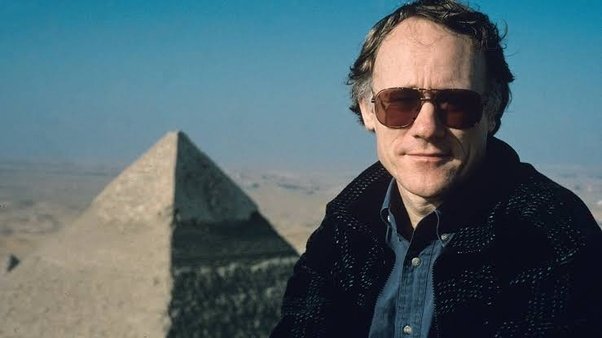
Erich von Däniken in the 1980s.

Erich von Däniken has protested against the raising of his criminal record in the evaluation of his work. He argues first that he was innocent—all three times he was convicted of the same crimes—and second that his criminal record is not relevant to his theories. It is little more than an ad hominem attack, he complains, poisoning the well in order to unfairly put all of his arguments in doubt. I will grant this, but I raise his criminal past for historiological purposes, to demonstrate that his thievery (and I need not qualify that as alleged, since he was convicted of it every time), in order to draw a further parallel with his liberal borrowing of other people’s ideas. In the recent conclusion to my series on pyramid myths, I discuss the work of Jason Colavito, who traces the entire concept of ancient astronauts from Theosophy to von Däniken through Lovecraft by way of the French writers Louis Pauwels and Jacques Bergier, whose book Morning of the Magicians preceded von Däniken’s by nearly a decade. In it, Pauwels and Bergier suggest that “it is quite legitimate to imagine that ‘Strangers from Beyond’ have been to inspect our globe, and have even landed….” In a strikingly similar fashion to the Ancient Aliens meme, they write, “Have we already been visited by the inhabitants of Elsewhere?” and then immediately answer, “It is highly probable.”  And indeed, since so many examples and supposed pieces of evidence that von Däniken raises for his thesis were raised also by Pauwels and Bergier, Von Däniken was forced to include a citation for their book in the bibliography of later editions. Nor was this the only instance of von Däniken stealing from other writers and being forced to document them as sources only under threat of lawsuit. Very much the same thing happened with the book One Hundred Thousand Years of Man’s Unknown History by Robert Charroux, another French author who had taken up the ancient astronaut theory in 1963, five years before von Däniken’s book came out. While Pauwels and Bergier’s work was focused largely on compiling every weird fringe claim they could, with only passing theorizing on alien visitation in the past, Charroux’s work came to this explicit conclusion. After numerous chapters touting supposed evidence of lost continents and ancient high technology, he builds up to a chapter actually called “Extraterrestrials Have Come to Our Planet,” and this becomes a central argument. And he too partakes of the same sorts of rhetoric, ridiculously presaging the Ancient Aliens meme. When listing unsupported claims of there being a space base on the Moon, he writes, “Are we to conclude that these lunar craters have been frequented by extraterrestrial astronauts?” and immediately answers his own question, stating with confidence, “The possibility cannot be rejected.” Interestingly, not only did Erich von Däniken steal his thesis from these books, and nearly all the supporting examples that he discusses, he also takes from them his rhetorical style, which touches on his supposed evidence only In brief outline, then launches into long series of questions and thereafter moves on and refers back to the questions he raised as if they were solid points he has already established.

Von Däniken tries to preemptively address criticism of his arguments in his book by saying “Admittedly this speculation is still full of holes. I shall be told that proofs are lacking. The future will show how many of those holes can be filled in.” So let us look now at his supposed proofs and see how well holes have been filled in the 56 years since the book’s publication. One of the first pieces of “evidence” he raises is the Piri Re’is Map, which should by now be very familiar to my listeners. This map was actually only recently discovered, in 1929, when the old Imperial Palace of Constantinople was being turned into a museum. In the 1930s, it garnered scholarly attention, as it appeared relatively accurate for a 16th-century map, and the cartographer, Piri Re’is, an Ottoman navigator, makes mention in the marginalia of the map that he had based his map on a number of existing maps, Iing a now lost map created by Christopher Columbus. The entrance of the Piri Re’is Map into fringe pseudohistory came as the result of its depiction of a coastline that stretched both west and south of Africa. Clearly at least part of the landmass depicted is meant to represent South America, as Rio de Janeiro is unmistakably pictured. There are a variety of reasons why the South American coastline is thereafter depicted as sloping eastward, toward and beneath the African continent, the most obvious being that the rest of the continent had not yet been mapped. This, in conjunction with notions about terra australis and the hypothetical balancing of landmasses on the different hemispheres of the planet may have caused Piri Re’is to imagine the size and dimension of South America that way. Then there is the additional notion that, since the edge of the parchment used actually curves the same direction, he was actually just using the space available to him to depict the continuing coastline, without a real sense of its accuracy. But in the 1960s, a certain theory, championed by one Charles Hapgood, a New Hampshire state college history teacher, suggested that this was actually depicting Antarctica, and this false idea simply hasn’t been shaken. You hear Graham Hancock prattle on about it quite a bit, for example. Hapgood himself was more of a catastrophist, denying the science of continental drift and arguing that in the distant past, the Earth’s poles reversed, thus Antarctica was not always a frozen landmass. But like all the pre-Columbian trans-oceanic contact theorists and ancient lost civilization theorists who rely on his theory, his argument rests on the idea that the Piri Re’is map was based on some lost ancient maps.

The Piri Re’is map.

Pre-Columbian Trans-Oceanic Contact theorists attribute Piri Re’is’s source maps to ancient mariners, and lost civilization theorists attribute them to, you guessed it, lost civilizations. Ancient astronauts theorists attribute them to, you’re right again, ancient aliens. What’s ridiculous is that Piri Re’is describes his source maps on the marginal notes of the map itself, identifying them not only as Columbus’s lost map but also as being Arabic and Portuguese maps, as well as mappae mundi, or medieval Christian world maps. But ancient astronauts theorists take their claims about the map much further, declaring that it could only have been drawn from an aerial view of the world. Pauwels and Bergier suggested it first in their customary series of questions, asking, “Were these copies of still earlier maps? Had they been traced from observations made on board a flying machine or space vessel of some kind? Notes taken by visitors from Beyond? We shall doubtless be criticized for asking these questions.” Then Charroux followed suit, claiming, “As for the means by which the surveys were made…they could only have been aerial.” Von Däniken merely repeats them, and repeats their mistake in referring to the singular Piri Re’is map as a set of maps (another sign of his plundering of their material), and taking their claim that the map is suspiciously accurate even further, claiming it is “absolutely accurate” and asserting that originals of Piri Reis’ maps must have been aerial photographs taken from a very great height.” The precision of the Piri Re’is map is a blatant lie that can be easily discerned by anyone comparing it to an accurate world atlas. But it’s quite apparent that these authors weren’t too concerned with accuracy. Pauwels and Bergier wrongly state that Piri Re’is himself presented his maps to the Library of Congress in the 19th century, which would have been quite a feat for a 16th-century Ottoman. Von Däniken claimed that the map (or maps, in his verbiage) were discovered in the 18th century, only about 2 centuries off the mark. The closest was Charroux, who very specifically said the map was discovered in July of 1957, when in fact it was discovered in October of 1929. These inaccuracies seem to indicate that all these guys were careless in their research and perfectly willing to misrepresent facts in order to create mystery where it otherwise does not exist.

Keeping this in mind, let us move on to Erich von Däniken’s further claims in Chariots, which look much further back than 16th century maps, finding the presence of aliens in the Bible. Here he raises ideas that I have addressed ad nauseum in the past, such as that the Genesis story about the “sons of God” who fathered “Nephilim,” typically translated as giants, with human women is really a story about genetic engineering and hybrid species. If you want to hear all the reasons for us to doubt that “sons of God” even referred to angels, or that “Nephilim” even meant giants, or that any giants ever actually existed, I did a whole series about it a couple years ago called “No Bones About It.” Check it out. He also raises the idea that the Ark of the Covenant was a high-tech device, something I have touched on a few times. You can hear a great deal more about the legends surrounding the Ark in my episode The Whereabouts of the Lost Ark of the Covenant. He spreads the further interpretation that, the pillars of fire and cloud that led the Israelites out of Egypt were actually alien craft, and when God descended on Mount Sinai, it wasn’t just a thunderstorm, as the text would suggest, but rather the arrival of a spacecraft, all notions I have again discussed before, in my episode on the Religious Dimension of UFO belief  as well as in my recent episode on the Bible Code. In putting forth these claims, he moves away from his most obvious French sources, and instead borrows from the works of UFOlogists who had already raised the notion of certain Bible stories actually referring to aliens, such as Brinsley Le Poer Trench, who in his book The Sky People asserted that not only were the Nephilim a hybrid offspring of aliens and humanity, the creation of Adam and Eve was also just an experiment conducted by extra-terrestrials. Perhaps more influential overall on the ancient astronaut theory was Morris K. Jessup, whose 1956 book UFO and the Bible was the first to suggest that “There is a causal common denominator for many of the Biblical wonders; and …this common cause is related to the phenomena of the UFO.” You may remember me mentioning Jessup in regards to the connection made between his tragic suicide and the Philadelphia Experiment hoax. In his prolific writings, Jessup was one who anticipated the Dänikenitis to come. Another was M.M. Agrest, a Russian mathematician who wrote extensively on the prospect of “paleocontact,” specifically suggesting that the destruction of Sodom and Gommorah was actually the result of a nuclear detonation, as ancient aliens wanted to destroy their nuclear stockpile and thus warned the inhabitants of the cities to flee the coming atomic destruction. This claim came to von Däniken by way of Charroux, who repeats much of Agrest’s claims without question. What both should have asked is why these aliens wouldn’t just detonate their nukes somewhere uninhabited. They might also have asked why the destruction was described as fire and brimstone raining down, when a nuclear detonation would appear to be a rising cloud of fire. Many have been the theories about the historicity of the destruction of Sodom and Gomorrah, but this one is just ridiculous. A more rational one, published a few years ago in Nature, suggests that it may have been the result of a meteor strike, or more specifically, a cosmic airburst as is thought to have happened over Tunguska in the early 20th century. But of course, von Däniken and his French predecessors think the Tunguska Event was also the result of alien nuclear technology.

A late 16th-century depiction of the destruction of Sodom and Gomorrah

Perhaps most telling of Erich von Däniken’s desire to see extraterrestrials in Bible stories are his tortuous twisting of scriptures to fit his interpretation. It has been noted before, by Richter Jonas in a 2012 scholarly article entitled “Traces of the Gods: Ancient Astronauts as a Vision of Our Future,” that just as Greeks remade Egyptian and other mythology through their own lens, nterpretation graeca, and the Romans then reinterpreted Greek mythology to suit their own culture, nterpretation Romana, what Däniken seems to be doing could be called nterpretation technologica, reinterpreting myths to suit his own worldview. For example, he scours the scriptures for passages that might refer to spacecraft, and some are a real reach. His title, Chariots of the Gods, seems to derive from his creative interpretation of a couple Bible passages. One is Elijah’s translation into heaven, saying that he was taken up by a “chariot of fire.” In fact, what it says in 2 Kings is that a chariot of fire, driven by horses of fire, came between Elijah and his son, and then Elijah is actually carried into heaven “by a whirlwind.” Von Däniken keeps the chariot of fire image and does away with the whirlwind, because one seems to work with his argument and the other doesn’t. And more than that, he then inserts the chariot of fire image into other stories that never included it. For example, Enoch, whom the Bible only says “was no more, because God took him away,” but von Däniken, either in error or through purposeful transposition claims that “according to tradition, [Enoch] disappeared forever in a fiery heavenly chariot.” Likewise, von Däniken saw in Ezekiel’s vision of God a detailed description of an alien spacecraft, described as a “wheel within a wheel,” able to move “in any of the four directions without veering.” Having spoken about this vision before, in my episode on UFO religions, you may already realize that this description in Ezekiel’s inaugural vision was of God on his throne, carried aloft by angels. Nine chapters later, when again Ezekiel sees these living creatures beside the wheels, he explicitly says these were cherubim. More than that, these flaming wheels within wheels, which are covered in eyes, came to be identified with the Throne itself, a class of angels called ophanim. What makes Von Däniken’s discussion of this vision less than honest is that he again omits whatever doesn’t work well with his interpretation. For example, he only partially quotes Ezekiel 1:1, including “the heavens were opened,” but omitting “and I saw visions of God.” He is misrepresenting his sources, cherry-picking only what makes his claims sound convincing, and this is characteristic of all his work, as we will see in Part Two of this series. What’s curious to me is that, though he renounced his religious background and his efforts to undermine the religious views of his father are clear in his work, he nevertheless seems to understand his ancient astronaut theory as a kind of religious view. He has said that the basis of his theories first came to him in visions during his incarceration. And though he claims to be challenging orthodox science with legitimate scientific evidence, when he defends his claims against criticism, he tends to refer to it as if it is religious belief and therefore unassailable. “[W]hen I compare it with the theories enabling many religions to live unassailed in the shelter of their taboos, I should like to attribute a minimal percentage of probability to my hypothesis,” he says, which is just a convoluted way of saying his ideas may not hold water, but they’re at least as believable as religion. And when, in an interview, he was directly confronted about his cherry picking, he said, “It’s true that I accept what I like and reject what I don’t like, but every theologian does the same.” It almost seems like von Däniken never really believed his claims about ancient astronauts and only expressed them as a kind of satire of religious belief. Were it not for the fact that he has led so many to believe in his theories, I might actually appreciate them as an elaborate refutation of religion.

Until next time, remember, whenever someone like von Däniken or Hancock tells you that they are unfairly criticized by “orthodox” academics simply for “asking questions,” that means their ideas have been disproven and they’re resorting to claims of being victimized just to save face. Von Däniken did not write Chariots of the Gods in good faith. He knew before its publication that it would be refuted. That’s why in the first paragraph of his introduction, he says “scholars will call it nonsense” but sets up himself and those who will believe him as somehow better than all experts, saying in his first sentence, “It took courage to write this book, and it will take courage to read it.” And I guess it does take a kind of misplaced courage to be insistently wrong in the face of all contrary evidence. Or maybe we call that obstinacy, not courage.

Further Reading

Gershon, Livia. “Ancient City’s Destruction by Exploding Space Rock May Have Inspired Biblical Story of Sodom.” Smithsonian Magazine, 22 Sep. 2021.

Colavito, Jason. “The Origins of the Space Gods: Ancient Astronauts and the Cthulhu Mythos in Fiction and Fact.” 2011, www.jasoncolavito.com/uploads/3/7/5/9/3759274/the_origins_of_the_space_gods.pdf

Richter, Jonas. “Traces of the Gods: Ancient Astronauts as a Vision of Our Future.” Numen, vol. 59, no. 2/3, 2012, pp. 222–48. JSTOR, http://www.jstor.org/stable/23244960. Accessed 12 July 2024.

Story, Ronald. The Space-Gods Revealed: A Close Look at the Theories of Erich von Däniken. Harper & Row, 1976.


Ancient High Technology - Part Two: Electric Boogaloo

Ancient lizard people and their lost advanced civilization: that is what the Silurian Hypothesis, a scientific thought experiment, is based on. The Silurian age is a geological period of about 24 million years, falling between 443 and 419 million years ago, but that really has nothing to do with it. Rather the Silurian Hypothesis takes its name from a fictional species of reptilian humanoids whose civilization existed at the dawn of human evolution, who went into hibernation in order to survive the cataclysmic event of the moon’s formation, when an object or objects crashed into the young Earth around the beginning of our solar system, flinging debris into orbit and thereby creating our earthly nightlight. Of course, the name of this fictional reptile species was borrowed from the Silurian geological age, but that’s not when any of those things happened. And those with some working knowledge of the geologic timescale will recognize that the dawn of humanity did not occur anywhere near the time of the moon’s formation. The moon is estimated to have taken form about 4.5 billion years ago, whereas humankind only developed within the last hundred million years or so, whether you’re counting from the appearance of primates or the emergence of hominids. But it’s close enough for the British sci-fi series Doctor Who, which is where this fictional story was told. No offense to Doctor Who fans; I love Doctor Who, and I’m very much enjoying Ncuti Gatwa’s Doctor. But you may be wondering what kind of scientific thought experiment could be based on such a story. In 2018, two astrophysicists, Adam Frank and Gavin Schmidt, published a paper in the International Journal of Astrobiology in which they asked the question how science might go about detecting such a civilization as was imagined in Doctor Who—an advanced civilization that existed in the distant past, all remnants of which would have been destroyed by cataclysm or simply by the natural changes of the Earth. They concluded that direct evidence for such a civilization, such as pieces of their technology, would likely never be found on the Earth’s surface, as tectonic activity and erosion would wipe it out of existence. While they did theorize that, should such a civilization have developed space flight, we may be able to find their technological artifacts on the Moon or on Mars, here on Earth, we would be more likely to discover only trace evidence of such a civilization deep underground, such as nuclear waste or plastics. Or we might be able to see signs of their activity in the geologic record, through the chemical anomalies in sedimentary layers or by detecting periods of climate change in the past that may have been triggered by their technology. Now, one might take the Silurian Hypothesis one of two ways. You might take it as support for the perspective that, if there ever was a lost ancient civilization with advanced technology, scientists would come up with a way to detect it. Or you could take it as evidence that a lost advanced civilization can disappear without a trace, all evidence of it easily going unrecognized by science. If you are of the latter mind, then before you apply this thought experiment to the most popular claims of a lost ancient civilization with advanced technology that are propagated today, most vocally by Graham Hancock, you must recognize that the Silurian Hypothesis is talking about what evidence such a lost advanced civilization might leave behind if it existed millions of years ago, about 2.5 million years ago to be more specific. Whereas Hancock imagines his technological Atlantis to have been destroyed only about 13 thousand years ago. Unlike the hypothetical civilization of the Silurian Hypothesis, we cannot blame erosion and tectonic activity for entirely erasing all evidence of such a Stone Age civilization. More precisely, this would have been a Mesolithic civilization, and archaeologists have excavated and studied many Mesolithic sites, as well as even more Paleolithic sites, finding plenty of stone age artifacts, and no evidence of high technology anywhere. Does this lack of compelling evidence dissuade Hancock and other proponents of lost high-tech ancient civilizations? I think you know the answer to that question already.

For as long as the subject has been studied, ethnologists and folklorists have puzzled over the apparent migration and diffusion of similar mythological traditions. Why do strikingly comparable myths appear in surprisingly distant and separate cultures? It has long been the goal of comparative mythologists to note these likenesses and to theorize about the migration of these stories. In more recent years, the method of genealogists has been leveraged to assemble family trees identifying specific elements of myths, or mythemes, and this “phylogenetic” analysis of mythology has led to the conclusion that many myths and folktales date all the way back to the Paleolithic period and even reflect Stone Age cave art. Now, it seems to me that, if there really were a technologically advanced civilization during this time period, especially one that interacted with less advanced peoples, the way Graham Hancock and other proponents of the theory claim, that some trace of them and their technology could be found in surviving mythology. Of course, this is the bread and butter of lost high tech ancient civilization theorists, who lack actual concrete evidence and instead rely on myths about cataclysms as evidence of the loss of their supposed civilization, or about gods coming from the sky or from the sea to suggest those gods must have been the technologically advanced people, but let’s examine that further. Certainly there are widespread myths about a flood cataclysm, but this may be simply explained as a reflection of local flooding disasters, since there is not geological evidence of a global flood, as I spoke about in great detail in my episode The Deluge and the Ark Seekers. And in general, myths about disasters are common simply because, when a natural disaster affected ancient peoples, whether it be a flood, an earthquake, the landfall of a hurricane, or the eruption of a volcano, they tended to remember it and think it happened because their deities were upset with them. So disregarding mythemes related to natural disaster, what I’m looking for are mythemes that actually indicate some sort of advanced technology, wielded by people or gods, in the distant past. Of course, Hancock and others go to the Atlantis myth, but there is compelling reason to view that whole story as Plato’s allegorical twist on flood narratives, as I’ve already discussed. And surprisingly, there is little to suggest the presence of really advanced technology in Plato’s story. There is mention of seafaring, canals, and metallurgy, all technologies common in Plato’s time, and there is no indication of this being an element of previous flood narratives. Some, including Hancock, may want to point out that the bene ha-'elohim, or “sons of God” of Genesis are said to have imparted forbidden knowledge to mankind before the flood of Noah, but this was a much later, apocryphal addition to the narrative, when these figures were called Watchers, and the forbidden knowledge they are said to have given to mankind had to do with crafting weapons and jewelry and making colored dyes for make-up, things that again were commonly known at the time of the tradition’s appearance and also certainly aren’t what we would consider advanced technology. Really the only mythological tradition I can find that definitely seems to depict an advanced technology is that having to do with the creation of artificial life. Hephaestus, the Greek god of craftsmen and metallurgy, is said to have built, basically, a giant robot, Talos. This giant bronze android, tasked with protecting the island of Crete, was even described as having specific workings, with a kind of fuel or oil line: a tube that carried ichor, the blood of the gods, from his head to his ankle. While this is certainly interesting, the story cannot be traced any further back than about 400 BCE, and a story of one giant robot, even if it were traceable back to the Stone Age, would not really stand as evidence of a technological society.

Talos, the Bronze Giant, as depicted in the 1963 classic, Jason and the Argonauts.

What then would stand as evidence of a lost ancient technological society? This is the question. For a lost technological civilization of the Stone Age or later, we need not dig deeply beneath the Earth to test sediment for nuclear waste, as we would to find evidence of a civilization from 2.5 million years ago. Rather, you would just provide the same sorts of archaeological evidence that is used to establish the existence of and reliably date any other human settlement. We would need evidence of their material culture, as in artifacts and tools, as well as structural remains, and we would need reliable dates for them, through carbon dating or stratigraphy. In the case of a technologically advanced civilization, the structural evidence and artifacts must do the heavy lifting, demonstrating their high technology. Not only that, but to prove this technological civilization was globe-spanning, which is a typical claim about ancient advanced civilizations generally and Atlantis in particular, these cultural layers must be found at comparable stratigraphic layers in numerous places all over the world, or the material culture left behind must be dated to a comparable age using other scientific means. Linguistic evidence would be useful not only to establish any degree of technological advancement but also in connecting geographically distant cultures, as a common or related language present at numerous sites would help to establish the presence of this advanced culture’s presence around the world. Skeletal evidence would also accomplish this, as DNA could prove the genetic relation between these distant peoples. Of course, none of this has actually been found. As for the material culture of a technological society, I can already imagine some arguing that actual technological devices might have existed and simply have not yet been discovered. I will grant this, especially since no evidence of hand-powered orreries or astronomical calculators was known to exist before the Common Era until part of one was discovered near Antikythera in the 20th century. However, if we really think about this argument, it contains its own refutation. You could say that anything might have existed and we just haven’t found evidence of it yet. Unicorns and dragons may have existed and we haven’t found the evidence yet. This is essentially the argument for Bigfoot’s existence. But this is a tacit admission that no evidence exists, which means there is no good reason to believe it existed. Moreover, I would take that fact that only one such device as the Antikythera mechanism has ever been found and was not discovered until the 20th century as a further refutation of any claims about ancient advanced civilizations, as the very rarity of it, as well as the sense we get from Cicero’s remarks about such orreries, indicates that such devices were outliers. If devices like that had been common in the distant past, as would be the case in a truly advanced technological civilization, I imagine we would find them at Stone Age habitation sites, not just in Roman shipwrecks. So just as I asked where all the giant bones are when I looked at the myth of ancient giants, I now ask, where are all the ancient technological devices? Or even the depictions of technological devices in ancient art?

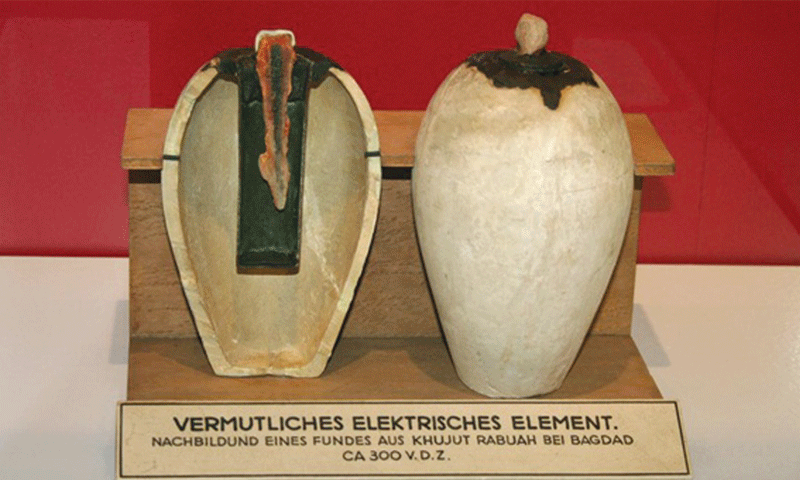
Lost ancient civilization conspiracists love to point to one or two totally unrelated and usually misrepresented finds to argue that, actually, evidence of advanced technological devices has been discovered. The only artifact typically pointed to is the “Baghdad Battery,” whose popular name is extremely deceiving. This terracotta pot discovered in Iraq, first of all, dates to the Parthian period, more than 10 thousand years after the supposed advanced technological civilization that Hancock and others propose. This dating also might be inaccurate, because the context of its find is not certain, so it may be of a far later origin, even medieval. Its lack of study in situ, within the context of an archaeological excavation, make it already a questionable find, and the claims made almost immediately about it by the head of the National Museum of Iraq make it even more dubious. The pot contained a rolled copper cylinder, within which was an iron rod, affixed within the cylinder using a bitumen plug. The director of the museum happened to have a pet theory that some gilded artifacts he had discovered were electroplated, and he theorized that the pot was actually a galvanic cell, used to generate electricity for electroplating, an electrochemical process for producing a thin metal coating. Subsequent testing showed that some acidic substance had formerly filled the jar, such as wine or vinegar, further fueling speculation that it was a battery using a primitive electrolyte. In fact, using reproductions of the pot and lemon juice as its acidic agent, MythBusters was able to prove that such a device could produce an electrical charge. However, it only produced about one volt, not enough for the purpose of electroplating, nor have any devices for the conducting of that electricity, such as wires, ever been discovered, and most importantly, the museum director’s theories about Mesopotamian electroplating have since been disproven due to a lack of electroplated artifacts. What exactly was this pot, then? Along with this terracotta pot apparently three others were found, two with similar copper cylinders and one containing parchment. This has led to suggestions that the jars were intended to preserve parchment, though it’s unclear how the copper cylinder and iron rod facilitated this, and the traces of wine/vinegar in the one jar certainly indicates that those with the cylinder were used for something else. One recent theory, that it was used for pain relief, as a kind of mild electrotherapy, is interesting, but again, it would seem to require some actual conductor, and since the bitumen plug appears to have covered the iron rod in the cylinder, its not even clear that there was a connector or head of any sort. The simple fact is that we don’t know for certain what it was used for, and we may never know, since it was looted and disappeared during the U.S. invasion of Iraq in 2003. If I were asked to speculate, I would say traces of wine or vinegar might indicate that the pots were used to store or even ferment wine, and the well-known use of copper to reduce the unpleasant smells produced by fermentation and to mediate oxidation, thereby decreasing the intensity of the wine’s aroma, along with the fact that clay pots have been used to ferment and age wine since the Neolithic age, causes me to suspect these were just wine crocks. I have not been able to find this idea actually discussed anywhere, so I’m not sure if I have originated it or if it’s fundamentally flawed in some way, so take it for what it’s worth. What I do know is that there is no evidence whatsoever that it was a battery used to power electrical devices.

A reproduction of the “Baghdad Battery” artifact, in cross-section.

Those who try to claim that the Baghdad Battery actually was a galvanic cell used to power ancient electrical devices long before the 18th century, when electricity was first harnessed, often find as their evidence not an actual electrical device but what they claim is an artistic depiction of one. You may be thinking, “Artwork depicting an electrical device in a Parthian era archaeological site? Surely this proves the battery theory!” but this was not in Iraq, nor was it in an archaeological site associated with the same time period. Rather, it was found in a temple that is at least a couple hundred years older than the Baghdad pot, maybe several hundred years older if the pot is from a later period, as some suspect, and it’s located more than 1700 kilometers away, in Dendera, Egypt. Egypt! Some might excitedly exclaim, for if there were ever proof of ancient advanced technology that may have been imparted by a lost civilization like Atlantis, it must be there, right? Well, trudge with me back to the desert to find out more about the also very deceptively named “Dendera Light.” There, in the Temple of Hathor, a massive holy site boasting tons of hieroglyphs, some reliefs depict an object that the fringe claim is a big, elongated lightbulb! When I men big and elongated, I mean it is larger than any figure in the carving, which we could attribute not to the literal size of the thing but to hieratic scale, making it larger to emphasize importance. However, regardless of hieratic scale, this supposed light bulb is shown in each depiction as being held up by two to three people and sometimes a djed, which is a sort of symbolic pillar in Egyptian art. However, as is abundantly clear just from looking at it, the “bulb” in the reliefs is coming not out of a socket attached to a wire, but rather out of a flower on a vine, and the supposed filament seen within the bulb is clearly a snake. Promoters of this claim, which actually did not appear until 1992 in a German book produced by two ancient astronaut theorists called The Light of the Pharaohs, argue that these are only stylistic representations of a real, working lightbulb. But the hieroglyphs around these glyphs explain exactly what they are depicting, the Egyptian creation myth: a snake born from a lotus flower. The “bulb” is here representative of a womb, but in the many other depictions of this creation myth to be found in other Egyptian art, no womb is seen, just a snake emerging from a lotus vine, looking nothing like a lightbulb. With the literal inscription itself that you’re pointing to as evidence telling you you’re wrong, you’d need to have some compelling evidence beyond “It sure looks like a snaky lightbulb,” so what further evidence do pseudohistorians rely on to prove that Egyptians had electrical lighting, since no actual electrical devices are to be found and no electrical infrastructure actually exists, like those pesky wires and sockets they’d need. Well, one 19th century archaeoastronomist, Norman Lockyear, who helped to popularize ideas about astronomical alignments of ancient monuments, mentions in his book The Dawn of Astronomy, that “in all freshly-opened tombs there are no traces whatever of any kind of combustion…” further remarking that in discussing this, his friend “laughingly suggested the possibility that the electric light was known to ancient Egyptians.” This remark, clearly made in jest, and its indication that there was a distinct lack of lampblack or soot in these sites, has actually been touted as evidence for Egyptian knowledge of electricity. Actually, just before that, Lockyear offers a simple explanation, that “doubtless all inscriptions in the deepest tombs were made by means of reflected sunlight,” and this theory, of “a system of fixed mirrors” is still subscribed to by some Egyptologists. However, there is a simpler explanation, supported by archaeology and Egyptian texts themselves, that Egyptians added natron pellets, or salt, to the castor oil in their lamps, which created a smokeless fuel, no lightbulbs or electricity needed.

When it comes to claims about advanced Egyptian technology, specifically having to do with energy like electricity, you cannot get much more extreme than the claims of Christopher Dunn, who just happened to be platformed by Joe Rogan a couple months ago. I spoke about Dunn’s claims briefly in the conclusion of my Pyramidiocy series, as they were promoted by Billy Carson. Essentially, he argues that the Great Pyramid of Giza was designed to be a hydrogen generator, which generated electricity through the vibration produced by water beneath the pyramid. His theory further relies on the use of hydrogen gas to produce microwaves, making of the pyramid a kind of hydrogen maser, which if you’re not familiar is basically an acronym like laser, but referring to microwave amplification by stimulated emission of radiation rather than light amplification. Dunn puts it succinctly himself in the summary of his 1998 book The Giza Power Plant, “Facilitated by the element that fuels our sun (hydrogen) and uniting the energy of the universe with that of the Earth, the ancient Egyptians converted vibrational energy into microwave energy.” Like other pyramidologists, Dunn recycles old ideas, and he’s understandably rather cagy about where his claims originated. First and foremost, his theory relies on outdated ideas about a watercourse running beneath the pyramid, and a long debunked pseudoarchaeological claim that the pyramids were designed to pump water up from below. This theory was first floated, so to speak, by Edward Kunkel, in 1962’s Pharaoh’s Pump, which claimed that fires were built in the King’s Chamber, which would draw water upward. Not only is there no evidence of the scorching that such fires would have created, and not only would such fires not provide the suction necessary to pump water so high, but also, despite what pyramidologists like to claim about how tightly the stones in the pyramid fit together, the shafts and chambers of the Great Pyramid are not watertight. Dunn’s further claim that about the use of hydrogen is predicated, like most pyramidology, on his creative interpretation of measurements. One shaft within the Great pyramid is 8.4 inches wide, and he points out that the wavelength of hydrogen is 8.309 inches and therefore must be a wave guide. Well, for a wave guide to work, it must be lined with metal, which Dunn says it must have been with no evidence that it was. But more than this, just as the pyramid stonework is not watertight, it is not airtight and would not hold the hydrogen gas that he says, again without evidence, the Egyptians pumped into it—never mind that we have no reason to think Egyptians could manufacture or even contain hydrogen gas. In other words, for his whole theory to hold water, so to speak, the entire interior of the pyramid would have had to be lined with airtight metal. Dunn’s claims culminate with the further claim that the pyramid’s production of microwave energy was for the purpose of its wireless transmission to power electrical devices, something like Nikola Tesla’s Wardenclyffe experiment in the beginning of the 20th century. And predictably, he cites the Dendera light as an example of something that might be powered by this wireless energy, even though, as we’ve seen, there weren’t any such lights. So what we’re left with is a claim that the Pyramid could have worked as a power plant if they had the water needed, the pumps necessary, the hydrogen gas required, the impermeable lining throughout the pyramid to make it possible, and also technological devices to which it might transmit that energy. And that is a lot of missing pieces, not to mention the fact that shafts he says were used in this power plant were actually closed off, and the further fact that this idea of his doesn’t work for any other pyramids, which would mean they decided to make a power plant in the shape of a tomb just next to other tombs.

One of the Dendera reliefs mistaken for depicting a big light bulb.

Finally, having exhausted the explicit claims about ancient knowledge of electricity, I find myself drawn back to the claims of Graham Hancock. Inevitably, I will probably have to take on his and others’ claims about Atlantic and a lost ancient and technologically advanced civilization in more detail in some future series, but at this point I’m fatigued by them. All I will say, overall, is that regardless of the many claims he makes throughout his books and Netflix docuseries, he simply never provides the evidence necessary to prove his claims, that being the material culture and skeletal evidence with reliable dating to prove the existence of a world-spanning advanced civilization at the end of the last Ice Age. What I want to address here, at the conclusion of this series, are his claims that the lost civilization he proposes was technologically advanced. To go back to the original story of Atlantis, from Plato in his Critias, not much in the way of advanced technology is hinted at. They were said to have been a seafaring people, and depending on the sophistication of their vessels and navigation methods, this could definitely be seen as technologically advanced 12,000 years ago, but what evidence does Hancock provide? He points to 16th century maps, including the Piri Reis map. Hancock claims that the Piri Reis map was based on source maps that are now lost, and without any evidence or real reason, he claims those source maps go all the way back to his Stone Age Atlantean mega-civilization. With this claim, he argues that knowledge of previously undiscovered parts of the world were actually passed down from those Atlantean seafarers. I’ve talked about the Piri Reis map before in connection to Pre-Columbian Trans-Oceanic Contact theories. There are simple explanations for its depiction of both the Caribbean and South America, which Graham Hancock mistakes for Antarctica. The most relevant of these is that the mapmaker was working with a source map from Columbus’s voyages. And no matter how many 16th century maps Graham Hancock turns up with curious aspects on them, there is no explaining why some Atlantean source maps from the Stone Age would go unnoticed and unremarked on for 12,000 years and only be used by cartographers in the 16th century during the Age of Exploration, when we know that new maps that could be used as sources were being created.

Perhaps the best argument that Hancock comes up with relates to Göbekli Tepe, a Neolithic archarological site in Turkey. Dating to 11,600 years old, this was shown to be the oldest megalithic site in the world when it was first studied in depth in the 1990s, though Karahan Tepe, another site in Turkey, has been shown to predate it. What makes these sites so astonishing is that during this time period, before the development of agriculture in most parts of the world, humans were hunter-gatherers, and thus typically migratory and unlikely to stay in one place, building permanent structures like this. Honestly, it is not surprising that Hancock would seize on Göbekli Tepe, which looks at first blush like just the sort of evidence his theory might need, in that it’s almost 12,000 years old and definitely constitutes material culture. However, it does nothing to prove his globe-spanning Stone Age civilization hypothesis, and since by his theory, Atlantis was destroyed about a thousand years earlier, in a cataclysmic comet strike during the Younger Dryas period, he finds another way to spin the find. He suggests that Göbekli Tepe is evidence that an advanced civilization taught agriculture to the hunter-gatherers of the Stone Age, and it therefore stands as evidence of Atlantis’s civilizing influence on less advanced cultures. Well, this is the reason that Graham Hancock is accused of spreading racist ideas. I spoke about this in my episode on the Myth of a Lost Mound Builder Race, as claims that some indigenous people could not possibly have built certain monuments or structures, or developed agriculture, without the civilizing influence of a superior race, is just fundamentally, historically racist. As hard as Hancock tries to rephrase his claims to avoid this, it still stands at the heart of his theories. And regardless, there is no evidence that the builders of  Göbekli Tepe had developed agriculture. Rather, archaeologists believe it was built by nomadic hunter-gatherers as a sanctuary rather than as a permanent dwelling place. And though Hancock and others rail against “orthodox” archaeologists refusing to change their views of prehistory, and even resorting to cover-ups to hide finds that challenge their established ideas, the very fact that Göbekli Tepe challenged views of hunter-gatherers, resulting in a new understanding of their culture in the Near East, proves that archaeology adapts to new information when evidence merits a change in our understanding. But Graham Hancock complains that scholars won’t accept his claims for which he offers no evidence. There is nothing connecting Göbekli Tepe or the people who built it to geographically distant sites, which we would expect to find if Atlanteans civilized the rest of the world as well, and more importantly, agriculture, the technology he believes they spread, clearly developed independently, as ancient agricultural civilizations had no common crop. If Atlanteans had really gone around teaching hunter-gatherers all over the world how to grow crops, it is odd that they wouldn’t have carried the same crops to every part of the world.

Göbekli Tepe

But this episode is really about the notion of lost high technology, and Graham Hancock doesn’t just suggest that his Atlanteans were technologically advanced compared to the hunter-gatherer cultures that he envisions Atlantis in contact with. This is not the difference between a crop-growing culture and a nomadic culture. In his own words, he imagines that a “realistic parallel for the level of science attained [by this proposed lost civilization] would be with Europe and the newly formed United States in the late eighteenth and early nineteenth centuries.” So what does that mean? Well, such a civilization’s mastery of electricity would only be in its beginning phases. But it would have mastered steam power and the mechanization of industry. It would seem that some folktales about such technology would have survived, but the most advanced technology Plato mentions his fictional Atlantis having mastered is metallurgy, specifically in regards to the mysterious metal orichalcum, which he claims “is now only a name and was then something more than a name,” saying it was more precious than gold, and birthing a legend about a lost or unknown metal. However, later writers, such as Cicero wrote about orichalcum being a kind of copper alloy. Whatever it was—a specific allow, a metal we now have a different name for, an ore whose mines were depleted—this element of the story does indicate ancient metallurgy. Though Plato describes nothing that could be interpreted as steam-powered machinery, certainly for any such machines to be made, mastery of metalwork is a prerequisite. So how could we prove or disprove the idea? Well, Graham Hancock recently arranged a debate with archaeologist Flint Dibble on Joe Rogan’s podcast, and when Dibble proved that Hancock had no evidence for his claims, Hancock went into face-saving mode, afterward saying he’d been conned by Dibble, even though Hancock had personally chosen Dibble as his debate opponent. Dibble simply pointed out that ice core analysis can prove when cultures were engaging in metallurgy and can determine whether there was industrial activity in a given historical age, as the ice would trap the emissions of such technology. After their debate, Graham Hancock only objected that the paper Dibble referred to in making this point did not actually test ice cores from the Stone Age, demanding that Dibble produce ice core evidence from the Stone Age to disprove his hypothesis. Well, that is not really how the making and supporting of claims works. The burden of proof is not on others to disprove the unsupported claims Hancock makes. He needs to produce ice core evidence that proves his thesis. This should now be the focus of his efforts, and he cannot claim that no one has taken such ice cores or that no one has studied them, as Antarctic ice cores going back two million years have been extracted and studied to learn about the content of atmospheric gases, with especial focus on the last 100,000 years. So if Graham Hancock can’t produce any such ice cores demonstrating that an advanced industrial civilization was engaging in metallurgy 12000 years ago, it’s because the ice cores actually stand as proof that this wasn’t happening, which is what all actual experts have been saying for years. And in the end, even Hancock admits there is not evidence for his theory. He may hem and haw that archaeologists don’t study enough sites or don’t investigate the right places to find the evidence he says is out there, but what reason is there to believe this evidence exists? When he admits that there is no evidence, what reason even is there for a debate on the topic?

Until next time, ask yourself, what harms might these pseudohistorical ideas cause? A friend recently suggested that Joe Rogan’s podcast is just the new Coast to Coast AM, and that I shouldn’t be bothered by the platforming of fringe claims on it. I in turn would argue that shows like Coas to Coast paved the way for the modern media dissemination of pseudohistory and pseudoscience that pervades our culture today and erodes trust in nor only academia but all important cultural institutions and even the concept of empirical knowledge and verifiable truth. It is harmful indeed.

Further Reading

Colavito, Jason. “Review of Ancient Aliens S06E22 ‘Mysterious Devices.’” Jason Colavito, 28 June 2014, www.jasoncolavito.com/blog/review-of-ancient-aliens-s06e22-mysterious-devices.

de Camp, L. Sprague. “Pharaoh’s Pump.” Technology and Culture, vol. 4, no. 1, Wayne State University Press, 1963, pp. 56–57, https://doi.org/10.2307/3101339.
Eggert, Gerhard. “The Enigmatic ‘battery of Baghdad.’ (Scientific Theories on the Ancient Uses of a 2,000 Year Old Finding).” The Skeptical Inquirer, vol. 20, no. 3, Committee for the Scientific Investigation of Claims of the Paranormal, 1996, pp. 31-.

Feagans, Carl. “Dendera Light Bulb and Baghdad Battery Nonsense.” Archaeology Review, 6 Nov. 2016, ahotcupofjoe.net/2016/11/dendera-light-bulb-and-bagdad-battery-nonsense/.

Keyser, Paul T. “The Purpose of the Parthian Galvanic Cells: A First-Century A. D. Electric Battery Used for Analgesia.” Journal of Near Eastern Studies, vol. 52, no. 2, 1993, pp. 81–98. JSTOR, http://www.jstor.org/stable/545563.

Schmidt, Gavin A., and Adam Frank. “The Silurian hypothesis: would it be possible to detect an industrial civilization in the geological record?” International Journal of Astrobiology, vol. 18, no. 2, April 2019, pp. 142-150. DOI: https://doi.org/10.1017/S1473550418000095.

“What the ‘Light Bulb’ Relief Means at the Dendera Temple.” The Archaeologist, 21 Jan. 2024, www.thearchaeologist.org/blog/what-the-light-bulb-relief-means-at-the-dendera-temple.

Ancient High Technology - Part One: The Archimedean Spiral

In 1900, sponge divers discovered a wrecked Roman cargo ship near the Greek island of Antikythera. This was a true instance of discovering sunken treasure. The following year, from within the wreck, the divers were able to recover numerous Roman coins, priceless jewelry, and statues of both marble and bronze, as well as a variety of other artifacts, glassware, pottery, and assorted unidentified detritus. Like real life Indiana Joneses, these divers surrendered everything to a museum: the National Museum of Archaeology in Athens, to be specific. There, the recovered artifacts were stored and slowly but surely analyzed. A year later, in 1902, an archaeologist at the museum was examining a rock that had been given to the museum with the rest of the items, and he noticed that a gear wheel appeared to be embedded within it. This artifact, surviving only as a fragment, was really no more than a corroded chunk of bronze and wood. Unfortunately, had it been treated as soon as it was removed from the saltwater, it may have remained in better condition, but even in its deteriorated state, it appeared to contain miniature gears like that of an astronomical calculator. This, however, did not comport with the archaeological record, as no such devices were known to exist until the 14th century. Nevertheless, all scientific analysis of the Antikythera Mechanism since this time has tended to confirm that this device was a sort of hand-powered orrery, its clockwork gears activated by a crank. Scientific testing began in the 1970s with simple X-ray imaging, and have continued to more recent X-ray tomography and CT scanning. Imaging has revealed not only previously hidden gears, but also faint inscriptions on what was once the outer casing. All of this data tends to confirm that this device was an astronomical calculator, designed to track the movements of both the sun and the moon, with indications that missing portions of the device also tracked the movements of all five planets known to exist in antiquity. Evidence suggests that the Antikythera Mechanism was used to predict eclipses as well as to determine the dates of Olympic Games. Numerous lines of evidence confirm that the shipwreck in which the Antikythera Mechanism was found dates back to around 60 BCE, with some dating the device itself as much as a hundred years older. With this, as well as mentions of such orrery devices in 1st century BCE Roman sources, it seems quite apparent that this is a genuine example of lost ancient technology, or a technology known in antiquity that would not be developed again for around 1500 years. Is it then reasonable to entertain other claims of lost ancient high technologies, such as those associated with the pyramids and other monument building cultures?

Last year, throughout much of my 2023 season of the Historical Blindness podcast, I devoted numerous episodes to the MacGuffins of the Indiana Jones films, concluding with one on the Nazi plunder trains, which served as the setting for the opening set piece of the latest film. Of course, the real MacGuffin of the new film, the Dial of Destiny, was the Antikythera Mechanism, which the film calls Archimedes’s Dial. In reality, the mechanism looks nothing like the well-preserved artifact depicted in the film, nor do any of the proposed reconstructions of the device really resemble the Dial of Destiny in the film. And of course, it was likely not designed by Archimedes to predict time rifts, as the film claims. But there is, in fact, some reason to associate the mechanism with Archimedes, ancient Greek mathematician and inventor who was so central to the latest Indiana Jones film. Some historical texts have actually been turned up that indicate such devices definitely did exist in Hellenistic Greece, and one of them mentions Archimedes by name. The Roman politician and orator Cicero seems to describe such a device in De re publica, referring to some kind of machine “on which were delineated the motions of the sun and moon…” and explicitly stating that “Archimedes…had thought out a way to represent accurately by a single device for turning the globe those various and divergent movements….” While this does appear to credit Archimedes with the invention of such a device, in another work, Cicero also describes such an “orrery recently constructed by our friend Posidonios, which at each revolution reproduces the same motions of the sun, moon, and the five planets that take place in the heavens every day and night.” In short, it’s not certain that Archimedes was the inventor of such devices, though he does seem to be the best candidate, as Pappus of Alexandria, writing hundreds of years later, mentions a work of Archimedes, called On Sphere Making, that apparently described the creation of such devices. At the time that the Dial of Destiny released, I did not see a feasible way to approach this MacGuffin. Simply put, I did not think I could stretch it into an entire episode, even with all the other bits in the film about ancient inventions that Archimedes had built, such as the weapons of war that Archimedes is said to have invented to defend Syracuse from Roman invasion. But I imagined that I could talk about both the Antikythera Mechanism and the Archimedes Weapon in an episode or series about these and other claims of lost ancient high technology. And of course, after my long series on pyramid myths, discussing the claims that some lost technology or lost advanced civilization must have been responsible for their construction, now just seemed like the right time. So you can consider this, in part, one further installment of my series on Indiana Jones MacGuffins, though maybe not the last, with the upcoming release of the video game Indiana Jones and the Great Circle, which I imagine is raising an old Victorian idea about ancient sacred sites being aligned around the Earth, so it could be interesting to do an episode on that next year. In the meanwhile, though, let’s consider, first, what evidence there really is for actual lost ancient technology.

A speculative reconstruction of the Antikythera Mechanism. Attribution: Tony Freeth, licensed under Creative Commons (CC BY 4.0).

The Antikythera Mechanism is really the only hard piece of material evidence of a sort of high technology, like a computing system, existing in our ancient past, and dating to only a century or two before the common era, it isn’t really that old, compared to the antiquity that is often claimed for lost high tech civilizations, which we will discuss before we’re done. The fact is that the knowledge and technology needed for the creation of the orrery found near Antikythera already existed. It was a combination of mathematics taught at Plato’s Academy and the theories and cycles of Greek and Babylonian astronomy. Although the Antikythera mechanism is the earliest example of gears discovered in Europe, they appear to have been around already for hundreds of years, as gears have been found in China that date back to the 4th century BCE, and in 330 BCE, gear trains were clearly described in the pseudo-Aristotelian work Mechanica, which though spuriously attributed to Aristotle was certainly written before Archimedes’s time. And with the attribution of the orrery’s invention to Archmedes also uncertain, what advanced technology can we actually credit him with inventing? What we find when we look at the life and accomplishments of Archimedes is rather similar to what we found when looking at Pythagoras. There are traditions and legends about his life and his inventions, but little is known for certain. It is said that he went to Egypt to learn from scholars in Alexandria, perhaps even from Euclid, but much as was the case with Pythagoras’s travels and the influence of Eastern knowledge on his mathematics, this is only a tradition, a legend. Stories of his scientific breakthroughs are likewise questionable, framed in colorful narratives, just like Pythagoras supposedly discovering musical harmony by listening to the hammering of blacksmiths. Take for example the story of his discovery that through water displacement one can measure volume, and when combined with weight could determine density, in order to determine whether something was pure gold or alloyed. It’s said he figured this out by seeing the water level rise when he sat in a bathtub. This is the story of Archimedes crying “Eureka!” as he ran naked through the streets, exulting in his breakthrough. It is so simplistic an explanation of the discovery that, like the apple falling on Isaac Newton’s head raising the notion of gravity, it is likely not true, and indeed, it has long been thought apocryphal, with some scholars even pointing out that there was a far simpler way to determine the same thing, simply by balancing the item with pure gold and plunging the scale into water to see if they remained balanced despite buoyancy. With Archimedes and his discoveries thus shrouded in questions of legitimacy, we must look skeptically at the more outlandish claims about his inventions.

As depicted in that last Indiana Jones film, during the siege of Syracuse by Roman forces in 213 BCE, there is a legend that Archimedes devised a number of ingenious war machines to repel their ships. One was the iron hand or claw, said to be extended out from the walls of the city to grasp Roman ships by their prows and submerge their sterns. Another was his heat ray, the Archimedes Weapon, said to have reflected the rays of the sun onto the Roman ships, causing them to burst into flames. Conventional explanations of the Claw of Archimedes imagine it to have been a grapnel or pincer depending from a wooden beam by a chain, which by means of levers and pulleys could then be pulled by teams of men or animals, thereby raising the vessel. Some recent BBC and Discovery Channel programs have found engineers that declare the device to have been feasible, and it probably is possible for such a device to work. As Archimedes is said to have once stated of levers, "Give me a place to stand on, and I will move the Earth.” However, is it believable? This device would require huge freestanding wooden structures within the walls of Syracuse, as well as extremely long and sturdy wooden beams. First, it is unlikely that there was so much large open space just within the city’s walls to accommodate not only the massive wooden towers that would have been needed to support the device but also space for all the people and/or teams of animals needed to haul the chains and raise the ships. Moreover, the wooden beams would need to be so long and so straight and sturdy that they would have needed to come from sequoias or fir trees or other similarly tall and straight-trunked trees, which were not then available in the Mediterranean. Lastly, nautical maps indicate that the waters around Syracuse were actually shallow at the time, and standard fortification practices of the era would have included the sinking of stones offshore to make it even more inaccessible by ship. These last two facts alone demonstrate that not only would the sinking of ships by such a device be unlikely, there may not have even been a need for such devices. Likewise, the Archimedes heat ray, conventionally held to be a kind of burning mirror or lens, which either reflects or concentrates sunlight, is also feasible, if still not likely. Anyone who has used a magnifying glass to burn ants knows the concept, but the fact is that the claim did not appear until hundreds of years after the siege of Syracuse. Earlier historians, like Polybius, Livy, and Plutarch, who all wrote about the siege, make no mention of such a weapon. The Greek geometer Diocles, a contemporary of Archimedes who wrote about the use of parabolic mirrors to focus light, makes no mention of the weapon or of Archimedes interest in the topic. The first mention comes in the 2nd century CE, when it is only said that he burned Roman ships, with no mention of any unique device. The full legend does not seem to have actually appeared until 700 years after the siege, when in a treatise on parabolic mirrors, Anthemius of Tralles suggested offhandedly that Archimedes might have used a “burning-glass” to set fire to the invaders’ ships. So it is nothing more than conjecture that came to be taken as genuine history. Moreover, three times in 6 years, the television program MythBusters devoted episodes to testing the plausibility of the Archimedes Death Ray. Discovering that ships would need to remain essentially motionless, and the sky would need to be cloudless, and since the seaward side of Syracuse faces eastward, the Roman fleet would have only been vulnerable to such attacks during the morning, they declared the myth busted each time they tested it.

Painting imagining Archimedes’s Death Ray by Giulio Parigi, c. 1599

This is not to say that the existence of these weapons was impossible. As I’ve said, the engineering principles behind both make them plausible to some degree. While documentary evidence clearly suggests the heat ray legend arose later from conjecture, Plutarch did describe the claws in his account of the siege, and it’s possible that it has only been reconstructed erroneously in modern times, and that Archimedes actually had a more elegant design that had no need of such long wooden beams, for example. Plutarch explicitly says of Archimedes’s weapons that he “would not deign to leave behind him any commentary or writing on such subjects.” We can take this as a lame excuse for why there is no surviving evidence of such technology, or we may believe that he chose to destroy his plans for them, whether because he hated that his work was used for warfare or, as Plutarch says, that “repudiating as sordid and ignoble the whole trade of engineering,” he simply preferred “purer speculations.” It would not be the last known time in history that the knowledge of some specific weapon technology would be lost, after all. Take for example the technology of Greek Fire. Much like the devices of Archimedes, which were said to have intimidated the Roman invaders, convincing them that they were fighting against gods, Greek fire, originally called liquid fire or sea fire, was used to repel a far superior naval force in 941 CE, when Byzantines used it to repel the invading Russian fleet attacking Constantinople. Historically, Greek fire has been confused with other incendiary weapons, such as hand-thrown or catapulted fire bombs. Because of this, it was wrongly thought, at different times, to have been a sulphur- or quicklime-based explosive, or even a gunpowder weapon hundreds of years before the appearance of gunpowder. In examining contemporary descriptions, though, scholars have come to recognize that it was a petroleum-based weapon that appears to have been sprayed from hoses or nozzles aboard Greek ships. It was essentially a flame-thrower. Although there are some aspects of the weapon’s workings that remain a mystery, such as the consistency of the fuel, and the method of pumping and siphoning it, the technology itself is not so very mysterious today. We know where the inflammable oils they needed could have been collected, in the North Caucasus oilfield, where wells naturally produced naphtha, and the fact that such petroleum oils may not have been as readily available elsewhere may account for the decline in the weapon’s use. Then there is the fact that it was something of a secret weapon, intended not only to incinerate but also to inspire dread. Historically, technology used for weapons is less likely to be shared, less likely to spread through cultural diffusion, for the simple fact that one group does not want their enemies to have as advanced weaponry as they have. When a technology is purposely kept secret, there is just a higher chance that it may be lost. Take for example the material used to line thermonuclear warheads in the seventies and eighties, which was codenamed Fogbank and was kept so classified that, in the nineties, when it was time to restore the warheads, it was discovered that the composition of the material and the process for its manufacture was never documented, and the retired scientists who had produced the material decades earlier could not recall how to produce it.

Another such medieval weapon technology thought to have been lost is the process for forging Damascus steel. True Damascus steel blades were said to be the strongest and sharpest of blades, such that a swordsman who wielded one could slice easily through a rifle barrel. Legends surrounding Damascus steel make it almost supernatural, like the adamantium or vibranium of Marvel comics. Besides those qualities, it was marked by its appearance, with a rippling water-like pattern in the metal, providing its other name, “watered steel.” Modern experiments have recreated this pattern, but the resulting blades to not appear any stronger than other blades. We could take this for evidence that Damascus blades were never as strong as claimed, but scientific examination does seem to support that genuine Damascus steel blades are different than modern reproductions. In 2006, a German research team claimed that they had discovered nanowires within the blade, which of course sets the imagination afire with ideas about medieval electronics. However, other researchers protest that they actually appear to be carbon nanotubes that formed naturally from cementite during the blades’ forging. This does indeed give us some indication of what made Damascus steel different, though. While there have been alternative notions of the origins of its name, such as that it came from the name of the swordsmith who made them, or that it derives from a root Arabic word, damas, meaning “aqueous” or “watery”—which doesn’t seem like an accurate translation at all, as far as I can determine, so I suspect it’s entirely made up—it is typically thought that the name associates the swords with Damascus, a medieval city in Syria, just as Damask fabric was named after the city, though some say the name comes from the rippling pattern being likened to Damask fabric. The notion that it could have taken its name from Damascus makes sense, though, as these swords were likely first encountered by Europeans in the Middle East. However, their actual forging has been traced to India and Sri Lanka, where a particular crucible steel, called wootz, was used, the ore of which contained just the right trace impurities, with carbide-forming elements such as tungsten and manganese, that made the peculiar qualities of Damascus steel possible. Thus we find that this was not some special technology or process but rather a fluke determined by the specific materials used. The “technology” was lost likely because of the British colonialist rule of India, which disrupted many Indian industries, including mining.

12th century illustration depicting the use of Greek fire in naval warfare.

But again, it is possible that, in addition to the unique materials used in the forging of Damascus steel, there may also have been some unique technique involved. This is exactly the case with another supposed lost technology sometimes cited as a kind of precedent for the idea that ancient civilizations were more advanced than we give them credit for. This one has to do with Roman technology. There are numerous Roman legends about technologies that we would today consider beyond their time. For example, there was Mithradatium, a supposed miracle drug said to have been invented by the Anatolian King Mithradates to save himself from attempts to poison him. This herbal concoction, said to have been brought to Rome by Pompey, was real in the sense that Roman physicians mixed it according to recipes that started to spread, and added to it new ingredients. But certainly it was a myth in that it was just herbs like ginger, cinnamon, and parsley, and certainly not the panacea it was claimed to be, and this was seen as far back as the 2nd century CE, when Pliny the Elder suggested that, with all of its more than fifty ingredients, each in such specific proportions, it was a fraud, calling it “a showy parade of the art, and a colossal boast of science.” Then there was the legend of vitrum flexile, the flexible and therefore unbreakable glass that I mentioned in my episode on technofear last year. The story of this lost technology claims that Tiberius Caesar had its inventor beheaded because he feared the economic effects that such an invention might have. This story is plainly a fiction. It first appeared in the Satyricon, a work of satire, yet the story of flexible glass is still sometimes cited as an actual example of lost technology. The more serious-minded look to genuine Roman accomplishments in infrastructure, such as the aqueducts, and magnificent structures like the Pantheon Dome. The lost technology for which they are credited is their concrete, which was used to build the Pantheon Dome, as well as many other structures, which remain strong and intact. This should not be the case with the kind of crude lime concrete known to be in use in antiquity, yet their concrete appears to be more durable and to stand the test of time better even than modern concrete. Much like the fluke of wootz steel in India, though, the secret of Roman concrete appears to have mostly been in the qualities of the materials they used, in that they used pozzolanic ash, volcanic ash from Pozzuoli, on the Bay of Naples, which seems to help prevent the spread of any cracks that may form in it. However, just as Damascus steel may have resulted from the convergence of a unique material and a special technique, research published as recently as last year suggests that a particular hot mixing technique may have been used, resulting in unique lime clasts that allow the concrete to “self-heal.” It’s really quite amazing, but with no treatises in existence detailing the development of this technology, we can’t be certain that the Romans themselves knew why their concrete would last so long, or even that it would.

So with this discussion of building techniques, we come back to the foundation, so to speak, of claims about ancient lost technology. How did the ancients build these grand things that they built? In answering this, we are brought back to Archimedes, who is given credit for first describing the “simple machines,” as well as for inventing one of them, or at least one use for it. The simple machines are basic mechanical devices that it was long held must serve as the components of any machine, though since the Industrial Revolution, this is no longer accurate. The six simple machines—levers, wedges, pulleys, the wheel-and-axle, the inclined plane, and the screw—all work using leverage to increase force, and leverage was Archimedes’s jam, as we’ve established. Clearly he did not invent leverage, though, nor did he invent these simple machines. Ancient Egyptians had knowledge of them, and the simple answer of how they built the pyramids is that it was done using ramps and levers. Since part of Archimedes’s story was that he learned from scholars in Alexandria, it’s feasible that he was introduced to the mechanical uses of these simple devices while in Egypt. Interestingly, he is credited with inventing the Archimedes screw, which is not the simple screw but rather the water screw, a device for lifting or pumping water, while he was in Egypt, for the irrigation of the Nile Delta. However, it is also argued by scholars that the water screw was invented by the Assyrian King Sennacherib in Mesopotamia hundreds of years earlier, and that it may have already been in use in ancient Egypt long before Archimedes’s supposed time there. Archimedes was preoccupied with the mathematics of spirals, and how it corresponds to movement away from a fixed point, the Archimedean spiral, so it’s suggested these mathematics are what led to his invention of the water screw, but it may just as well have been that he had encountered a water screw or other simple screw machine and this inspired his exploration of the mathematics behind such devices. But regardless of when this water screw was invented, it was used simply to raise water. It was a simple machine. The fact is that the very simplicity of the technology associated with ancient civilizations, the simple leverage devices we know Archimedes worked with, and even the rather mundane nature of the ancient advanced technologies often cited as having been lost—strong steel and durable concrete—demonstrate that there was no high technology comparable to modern technology lost to time. Even the legendary war machines of Archimedes, if they really existed, were essentially just a crane with a grapnel and mirrors to reflect the sun. Only the Antikythera mechanism is impressive as an example of surprisingly ancient high technology, but even that is just a clockwork orrery. It did not run on electricity. Yet unsurprisingly, there are those who would suggest that the Archimedes screw was really a hydroelectric turbine, and that ancient Egyptians used electricity. In the second part of this 2-part series I’ll look at those claims, and in examining ideas about lost ancient tech, I’ll be led inevitably back to Graham Hancock’s claims about lost ancient civilizations.

Further Reading

Dalley, Stephanie, and John Peter Oleson. “Sennacherib, Archimedes, and the Water Screw: The Context of Invention in the Ancient World.” Technology and Culture, vol. 44, no. 1, 2003, pp. 1–26. JSTOR, http://www.jstor.org/stable/25148052. Accessed 2 July 2024.

Freeth, Tony, et al. “Calendars with Olympiad Display and Eclipse Prediction on the Antikythera Mechanism.” Nature, vol. 454, no. 7204, July 2008, pp. 614–17. www.nature.com, https://doi.org/10.1038/nature07130.

Freeth, Tony, et al. “A Model of the Cosmos in the Ancient Greek Antikythera Mechanism.” Scientific Reports, vol. 11, no. 1, Mar. 2021, p. 5821. www.nature.com, https://doi.org/10.1038/s41598-021-84310-w.

Haldon, John, et al. “’Greek Fire’ Revisited: Recent and current Research.” Byzantine Style, Religion and Civilization, edited by Elizabeth Jeffreys, Cambridge University Press, 2006, pp. 290-325.

Henriksson, Göran. “Thales of Miletus, Archimedes and the Solar Eclipses on the Antikythera Mechanism.” Journal of Earth Science and Engineering, no. 12, 2014, pp. 757–69. uu.diva-portal.org, https://urn.kb.se/resolve?urn=urn:nbn:se:uu:diva-371765.

Seymour, Linda M., et al. “Hot Mixing: Mechanistic Insights into the Durability of Ancient Roman Concrete.” Science Advances, vol. 9, no. 1, Jan. 2023, p. eadd1602. DOI.org (Crossref), https://doi.org/10.1126/sciadv.add1602.

Simms, D. L. “Archimedes’ Weapons of War and Leonardo.” The British Journal for the History of Science, vol. 21, no. 2, 1988, pp. 195–210. JSTOR, http://www.jstor.org/stable/4026979. Accessed 19 July 2024.

Verhoeven, J. D., et al. “Damascus Steel Revisited.” JOM, vol. 70, no. 7, July 2018, pp. 1331–36. Springer Link, https://doi.org/10.1007/s11837-018-2915-z.

Young, C. K. “Archimedes’s Iron Hand or Claw - a New Interpretation of an Old Mystery.” Centaurus, vol. 46, no. 3, 2004, pp. 189–207, https://doi.org/10.1111/j.1600-0498.2004.00009.x.

Pyramidiocy - Part Six: Pyramid Schemes

The transcript of this episode is incomplete, as I use audio clips in the podcast episode. Listen to the episode to hear audio of some of the claims I attribute to certain individuals and programs.

Years before the discovery of the King Tut’s tomb, the world discovered the pharaoh believed to have been his father, Akhenaten, formerly Amenhotep IV. In the late 19th century, his capital city, Akhetaten, was discovered, and his tomb was uncovered in the Valley of Kings in 1907. What we learned about this previously unknown pharaoh was extraordinarily interesting. He has been called the “heretic pharaoh” because he rejected the gods of his forebears and instituted widespread religious reform. He founded his new capital city on the worship of Aten, an aspect of the sun god. One journalist with an interest in Egyptology, Arthur Weigall, wrote a book about Akhenaten, The Life and Times of Akhnaton, in 1910. Weigall saw Akhenaten’s religious reforms as a parallel to the development of Christianity, since he was leading the pagan Egyptians toward monotheism. To get a sense of how credible Weigall’s writing was, and how he leaned toward the sensational, we need only recognize that Weigall was present at the Tomb of King Tut more than a decade later, writing about the discovery, and upon the death of the Earl of Carnarvon, he seems to have started the Curse of the Pharaohs rumor, claiming he’d heard Carnarvon joking around before entering the tomb and saying he predicted that, “if he goes down in that spirit, I give him six weeks to live.” Like many a propagator of false ideas, Weigall actually claimed that he did not believe in the curse himself, even though he’s the one who seems to have gotten people started believing in it. This legend would eventually live longer than he did, and when he died, some claimed he himself had been a victim of the curse. His notions about Akhenaten too spawned false ideas that would live far longer than himself. First, Charles Spencer Lewis of the San Jose Rosicrucians latched onto Weigall’s writings about Akhenaten and imagined that the monotheist pharaoh had actually founded the Rosicrucian Order. So yet again, much like the Freemasons, an esoteric order that did not actually appear until the Renaissance Period—or in the case of Lewis’s San Jose branch, the early 1900s—falsely claimed to have first formed in ancient times. Then in 1939, Weigall’s ideas would inspire someone else, this time a far more influential thinker: Sigmund Freud. In his book Moses and Monotheism, Freud reimagined the story of Exodus through the lens of Weigall’s biography of Akhenaten, imagining that the heretic pharaoh was actually the unnamed pharaoh of Exodus, and that Moses was actually one of the chief priests of his new religion, who after Akhenaten died had actually led a group of those faithful to the sun god, Aten, out of Egypt, inspiring the story of Exodus. Freud draws his conclusions very confidently, assured that his science of psychoanalysis allowed him some deeper discernment than any Egyptologist or Bible scholar or archaeologist or historian actually trained and qualified to prove such things. Should anyone take his claims seriously, they would do well to recall that Freud also believed his psychoanalytical skills allowed him to discern that the works of Shakespeare had been written by someone else, and I’ve done my best to demonstrate how wrong that is. Freud’s ideas about Akhenaten would outlive him as well, with some later writers revising him to claim Akhenaten was Moses, and that Christianity was actually derived from a cult that worshipped Tutankhamun. But perhaps the most outrageous modern claims about Akhenaten come from astronomer and UFOlogist Jacques Vallée, who I believe was the first to suggest that Akhenaten was actually not worshipping the sun, but rather, a flying saucer. The confusion seems to have been borne out of the fact that Aten was a particular aspect of the sun god, namely the sun disk, as it has been translated. The simple word “disk” appears to have fired  Vallée’s UFO-addled imagination, but in reality, the word could just as accurately be translated “circle,” and hieroglyphic depictions of Akhenaten’s worship of a bright yellow circle in the sky with rays emanating from it can only be interpreted as sun worship if one is honest with oneself and makes no leap in logic to a far less likely conclusion simply because one wants to believe it. But this is far from the only connection between Egypt and less than honest fringe ideas about alternative history and ancient aliens that still circulate today.

The story of the ancient astronauts theory and its connection to the pyramids can be traced back long before Vallée, but not that far back. In the late 19th century, the very first ancient astronaut grifter, Helena Blavatsky, made claims about aliens from Venus having been in contact with ancient peoples and having influenced the evolution of mankind. Later Theosophists, like Blavatsky’s successor as leader of the Theosophical Society, Annie Besant, would eventually claim even more specific knowledge about the development of extraterrestrial life and its intercourse with humanity. One theosophist, W. Scott-Elliott, expanded on the connection of these astral visitors with ancient lost civilizations, such as Atlantis, a key element of theosophical pseudohistory and of modern ancient aliens claims. The ideas of theosophists would inspire many during the 20th century. In my episode Technological Angels, about the religious dimension of UFO belief, I discuss how theosophical claims cropped up time and again in UFO religions. Well, these ideas also made a major impact on a certain fiction writer working in the early 1900s: H.P. Lovecraft. Lovecraft also had a long interest in myths about Egypt and the Pyramids. In 1924, during the Tutmania that ensued after the opening of Tutankhamun’s tomb, he ghost-wrote a pulp fiction story for Harry Houdini about the celebrity becoming trapped in subterranean passages beneath the pyramid, confronting undead mummies and demonic gods. He also tried his hand at a vengeful mummy tale in 1935. But the influence of theosophical ideas and other myths about the pyramids become more prominent in his Cthulhu mythos, which featured ancient extraterrestrial gods that had previously been known to ancient peoples. Lovcraft featured all the same ideas about extraterrestrial contact with Atlantis, and Atlantis’s founding of Egypt before its destruction. Even his notion of the magical Necronomicon written by a “Mad Arab,” seems to have been inspired by medieval Islamic works that transmitted myths about the pyramids, as described in my principal source for this whole series, and just an all around great piece of research, The Legends of the Pyramids by Jason Colavito. It is because of the work of Lovecraft, likely moreso even than the occult works of theosophists, that the notion of ancient contact with aliens came to be so common in the public imagination. In the 1950s, they spawned many another pulp fiction tale like them, and some even masqueraded as non-fiction, like the so-called Shaver Mystery published by Ray Palmer in his pulp magazines. These bonkers stories by Richard Sharpe Shaver claimed knowledge of an ancient, technologically advanced civilization that resided underground. Palmer is often credited, as I’ve discussed before in a patron exclusive, with inventing the myth of extraterrestrial flying saucers because of his involvement in the very first saucer sighting incidents, the first involving Kenneth Arnold and the second the Maury Island hoax, which he latched onto as proof that the Shaver hoax he’d been profiting by, about underground creatures piloting spaceships, was real. The art that he commissioned for his magazines, featuring many a flying disk, certainly contributed to the craze. Another science fiction author who would be very influenced by all this pulp fiction about ancient astronauts was L. Ron Hubbard, who would go on to found his own religion based on a myth about ancient extraterrestrial contact with Earth. By the 1960s, the idea was so engrained in the American zeitgeist that it regularly cropped up in sci-fi television programs like Star Trek.

This science fiction story set in Egypt was attributed to Houdini but actually written by Lovecraft.

Lovecraft’s influence on the nascent theory of ancient extraterrestrial contact was more than is more than just speculative, as Colavito has pointed out in more than one. The first major “non-fiction” work to seriously put forward the thesis outside of theosophy was 1960’s The Morning of the Magicians, a French work by journalists Louis Pauwels and Jacques Bergier. This book blends alchemical lore, New Age spiritual philosophy, legends about Naxi occultism and the Hollow Earth, and UFOlogy. One entire section is devoted to “vanished civilizations,” which they connect to Egypt. They recycle myths about biblical giants, they rely on the Atlantis nonsense of Ignatius Donnelly, they recycle the pyramidology of Piazzi Smyth to claim some advanced technology must have been involved in the pyramids’ construction, and they point to the Sūrīd legend’s tidbit about magic spells that make stone blocks fly into place to suggest they possessed some sort of extra-terrestrial levitation technology. And they were intentionally nebulous about the reliability of their sources and the accuracy of their claims and conclusions. In the preface, Pauwels states trickily, “This book is not a romance, although its intention may well be romantic. It is not science fiction, although it cites myths on which that literary form has fed. Nor is it a collection of bizarre facts, though the Angel of the Bizarre might well find himself at home in it. It is not a scientific contribution, a vehicle for an exotic teaching, a testament, a document, a fable. It is simply an account—at times figurative, at times factual—of a first excursion into some as yet scarcely explored realms of consciousness. In this book as in the diaries of Renaissance navigators, legend and fact, conjecture and accurate observation intermingle.” He says, at least in this English translation, that it’s not a document; ponder that for a moment. And to further confuse what might be fact and what conjecture, he says, “so as not to weigh down the book too much, we have avoided a multiplicity of references, footnotes, and bibliographies,” which is very unhelpful. If they had documented their sources more diligently, they likely would have made further mention of Lovecraft, who is only mentioned once, his science-fiction writings praised as “a sort of Iliad and Odyssey of a forward-marching civilization.” The fact is, the authors were great fans of Lovecraft and were even responsible for translating his work for French readers. And taking it a step further, one of the authors, Jacques Bergier, in his 1970 book Extraterrestrial Visitations from Prehistoric Times to the Present, insinuated that Lovecraft based his fiction on obscure but factual sources. Nor was he the first to have claimed that Lovecraft’s work was secretly accurate in its depictions of ancient alien gods. But by this time, the ancient astronauts myth had spread, and its most effective proponent, Erich von Däniken, had appeared. So heavily did he draw from The Morning of the Magicians that Pauwels and Bergier threatened to sue him if he didn’t give them source credit, which he eventually did.

There is much I’d like to say about Erich von Däniken, much that deserves to be said about the claims in his 1968 book, Chariots of the Gods? As well as all its follow-ups, which did away with the question mark in the title and the caveat that it represented. A thorough reckoning of von Däniken’s claims about, for example, ancient civilizations in the Americas, is beyond the scope of this series, so let us only look at his misunderstandings or misrepresentations about Egyptian history and the pyramids, as well as his propagation of old myths and legends. Of course he relies on the idea that there is no way Egyptians themselves built the pyramids, presuming they’re the work of some precursor culture. That’s the old falsehood about the Followers of Horus borne out of the Inventory Stela, which as I discussed, was a pious fraud. Also, in claiming that in Cheops’s or Khufu’s time there was no such engineering technology, he not only ignores the evidence of the Great pyramid itself, but he also ignores or purposely omits the entire archaeological record of the development of pyramids, from mounds to mastabas to step pyramids, which show the gradual development of this engineering, including the imperfect pyramids built by Khufu’s father, Sneferu, such as the Bent Pyramid, sometimes called Sneferu’s Snafu. He then relies on Arab legends, specifically the Sūrīd legend, for an alternative story of its construction. What he does not emphasize, however, is that this legend did not appear until the Middle Ages, thousands of years after the pyramids’ construction, among the conquerors of the region, not among native Copts. It becomes exceedingly clear, however, that von Däniken is mostly interested in these Arab legends because of his notion that Sūrīd was identified with Enoch. Now, there is a basic problem with this, in that Enoch is identified with Hermes Trismegistus, who in turn was a Hellenization of Thoth and Hermes. In Islamic legend, there was a prophet named Idris who was conflated with Enoch/Hermes, and while it’s true that some early versions of the Sūrīd story present him more like a priest than a king and may have been inspired by stories of Enoch foretelling the flood, it is not an explicit connection in the Arab literature von Däniken cites. Rather it is a later connection suggested because of the names Sūrīd and Idris sharing the same consonants. Regardless, the real problem is that von Däniken piles legend on conjecture, presenting dubious claims as if they are evidence. For example, he says Enoch was abducted by aliens and was taught the engineering needed to build the pyramids, and this is pure fantasy inspired by the single line that God “took” Enoch, a verse in Genesis that would later be taken to mean that he was translated to heaven while still alive, and that would be expanded on in rabbinic literature and apocrypha as stories about his becoming an angel or even a kind of second God. You can hear all about it in my episode the Secrets of Enoch. In making of the story a tale of alien abduction, von Däniken is writing his own fictional version of an already apocryphal legend. And then he leans into the myth of Enochian Pillars, by way of a Hidden Book legend and that pesky legend of the secret Hall of Records that would one day be revealed. And to top it off, he invents a massive conspiracy, involving all archaeologists ever, to suppress the truth. As we will see, for such nonsense to be spread today, much like denialist claims, it has to rely on untenable massive conspiracy claims.

Von Däniken’s book, which popularized the ancient astronauts theory, promises “amazing facts” about the pyramids on its cover.

The publication of von Däniken’s book created something of a sensation, dubbed “Dänikenitis.” It was serialized in the National Enquirer in 1970, and in 1973, his work was adapted into a documentary titled In Search of Ancient Astronauts, hosted by Rod Serling, of Twilight Zone fame. In it, they emphasized some of the false pyramidology of Charles Piazzi Smyth that von Däniken had dutifully included in his book. This documentary was nominated for an Oscar and would eventually be turned into the ongoing television series In Search Of…, hosted by Leonard Nimoy. Eventually, Dänikenitis waned in the face of irrefutable debunking by archaeologists, but in the 1990s, after a 25-part German docuseries revived his claims, von Däniken started writing again after a lull of more than a decade, and then the History Channel got in on the nonsense, premiering Ancient Aliens in 2010. In my series on Oak Island, I marveled at the long-running History Channel series on that topic, but Ancient Aliens has it beat by far. Its 21st season premiered just last week, and the previous season started in January and wrapped up in March. They are pushing out nonstop episodes. Not all of the series is about Egypt, of course, but what is follows much of the same old baloney, a lot of it just the long disregarded claims of Charles Piazzi Smyth, repeated ad nauseum since the 19th century. They talk about the orientation of the pyramids in relation to the cardinal directions as if building something with a mind toward how the morning or evening light will strike it is unthinkable. They take an old Piazzi Smyth claim about the Great Pyramid’s latitude and longitude lines crossing the most landmasses, making it somehow the “center” of all landmasses, which already was both untrue and nonsensical, and which von Däniken misquoted as meaning the pyramids had been built on the world’s “center of gravity,” which makes even less sense, and they take it further, drawing lines not from latitude and longitude, which of course wasn’t even invented until Eratosthenes in the 3rd century BCE, to instead using lines drawn from its faces and corners, which of course pass through a lot of landmasses, since they’re basically going in all directions around the world. They repeat many of the same measurement claims that go all the way back to Piazzi Smyth, about side lengths and height corresponding to the world’s dimensions, without acknowledging where these ideas came from or the fact that Smyth had to invent a new measurement unit, the pyramid inch, for the math to work. And they add some additional but no less bonkers claims about the coordinates of the pyramid corresponding to the speed of light, our system of which was only developed in the 17th century by René Descartes. Not only is it a major assumption that aliens would think in terms of latitude and longitude and Cartesian coordinates, it also doesn’t quite work. The number they take to correspond to the speed of light is only a latitude that passes through the Great Pyramid. Without the other half of the coordinates, it does not give us a precise location, and according to Snopes, that latitude does not even pass through the center of the pyramid but rather just intersects a portion of it.  

The program also makes much of the supposed star alignments of the Great Pyramid’s openings and shafts, which as I discussed earlier in this series has been an obsession of pyramidologists ever since John Herschell imagined its entrance passage was directed at Draco. Many are the claims about shafts in the pyramid being aligned with Sirius and Orion’s Belt. That last alignment should give you pause, as it is not a single star but rather a grouping of stars. How, you may ask, does an opening align with more than one star? The simple answer is that openings in stone are not telescopes. Think about this. John Herschel thought the entrance to the Great Pyramid had been oriented to align with Draco, but in a larger opening like a door, one can see an entire swathe of the night sky. And even through the smaller shafts, such alignment is not perfect. Also, spying out stars through long stone shafts doesn’t make stargazing easier. The equally false notion that the tip of the pyramid was used as a platform for stargazing would at least make some sense as an open-air observatory would work far better than peeping at a star through a 240-foot shaft. Pyramidologists and Ancient Aliens talking heads say that these shafts were created to observe the passage of stars, which we should also think a little harder about. Stars move. We observe them with the naked eye or with telescopes that can also move to follow them. A shaft in stone actually makes for the worst possible observation point for the passage of a star, since it only allows a view of that star at one position, at certain times, after which, you’d just have to leave the pyramid and look up to see it. Some versions of this claim assert that they were directed to observe specific “transit points,” which sounds good until you realize that transit points of stars are when they are occluded or obscured from view by other heavenly bodies. It is just nonsensical, and yet so many people believe that the star shaft claim is a given, a proven fact. Nor are these the only sort of stellar alignments that pyramidologists who appear on Ancient Aliens claim have been proven. They will also claim that the layout of the Giza pyramids, as seen from above, is an exact match with the stars of Orion’s Belt. This notion goes back, but not far back, to the 1980s, when writer Robert Bauval, picked up a certain work of pyramidology, The Sirius Mystery, in an airport, and inspired by its claims that the monuments of the Giza plateau corresponded with the star Sirius, thought he could one-up the idea. In his book, The Orion Mystery, influenced by Hermetic legend and the alchemical notion “As above, so below,” which was said to have been inscribed on the Emerald Tablet, he laid out his Orion correlation theory claiming that the pyramids were an exact match of the constellation above. Afterward, he was roundly refuted, not only because Zodiac constellations were known in Mesopotamia and not known in Egypt until the Graeco-Roman era, and not only because Bauval had inverted his diagram of the pyramids to make it fit the constellation, but also because it still did not quite match up. Despite his debunking, his ideas continue to be repeated, attributed only with vague phrases like “scholars claim,” on the History Channel, and he would later go on to repeat the same theory in a book he co-wrote with our next major spreader of misinformation, Graham Hancock.

A promotional image for the History Channel program features the pyramids, a favorite topic of the series, prominently.

In episode one I name dropped Hancock as a grifter, and immediately I received some tersely worded emails from Hancock fans, though this shouldn’t have come as a surprise to them if they really listened to the podcast, as I have called out Hancock in the past for his spreading of myths about the Ark of the Covenant at the beginning of his career, and for his propagation of the old racist myth of a lost mound builder race more recently. To his credit, he has not focused on ancient astronauts claims in his work, though he has appeared on 18 episodes of Ancient Aliens and did promote the idea that a sphinx and pyramids could be seen in photos of the Cydonia region of Mars, which I spoke about in my recent Patreon exclusive. Rather, he has gone the route of Ignatius Donnelly, using all the Victorian-era and early-20th-century pseudohistory and pseudoscience at his disposal to argue that monuments all over the world are evidence of a high-tech ancient civilization, which he identifies as Atlantis. There is just so much to address when it comes to the work of Graham Hancock that I won’t be mounting a complete examination of his arguments here. Instead I’ll limit myself to his misinformation on the pyramids. In one of his first books to discuss Egypt, The Message of the Sphinx, he not only promotes the claims of Rosicrucians and the psychic Edgar Cayce about secret records to be found beneath the Sphinx, as I mentioned in the last episode, but he also promotes the idea that evidence of Khufu having built the pyramids was fraudulent. I mentioned this previously as well. Howard Vyse, who dynamited the entrance of the pyramid in 1837, discovered the cartouche of Khufu within. This cartouche is part of the pyramid laborers’ graffiti I’ve discussed that indicates workers were not slaves and actually identified themselves as “friends of Khufu.” The notion that Vyse forged this cartouche actually originates in the work of ancient astronaut theorist Zechariah Sitchin, who has made a great many claims about a phantom planet peopled by Sumerian gods. Sitchin argued that the name in the cartouche was not quite right, not the name Khufu would have used, when actually, more than one cartouche was found within the Great Pyramid’s nooks and crannies, and more than one version of Khufu’s name is present, in abbreviated form and more formal forms. Moreover, the fact that some of these cartouches can be seen deep within the masonry, meaning that they must have been applied before the stones were set in place, proves they weren’t added in the 19th century. To his credit, Hancock quietly retracted the claims two years later, but if you look up the Vyse cartouche or Khufu cartouche today, Google gives you mostly a lot of conspiracist blogs still claiming it’s a fake.

More recently, with his books Fingerprints of the Gods and Magicians of the Gods, he has gone full bore pyramidologist in his commentary on the pyramids. In Fingerprints, he repeats all the claims I refuted back in episode one about pi and the Golden Ratio having been purposely encoded into the pyramid’s dimensions and about its correspondence with the Earth’s dimensions, yet he only cites the obvious source of these claims, Charles Piazzi Smyth, without naming him except in a footnote, instead generously referring to him as “a former astronomer royal of Scotland.” To his credit, though, he avoids Smyth’s reliance on “pyramid inches,” finding number correspondences instead in the metric system, which would have made Smyth roll over in his grave. In Magicians, he claims that the if the height of the pyramid is multiplied by 43,200, you get the polar radius, and if you divide the perimeter of its base by the same number, you get the equatorial circumference. In reality, the results he gets vary widely off the mark, with his equation using the base being about 273 kilometers short of the actual Earth circumference, and his equation using its height giving a result 763 kilometers short of the polar radius. More than that, though he acts as though it is so precise, he is working from imprecise estimates of the pyramid’s dimensions, since without its casing stones, we don’t know exactly what its height and side lengths originally were, a fact he himself admits. So what he does is tout the superhuman precision of this engineering, while handwaving any inconsistencies as the errors of its human builders. He can’t have it both ways. But of course, all of this is really to lead to his further smoking gun that the number 43,200, the factor that allows his equations to work, is actually a representation of the Earth’s axial precession, its wobble as it spins on its axis. If you trust Hancock, this demonstrates that ancient Egyptians had very advanced knowledge about the Earth’s rotation. But you should not trust Hancock. His claim derives from the cycle of precession in years, which he says takes 25,920 years. This is already off, since he’s taking an outmoded calculation that’s about 150 years longer than what modern astronomers calculate. Regardless, the number is far short of his 43,200, so how does it correspond? Here’s where Hancock really stretches things. The two numbers share some common factors. The two numbers are both multiples of 72 and 360. What he’s doing here is recycling yet again. The notion of certain numbers being “precessional,” and of the measurements of megalithic structures revealing that ancient cultures had knowledge of axial precession because these numbers are factors of the measurements, goes back to a long-discredited 1969 work on archaeoastronomy called Hamlet’s Mill. Not only did the book’s arguments rely on outdated etymology, its claims about the presence of precessional numbers were very simply refuted, because the factors they kept seeing were simply a result of the Sumerian counting system having a base of 60 and their having a calendar with 12 lunar months of around 30 days. But we need not even rely on this explanation to refute these claims about ancient Egypt, since the Law of Small Numbers, which I discussed in my episode on Pythagoras and Numerology, proves that simple coincidence can easily result in the finding of certain numbers when reducing any large number to its factors. Like most pyramidology, this is just numerology masquerading as Egyptology. But Hancock not only mistakes coincidence for ancient advanced knowledge. He also spreads outright myths and science fiction, presenting them as potential scientific truths. For example, ever eager to sow doubt in “orthodox” archaeology, he’ll claim that any rational explanations of how the pyramids were built are actually lies being purposely spread by academia. But then he will turn around and suggest the most outlandish explanation himself, that they were built by levitating stones into place. He calls these “ancient Egyptian traditions,” and I believe he knows better. He’s too clever and well-read to really believe that these are ancient Egyptian traditions. This idea about magically floating blocks into place originates, of course, from the Sūrīd legends I’ve already described, which did not arise until the Middle Ages, thousands of years after ancient Egyptians built the pyramids, written by Arab conquerors who could not read Egyptian hieroglyphs and who let their imaginations run wild in crafting a myth about the pyramids. This is why I call Hancock a grifter. I believe he knows when he is misrepresenting evidence or not being forthcoming about the sources of his ideas, and I don’t believe he really thinks archaeologists are all involved in a massive coverup. But to be very careful with our phrasing, since grift means small-scale swindling, I suppose he’s not a grifter, since he is swindling the public on a rather large scale.  

Graham Hancock posing with one of his favorite topics: the Giza pyramids.

I think that some take umbrage with me calling Hancock a grifter because, on the spectrum of fringe pseudohistorian grift, his brand is convincingly earnest. Many think that he really believes what he promotes. The same cannot be said for the other pyramid myth grifter that I mentioned in the same breath in the first part of this series: Billy Carson. In some ways, Billy Carson is one of the reasons I felt compelled to finally tackle this huge topic. Because I seek out pseudoarcheology and pseudohistory on social media in an effort to learn what kind of misinformation is trending, I frequently find Billy Carson showing up in my feed. He is a prolific podcast guest, and having appeared on Joe Rogan recently, he has achieved some fame and reach. Here at the end of my series, it seems very difficult to adequately address all of Carson’s wild claims, but I’ll give it a shot. He recycles the claims of that original grifter, Madame Blavatsky, about the existence of the Akashic field. He claims it was written about in the Emerald Tablets, which he says really existed. He refers to the tablet, singular, and the tablets, plural, claiming both were engraved in stone and originate in antiquity, acting like actual tablets can be viewed in the Cambridge Library. As we know, there is no tablet in existence. The tablet is legendary, and the text supposed to have been on it only appeared in the Hellenistic Period at the earliest, and maybe as late as the fifth century CE—nowhere near the antiquity supposed. The other, plural tablets he refers to are a hoax perpetrated by an occultist in the 1920s who claimed he found emerald tablets in the Great Pyramid and translated them, but much like Joseph Smith, couldn’t show anyone the actual tablets. So we have Carson here referring to a certified grifter’s hoax to support his claims about the Emerald Tablet, which he has written whole books about, making of them a kind of self-help text, selling them to the public. As for his claims about the pyramids, they are astonishing and seemingly never-ending. He recycles the old Piazzi Smyth nonsense so widely repeated on the History Channel that they are located at the center of Earth’s landmasses. He also repeats the claim about the pyramids matching up with Orion, but also that structures on the Giza Plateau somehow represent a map of the solar system, “down to the millimeter,” even. I’m sure Billy has the proof of that… but how would that even work since planets do not remain immobile to be mapped? Well, like everything Billy says, he is just repeating someone else’s claim, which is a fringe claim not that it maps the solar system, but rather that it predicts some future date when planets will align in similar positions. But Carson doesn’t stop to expand or support any of these claims.

His style of argument is the Gish gallop, overwhelming those who listen with excessive claims without regard to their strength or accuracy. He’ll claim that the pyramids are on the 33rd parallel, repeating the claims about a mystery circle at that latitude, on which many megalithic structures were built. No matter that the pyramids are actually on the 29th parallel; he’s already on to the next claim, that the height of the Great Pyramid represents the average of all mountain heights on Earth. Well, this doesn’t seem possible, since it’s only about 147 meters tall and many mountain peaks are thousands of meters high, but how are we to disprove the claim, since many mountain peaks on the planet have never even been surveyed. You might want to point out, then, that the claim itself can therefore not be supported, but he’s already on to the next, claiming that the pyramids were power generators. His assertion that water passed under and was pumped into the pyramids is based on no evidence beyond the old statement made by Herodotus, mentioned in the first part of this series, about there being a tomb in the middle of a lake within the pyramid, which seems to have been based only on a misunderstanding of the location of the recently discovered Osiris Shaft. And the idea of the water being used to generate power and turn the pyramid into a kind of particle beam accelerator, which was originated in the 1990s by one Christopher Dunn, who just happened to guest on Rogan about a month before Carson did, just falls apart with no evidence of the water channel needed for any such technology to work. Though you might want to slow down and examine that claim further, he’s already talking about the granite coffer inside the King’s chamber, saying it couldn’t have been made to fit a sarcophagus, because he’s too tall for it, as though pharaohs could not possibly have been short, and taking it further, he asserts that the Ark of the Covenant would fit perfectly in it. Not even addressing the fact that such precise measurements are impossible, since we’re estimating when it comes to the cubit measurements mentioned in the Bible, even rough estimates make the Ark quite a bit smaller than the interior of the coffer, such that there would have been more than a foot of empty space on all sides of it. But Billy wants to make another claim about ancient power generators, and the Ark fits that narrative well. Never mind that he makes absurd claims about ancient Israelites having to wear lead plates and rubber boots when handling it, which isn’t in the Bible, of course. In case it’s not painfully obvious, ancient Israelites didn’t have rubber boots.

The audacity of this guy and his absolute nonsense is enough to make you want to look into who he actually is. If you listen to him talk about his origin story, you hear that he first became interested in the fringe as a child, when he saw a UFO. OK, I can believe that he thought he saw something at that age. But then he describes the journey of discovery he went on, researching aeronautics in his school library and somehow managing to hack the Mars rover camera so that he could turn it, and thereby discovering the ruins of an ancient civilization on Mars? I’m going to go ahead and call BS on that. If we can’t trust Billy’s autobiography, than we may look to what others have found when researching him, such as financial planning YouTuber Jayson Thornton, who does the world a service by exposing scammers in his content, who uncovered some interesting things about Billy Carson’s background. According to Thornton, Carson, who says he was educated at MIT and Harvard, holds no degrees from those institutions, but rather completed some free, 6-week certificate programs they offer. And Thornton also dug up some documents from the Broward County Sheriff’s Office that show Billy Carson has a criminal record, under the name William Karlson, having been arrested for fraud in 2013 and afterward changing his name. Although this certainly does appear to be strong evidence that Billy Carson was a grifter by any definition, Carson threatened to sue him for defamation if he did not take down his videos. So, there we are. I won’t be surprised if I too get a cease and desist from Billy Carson, though I may be too small a fish for him to notice. All I’m doing here is pointing out the inaccuracy of his claims and reporting what others have reported about his background. But this is the world we live in now. Someone may make a career based on spreading falsehoods and myths, and if a skeptic points out that they don’t appear to be genuine, legal action can be taken against them. And in this world, in which Egyptomania is clearly alive and well, judging just by how frequently guests on Joe Rogan, the most popular podcast in the world, with nearly 15 million listeners, bring up the pyramids, it seems interest in ancient and medieval myths and Victorian legends and long-disproven misconceptions and impossible to credit conspiracy theories about Egypt and the pyramids are far more appealing than the real history of these fascinating wonders of the ancient world. And it’s this foolishness that led me to call this series Pyramidiocy.

Further Reading

Brier, Bob. Egyptomania: Our Three Thousand Year Obsession with the Land of the Pharaohs. St. Martin’s Press, 2013.

Colavito, Jason. The Legends of the Pyramids: Myths and Misconceptions about Ancient Egypt. Red Lightning Books, 2021.

El-Daly, Okasha. Egyptology: The Missing Millennium; Ancient Egypt in Medieval Arabic Writings. Routledge, 2016.

Hornung, Erik. The Secret Lore of Egypt: Its Impact on the West. Translated by David Lorton, Cornell University Press, 2001.

Kasprak, Alex. “Is The Great Pyramid of Giza's Location Related to the Speed of Light?” Snopes, 9 Sep. 2018, www.snopes.com/fact-check/pyramid-location-speed-light/.

Lehner, Mark, and Sahi Hawass. Giza and the Pyramids: The Definitive History. University Chicago Press, 2017.