Pyramidiocy - Part Five: The Curse of the Pharaohs

It is no surprise that fiction about Egyptian crypts and mummies would develop as tropes of the horror genre. On the surface, they are obviously related to death and burial, which was a common subject mined by horror authors in the 19th century. Think, for example, of Poe’s stories of being buried alive or Mary Shelley’s tale of grave robbery and resurrection or Stoker’s use of old folklore about revenants in his invention of the modern vampire story. But more is at work here. Egyptomania led to some exceedingly horrific phenomena in the Victorian era. These Victorian writers were influenced by the aesthetic of the Gothic literature that preceded their work, but they must also have been influenced by the macabre preoccupations of their time. Victorians in general developed a morbid fascination with death. Indeed, they have been compared with so-called “dark tourists” of today. With the progress of medical science and the technology of waxworks, medical museums became popular tourist attractions, where ladies and gentlemen paid the price of admission to see both wax models and preserved physical specimens that demonstrated a variety of diseases. In Paris, the morgue itself became a popular attraction, where people could view freshly executed criminals and the corpses of children tragically dead before their time. This interest in the macabre was not new. In the late 18th century, Madame Tussaud, famous for her waxworks, started her career by taking death masks of people just after their execution, such as she did with the guillotined head of Marie Antoinette. But it wasn’t until the 1830s and ‘40s that she made her fortune with exhibitions like her Chamber of Horrors. And Egyptomania had brought with it fresh fodder for the ghoulish interests of Victorians. This fascination with death makes it even more apparent why mummy-viewing was a popular roadshow, like the one that passed through Ohio and captured Joseph Smith’s attention in the 1830s. It turns out, Egyptian mummies were a tourist draw all over. At the Royal College of Surgeons in London, mummies were unwrapped and examined for anatomical study and craniometry, and much like the Paris Morgue, they charged admission. Indeed, mummy unwrapping parties became quite popular, even outside the confines of academia, as aristocracy purchased their own mummies and hosted their own private unwrappings. Much was made of the inhalation of “mummy dust” at these parties, as for centuries, the flesh of mummies was thought to have medicinal qualities. This goes back to notions about how they were embalmed. Indeed, the ingestion of mummy powder, or “mummia,” which was basically just ground up mummies, was long believed to be a panacea or cure-all, and today is remembered as a form of quackery likened to snake oil. So even as late as the 1800s, we see Egyptomania encouraging what was essentially cannibalism. So popular were mummies for road shows, unwrapping parties, and medicine that it is said mummies became very scarce in the Victorian era. When they had all been robbed from their tombs, the unscrupulous were apparently not above passing off any old desiccated corpse as a mummy. One report had it that a certain purveyor of mummies would get ahold of any corpses he could, stuff them full of bitumen and dry them out in the sun so he could sell them to European apothecaries. Anther story claimed that the Prince of Wales, on a visit to Aswan, was shown a mummy in a sarcophagus that was actually an Englishman who had died and dried out in the desert. Rumors abounded regarding the mass waste of these Egyptian antiquities. Mark Twain joked about mummies being burned as coal to run locomotives, but some believed him. Likewise, l9th century newspapers claimed that most American paper products, including postcards and even their own newsprint, were made out of mummy wrappings, of which there was a great overabundance because of the popular use of mummies. Some even framed it as a warning to “[p]eople who are in the habit of chewing paper,” suggesting they may not want to use mummy wrappings “for mastication purposes.” While it is true that printers in America, which produced more newspapers than any other country, had reached a crisis in the 1850s and had turned to importing rags from Egypt for paper manufacturing, linens were a major industry in 19th century Egypt. There is no evidence that the rages imported for American paper were actually mummy wrappings, and in all likelihood, this was a piece of sensationalist fake news. As it turns out, many were the false and exaggerated claims printed in 19th century newspapers that would contribute to the further spread of myths about Egypt and her pyramids.

As I began to discuss in the last installment, there is a long history to the fictional tropes of stories involving resurrected mummy’s and curses. As indicated in the cold open, we might trace Victorian interest in the topic to Egyptomania and the general macabre preoccupations of the era. While they may have little to nothing in common with vampire stories, which derived from European folklore about revenants, itself evolving out of a poor understanding of the decomposition of corpses—for more on that, check out my series on vampire legends—they certainly do connect with tropes in the work of that other Shelley, not the poet Percy Bysshe, whose poem “Ozymandias” demonstrated his own preoccupation with Egypt, but that of his wife Mary, author of Frankenstein. The very first mummy story, which I mentioned previously and which appeared nearly a decade after Frankenstein, featured a mummy being reanimated with electricity, much like Frankenstein’s monster. Many a made-up mummy would likewise be revivified, such as the one in Poe’s Some Words with a Mummy, which was first unwrapped in a Victorian party and afterward shocked to life. Even the very first silent mummy horror movie in 1911 featured a mummy brought to life through the power of electricity. Of course, the idea of a resurrected mummy must have derived in part from the growing understanding of Egyptian mythology and the ancient belief that preparing their dead ensured their successful rebirth in the afterlife. But this idea of electricity bringing them to life came from the popularity of galvanism in the late 18th and early 19th century. Galvanism was named after Luigi Galvano, who discovered that dead frogs moved when electrified. Displays of galvanism, the shocking of dead animals and even dead people, was very popular for years, yet another example pre-Victorian interest in the macabre. People tended to think the electricity had actually resurrected the dead momentarily, rather than just artificially contracting their muscles, and some even swore that the dead spoke when thus reanimated. While the notion of the risen mummy may have been a Victorian spin on actual ancient Egyptian beliefs, the notion of a mummy’s curse, which became so prevalent in myths about ancient Egyptian tombs, was a bit older and seems to have derived from later legends that had no real connection to actual Egyptian beliefs. One of the earliest versions of a mummy’s curse tale also has mummies returning, but only as ghosts. At the dawn of the 17th century, a Polish royal claimed to have bought mummies in Alexandria and chopped them up in order to smuggle them past Ottoman officials, who were supposedly worried about mummies being used for magical purposes, when in reality they were probably only being ground into dust and ingested as medicine. According to this Polish prince’s report, their ship thereafter became troubled by storms and visions of the mummies’ ghosts led him to throw the mummy parts into the sea. So as far back as we can trace it, the curse of mummies was associated with vengeful spirits. The Hellenistic legend of Setna, with its tomb full of ghosts and cursed magical book that must not be taken out of the tomb, may have been an early forerunner of the mummy’s curse legend. Likewise, the medieval pyramid legend of Sūrīd, with its idols that struck dead any who entered the pyramid, may also have contributed to notions of the tombs themselves being magically protected or cursed. It has been speculated that this part of the legend may have been inspired by the superstitious fear that pierced the hearts of Arab tomb raiders when opening a tomb and finding statues there in the dark, staring at them. These legends were clearly rampant among Arab and Coptic Egyptians as well. Numerous European travelers in the 19th century wrote that residents of Cairo believed tombs were haunted by ifrits, which may have meant a kind of demon or djinn, but which Muslim Egyptians seem to have basically taken for ghosts. Legends about the pyramids being cursed or haunted by demons or ghosts were surely encouraged by the fact that, according to later Victorian reports, wild animals, specifically jackals, had taken up residence in the cramped passages and hollows of the pyramids. These legends were carried to the European and American public and transformed into horror tropes, and in the early 20th century, they became fodder for sensationalist newspaper articles that would promote anything to grab attention at the newsstands.

A 1909 Pearson’s Magazine cover. This edition featured a mummy story and used a picture of the mummy-board on the cover, and this may be the origin of its association with a curse.

On April 15th, 1912, the massive British ocean liner RMS Titanic struck an iceberg and began to sink. The event is etched in the public imagination of everyone the world over, especially since the global sensation over James Cameron’s film about the tragedy. We can all summon to mind images of Edwardian ladies and gentlemen woken from their sleep, stumbling out of their luxurious cabins only half dressed and facing their mortality. Many were the small dramatic moments among the passengers as they discovered there were not enough lifeboats. One moment was when W. T. Stead, the most famous newspaper editor in all the British Empire, helped women and children aboard the lifeboats and gave his life jacket to someone in need. Survivors of the Titanic’s sinking later told stories about Stead’s final days aboard the ship, and about his entertaining conversation during dinner the night before his drowning. Supposedly, he regaled those near him with stories about a certain wooden “mummy-board,” or sarcophagus lid, that had been donated to the British Museum in 1889. Stead claimed in dinner conversation, according to later reports that were printed in newspaper stories about his death, that this Egyptian artifact was cursed and brought misfortune and catastrophe to those who encountered it. Of course, there is no evidence that Stead actually made these claims beyond the reports about his last meal on the Titanic, but it wouldn’t have been out of character. Stead was both admired as an advocate for reform in his newspapers and also maligned as a sensationalist who would gladly stoop to printing entirely false stories if it sold his papers. He is viewed as a forerunner of British tabloid journalists. But whether or not he actually told such stories about the mummy-board, the humbug was already in print and would continue to be embellished in further newspaper stories. As the urban legend evolved, it was said that this lid was actually a complete sarcophagus, and it was rounded out to include an actual cursed mummy, called the Unlucky Mummy. And it was claimed that a certain journalist who had written about the mummy-board in 1904 had died because of its curse, even though he actually died three years after writing about the mummy-board from a typhoid fever caused by a Salmonella infection, an illness that commonly plagued many British living abroad, killing some 15,000 troops during the Boer War. As the legend expanded, it was claimed that the Unlucky Mummy was actually on board the Titanic when it sank, making the tragedy actually the result of the curse. And more than that, it was claimed that the artifact survived, perhaps used as a makeshift raft by some unlucky passenger who let go and succumbed to the waters when his feet were frozen, as had been the case with Stead, and astonishingly, the mummy could be traced to two other shipwrecks, having been onboard both the Empress of Ireland, which collided with a collier 2 years later, and the Lusitania, sunk by a German U-boat the year after that. But all of this was utterly fake news, as in 1934, with claims about the Unlucky Mummy still running amok, an Egyptologist felt compelled to point out that there was no mummy, nor even a whole sarcophagus, and that the mummy-board in question had never left the British Museum.

The urban legend of the Unlucky Mummy merely presaged the biggest fake news sensation relating to a cursed Egyptian tomb and mummy: that of King Tutankhamen. In 1922, Egyptologist Howard Carter made perhaps the greatest discovery of modern times, and one which helps to disprove many fringe claims about the pyramids. One common objection to the academic consensus that pyramids were pharaonic tombs is that nothing was found within, despite the fact that we know from medieval Arab sources that the pyramids were entered and robbed, and despite the further fact that almost every pharaoh’s tomb was likewise emptied. The discovery of King Tut’s tomb proved this, as it had only remained intact because it had been dug into the floor of the Valley of the Kings and had long ago been covered by materials from the construction of later pharaohs’ tombs. Stories about Carter’s discovery of the boy-king’s tomb, filled with gilded statues and other furniture that glittered by candlelight, threw new fuel on the fires of the waning Egyptomania of the 19th century, setting off a new craze called Tutmania. But when the bankroller of the excavation, the Earl of Carnarvon, died several months after the opening of the burial chamber, rumors of a mummy’s curse began to rumble. As the story of the Unlucky Mummy showed, real life mummy’s curse claims were not new, and they typically followed when anything unfortunate happened to anyone who had encountered a mummy. For example, in 1885, one Walter Herbert Ingram bought a mummy in Luxor and gifted it to a certain British noblewoman. When three years later he was trampled by an elephant that he was shooting at while hunting. This became a mummy’s curse story, even though he obviously brought it on himself by hunting elephants. In the case of King Tut, Carnarvon had long struggled with poor health, and he died because of a mosquito bite that became infected. He probably should not have been tramping around Egypt in his frail condition. But with the notion of a curse already in the public mind, any ensuing misfortune would be blamed on the curse. One visitor to the tomb would die the following month of pneumonia, but there were hundreds of visitors to the tomb daily as a result of Tutmania. One study has even shown that, statistically, visitors to the tomb were not more likely to suffer untimely deaths. And then it was claimed that the curse spread beyond those who actually visited the tomb to those connected to the tomb’s discoverers, like Carnarvon’s half-brother, who would die a few months later after having all of his teeth pulled on bad medical advice. Even many years later, whenever any of those involved would pass away of an illness, this very picky and slow-acting curse was blamed.

Tourists crowd around King Tutankhamun’s tomb. Most are just fine.

The myth of the curse of King Tut was created and spread by the press. Tutmania was already selling newspapers for them, and newspapers were only too happy to print wild speculation and legends when it would garner the reading public’s attention. In the midst of Tutmania, for example, William Randolph Hearst, the godfather of yellow journalism, syndicated an article that claimed the Great Pyramid was one and the same as Noah’s Ark, that the Ark was no boat but rather this building created to survive the flood, and on whose exterior can still be seen the high water mark. The article just regurgitated Arab-Egyptian legends from the Middle Ages, with the bold assertion that “science” had made this determination. When the additional aspect of a pharaoh’s curse became attached to the story of King Tut’s tomb, newspapermen couldn’t help themselves. They ran with it and sought out anyone willing to lend support to the claims. If they were going to lean into this occult angle on the story, then they thought they’d better get some occult experts to weigh in, so they contacted celebrities with some interest in the occult. One of them was Arthur Conan Doyle, author of Sherlock Holmes and spiritualist, who in the 1890s had written two stories about reanimated and vengeful mummies. Doyle obliged, giving the American press a juicy quote: "The Egyptians had powers that we know nothing of. They easily may have used those powers, occult and otherwise, to defend their graves.” He concluded by speculating that Egyptian priests had conjured “elementals” to attack tomb robbers, which is a far cry from the reality of an infected mosquito bite. One of the biggest purveyors of old myths who responded to the press was one Marie Corelli, a novelist who promoted fringe beliefs in her work. Corelli misquoted and incorrectly cited a number of medieval Arabic works whose legends we have already discussed, which originated legends like that of Sūrīd with its magical pyramid guardians and Hermetic legends about Egyptian tombs being full of alchemical elixirs, suggesting that perhaps those who died had actually come into contact with some ancient poison. This suggestion, though based on legends that arose far later than the construction of Egyptian tombs, nevertheless were used as a kind of rational version of the King Tut curse claims, thereby lengthening its life. As this urban legend took on a life of its own, kind of like an awakened mummy, it gathered other elements, such as that a literal curse was inscribed on the walls of the tomb—that pesky magical inscriptions myth. It was claimed that the inscription said something like “After any man who shall enter this tomb to usurp it, I will receive him like a wild fowl and he shall be judged for it by the great God,” and it morphed through endless retellings to become “Death shall come on swift wings to him that toucheth the tomb of the Pharaoh.” But no such inscribed curse has ever been documented on the tomb walls, or over its doorway, or on any of the objects discovered within. Nevertheless, this claim, and others about the “curse of Tutankhamun,” continue to be made even today. Their popularity in the press would last throughout the 20th century, as even decades later, when someone peripherally related to the digs happened to pass away, major newspapers would throw an insinuation into their obituaries that their demise, no matter the cause or how natural it had been, was caused by the mummy’s curse.

Not all of early 20th century fake news and hoaxes about Egyptian burial structures, like the pyramids, were related to the curse of the pharaohs myth. Some tied in to other myths we have discussed. For example, as Jason Colavito reveals in my principal source for this series, Legends of the Pyramids, which remains the best and most complete book providing an overview of these myths and misconceptions, in 1909, around the same time that the “mummy-board” in the British Museum was earning a reputation as a cursed artifact, a sensation occurred when grains were discovered in the Great Pyramid, seemingly providing evidence for the old myth that they were, in fact, Joseph’s granaries. However, when these discoveries went from dried grain native to Egypt to maize, a distinctly American crop, it was discovered that it was all a prank. Arab-Egyptians had placed these objects within the pyramid to make a mockery of European Christians who still clung to the long disproven notion that Joseph had built the structures. But there were those who would look at the maize planted in the pyramid and claim it was proof of prehistoric Egyptian contact with the Americas. Avid followers of the podcast will recall my recent series on Pre-Columbian Trans-Oceanic Contact myths. While this was long before Afrocentric Hyperdiffusionists like Ivan Van Sertima would make their claims, the notion was already circulating, having been proposed by Atlantis theorists like Ignatius Donnelly and his French predecessors. Also in 1909, when pranksters were leaving maize in the pyramids, here in the U.S., the Arizona Gazette printed a story claiming that two archaeologists from the Smithsonian had discovered a warren of tunnels beneath the Grand Canyon, within which they had discovered a massive cache of Egyptian artifacts, hieroglyphic inscriptions, and mummies! The fact that this was a hoax article should have been immediately apparent, simply from the way it identifies one of the Smithsonian archaeologists as “the first white child born in Idaho,” insisting that “his history sounds fabulous, even grotesque.” The character was clearly a fiction, as would later be confirmed, for none of the characters named had ever worked for the Smithsonian Institution, which the article called “Institute.” As it turns out, they seemed not to exist anywhere. The article further tips its hand when it insists that readers not go looking for this cavern, which the author assures “is nearly inaccessible.” And the confusion between Egyptian culture and Tibetan culture shown in the article’s description of the artifacts is enough to make apparent that it was not reporting an actual archaeological find. Most likely, it was written by famous newspaper hoaxer Joseph Mulhatton, the Liar Laureate, to whom I devoted an early episode of the podcast. Nevertheless, despite the clear falseness of this report, it continues to be touted by the fringe today as evidence of Pre-Columbian Trans-Oceanic Contact, or of some lost precursor civilization such as the mythical Atlantis, evidence of which, like that for giants, they claim the Smithsonian is actively covering up.
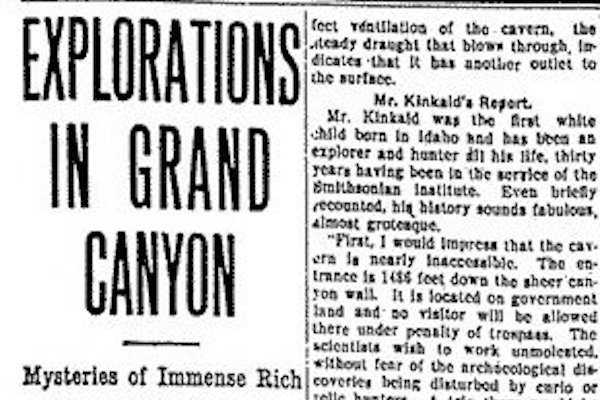
The hoax newspaper article itself

And so we enter the fringe. We dipped into the fringe already, throughout the series, with old pyramid legends entering occult beliefs, but as we approach the modern day, we find that is where all of these myths survive. Throughout the 20th century, occultists have more and more embraced misconceptions and misguided notions about the pyramids and created numerous branching belief systems with these myths at their heart. In the late 19th century, Charles Taze Russell embraced the pyramidology of Charles Piazzi Smyth, coming to believe that Hebrews built the Pyramids of Giza according to divine instruction, and that its measurements and dimensions could be used to foretell the future, making a series of predictions about end times occurrences coming in 1914, none of which actually took place, of course. Russell’s millenarian movement would become the Jehovah’s Witnesses today, who never seem to want to talk about this stuff with me and act offended when I bring it up, even though they’re the ones that knocked on my door. Henry Spencer Lewis, in 1915, repopularized the old 17th century esoteric beliefs of Rosicrucianism (a subject itself fit for another episode or series) when he founded the Ancient Mystical Order Rosae Crucis, or AMORC, in San Jose. Inspired by old Masonic iconography and lore, as well as Hermetic legends and even Pythagoreanism, Lewis made wild and unsupported claims that Rosicrucianism, and his little San Jose order in particular, had descended directly from the priests of an Egyptian mystery cult. He took out ads in major American magazines claiming that the Pyramids of Giza had been built by Atlanteans, and he asserted that a secret chamber beneath the Sphinx containing records proving all the things he claimed would one day be discovered. One can go and visit the Rosicrucian Egyptian Museum in San Jose today, owned and operated by AMORC, where in 2015, on the anniversary of AMORC’s founding, they premiered an alchemy exhibit in which visitors are led in guided meditation. Inspired in part by the writings of AMORC’s Henry Spencer Lewis, as well as the Theosophical writings of Helena Blavatsky and others, the famous clairvoyant Edgar Cayce, the so-called “sleeping prophet,” who made his pronouncements while supposedly in a trance state, also spread such claims about Egypt and the pyramids. He claimed to have been an Egyptian priest in a past life, and that the wonders of ancient Egypt were the work of biblical giants. Besides this old myth, he repeated pyramidological claims about the openings of the Great Pyramid being meant to align with stars and that future events could be foretold by examining its measurements and dimensions. From Ignatius Donnelly he took the notion that the Pyramids were built by Atlanteans, and from Blavatsky, he took the notion that these giant Atlanteans were a “root race,” and from AMORC’s Henry Spencer Lewis he took the notion that these Atlanteans had hidden the evidence of their handiwork beneath the Sphinx in a “record house.” During the course of his trance, when he was supposedly channeling knowledge directly from what theosophists call the Akashic record, the repository of all knowledge, accessible only mentally, Cayce gave indications that he was only regurgitating ideas from his voracious occult reading, even letting slip the sources of his pronouncements by explicitly mentioning them, which should be enough to show that he was neither a prophet nor really asleep during these sessions.

Yet Edgar Cayce’s influence on fringe pseudohistory today is immense. Many notions about Atlantis, its location, its influence on other cultures, and its advanced technology, its crystal death rays and whatnot, came from this fake psychic grifter, and other grifters who make claims about Atlantis and ancient aliens today have relied heavily on this fraud. For example, in his recent Netflix series, Graham Hancock, perhaps the most prolific and influential of lost civilization theorists today, spent a great deal of time ginning up evidence for the existence of Atlantis in Bimini, in the Bahamas, the very place where Edgar Cayce claimed the tallest mountains of Atlantis could be found. And in his book The Message of the Sphinx, he devotes an entire part, three chapters and 46 pages, to the notion originating from the Rosicrucians and Edgar Cayce that a Hall of Records may be found in some as yet undiscovered subterranean chamber there. So widespread was the belief that beneath the Sphinx an ancient hall of records would be found that when a new subterranean chamber was indeed discovered, not actually under the Sphinx’s paw but nearby enough to whet the appetites of modern followers of Cayce and the Rosicrucians and Graham Hancocks of the world, that its opening was broadcast live on television in a program hosted by Maury Povich. It was no Hall of Records, but rather the Osiris Shaft, the watery chamber with stone coffins corresponding to some of the earliest claims about tombs beneath the pyramid, in the middle of a lake, going all the way back to the writings of Herodotus, as mentioned in Part One of this series. But disappointments like this would not slow down or deter people like Graham Hancock, who has built his career on claims that “orthodox” archaeology is suppressing the truth about Egypt and the Pyramids. I received an email recently from a listener who took issue with me suggesting Graham Hancock is a “grifter” in Part One. In the next installment, Part Six and definitely the final part of this series, I will give some further reason for why the arguments of Graham Hancock appear disingenuous and why I class him among the modern day grifters who have inherited the tradition of such fraudsters as Helena Blavatsky and Edgar Cayce, whose careers show us that the real Curse of the Pharaohs is misinformation.

Cayce at his desk

Further Reading

Bates, A.W. “Dr Kahn’s Museum: Obscene Anatomy in Victorian London.” Journal of the Royal Society of Medicine, vol. 99, no. 12, 2006, pp. 618-624. doi:10.1177/014107680609901209

Brier, Bob. Egyptomania: Our Three Thousand Year Obsession with the Land of the Pharaohs. St. Martin’s Press, 2013.

Cavendish, Richard. “Tutankhamun’s Curse?” History Today, vol. 64, no. 3, March 2014

Colavito, Jason. The Legends of the Pyramids: Myths and Misconceptions about Ancient Egypt. Red Lightning Books, 2021.

Dawson, Warren R. “Mummy as a Drug.” Proceedings of the Royal Society of Medicine, vol. 21, no. 1, Nov. 1927, pp. 34-39, www.ncbi.nlm.nih.gov/pmc/articles/PMC2101801/.

Dolan, Maria. “The Gruesome History of Eating Corpses as Medicine.” Smithsonian Magazine, 6 May 2012, www.smithsonianmag.com/history/the-gruesome-history-of-eating-corpses-as-medicine-82360284/.

El-Daly, Okasha. Egyptology: The Missing Millennium; Ancient Egypt in Medieval Arabic Writings. Routledge, 2016.

Hornung, Erik. The Secret Lore of Egypt: Its Impact on the West. Translated by David Lorton, Cornell University Press, 2001.

Lehner, Mark, and Sahi Hawass. Giza and the Pyramids: The Definitive History. University Chicago Press, 2017.

Martens, Britta. “Death as Spectacle: The Paris Morgue in Dickens and Browning.” Dickens Studies Annual, vol. 39, 2008, pp. 223–48. JSTOR, www.jstor.org/stable/44372196.

Pyramidiocy - Part Four: Egyptomania

In 1798, as Napoleon Bonaparte bided his time, waiting for the right moment to seize power, he sought to win further military victories in the name of France, and knowing the strategic importance of Egypt, it seemed the best territory to take. As one official of the East India company had famously stated, “France, in possession of Egypt, would possess the master-key to all the trading nations of the earth…. England would hold her possession in India at the mercy of France.” This was just what Napoleon hoped to accomplish, to disrupt British overseas trade, as well as to burnish his own reputation. Though he could not hope to conquer the East, he did fancy making of himself a modern day Alexander the Great, whom in his memoirs he placed “in the first rank…on account of the conception, and above all the execution, of his campaign in Asia.”  After eluding a British fleet, he captured Malta, landed 35,000 troops in Egypt, and captured Alexandria within a couple days. Across the desert then he marched them, and as they came within sight of the pyramids, they faced a battle against 10 thousand fierce Mamluk horsemen of the Ottoman Empire. Napoleon is said to have told his soldiers that “from the height of these pyramids, forty centuries look down on you,” and then he formed his army into five squares, in which his men knelt and fired their muskets up at the riders, decimating them. Perhaps thirty French were killed, compared the five or six thousand Mamluks killed. Napoleon took Cairo within days, imagining himself like Alexander the Great, or a new prophet: “I saw myself founding a new religion, marching into Asia riding an elephant, a turban on my head, and in my hand the new Koran.” But the reason for the French Revolutionary government’s sending of Napoleon to Egypt was not to make him into a grand conqueror. In fact, expansion overseas was not an approved policy, and they had no desire to go to war with the Ottoman Empire. They did hope to disrupt British commerce, but they also simply wanted to keep Napoleon busy and away from  France, as his popularity was growing problematic. So they came up with a cover story for their invasion. Their Egyptian campaign, they claimed, was only a science mission, intended “to enlighten the world and to obtain new treasures for science,” a sign of Revolutionary France’s devotion to Enlightenment principles. Therefore, accompanying the invading troops were 167 scholars who studied the monuments and temples of Egypt and worked to produce a series of academic publications, the Description of Egypt, that would appear over the course of twenty years in the early 19th century and drive public interest in Egyptian history and the pyramids. During the Napoleonic campaign in Egypt, one scholar discovered the Rosetta Stone, and amidst the publication of the Description of Egypt, in 1822, the French philologist Jean-François Champollion deciphered it. It was the birth of modern Egyptology proper, an academic pursuit that had only been in its infancy since the myth-perpetuating work of Athanasius Kircher. But the great, concomitant public interest in Egypt was far from purely academic. It was called Egyptomania, and it would fire the imaginations of many an artist and occultist during the 19th century.

In case I gave the impression that Egyptomania was a French phenomenon, it should be clarified that Egyptomania swept too through the English-speaking world. In the 1830s, Egyptomania drew Major General Richard Vyse to Egypt, where as I mentioned previously, he used gunpowder to gain entrance into previously inaccessible chambers beneath the Great Pyramid. Egyptology actually owes him something of a debt of gratitude for his discovery of Khufu’s name within the pyramid, which confirmed finally the association of the Great Pyramid with that pharaoh and not one of the many other candidates named in myth. However, in his published study, Operations Carried On at the Pyramids of Gizeh in 1837, he also repeats Arab myths such as that the monument was built by Hermes or Surid, saying “ignorance and superstition so completely disguised tradition and facts, that it is scarcely possible to ascertain the foundations upon which they rest.” Egyptomania spread even as far as the United States, as evidenced by the Egyptian architecture and symbolism so prevalent in our iconography. Of course, this was already underway, likely because of the popularity of Freemasonry in America, but even during a period when Freemasonry was largely suppressed in the U.S. in the 1830s by the Anti-Masonic movement, we see the rise of Egyptian Revival architecture in many American buildings, and American preoccupation with Egyptian aesthetics reached their pinnacle, so to speak, with the obelisk design of the Washington Monument. Throughout the 19th century, we see myths about Egypt and scholarly Egyptology split and take separate paths, much as we saw that legitimate mathematics split from the number mysticism of Pythagoras and true chemistry diverged from alchemy, but it cannot be said that pseudoscience did not muddy the waters in those years too. And as we’ve seen time and time again, pseudoscience twists real science and fact to suit ideology. That was very much the case with Charles Piazzi Smyth, the popularizer of Pyramidology. As I described previously, his scientific seeming measurements were his way of supporting British Israelism, and also, his invention of the “pyramid inch” was part of his argument that the Imperial measurement system was superior to the metric system, since if Egyptians used something like it, it must have been better. Many of the 19th century pseudoscientists who perpetuated pyramid myths did so in order to argue in favor of biblical literalism, as we have already seen in claims that Hebrew slaves built the pyramids or that they were Joseph’s granaries or that they stood as evidence of certain Genesis traditions. One German writer, Carl von Rikart, for example, claimed Noah’s son Shem built the Pyramids, and perpetuated the idea that the shafts of the pyramid were meant to align with certain stars, like a telescope—a notion I erroneously attributed to William Herschel in the first episode, but which actually was the wrongheaded notion of his son John Herschel, right smack dab in the midst of Egyptomania. And perhaps the worst of all the pseudoscientific claims related to Egypt in this period were those related to race. Many were the ethnologists of the 19th century who speculated about racial hierarchy and measured the skulls of ancient Egyptian mummies in order to argue that modern whites must have had more in common with ancient Egyptians than did Black Africans, a racist claim that we can still see touted today. But the line between science and pseudoscience was not so well understood in those years, and even otherwise credible Egyptologists were known to reach inaccurate conclusions that would end up confusing the truth about ancient Egypt and encouraging the spread of false history.

The Inventory Stela

While excavating near the Sphinx in 1858, French archaeologist Auguste Mariette discovered a previously unknown temple dedicated to Isis. There, he discovered a tablet, or stela, on which is inscribed a list of statues, presumed to have once been housed within the temple. The tablet also states that this temple was discovered and rebuilt by Khufu. Mariette thus took the tablet to be evidence of some culture that had preceded that of the Egyptian dynasties. Since the Temple was next to the Sphinx, it appeared that this earlier people were capable of building great monuments. Other French scholars took it further. They gave this people a name, Shemsu Hor, the “Followers of Horus,” and since the tablet mentions Khufu finding the temple east of the Great Pyramid, but not his having built the pyramid, mentioning only his having afterward built one of the small Queens’ Pyramids, this once scholarly notion has contributed to claims that the major pyramids at Giza were only found by ancient Egyptians, but had been constructed by some earlier mystery culture. However, even right away the claims about the Inventory Stela, as it was called, were doubted by scholars outside of France. The name used on it to refer to Khufu does not follow known convention, and its reference to the goddess Isis appeared anachronistic, since no other references to Isis appear until a later dynasty. Today, Egyptologists recognize the Inventory Stela as a pious fraud. The temple was built in the ruins of a mortuary temple originally built with one of the Queens’ Pyramids, and the tablet appears to have been forged in order to create a false legend about the age of this later temple. Nevertheless, this fraud, which went unrecognized at first and was still stubbornly clung to by French Egyptologists for some years, would serve as what seemed to be scholarly evidence for the pseudohistorical theory that the Great Pyramid was not built by ancient Egyptians but rather by some even older mystery culture, which is a notion that stands at the heart of much pseudohistory, such as hyperdiffusionist claims about a precursor civilization that built pyramids all over the world, and identification of this theoretical civilization as Atlantis.

Hyperdiffusionist ideas have abounded for a long time and are reached by the strangest and most circuitous routes. We saw how the growth of Pythagorean number mysticism evolved into numerology and then into the idea that Pythagoreans had long ago traveled the world and designed megalithic monuments with telltale numerical puzzles built into their measurements. Numerological, or rather pyramidological claims like those of Charles Piazzi Smyth would do likewise. In the 18th century, one Jean-Pierre Paucton would try to connect pyramid measurements to longitude, and thus to the size of the Earth, and during the Egyptomania that gripped the French in the wake of the Napoleonic campaign, one member of the Egyptian Scientific Institute that Napoleon established in Cairo, named Dufeu, believed, according to my principal source for this series, Jason Colavito’s The Legends of the Pyramids, that by taking the measurements of the Great Pyramid’s interior chambers, one could find there encoded the coordinates of the places the ancient builders of the pyramid had visited, which included, surprisingly enough, the State of Oregon on the U.S. West Coast. But hyperdiffusionists need not depend on such arcane numerological arguments, for all they needed to argue that the builders of the pyramids had been to the Americas was the perfect evidence of Mesoamerican pyramids. One of the most influential early proponents of this claim was the French priest Charles-Étienne Brasseur de Bourbourg, who in his 1868 book, Four Letters about Mexico, speculates about similarities between Mayan and Egyptian hieroglyphs, pantheons, and cosmologies and argues that both cultures originated in Atlantis, which was submerged due to a catastrophic pole reversal some 12,000 years ago. While no scholar of his era took de Bourbourg seriously, he had an influence on the fringe. For example, another Frenchman, Augustus le Plongeon, a photographer, together with his wife, dedicated his life to fleshing out this fake mythology, weaving the history of Freemasonry into it, and even totally making up stories, rewriting the Egyptian myth of Isis and Osiris, for example, with names of his own invention, Queen Moo and Prince Coh. And he cried vast scholarly conspiracy to cover up the truth when his claims were rejected as fictional by legitimate Egyptologists and experts on the Mayan reliefs that he claimed were his sources. But the fact that de Bourbourg and le Plongeon were recognized as cranks in their own day doesn’t mean squat in the world of pseudohistory and fringe belief. Their claims spawned the New Age beliefs of Mayanism as well as sundry other false ideas about Atlantis and ancient astronauts that continue to capture the attention of the credulous today.

Augustus le Plongeon

Of course, belief in ancient transoceanic contact with the Americas was not new. Long had there been claims about the Hebraic origins of Native Americans. And since the late 1820s, Joseph Smith, the founder of Mormonism, had been making claims connecting the Americas and Mound Builder culture with Egyptians. He claimed they were the Lost Tribes of Israel, but their scriptures, which he claimed to translate from some golden plates an angel had revealed to him, and which he conveniently was not allowed to show others, was inscribed in what he described as “reformed Egyptian.” When a transcription of these supposed plates was shown to classical scholar Charles Anthon by one of Smith’s adherents, Anthon said he counseled the fellow not to give Smith any money, though the Mormon version of the meeting has it that Anthon confirmed the characters were Egyptian and signed a statement to that effect, only to afterward tear it up upon hearing more about their provenance. So an expert says he saw right through them, and the believers claim, conveniently without evidence, that he actually believed them genuine hieroglyphs. But why a lost Tribe of Israel would be writing in Egyptian hieroglyphs was never adequately explained. Smith would continue in his Egyptomania throughout his lifetime. When during the height of Egyptomania a travelling show came through the Mormon Mecca of Kirtland, Ohio, exhibiting a mummy and some papyri, Smith bought the manuscripts and claimed once again to have magically translated them, revealing that they were actually the writings of Abraham and Joseph. It is from this Book of Abraham that the Mormon cosmology was promulgated, which involved a slowly rotating planet near to the throne of God called Kolob. This is given as an  Egyptian cosmology, again presenting Egyptians as ancient astronomers, though of course, no Egyptian hieroglyphs anywhere have ever corroborated this strange cosmology. Eventually, when legitimate Egyptologists were able to examine these papyri, they proved to be rather typical funerary texts. Nevertheless, as the basis of their religion relied on the notion of ancient transoceanic contact from the Near East, the Mormon Church would continue to amplify pseudohistory like that of de Bourbourg and le Plongeon whenever it appeared, as would others promoting alternative world histories, like the man sometimes credited as the father of modern catastrophism and alternative history, or pseudohistory as it should rightly be called: Ignatius Donnelly.

Donnelly has come up recently, in my series on Shakespeare denialism, because of his publication of The Great Cryptogram, arguing that Francis Bacon wrote Shakespeare and left clues to prove it in the form of an elaborate cipher embedded within Shakespeare’s works. That wasn’t the only work of paranoid fantasy that Donnelly wrote and passed off to the world as scholarship. Not only credited as the father of fringe history, but also the father of American Populism, he’d had a long career railing against the corruption and decadence of the Gilded Age as a lieutenant governor in Minnesota, a three-term congressman, and a vice presidential candidate in the People’s Party. Already paranoiac in his politics, he saw political corruption everywhere and claimed that a “vast conspiracy against mankind has been organized on two continents and is taking possession of the world.” After leaving politics, he aimed that paranoia at historical research, but he had studied law, not history. He was an auto-didact, completely self-taught, and like many such people drawn to the field of history, he gravitated toward the most sensational subjects and used a simpleton’s logic to assert completely false claims. He would have been a great YouTuber and podcaster today. He took Plato’s allegory about Atlantis as fact, and he synthesized it with biblical literalism to create a mish mash legend that even today enthralls those who mistake his work for legitimate historical research. Rather than concluding the obvious, that Plato was mythmaking within the established tradition of flood narratives, Donnelly said that Atlantis had been the geographical setting of Genesis, the location of the Garden of Eden, and thus its sinking had been the very same event as the flood of Noah. He borrowed liberally from de Bourbourg and le Plongeon, claiming falsely that Mayan hieroglyphs contained elements of Egyptian hieroglyphs and even Greek, and arguing that there was no possible way that Mesoamerican cultures and ancient Egyptians could have imagined the same pyramidal structures independently, and so this unique architecture must have come from a progenitor culture, the Atlanteans. Of course, as Colavito points out convincingly, pyramidal structures arise naturally, such as when sand is poured into a pile, and really, before more advanced building techniques involving internal frame structures were developed, a tapering shape was the only possible way to build something tall like these monuments. Donnelly was just profoundly wrong, and would go on to be very wrong time and time again, such as when he invented catastrophism in his second book, Ragnarok, which would greatly influence the more modern catastrophist and chronological revisionist Immanuel Velikovsky in his own pseudohistorical, pseudoscientific wrongness.

Ignatius Donnelly in 1898.

Egyptomania was not limited to scholars and pseudoscholars, however. It was also rampant among the literati. Among Romantic poets, Egypt was an especially favorite subject, as were the Arab legends about it that had been transmitted to them. The same year as Napoleon’s campaign, Walter Savage Landor reworked a legend about an Iberian invader falling in love with an Egyptian queen in the long poem Gebir, and this work would inspire many 19th century writers who would themselves write works with an “Orientalist” theme. Robert Southey in Thalaba the Destroyer, and Samuel Taylor Coleridge in “Kubla Khan” demonstrate this influence, but the most relevant to Egypt would again be Shelley’s “Ozymandias.” But Orientalism and Egyptomania emerged in fiction within a different genre: horror. While many of the staples of Egyptian horror tales can be traced back to the story of Setna, with its ghosts and curses, and the story of Surid, with its booby traps and monster haunted subterranean catacombs, the very first story involving a reanimated mummy appeared in 1827, in a science fiction novel called The Mummy! A Tale of the Twenty-Second Century, in which galvanic shock is used to revivify Khufu in very Frankenstein fashion, who then goes on to give sage advice. In the ensuing years, many very famous authors wrote mummy stories. Edgar Allan Poe wrote a satire called “Some Words with a Mummy,” and afterward mummy stories became horror stories, with Louisa May Alcott of Little Women fame writing the first story involving a mummy’s curse, called “Lost in a Pyramid,” and Jane Austen following suit with her own mummy’s revenge story, called “After Three Thousand Years.” Arthur Conan Doyle, inventor of Sherlock Holmes, would eventually get in on the trend too, as would Dracula creator Bram Stoker. But some artists of the era would move beyond the Orientalist themes of Egyptomania and take an interest in the old pyramid legends, which had carried over into the occult. For example, Éliphas Lévi, better known today as an occult magician than a poet, was a 19th century French esotericist and former Catholic seminary student. He devoted his life to writing about the occult, and within his can be found many pyramid myths as transmitted to him through the Hermetic traditions that he helped to spread to a new generation. Likewise, Sir Arthur Conan Doyle did not just write a simple mummy story; he wrote about a mummy preserved in a deathless sleep by an alchemical elixir, who was resurrected by the titular talisman, “The Ring of Thoth.” Doyle was also a convert to that other great 19th-century occult belief, spiritualism, the notion that the souls of the dead could communicate with the living through mediums in a séance. And there was one major spiritualist figure, Madame Blavatsky, who, inspired by the occult writings of Éliphas Lévi and others, would establish her own branch of occult “science,” called Theosophy, and would promote and reinvent numerous pyramid myths.

Helena Blavatsky, whom I’ve had occasion to talk about before in relation to the religious dimension of UFO belief, was a Ukrainian woman who, after leaving her aristocrat husband, apparently traveled a great deal in Europe and elsewhere. Many are the tales about her travels before she eventually settled in the US, with claims about her performing as a concert pianist and riding horses in a circus. Stories she told herself had her traveling much further afield, to Nepal, India, and Egypt. She would eventually claim that she had been tutored by so called “hidden masters,” interdimensional sages who schooled her in the secret histories of the world. In New York, she was a practicing medium, and she attracted the interest of one Henry Steel Olcott, a spiritualist with an interest in the occult. The two of them would go on to found the Theosophical Society, dedicated to establishing a universal brotherhood, to encouraging the comparative study of religion, philosophy, and science, and to investigating the unexplained and humanity’s supposed paranormal powers. She published her first book, Isis Unveiled, which presented itself as a “master-key” to all knowledge and mysteries, achieved through ancient wisdom. It is hard to overstate the influence of Blavatsky and Olcott and their Theosophical Society. They traveled to India and were extremely influential on Mahondas Gandhi and helped bring about a Buddhist revival throughout the Indian subcontinent. It is thanks to their journeys of religious and philosophical awakening that India became a place for pilgrims to go in search of enlightenment and Americans came to believe in the wisdom of Eastern gurus. But Blavatsky is widely remembered today as a total fraud. Her book, it turned out, was a patchwritten hodgepodge of occult texts she had plagiarized. Arthur Conan Doyle said it “was edited rather than written by her…that a hundred books were used for its production, and that when the unacknowledged quotations are taken out there is practically nothing left.” Moreover, she was revealed by the London Society for Psychical Research to be a fraud, engaging in fake parlor tricks as a medium, as indeed, most or all mediums did, and forging letters from her supposed “hidden masters” in order to fake their existence. Nevertheless, Theosophy survives today, and Blavatsky’s claims about progenitor civilizations remain as popular as ever. In Isis Unveiled and especially her later work, The Secret Doctrine, Blavatsky laid out her conception of the secret history of mankind, which she claimed extended back much further into the benighted past than historians allowed. She traced history back through several “Root Races,” beginning with beings of pure spirit. Subsequent, physical iterations of mankind had their time, each on some lost and mythical continent, beginning with Hyperborea, followed by Lemuria, and then Atlantis, and she claimed that vestiges of Atlantean monuments remained, in Stonehenge and the pyramids at Egypt. She imagined Atlanteans to be giants who mated with “she-animals” to produce primates—a weird reimagining of the story of the Watchers and the Nephilim. To buttress her claims, she made reference to the work of the pseudohistorian Augustus Le Plongeon, claiming against all contrary scholarship that the Mayan and Egyptian civilizations were one and the same, remnants of Atlantis. Later Theosophists would even claim that these Atlanteans were one and the same as the Followers of Horus, the Egyptian precursor culture that had been imagined because of the fraudulent Inventory Stela. Blavatsky was a grifter who took the myths and fake histories about the ancient past that came before her and remixed them as a new revelation, making of herself a sage master when she was little more than a liar and cult leader. And in doing so she set the stage for the final modern chapter of pyramid myths, when falsehoods are more and more purposely spread and grifters like her abound.

Helena Blavatsky, circa 1877.

Until next time, remember, all legitimate sciences and academic fields have some embarrassing episodes in their pasts, having developed in periods of backward thinking and prejudice. The sign of a true science is how successfully it has extricated itself from its own ignorant past.  

 Further Reading

Brier, Bob. Egyptomania: Our Three Thousand Year Obsession with the Land of the Pharaohs. St. Martin’s Press, 2013.

Colavito, Jason. The Legends of the Pyramids: Myths and Misconceptions about Ancient Egypt. Red Lightning Books, 2021.

El-Daly, Okasha. Egyptology: The Missing Millennium; Ancient Egypt in Medieval Arabic Writings. Routledge, 2016.

Hornung, Erik. The Secret Lore of Egypt: Its Impact on the West. Translated by David Lorton, Cornell University Press, 2001.

Lehner, Mark, and Sahi Hawass. Giza and the Pyramids: The Definitive History. University Chicago Press, 2017.

Pyramidiocy - Part Three: The Book of Thoth

Out of the ancient Egyptian past, more survived than just hieroglyphs and monuments. A mythology also survived, as recorded by Manetho and attested by countless inscriptions that, while unreadable for more than a thousand years, would eventually be accessible again, thanks to the Rosetta Stone. But in the Hellenistic period, Greco-Egyptian storytelling took the figures of Egypt’s past and created a new mythology. One such story, from the 4th century BCE, survives in a manuscript likely copied during the Ptolemaic period and tells the story of a prince named Setna, son of Pharaoh Ramesses II, who sought secret knowledge within ancient Egyptian tombs, kind of like the first Indiana Jones. Indeed, there does appear to have been some historical basis for the tale, as Khaemweset, son of Ramesses the Great, was known for restoring monuments and temples, and for entering tombs to learn what he could of the inscriptions therein. He has even been called the “first Egyptologist” because of it. In the legend, Setna, the prince seemingly based on Khaemweset, hears that in a certain tomb in Memphis can be found the Magic Book of Thoth, written in the very hand of the Egyptian god of wisdom, who would later be Hellenized as Hermes Trismegistus and Judaicized as Enoch. This book granted the magics to enchant the world and to see the gods, and even to speak with animals, much like the sort of magic that would later be attributed to King Solomon and his magic ring. We see here an early parallel to stories of the Pillars of Wisdom, inscribed with their ancient antediluvian knowledge of magic, and the Emerald Tablet of Hermes Trismegistus, which has been referred to as a book and was often described as hidden within a tomb. In the story of Setna, he encounters ghosts who guard the Book of Thoth and warn him of its curse. Setna nevertheless takes the book and its magic for himself, becoming cursed until he brings the book back to the tomb. We see in this ancient legend a model for later legends about a mummy’s curse, but we also see in it a motif about a hidden book of magic that would return in association with other legends inextricably linked to myths surrounding the pyramids. When not adapting the Pillars of Wisdom legend, such as the 4th century CE Greek magico-medical treatise, the Kyranides, which was said to have been inscribed by Hermes Trismegistus on iron pillars, then such legends, especially those originating from medieval Islamic sources, frequently claimed to have originated in lost or hidden books like the Magic Book of Thoth. The legend of the Emerald Tablet, for example, seems to have originated in a 9th-century Arabic legend about Neopythagorean sage Apollonius of Tyana venturing into a subterranean chamber beneath a statue of Hermes Trismegistus and finding the mythical Emerald Tablet there in the grip of another statue of Hermes. In the 10th century, the alchemical treatise Silvery Water and Starry Earth by Muslim author, Muḥammad ibn Umayl al-Tamīmī, describes his having discovered a lost book in hieroglyphs, full of what he assumed were magical secrets, hidden with a statue of Hermes beneath what he claimed was the prison in which Joseph had long ago been held captive. The trope of legends having their origin in lost or hidden books of magic or secret knowledge is so convenient from a storytelling perspective. Think, for example, of the Tablets of the Law, which were the very commandments of God and which were hidden away in the Ark, such that no one could actually view them. Or take a more modern example, the Golden Plates of Nephi, another hidden/lost book legend promoted by Joseph Smith, who also insisted that people could not just be allowed to look at the plates for themselves. The examples are numerous, and this element would also be present in the most pervasive of pyramid myths, which developed in the Middle Ages among Muslim Egyptians and Hermeticists.

While it is clear that, after the Arab conquest of Egypt, many Muslims embraced and built upon the Hellenistic myths and Hermetic legends of the pyramids, it would be untrue to claim that there was uniformity or unanimity of belief in such tales. As evidenced by Caliph al-Ma'mun’s decree that the Great Pyramid be opened and its treasures and magical texts be seized, and in the ensuing claims about their having found a mummy within clutching a book of magic, these myths were clearly extant and spreading among the land’s Muslim conquerors. However, while some credited the tales that the pyramids had been built before the flood, that they were the repositories of ancient knowledge, and that the Great Pyramid was the tomb of Hermes or Enoch, even going so far as to claim certain lines they thought they could perceive on the Great Pyramid’s sides represented the high water mark of the flood, the Prophet Muhammad himself rejected the antediluvian history of Egypt. As a result, most Muslims held that Egypt was founded after the flood, by Ham’s son Mizraim. And medieval Islamic writers developed a number of alternative, postdiluvian myths of the pyramids. They had been built by Nimrod, the great-grandson of Noah responsible for that other, wholly fictional monstrous construction, the Tower of Babel. Or perhaps they had been designed by Aristotle, who oversaw their construction to serve as tombs for Alexander the Great and himself. Then again, perhaps they were built by Daluka, a queen said to have ascended to power after the Pharaoh of Exodus was drowned in the Red Sea. Daluka was also sometimes credited with building the Lighthouse of Alexandria, now ruined but once a Wonder of the Ancient World. But the historical existence of Daluka is inconsistent. The Lighthouse of Alexandria was built during the Ptolemaic Kingdom, so she could not have built it. Before she was claimed to be the successor of the Pharaoh of Exodus, Daluka was also thought to have been an antediluvian queen of Egypt. In fact, like other figures in Exodus and other figures associated with the building of pyramids, she may have never even existed. Another popular contender in medieval Muslim stories about the pyramid was Shaddād bin ʽĀd, said to have been king of the world, ruling from a lost Arabian city called Iram of the Pillars, a place that has been associated with Atlantis because it was said in the Qur’an to have been destroyed by God because of its corruption. This legend proved especially desirable, as it attributed the pyramids’ construction to an Arab. In the end, the legend that would win out was one that synthesized almost every pyramid myth that had come before it: the legend of Sūrīd ibn Salhouk.

A depiction of Setna emerging from the tomb carrying the magical Book of Thoth.

The story of Sūrīd would be told and retold in so many variations that it is difficult to tell without endless digressions to acknowledge alternative versions. For the sake of brevity and engaging storytelling, I will endeavor to blend elements from numerous versions and tell a more cohesive tale. Across the many medieval Islamic and Coptic versions of the story, which can be imagined to trace back to a lost original version, we see the familiar framing device of a lost book of secrets. Two Copts are said to have entered a tomb and discovered a mummy clutching an ancient, moldering book. Unable to read the book, these Copts took it to a faraway monastery, where a monk, who was said to be the last man able to read hieroglyphs, translated it for them. The book told of an antediluvian king named Sūrīd who was a Nephilim, a descendant of the union of Sethite men and Cainite women, and thus a giant, as were all the kings of his dynasty. Sūrīd had a prophetic dream of the Earth being overturned and the stars crashing out of the heavens. His trusted advisor, Philemon, interpreted the dream as a prophecy of the end of the world, and using astrology, he calculated the exact date of the forthcoming flood. Sūrīd then commanded Philemon to oversee the building of the pyramids of Giza, which would serve as tombs for himself and his family and house all their earthly treasures. These grand monuments would also preserve the wisdom and knowledge of the world, though, for Sūrīd directed all the secret sciences of the ancient world to be inscribed on its interior and exterior walls, and all its ceilings and columns. These secret sciences were used by Philemon to build the pyramids, according to the tale. He had only to touch a magical scroll, and the stone blocks were cut and flown into position by magic! And though Sūrīd sought to preserve the knowledge of the past for posterity, he also sought to protect his treasures, setting up magical statue guardians, idols who could kill any man that looked in their eyes, kind of like the Forbidden Eye of the idol Mara in the Indiana Jones ride at Disneyland. The legend ends with accounts of Caliph al-Ma'mun men entering the pyramid in the 9th century, finding the treasures untold that Sūrīd had sealed within its labyrinthine passages and chambers, as well as ghosts, monsters, and booby traps galore. However, the book said to have been found on the chest of the mummy within was not a part of this legend. Rather, the lost book containing the story of Sūrīd that would later be found by the two Coptic brothers actually survived the flood with Philemon, who after building the pyramids happened to befriend Noah and hitch a ride on the Ark so that he would survive to serve the future kings of Egypt, starting with Mizraim.

In this legend can be seen a syncretism of nearly every pyramid myth that came before it. There is its origin in a lost book of secret knowledge. There is the involvement of the biblical giants of Genesis, and the prophetic dream of the flood, as was had by Adam, followed by the efforts to preserve knowledge through inscriptions, traceable back to the myth of the Enochian Pillars. The interpretation of the king’s prophetic dream by his vizier, Philemon, who is then tasked with preparing for the catastrophe by building pyramids even echoes the story of Joseph and the idea that he built the pyramids to store grain. The pyramids are presented as both tombs and repositories for ancient knowledge, and the conclusion, with tomb raiders braving booby traps and facing ghosts and monsters in a vast subterranean warren of passages presages even the most modern myths about ancient Egyptian monuments. But lest anyone hear this and actually credit the story, the facts demonstrating its clearly mythological character should be emphasized. Some have tried to paint the story of Sūrīd with the brush of historicity, but it simply cannot be convincingly done. While it is true that the same Sūrīd may be a corruption of Suphis, the Egyptian priest Manetho’s name for Khufu, the reign of Khufu precedes nearly all the dates for the flood by hundreds of years, and more than that, calculations made according to details in Sūrīd narratives alone place the construction of the Pyramids a thousand years earlier than we now know them to have been built. Moreover, there are no labyrinthine subterranean passages beneath the pyramids, only a few cramped sepulcher chambers. There certainly was not room in there for so much treasure let alone room for giants to have entered it. Indeed, the interior dimensions of the granite coffer within the King’s Chamber, built to hold Khufu’s sarcophagus, was only six and a half feet in length, which proves he could not even have been more than six feet tall and was likely shorter. Then there are the claims that Philemon and the other priests serving Sūrīd used astrological calculations to determine the exact date of the coming catastrophe. It has been accepted since the late 19th century work of French Egyptologist Gaston Maspero that no system of astrology was in use in Egypt until around 500 BCE. Not only does this prove that the story of Sūrīd was not of ancient Egyptian origin, it also disproves so many pyramid myths that claimed the pyramids and obelisks of ancient Egypt were inscribed with the secrets of magic, and specifically astrology. Of course, with the decipherment of hieroglyphs, this eventually became easily provable when it came to inscriptions on other pyramids and obelisks. But not so the inscriptions on the Great Pyramid at Giza, which were so central to many myths and could not actually be found.

Caliph al-Maʾmūn, who first opened the Great Pyramid in the Middle Ages.

Going all the way back to the account of Herodotus, it was said that the Great Pyramid at Giza was absolutely covered with inscriptions. According to his account, Herodotus was told by interpreters that the inscriptions were essentially a record of the costs incurred in the building of the pyramid, but this seems unlikely and may have been misinformation fed to the Greek visitor, if he was actually told this. It was these inscriptions that were said to have preserved ancient antediluvian knowledge and magic formulae. Through the centuries, as myth upon myth propagated and legends developed about inscribed pillars and tablets within the tomb, of secret books clutched by mummies, the myths of pyramid inscriptions at Giza were embellished, such that the entire interior of the Great Pyramid, which was often imagined to contain a far more vast complex of rooms and passages than would actually be found within, was covered, every inch, floor to ceiling, with mysterious hieroglyphs. In reality, when Colonel Richard William Howard Vyse launched an expedition to Egypt during the wave of Egyptomania in the early 19th century and blasted his way into the interior using gunpowder, no inscriptions whatsoever were found, just one some painted graffiti left by the laborers who built it, which included a cartouche depicting Khufu’s name, which cartouche has become a subject of conspiracy theory, with some claiming Vyse forged it for some nefarious reason. Nor is there any inscription on the exterior of the Great Pyramid to be found, except for graffiti carved into its stones by later visitors. Most is easily recognized as graffiti, but above the lintel of the entrance into Khufu’s pyramid, one square hieroglyphic text can be found, but it was actually left there by German Egyptologist Karl Lepsius in the 1840s, using the new hieroglyphic grammar published by Champollion using the Rosetta Stone. It names the members of his expedition and pays respect to Prussian king Friedrich Wilhelm IV. In 1934, another inscription was discovered under the lintel by French Egyptologist Andre Pochan—four symbols that aren’t recognizable as hieroglyphs and remain undeciphered. Considering that Karl Lepsius a hundred years earlier was carving his graffiti on that lintel and made no mention of this inscription, we can safely presume it to be a later graffiti as well, though it too has fueled conspiracy theory, with some brilliant online sleuths claiming it connects the pyramids to Roswell and aliens.

While both the Great Pyramid and the slightly smaller pyramid of Khafre, his son, contain no inscriptions on their exteriors or interiors, there is still the possibility that they once did have some sort of inscriptions on their exteriors. As Herodotus described the pyramids at Giza, other stones were used “to fill up the angles of the steps, and make the side of the pyramid a smooth inclined plane.” What Herodotus was describing were the limestone casing stones that once covered these pyramids, making their exterior smooth and gleaming white in the sun, an image of the Giza Pyramids that we can only imagine today. In the Middle Ages, most of the casing was stripped away, said to have been used by Muslim conquerors to build the city of Cairo. Considering the number of ancient testimonia claiming that inscriptions had been carved into the pyramid’s exterior, it is feasible that some of the casing stones were inscribed. However, some casing stones have survived, and none show any signs of inscription. Therefore, it is also possible that the inscriptions were entirely legendary. For example, the story of Sūrīd famously states that an inscription appeared on the pyramid in which Sūrīd took credit for their construction and challenged any who would come after him to prove their greatness by destroying them, with the scathing final remark that “it is easier to destroy than to build.” This element of the story appears to be an adaptation of Diodorus Siculus’s claim that on the Colossus of Ramesses the Great, whose throne name he approximated as Ozymandias, there was an inscription that challenged any who “would know how great I am” to “excel me in any of my works,” a likely fictional inscription that Romantic poet Percy Bysshe Shelley immortalized in his sonnet Ozymandias as “Look on my works ye Mighty, and despair!” If the inscriptions on the Great Pyramid were entirely legendary, then the idea of them may have derived from temples and obelisks elsewhere in Egypt, which were inscribed with hieroglyphs, or the pyramids of later dynasties, which did contain interior inscriptions—the Pyramid Texts I spoke of in the last episode, whose contents were not magical formulae or secret lost wisdom. We can see this development even at Giza, as the other major pyramid at Giza, that of Menkaure, son of Khafre, does have some few inscriptions. At its entrance, there is an inscription giving the date of Menkaure’s death, though this inscription is thought to have been carved later, and within the pyramid is another inscription, made by Menkaure’s son, dedicating the monument to his father. Judging by these inscriptions, even if there are lost inscriptions on undiscovered casing stones, there is no reason to believe their content would be much different than an epitaph on a tombstone.

Plate from Charles Piazzi Smyth’s Our Inheritance in the Great Pyramid showing some of the casing stones still in situ at the base. This book blended fact, like this, with pyramidological nonsense.

These many myths about the pyramids had in large part part remained limited to Egypt and Greece, but the Renaissance brought renewed interest in ancient history and “lost knowledge,” especially Hermetic, alchemical lore in Europe. Thus interest in the pyramids and Egypt grew. Italian humanist Peirio Bolzani put in effort to decipher hieroglyphs and compile a dictionary of symbols, though his work relied on the 5th century Greek work of Horapollo, which largely misread hieroglyphs as magical and symbolic characters. He viewed them as ideographs, thinking of them more like ideas in drawing than as a script representing language with grammar and syntax. His work would influence Jesuit polymath Athanasius Kircher, who became unduly confident that he had finally deciphered hieroglyphs. In reality, he got most of his translations entirely wrong, and his view of ancient Egypt was almost entirely predicated on the religious and Hermetic myths that he discovered in Arabic texts that he acquired. He claimed that ancient Egyptian was the language of Adam and Eve, he believed that Adam had received some secret wisdom from the heavens that his descendants preserved from destruction by the flood, and he perpetuated the legend of Hermes Trismegistus as Enoch—in short, he was a major vector for the transmission of ancient pyramid legends to spread among Europeans during the Renaissance. He is the first to have shared the story of Sūrīd with a European audience. But as much as Kircher was a propagator of misinformation and myth, he was also an early figure in the development of a scientific worldview. Though he defended the story of Noah’s Ark as literally true, claimed large bones were the remains of biblical giants, and promoted notions about Atlantis being a real place in the mid-Atlantic, he also studied volcanism, recognized fossils as animal remains, acknowledged the evolutionary possibility of speciation, was one of the first to observe microbes with a microscope, and even concluded that the plague was caused by a microorganism, which he called an “animalcule.” Even his work on hieroglyphs was not without merit, as he was the first to recognize that the Coptic language retained elements of ancient Egyptian. Because of these accomplishments, he has been recognized as “the first scholar with a global reputation” and as the first Egyptologist. It is due to his influence that much Arabic literature was tracked down and translated for European audiences during the Renaissance. And he also influenced much scholarly study of Egypt, interest in which would remain high into the Enlightenment, as interest in cultural traditions and wisdom outside of Christian traditions was sought.

Kircher both perpetuated myths and encouraged a more rational and scientific approach to the study of Egyptian history, and thus the field of Egyptology was born as a kind of pseudoscience. And one of the first false steps it took was in its relation of ancient Egyptian monuments to the stars. Long before John Herschel imagined that the interior shafts of the Great Pyramid were aligned to view the star Draco, his notions were anticipated by an acquaintance of Athanasius Kircher’s, the English astronomer John Greaves. In his 1646 work, Pyramidographia, which otherwise disregarded ancient myths and provided the most detailed and accurate mathematical survey of the pyramids ever published, he allowed himself to be swayed by the Arabic works that claimed, without support, that the pyramids were built for the purpose of worshipping stars. Kircher promoted this notion as well, suggesting without evidence that Manetho’s name for Khufu, Suphis, was actually a reference to the star Sirius. According to Greaves, the flat top of the Great Pyramid was really a platform on which ancient Egyptians had observed the stars, making the pyramids a sort of observatory. This was his own speculation about the purpose of the pyramids, though as Jason Colavito observes in my principal source, The Legends of the Pyramids, Greaves makes it sound like this was the conclusion of Greek Neoplatonist Proclus Lycius, giving this false notion a false history and pedigree. We know this is untrue just as we know the pyramids were not built by and for giants. If they had been, the entrances would have been made far larger, and if they had been designed as observatories, some sort of passage would have been designed for ancient astronomers to climb to the tip, since remember, the smooth casing stones originally made the pyramids impossible to climb. Today we recognize that there never was a platform on the finished pyramid, as atop its casing stones likely was placed a pyramidion or pointed capstone, as was the case on obelisks. These wrongheaded claims, made by well-meaning and in many ways scholarly individuals, nevertheless forever associated the pyramids, in the imaginations of Europeans, with astronomy, leading eventually to the claims of purposeful alignments made by Herschel and the absolutely bonkers claims of pyramidologists like Charles Piazzi Smyth, as described in the beginning of this series. And this claim that the pyramid builders were preoccupied with the cosmos would also contribute, in the 19th century, to some of the wilder claims of occultists.

Athanasius Kircher

So we find that, while Egyptology began with misguided and false notions, it still was taking its first steps toward becoming the legitimate science and academic discipline that is respected today. And as is often the case, simultaneous to that development, and diverging from its efforts to rely on observation and evidence, there were occultists and poets working to perpetuate false notions and myths about the pyramids. Major contributors to this were the Freemasons. As indicated in the last episode, the legend of the Enochian Pillars was long used as part of the ritual initiations of this fraternity. Documents like the Cooke Manuscript demonstrate that the old myth was being incorporated into the fraternity’s lore as early as the 15th century, and in later versions, it's claimed that Enoch inscribed ancient sciences into golden tablets that he hid in deep underground vaults where King Solomon would later find them—thus we see it transformed through the years into the hidden or lost book legend, like that of Hermes Trismegistus’s Emerald Tablet and the Magical Book of Thoth. Into the 18th-century, as the rites and rituals of Speculative Freemasonry became more and more normalized, more and more Hermetic and Egyptian iconography would be incorporated into Masonic symbolism. Surprisingly, the Egyptian image most famously ascribed to Masons, the pyramid with the triangular eye at the top, as seen in the Great Seal of the United States and in this podcast’s cover art, is not actually a Masonic symbol, though the Eye of Providence or All-Seeing Eye in the seal has been used by the fraternity. None of this means that Freemasons really trace their origins back to great antiquity, as their myths claim, or that they are privy to some ancient preserved sciences. The simple fact is that the premise of their fraternity being the preservers of the ancient art of geometry and architecture, which arose from its origins among journeyman bricklayers, means that these legends about preserved knowledge just fit their purposes well. And just as Freemasons’ interest in Hermeticism would lead them to incorporate more of these myths into their mythology, so too would other occultists latch onto them and use them to lend their own practices a veneer of ancient legitimacy. Case in point: the Tarot, which originated simply as playing cards in 15th-century Europe. In the late 18th century, as Freemasonry was growing and appropriating Hermetic myths, these cards were transformed by occultists into a means of divination with a fake history. Early practitioners of Tarot called it “the science of Hermes,” and in 1783, Jean-Baptiste Alliette wrote that the Tarot were, in fact, the ancient Book of Thoth, preserving antediluvian secrets, inscribed by Hermes Trismegistus onto 78 gold tablets hidden within an Egyptian temple. It was the conclusion of the 18th century, two parallel movements had taken especial interest in the Egyptian pyramids at Giza, one scientific and one occult, and an Egyptomania was about to seize the world.

A Tarocchini deck, the game from which Tarot cards are derived.

Until next time, remember, when someone wants to give you a tarot reading, those cards were originally used in 16th-century Italy for a game called Tarocchini. So ask them what the rules are and how you win.

Further Reading

Colavito, Jason. “Hermes Trismegistus and the Origins of Pyramid Myths.” Jason Colavito, 5 July 2015, www.jasoncolavito.com/blog/hermes-trismegistus-and-the-origins-of-pyramid-myths.

Colavito, Jason. The Legends of the Pyramids: Myths and Misconceptions about Ancient Egypt. Red Lightning Books, 2021.

Colavito, Jason. “Mystery Solved: The Key Text That Explains the Origins of Hermes and the Medieval Pyramid Myths.” Jason Colavito, 7 July 2015, www.jasoncolavito.com/blog/mystery-solved-the-key-text-that-explains-the-origins-of-hermes-and-the-medieval-pyramid-myths.

El-Daly, Okasha. Egyptology: The Missing Millennium; Ancient Egypt in Medieval Arabic Writings. Routledge, 2016.

Hornung, Erik. The Secret Lore of Egypt: Its Impact on the West. Translated by David Lorton, Cornell University Press, 2001.

Lehner, Mark, and Sahi Hawass. Giza and the Pyramids: The Definitive History. University Chicago Press, 2017.

Pyramidiocy - Part Two: The Pillars of Wisdom

When Plato invented the story of Atlantis—and he most certainly invented it as an allegory meant to illustrate how hubris can bring about the downfall of civilizations—he chose to place the origin of the tale in Egypt, saying that Solon, who was actually Plato’s ancestor, had received the story from priests in Egypt, and that the priests knew the story because it had been inscribed on pillars in a temple there. As indicated in the first part of this series, the story recalls Herodotus’s tale of receiving the history of Egypt from priests, and indeed, by some interpretations, the entire allegory was meant to counter the growing Greek view that their civilization was inferior to that of Egypt or that Plato had taken his ideas about the ideal state from Egypt. By this interpretation, then, even though the story has it that Egyptians simply transmitted the story, Atlantis was actually meant to represent Egypt, to show that it was inferior to the “perfect society” of Athens, and that it had caused its own downfall. In inventing this story, he may have been inspired by the attempted Athenian conquest of Sicily, or perhaps by the very real destruction of Helike by tsunami, which saw an actual city-state sunk, or rather submerged, much like Atlantis is in his story. However, he had plenty of other models to inspire his story. Since in Critias, it is clear that Zeus is responsible for the sinking of Atlantis, that he chose to punish Atlanteans for their corruption and godlessness, it is further apparent that  Plato was reworking a flood myth, a widespread mythological motif in which a supernatural flood is sent by a god or gods to destroy a people or nation because of their corruption or hubris. Of course, when we think of a Great Flood today, because of the influence of the Bible on Western culture, we think of Noah’s flood, but there were other precursor myths to the one that appears in Genesis. I spoke about this at length in my episode The Deluge and the Ark Seekers, in which I refuted the claim that a global flood occurred and that Noah’s Ark was real. Plato was not the first Greek to imagine Zeus punishing hubris with a flood, for Greek myth held that Zeus had destroyed Arcadia with a deluge in his anger over a human sacrifice. And this myth appears to have migrated from the Babylonian flood myth seen in the Epic of Gilgamesh, which itself was derived from a Mesopotamian antecedent myth that likely only described the flooding of the Tigris and Euphrates Rivers. But the Genesis flood myth was different. The corruption that warranted the flood of Noah was not hubris, but rather something very strange: the mingling of peoples, intercourse between fallen angels and human women, and the issue of unnatural offspring who were giants. Later apocrypha would expand on the myth, with the first man, Adam, having foretold the flood, and with these angels, or Watchers, having revealed ancient knowledge and the secrets of the universe to mankind, and these ancient secrets having been preserved, just as in Plato’s tale of Atlantis, upon pillars that some would say were in Egypt. Just one problem, though: as both Plato and Herodotus asserted, and as the pyramids themselves demonstrated, civilization in Egypt was older than the flood, older even than Eden and the date of Creation, by any calculation at the time. Does the very existence of the pyramids then destroy Biblical literalist views of history? The answer, unfortunately, is no, since Egyptian pyramids are now dated to between 4,000 and 5,000 years ago, well within the 6,000 year range of Biblical literalists, but Jewish writers in antiquity and Christian and Gnostic writers in late antiquity, and Muslim writers in the Middle Ages, were working from an exaggerated timeline and would go to extreme lengths to reconcile the pyramids with their religious doctrines. And this would prove to be a major vector in the development of falsehoods about Egypt and the pyramids.

To think that Jewish theologians did not know how to account for Egypt in their theology is rather surprising. After all, Egypt plays a very large part in the Bible. Abraham lives there for a long time and interacts with a pharaoh. Abraham’s great-grandson Joseph is carried into captivity there but rises to become a vizier. The Israelites are said to have been enslaved there, and Moses is raised in the family of a pharaoh. Plagues are brought down on Egypt before the Israelites are liberated. King Solomon later marries a pharaoh’s daughter, and his son, Rehoboam is said to have lost the Ark of the Covenant to Egyptian Pharaoh Shishak. Even the New Testament has Joseph and Mary taking the baby Jesus into Egypt to escape the wrath of Herod. Even in these canonical scriptures, Egypt is portrayed as a place of evil magics, with the pharaoh surrounded by sorcerers capable wielding magic that rivals Moses’s demonstrations of God’s power. And yet, no mention is made of pyramids whatsoever. With the Israelites said to have been enslaved, one notion was that the Israelites had been forced to build the pyramids, after all, Exodus mentions them “at their hard labor,” and even describes an Egyptian beating a Hebrew slave, for which Moses kills him. Along with some of Herodotus’s phrasing, this proves to be the origin of the myth about pyramids being built by slaves. In fact, there is no archaeological evidence to support the claim that Israelites were enslaved in Egypt. But granting this premise, the Bible does not say what the Israelites did in their labors, and it makes no explicit mention of pyramids or structures that could be interpreted as pyramids. This has not stopped believers from seeing pyramids in the text; for example, it is argued that the word migdol, or tower, the same word used to refer to that other great monolith, the Tower of Babel, would have been used to refer to the pyramids, and furthermore since certain verses refer to a place called Migdol, this must be a reference to Giza. To make this argument one has to entirely disregard the context of every mention of these separate places called Migdol, which were in each case placed in relation to other locations that show it was not Giza. So where were the pyramids? If they weren’t in Exodus, perhaps they could be found in Genesis.

François de Nomé's The Fall of Atlantis, 1650

Of course, if Egypt and the pyramids did not conform to biblical views of chronology, a believer could always assert that God had created them already assembled on the Earth in order to test the faith of believers, as He had those pesky dinosaur bones, but for all their ignorance of science and magico-religious beliefs, even the ancients did not stoop to that sort of stupidity. That is a very modern sort of nonsense. Instead, they failed to question their own preconceptions about history when faced with evidence of a civilization of far greater antiquity than they had imagined possible, and sought to demonstrate that it must not have been so very old as was claimed. According to their own ancient traditions, the very first king in Egypt had been named Mizraim, and this name served also as the Hebrew name for the country. In truth, there is strong reason to believe this was a kind of personification, as the root of the name, misr, meant land, and in the dual form, misraim meant “two lands,” which you may recall from the previous episode was actually what the Egyptians themselves called their land. Mizraim was in the Bible, in Genesis 10, as a grandson of Noah, the second son of Ham, and this made for a great way to shoehorn Egypt into Genesis, such that Egypt became the land to which Ham, the wicked son of Noah, went after being cursed. Thus Ham was said to be the founder of Egypt, and his son Mizraim its first king. This notion would also eventually feed into the insidious myth that--because Ham had not averted his gaze from his father’s drunken nudity and his son Canaan was therefore cursed to be a slave to Ham’s brothers—Ham was the progenitor of all Black people, and that Black people had therefore all been cursed to endure slavery. This terrible falsehood would be bolstered in the 17th century by those who tried to prove Ham’s connection with Africa, or specifically Egypt, through inaccurate etymology, claiming Ham was derived from a Hebrew word for “black,” or from an Egyptian word for “servant,” or even from that other name for Egypt, Kemet, “The Black Land,” which of course, as I stated before, is a reference to the rich soil of Egypt, not to skin color. The name Egypt came from a Greek word that referenced the inhabitants’ skin color and, like all those other words, was not clearly connected to the name Ham in any way. Additionally, it’s just contradictory that the myth about Ham’s sons being cursed to be slaves derives from another myth about Ham’s sons being the first kings of the greatest kingdom in human history.

A further problem with identifying Ham’s Mizraim with Mizraim the first king of Egypt was that there were no records in king lists of a Mizraim being a pharaoh. According to Manetho’s king lists, the first king in Egypt was named Menes, but he was just the first human king, as Manetho traces god kings back untold thousands of years further. Other Greek writers claimed an even longer history for Egypt, stretching back some fifty millennia. Some later chronologists sought to resolve this discrepancy by recalculating the history of Egypt. According to Jewish and Christian traditions, Egypt’s history could not possible have stretched back so very many thousands of years because only a couple thousand years were thought to have passed between Creation and the Flood. With Manetho’s account of gods reigning on Earth for nearly 25,000 years, Christian historians of late antiquity, like Sextus Julius Africanus and Eusebius of Caesaria would try to resolve this by claiming that, after all, Manetho and the composers of Egyptian king lists had relied on lunar months which were mistaken for solar years, and that is why their numbers were so inflated. I’m not sure how you’d mistake the two, since they’re night and day (ba-dum-tss), but such a rationalization was good enough for many a believer to just forget about the inconsistency. Others, however, sought some further reconciliation, reasoning that perhaps, after all, the pyramids and Egyptian civilization predated the Great Flood, leading inexorably back to the weird story of the “sons of God” impregnating the “daughters of men” with giants, or Nephilim. In Hellenistic Egypt and the Egypt of late antiquity, as syncretism had birthed many divergent religious myths and belief in magic was giving birth to strange legends, the story of these giants exploded in popularity. With the appearance of certain apocryphal works, the Book of Jubilees, the Book of Enoch, and the Book of Giants, the myth of antediluvian giants grew exponentially. No longer called the “sons of God,” they became known as Egregori or Watchers. Long had there been doctrinal disputes over who the “sons of God” had been, whether truly angels or just men, and you can hear all about that in my series on giants, No Bones About It. What the apocryphal legend did was confirm that the Watchers were fallen angels, list their names, and detail their activities, which would conclude in their destruction in the Flood. Not only did they consort with human women and produce giant offspring, or nephilim—which may not even be correctly translated as giants—but these offspring were evil, and their ghosts still haunt the Earth, such that the story became a kind of demonology. It was claimed the Watchers taught humanity astrology and other ancient secrets, and with the loss of hieroglyphic literacy already underway and Egyptian inscriptions already being thought of as secret and inaccessible knowledge that had been preserved since antiquity, it was not a far leap to the notion that the Watchers had built the pyramids, or considering its size, perhaps their giant children had done so. There was, for example, a myth about these giants having survived the Flood to build the Tower of Babel, so why not the Great Pyramid too? And after all, looking at hieroglyphs, it’s clear that some figures are carved extremely large while others are very small, so… GIANTS, right? Well, no. Without an understanding of hieroglyphs, they did not recognize that the larger figures were just being emphasized as more important, a technique called hieratic scale.

Gustave Doré’s The Fall of the Rebel Angels, 1865, courtesy The Harvard Art Museums

Legends about fallen angels and giants would never stop being attached to the pyramids, and neither would the myth that they had been built to preserve ancient and evil knowledge, like…duh duh duuuh…astrology. That may not seem so sinister today, but the sorcery of divining the future by examining the heavens was certainly considered an evil science or magic by some back then. It is from this notion about hieroglyphs having been inscribed in pyramids to preserve these sinister secrets that we derive the modern numerological pyramidology claims about pyramids revealing advanced ancient wisdom and intelligence. This myth originates in the old legend of the Pillars of Wisdom. Hearkening back to Plato’s story about the history of Atlantis being inscribed on ancient pillars in Egypt, and corresponding to the notion that hieroglyphs represented the ancient secrets of the Watchers, the prevalent belief that hieroglyphs contained secret wisdom or magical formulae cropped up in the work of 1st century CE Roman-Jewish historian Flavius Josephus, who in his Antiquities of the Jews shares an apparent longstanding tradition that the descendants of Adam and Eve had taken steps to preserve an ancient and sacred wisdom that had been imparted to them. In this version of the Genesis story which would be further developed in apocryphal traditions such as appear in works like The Testament of Adam, The Apocalypse of Adam, The Conflict of Adam and Eve with Satan and The Cave of Treasure, Adam is not just a simple fool who is easily led astray by the corruptive influences of Eve and the Serpent. No, Adam was the wisest of sages because he had been in the presence of God. The secrets of the universe had been shared with him, and he in turn shared them with his son, who sealed them in a cave. This good son was not Abel, who had been killed by the wicked son Cain, but rather his youngest son, Seth, and Seth’s sons, or descendants, the Sethites, who kept the faith, unlike the sinful descendants of Cain, kept also the celestial knowledge passed down from their forefathers and took heed of a very specific prophecy of Adam’s that the world would be destroyed in a flood. According to Josephus, in order to preserve their knowledge, they inscribed them onto two columns or pillars, called stelae, one of brick and the other of stone. Josephus would state that these pillars were located in the “land of Siriad,” yet another term that was taken to mean Egypt, since it appeared to refer to the star Sirius, which was sacred among Egyptians. Then, the fact that Eusebius would later use the same term, stelae, to refer to pyramidal monuments, cemented the notion that the Sethites built the pyramids to survive a flood they knew was coming and inscribed them with all the secret knowledge of the universe.

Of course, none of this is history. It’s mythology, made up thousands of years after the construction of the pyramids in an effort to fabricate a biblical history of the tombs that so thwarted theologians’ efforts to explain them away. With the eventual decipherment of hieroglyphs, it became impossible to claim that the purpose of the pyramids was to serve as some kind of sacred book that held within it the secrets of ancient knowledge. Actual inscriptions in pyramids, like those preserved at Saqqara, or the Pyramid Texts, as they are called, simply recorded the accomplishments of the pharaohs interred therein, with the only magical spells being merely sacerdotal rituals meant to ensure that the deceased would transition properly into their afterlife. But Josephus’s purpose was not only to explain away those pesky pyramids. His version also revised the received story of Genesis, asserting the “sons of God” who impregnated the “daughters of men” with Nephilim, or giants, were actually the Sethites, those who had kept the faith and the wisdom of Adam, who had been seduced by the wanton women of the Cainites. In one fell swoop, he rewrote the whole affair, such that the ancient and secret knowledge was not some evil sorcery, but rather the Wisdom of God, preserved from the flood on pillars—or perhaps pyramids—by a godly antediluvian people. What we see Josephus doing, modifying ancient traditions to better suit a modern world and his own sensibilities, and even changing the identities of the central characters, is a process that would result in the myths about the pyramids changing and evolving, embraced by one people and then another, always taking the figures credited and identifying them as actually having been someone from their own traditions. In the apocryphal works that so popularized the story of the Watchers, it was one particular Sethite, Enoch, whom one tradition claimed was the inventor of astrology. You can hear me talk a great deal about the figure of Enoch and the unbelievable lore that surrounds him in my previous episode The Secrets of Enoch. What’s relevant here is that in the apocryphal Book of Jubilees, Enoch interacts with the Watchers and tries to reform them, and in the Book of Giants, it is Enoch who inscribes secret prophecies onto tablets. This would eventually translate into Enoch having been the engraver of the Pillars of Wisdom, and the legend of the Enochian Pillars is still widely repeated today as part of the highly metaphorical rituals of Freemasonry. And starting in the third century CE, as Christianity spread in Egypt, and especially that hotbed of syncretism, Alexandria, we would find that Enoch came to be identified with none other than the Father of Alchemy, Hermes Trismegistus. Again, you can hear me talk in great detail about Hermes Trismegistus in my episode on him, but what’s important here is to recognize that his eventual identification with Enoch was only the next step in a long history of syncretistic combination. The figure of Hermes Trismegistus had long been a composite. For hundreds of years, through the process of interpretatio graeca, he had emerged as an amalgamation of the Egyptian god of wisdom, Thoth, and the Greek god Hermes, giving birth to a new religion and school of philosophy, Hermeticism, from which the practices of alchemy sprang.

A depiction of the legendary Hermes Trismegistus

Through the centuries, Hermes Trismegistus went from being a Hellenized deity to being thought of more as a human sage who had really existed and taught secret wisdom. And then, with the spread of Christianity in the region, we see him become Christianized and identified with Enoch, who like both Hermes and Thoth before him had already been credited with secret knowledge and the preservation of wisdom. Additionally, apocryphal traditions claimed that, after being “taken” by God, he was actually spirited away to a faraway place, which was interpreted as Egypt, where Enoch was said to have become the sage Hermes Trismegistus. According to an early medieval Egyptian Jewish legend, Hermes Trismegistus had erected and inscribed the many obelisks of Egypt, called the “needles of the Pharaoh,” with the “secrets of the sciences which he had discovered,” clearly echoing the legend of Enoch’s pillars. And the legend of Hermes Trismegistus, as well as his identification with Enoch, would only be further developed after the Arab conquest of Egypt in the 7th century CE. Unsurprisingly, Muslims were interested in the majestic pyramids at Giza and elsewhere, as well as temples and other monuments, and their mystery was deepened by the fact that it seemed no Copts—those descended from the native peoples of the land—seemed to know anything with certainty about them and their inscriptions. As Hermeticism became popular among Arab-Egyptians, they further developed the myth of Hermes. Statues of the step pyramid architect Imhotep, depicted with a tablet inscribed with hieroglyphs, were mistaken for statues of Hermes, and the myth of Hermes Trismegistus’ Emerald Tablet, inscribed with the secrets of his sciences, was born. This of course corresponded nicely to the legend of the Pillars of Wisdom, so rumors abounded that the Great Pyramid was actually the tomb of Hermes Trismegistus/Enoch, and within could be found the secret of secrets, his occult knowledge, written in a book or inscribed on tablets, as well as the mythical MacGuffins of alchemy, the Philosopher’s Stone and the Elixir of Life. In the 9th century, a caliph ordered the Great Pyramid opened, but it was sealed so tightly—hermetically, you might say, because, again, it was a tomb—that the Caliph’s men had to break stones and tunnel in. Inside, according to competing traditions, they perhaps found Khufu’s treasures, or nothing, and discovered a mummy clutching a book or tablet. Surely Hermes Trismegistus himself! Or more likely Khufu, whom Manetho had more than a thousand years earlier credited with writing a sacred book. But we see this image echoing through the legends of Hermes Trismegistus, who was said to have been entombed with his tablet of secrets.

While Arab Hermeticists had taken the lore about Enoch/Hermes and run with it, Christians and Jews, from Late Antiquity to the Early Middle Ages, moved away from their apocryphal stories about antediluvian demons and giants and Bible patriarchs as astrologers and alchemists and developed a new explanation of the pyramids that might just be the most ridiculous one ever. They looked to one of the canonical stories of the Bible that center around Egypt, that of Joseph. Genesis tells us of Joseph’s enslavement in Egypt, and during his captivity, he was falsely accused of rape by his master’s wife, whose attempts to seduce him he had rebuffed. Thereafter, in prison, he demonstrated his talent at interpreting dreams to the Pharaoh’s cupbearer, and when the Pharaoh himself had a strange dream, about seven emaciated cows whom he observes swallowing seven fat cows, and of seven withered ears of corn devouring seven healthy ears of corn, Joseph is called on to interpret the dream. Joseph tells the Pharaoh that his dream foretells the coming of seven years’ prosperity and abundance, followed by seven years of deprivation. In order to prepare for the coming famines, Joseph advised the Pharaoh to stockpile grains. The Pharaoh puts such stock in Joseph’s prediction that he makes Joseph his chief official, or vizier, and places Joseph in charge of storing the grains. For six years, then Joseph oversaw the putting by of surplus grains, and when the famine began, just as he’d foretold, even people from surrounding lands came to Egypt for food and were directed to Joseph and his stockpiles. Long had Jews and Christians searched the Bible for any mention of the pyramids. Tortuous had been their rationalizations to explain not only their great antiquity but even their very existence. The very notion that they were great monuments to antediluvian demons and their abominable giant offspring flew in the face of their beliefs, and just as distasteful was the notion that they marked the resting places of pagan kings. Eventually, someone hit on the story of Joseph and came to the surprising conclusion that he had built the pyramids. According to their logic, in order to store grains, Joseph must have built great storehouses or granaries; therefore, Joseph had built the pyramids to store grains ahead of the famine he had predicted.

A 13th-century depiction of Joseph gathering grains in a pyramidal structure.

Just as it had been more desirable to Jews, Christians, and Muslims that they had been built by the patriarch Enoch, so too it was very pleasing to think that the pyramids were not the tombs of pagans but rather the great accomplishment of this celebrated Hebrew figure. There may also have been some syncretism involved with the development of this legend, as Eusebius reported that Jews and Christians in Egypt identified Joseph with the Hellenized Egyptian deity Serapis, who was associated with the provision of grain. Serapis was also associated with death, though, which meant he was associated with pyramids, as they were known to be tombs. Regardless of how this legend appeared, though, it waned in the Middle Ages, as it was simply impossible to credit. While some might say that pyramids could not be tombs because they were all empty, evidence that all pyramids were tombs is too abundant, as is evidence that they are empty because they were long ago looted. Moreover, though empty, pyramids are not hollow. They are almost entirely solid, each with only a warren of narrow passages and rooms. Therefore, they would not have held much grain. Lastly, if the myth were to be credited, it would mean that the pyramids were constructed within only 6 years, which even Herodotus would have found hard to believe. By the 17th century, the idea that pyramids were Joseph’s granaries was mostly considered laughable. And yet, we must never underestimate the potential for laughably false ideas to persist even into modern day. As an example, in 2016, then Republican presidential frontrunner Ben Carson came under fire in the media after video of a commencement speech he’d given in 1998 at a private Seventh Day Adventist university came to light. In the speech, he promoted the idea that the pyramids were Joseph’s granaries, and when asked about it, he doubled down. This just goes to show that there may be no idea too disproven or outdated to be promoted by religious conservatives, and as we’ve seen, many of the biggest myths and misconceptions about pyramids originate in misguided religious beliefs.

Further Reading

Colavito, Jason. The Legends of the Pyramids: Myths and Misconceptions about Ancient Egypt. Red Lightning Books, 2021.

Lehner, Mark, and Sahi Hawass. Giza and the Pyramids: The Definitive History. University Chicago Press, 2017.


Pyramidiocy - Part One: Khufu's Tomb.

In the last episode, I traced the development of numerology from the ancient Greek Pythagorean cult’s number mysticism to modern day hucksters and pseudohistorians. Among the claims made by modern day numerologists and neo-neo-Pythagoreans is the idea that Pythagoras’s number magic extended to distant cultures, all the way to the Americas, where by measuring the statues at Easter Island, one can discern hidden numerological significance. Likewise, in my recent patron exclusive on Patreon, I looked at similar outlandish claims made by numerologists that measure and seek arcane alignments at Stonehenge. One such unconvincing claim is that the megalithic stones at Stonehenge align in some meaningful way with the pyramids at Giza. And here, after all, we find perhaps the most fruitful playground for numerologists, such that they have invented an entire field of study for themselves: pyramidology. This field of study should in no way be confused with the legitimate academic field of Egyptology, which comprises the scholarly study of Egyptian history, religion, literature, language, art, and yes, architecture. What is pyramidology, then, you might ask? Also called pyramidism, it is a pseudoscience that makes insupportable claims about the occult significance of the design and measurements of the pyramids. The nonsense of pyramidology seems to have begun with John Herschel, son of the famous astronomer William Herschel, who while brilliant also perpetuated some misguided notions of his own, such as that Mars, the moon, and even the sun were inhabited by living beings. Much as was done with Stonehenge, John Herschel attempted to date the Great Pyramid by imagining that it had been built with an eye toward alignment with the heavens. The entrance was a steep shaft, which must have seemed to him inclined toward the heavens in the same way that his telescopes were, and so he performed calculations to determine what it might have been constructed to align with, since it didn’t seem to align with anything much at the time. He figured that if the Great Pyramid had been built in 2160 BCE, then it would have lined right up with alpha Draconis, a binary star in the constellation Draco. Why this star? Because it was the only one he could find that lined up, and he was wrong, as we now know the Great Pyramid is far older. But Herschel had unwittingly started something—the act of searching for measurements and alignments in the Great Pyramid that could be claimed to have occult significance: aka pyramidology. In an 1859 book by one John Taylor called The Great Pyramid, Why Was it Built and Who Built it?, the notion became fully formed. Notwithstanding the fact that we have had convincing answers to the questions of his title since antiquity, Taylor sought different answers in numbers. He thought of the Great Pyramid as a benchmark for certain important measurements. Everywhere in its measurements, he believed that the irrational number phi, the golden ratio, had been planned into the pyramid’s dimensions, and he believed that its height related in some wise to the circumference of the Earth. Taylor’s book would likely have come and gone with little impact had it not caught the fancy of the Astronomer Royal for Scotland, Charles Piazzi Smyth, who wrote his own book, Our Inheritance in the Great Pyramid, taking Taylor’s ideas even further, finding that dimensions of the Great Pyramid also showed that ancient Egyptians had knowledge of pi to many decimals. Of course, Smyth made it easier for himself and future pyramidologists to establish their claims by imagining a whole new system of measurements that would be needed for his calculations to work, so-called “pyramid meters” and “pyramid inches,” unable even to reconcile these units with one system of measurement, metric or Imperial. Although they did not know it at the time, a certain papyrus was then in the possession of a Scottish antiquarian named Alexander Rhind, and this papyrus, which was in fact a collection of Egyptian arithmetic problems and algebraic equations, would convincingly disprove all their theories by demonstrating that ancient Egyptians had no knowledge of the golden ratio or pi, at least not in the manner that pyramidologists claim—that they purposely used both in the construction of the pyramids. While pyramidologists claim they knew the numbers to many decimal places, when we see them actually approach the numbers in their mathematical calculations, they often miscalculated them, with pi being more like 3.16. But none of that matters to pyramidologists, who gleefully massage the numbers of every angle and every passage in the Great Pyramid, pretending they are far more exact than they really are. Perhaps the most absurd pyramidologist claim came in 1925, when Basil Stewart, author of numerous works on pyramidology, made the wild assertion that the Great Pyramid’s interior served as a kind of three-dimensional chart of future history, kind of like the Torah code was said to be a hidden record of all things to come. And since Egyptians could not have accomplished this themselves, then again, it must have been some supernatural power, a god or perhaps aliens. As absurd as the claims of pyramidologists were and are, for they are again on the rise with the emergence of a new generation hucksters, they are far from the first baseless claims made about the Pyramids. Rather, they are just the tip of a massive pile of such claims stretching back through history.

The topic of the Pyramids and all the nonsense that surrounds them has been one that I have wanted to tackle for a long time, and one that I confess to being more than a little intimidated to take on. However, when it arose in my reading on numerology, I thought that this was as good a time as any, and it helps that I’ve found a great book covering the topic by Jason Colavito, The Legends of the Pyramids: Myths and Misconceptions about Ancient Egypt, that is serving as a great guide as I try to navigate the topic. What makes me perhaps even more leery of taking this topic on than I might otherwise be is that I am myself guilty of having accidentally spread a myth about pyramids. Back in my episode The Deluge and the Ark Seekers, in addition to making a weird error about hybrid species, I made a comparison between the construction of the pyramids and the supposed building of Noah’s ark, saying that it involved a great number of slaves. This is what happens when I rely on somewhat out of date resources without double checking everything. It was long believed that slaves were employed in the construction of the pyramids, since some of the earliest written records of the pyramids suggested this was so, but archaeologists, examining the graves of pyramid workers, the port city where supplies for the building of the pyramids were landed, and the graffiti left by laborers have concluded that this was inaccurate, and that the pyramids were built by Egyptians who were paid and fed for their work, perhaps in rotating tours of service if they were pressed into their labors. Egyptian and other pyramids have long been lightning rods for myths, misconceptions, and misinformation, the exploding of which is the central purpose of this podcast at this point. They have come up time and time again. Think of the hyperdiffusionist claims of those who believe all pyramids the world over, in the Americas and in Africa, for example, must have been built by the same peoples, as discussed in my series Before Columbus, about Pre-Columbian Trans-Oceanic Contact Theories. And other pseudohistory that we’ve seen rearing its head in many an episode will come up as we delve more deeply beneath the pyramids, like connections to Atlantis and ancient astronauts. The pyramids are a mainstay of conspiracy claims about hidden histories, and because of that, as we will see, false claims about them are the stock in trade of grifters, some of whom you may know, like Graham Hancock, and some of whom you may not know, like Billy Carson. But the grift has a long history when it comes to the pyramids in Egypt, which we will see.

Charles Piazzi Smyth, popularizer of pyramidology

When we begin to look at the history of pyramid misinformation, it becomes clear why so much false information appeared and spread. It is simply because, for a very long while, little was known from historical records about the ancient Egyptians that built it. Indeed, this was the case for the majority of human history, by which I mean recorded history. If we compare Egyptian civilization to ancient Greek and Roman civilizations, Western knowledge of their culture was minimal, but this was not due to a lack of historical documentation or the destruction of historical records by invaders, as was the case in the Americas. Ancient Egyptians kept extensive records in the form of countless inscriptions and papyri. The problem was that, by the Middle Ages, there was no one who could still read the ancient hieroglyphs, even among Egyptians themselves. For around 2 thousand years, Egyptology and all knowledge of ancient Egyptian civilization relied on very few sources, such as the writings of an Egyptian priest named Manetho whose work survived in Greek, but not in its entirety. But Manetho wrote during the third century BCE, the Hellenistic period, long removed from the time of the pyramids’ construction. Josephus says of Manetho that he relied on “nameless oral tradition” and “myths and legends,” which isn’t so much a criticism as it was simply the practice of historians of the era. There is some sense that Manetho was influenced by Greek writings about Egypt, that he attempted to reconcile his dates with claims already circulated. He worked from ancient king lists, and his work was principally just a listing of deities and pharaohs. What fragments of his work that survive record only the general age of pyramid building, that it began with the architect of the first step pyramid, Imhotep, in the third dynasty. Of the pyramid king himself, Khufu, whom Manetho called Suphis and whom the Greeks called Cheops, who is credited with constructing the Great Pyramid at Giza, Manetho only says that he reigned 63 years, built the Great Pyramid, and “conceived a contempt for the gods,” and composed a certain sacred book. That’s it. Nothing about how or why the pyramid had been built, almost as if such questions were unimportant. Beyond this, the records of Egypt were inaccessible to historians until French adventurer and Egyptologist Jean-François Champollion, who reportedly always kept a copy of Manetho on hand, finally deciphered Egyptian hieroglyphs in the 1820s using the Rosetta Stone, a recently discovered trilingual inscription, written in both Egyptian and Greek, that would serve as the key to finally understanding Egyptian scripts.

Nevertheless, even with Egyptian writings inaccessible to us, we still were able to learn a great deal about the pyramids simply from the archaeological record, and what can be learned from archaeology goes a long way toward debunking the wildest of claims about the building of the pyramids. For example, notions that the pyramids were built as repositories of ancient knowledge or advanced technology or as some kind of puzzle box whose measurements and angles reveal some advanced understanding of the universe can be convincingly refuted with a look at the development of pyramid building. The archaeological record demonstrates that pyramids were always built as tombs for pharaohs. There is a clear evolution of pyramid technology, starting with the earliest funeral mounds, which were just a burial pit covered with a tumulus mound such as might be seen in many cultures all over the world. From there, we see the emergence of stepped mounds, when rather than just a pit, the mound was reinforced with mudbrick structures, called mastabas, in which rooms could be filled with the belongings of the dead. From this point, the development of a more permanent mound in the form of a step pyramid, such as the one found at Saqqara for the burial of Pharaoh Djoser, was inevitable. Not until much later, with the ability to read ancient Egyptian scripts, would we be able to ascertain the symbolic meaning of the pyramids and their connection to Egyptian belief about the resurrection of the dead, identifying the earthen mound with the sprouting of new life after the annual flooding of the Nile. Nevertheless, the funerary purpose of pyramids was exceedingly clear, as was the reason for the eventual size of the Great Pyramid, as we see the tombs of pharaohs growing over time, such that each king seems to have desired to outdo his predecessors. And the desire of powerful men to leave a lasting monument behind needs no explanation. As much as the Egyptians were preoccupied with immortality, and as much as everyone wants to make their mark on the world, men like the Pharaoh, Khufu, who is credited with the building of the Great Pyramid, especially want to be remembered. And as we have seen, the building of his Great Pyramid has ensured that his memory will live forever.

A mastaba, the forerunner of pyramidal structures, likewise used to cover a burial pit.

If the question of why they were built should never have really been a question, neither, perhaps, should have been the question of how, for while the writings of Egyptians were long unreadable, the writings of Greeks were not, and the earliest known mention of the pyramids describes their construction in surprising detail. In the 5th century, BCE, after the Athenians had come to Egypt to aid a revolt against the Persian Empire, the “Father of History” himself, the Greek historian Herodotus, traveled to Egypt, saw the Great Pyramid at Giza, spoke with Egyptians about its history, and recorded what he learned. Indeed, Herodotus’s account was perhaps the most important work on Egyptian history for something like 200 years, until Manetho, who regarded Herodotus’s account as so important that he refers to it several times, correcting the Hellenized names that Herodotus used—calling Khufu Cheops—to different Hellenized names of his own—calling Khufu Suphis. But regardless of the name Herodotus used, he was clearly talking about Khufu. He says that he spoke with Egyptian priests who traced Egyptian history back 10,000 years, and they painted the picture of Khufu as a tyrant who closed the temples and forced all his subjects into back breaking labor, building the Great Pyramid for him. This is sometimes cited as the beginning of the myth about slave labor building the pyramids, but Herodotus says he “bade all the Egyptians work for him,” and that they were only made to work “for each three months continually,” indicating more of a national service scenario. The priests apparently also told Herodotus about the great expense Khufu took to feed well all the workers, a hundred thousand of them at a time, for more than thirty years. Considering this, surely keeping the populace busy and therefore unlikely to rebel under his authoritarian rule can be added to the list of reasons for the Great Pyramid’s construction. As for the mysterious process by which the massive structure was assembled with stone blocks so huge that, as any pyramid huckster today will tell you, they would have been impossible to move, it didn’t seem so impossible to Herodotus, who described the stone quarries in which the blocks were cut—quarries that have been located and stand as clear evidence for rational explanations of pyramid construction. And he described in detail how the stones were transported on boats, and how they were raised by “machines”—likely meaning crude ancient devices like shear legs—and that such machines were easily moved—as shear legs would be—and placed on every step of the pyramid in order to pass blocks up to where they would be set. It would seem that every answer we might seek about the pyramids was given nearly two and a half millennia ago, and with more recent discoveries, like the Rhind mathematical papyrus described at the top of the episode, which showed that much of Egyptian mathematics related to pyramids, and the determination by Egyptologists that they used such mechanisms as wedges, ramps, pivots, and pulleys, the idea that they could develop simple machines to raise and move stone blocks is not only believable but certain, considering we can see the fruits of their labors. As for the frequent protest by pyramidiots that if it were so simple to build so great a structure, why is it the only one of its size, this can be simply answered. First, some Egyptologists believe the Great Pyramid was built atop a natural rock outcropping, as it certainly stands on some kind of hillock, and that this location was chosen in order to minimize the work required for so great a structure. If true, this certainly would account for why other pyramids were smaller. But actually, there is another pyramid almost as large as Khufu’s, just beside it, built by his son Khafre, and it too is believed to have been built using a natural rock outcropping. But there is no need to speculate about outcroppings, because the question’s underlying assumptions are flawed. Clearly it wasn’t simple. It was a tremendous effort, of unimaginable expense, requiring the compliance and labor of many hundreds of thousands workers, made possible through what seems to have been ruthless oppression. And anyway, was it a wonder that it was ever built in the first place or a wonder that more of them were not built? Pyramid nuts cannot have it both ways.

But of course, there is sound reason to take Herodotus’s report with a dash of salt. After all, he was visiting Egypt thousands of years after the construction of the pyramids. It’s not like he actually saw its construction himself, and his account is only as trustworthy as were his sources, who appear to have led him astray in several regards. First of all, their claims of ten thousand years of history are dubious, as in the 10th millennium BCE, Egypt saw only the earliest transition from hunter gatherers to crop growing cultures. There is no indication of a centralized society until around 6000 BCE, when tribal peoples migrated to the Nile River Valley and began to establish an agricultural economy. And these chronological misconceptions were passed on to Herodotus, whose timeline relating to the reign of Khufu and the building of the pyramids was off, and he even got the order of some pharaohs reigns all wrong. Moreover, Herodotus says that the priests told him that the inscriptions on the Great Pyramid recorded all the foodstuffs that Khufu had to buy to feed his workers, making it the very largest receipt in human history, rivaled only by those really long pharmacy receipts—you know the ones. Of course, this didn’t turn out to be true. And also untrue was the story they told him that Khufu had to prostitute his own daughter to help pay for the pyramid’s construction, and that she demanded an extra block of stone from each of her “clients” so that she could build her own pyramid, which is not only inaccurate but also kind of dumb. Was Herodotus to believe she took payment in massive stone blocks. It’s unclear if Herodotus actually credited this or merely repeated it, as he was known to repeat many a myth. Indeed, because of these inaccuracies and the unreliability inherent in much of his work, some scholars have suggested he never went to Egypt in the first place, but that seems insupportable now. In the 19th century, the Westcar Papyrus revealed that Herodotus’s claim about Khufu being a despot does appear to have been an Egyptian tradition, whether true or not. Moreover, the priests had told Herodotus that beneath the Great Pyramid was a burial chamber on an island in the middle of an artificial lake fed from the Nile via an underground channel. As it turns out, the subterranean chambers beneath the Great Pyramid, where the burial chamber would traditionally be located, were not completed, so Khufu’s sarcophagus was placed in an interior chamber, so this tale about a lake and an island tomb seemed entirely false, suggesting again that Herodotus was making things up or had been egregiously lied to. However, the discovery of the nearby Osiris Shaft, which was not explored until 1999 and revealed a symbolic sarcophagus for the god Osiris that had been placed within a flooded chamber, suggests that this may have been what Herodotus was referencing. The fact that his stories about Khufu and the secret chambers he had constructed may have been true, are signs that point to Herodotus actually having visited Egypt in the 5th century BCE and actually having talked to priests there, and though they may have misinformed him of some particulars, it would seem they were in a better position to have known details about the construction of the pyramids than any later writers, and the account transmitted to us from them depicts a very plausible process. Why even jump to incredible notions of giants and aliens and ancient advanced technology then?

Herodotus, the “Father of History,” who gave a rational and plausible relation of the building of the pyramids thousands of years ago.

While the work of Herodotus and Manetho may be viewed as instructive and, in some regards at least, accurate records of Egyptian history, the same cannot be said of the work of other ancient Greek writers who made mention of Egypt. And there were many. The Roman philosopher Pliny the Elder named a dozen writers to touch on the topic, but most of their work does not survive, and even if it did, it seems to have mostly been preoccupied with the amount of food it took to feed all the builders. What does survive are works that indicate how mythologized the history of Egypt was already becoming. Around a hundred years after Herodotus visited Egypt, Plato wrote Timaeus, the dialogue in which he first teases the story of Atlantis. He does so by having one of the characters, Critias, tell the story of Athenian sage Solon, who is said to have journeyed to Egypt and there been told by priests who traced the history of their land back nine thousand years, about the forgotten kingdom of Atlantis, which like so many others had been destroyed in a cataclysmic disaster. It sounds suspiciously like a retelling of Herodotus’s own meeting with Egyptian priests, and as Plato would go on to fill in the Atlantis myth in his next dialogue, it is very clearly an amalgamation of flood myths, with notions of divine punishment by deluge. In the end, it was not ostensibly about Egypt, but it set the stage for many later connections drawn between Egypt, its pyramids, Atlantis, and antediluvian civilizations—that is, civilizations destroyed in the Flood. And this kind of syncretism, of mashing together different histories and mythologies, would prove to be the general character of ancient Greek works that mention Egypt. In the first century BCE, Greek historian Diodorus Siculus repeated much of what Herodotus had written, including the inaccuracies, but added the choice fabrication, which would live on long after him and be believed by many a pyramidologist and pseudohistorian, that the construction of the pyramids was simply too perfect to have been accomplished by mere human beings.

It is astonishing how much of what the Western world understands about Egypt actually comes from ancient Greece. Even the word Egypt comes from the Greek aigyptos, which is not an approximation of ancient Egyptians’ own word for their home. No, they called their country Tawy, meaning two lands, referring to Upper and Lower Egypt, or Kemet, “the black land,” referring to the dark and fertile soil of the Nile Valley. Aigyptos means “burned faces” and refers to the skin color of the land’s inhabitants, and that is enough to make you not want to even use the word. After Alexander the Great’s conquest of Persian-controlled Egypt, it came under the rule of his general, Ptolemy, and this was the beginning of the end for Egyptian history. It was during this Hellenistic convergence of Greek and Egyptian culture, which saw an increased interest in Egyptian history, that syncretism led to cultural erasure. Manetho wrote his history of Egypt during this time, but he wrote it for the Greeks, and most of the works of this period focused on mythology, reconciling Egyptian gods with the Greek pantheon, identifying one as the other, Horus becoming Apollo, Isis Aphrodite, Osiris Dionysus. It was in this period that the Egyptian god Thoth was interpreted as the Greek Hermes, setting in motion the evolution of the alchemical legend of Hermes Trismegistus. In what today we might call “cultural appropriation,” the Greeks embraced aspects of Egyptian belief and history, but rewrote them, interpreting them according to their preferences, interpretatio graeca, interpretation according to Greek models. The Ptolemies used what aspects of Egyptian religion and tradition suited them and exploited social orders and political structures to increase their wealth and power. Greek was made the official language, myths and traditions changed, original forms were forgotten, and the number of Egyptians who could still read the old scripts dwindled. A few centuries into the Common Era, there was no longer anyone who could read hieroglyphs, the ancient sacred writing of Egypt which adorned the greatest works of their country. Their world had become obsessed with new religions and with new notions about magic and alchemy, and they came to believe that the inscriptions on their monuments were ancient formulae for magic. Views on the Pyramid had shifted forever. They had become, even to those who lived in their shadow, a supernatural mystery.

A Renaissance map of Atlantis made by Athanasius Kircher, sometimes called the “First Egyptologist,” also responsible for the perpetuation of numerous pyramid myths.

Further Reading

Colavito, Jason. The Legends of the Pyramids: Myths and Misconceptions about Ancient Egypt. Red Lightning Books, 2021.

Dudley, Underwood. Numerology; or, What Pythagoras Wrought. The Mathematical Association of America, 1997.

Lehner, Mark, and Sahi Hawass. Giza and the Pyramids: The Definitive History. University Chicago Press, 2017.