The Thrust of the Holy Lance of Longinus

The story of the conversion of Roman Emperor Constantine I is a powerful tale marking the birth of the Holy Roman Empire. It is said that around 312 CE, only 6 years into his reign and at a time when his rule was threatened by civil war and rebellion, he had a dream. The night before he went into battle at the Milvian Bridge in Rome against Maxentius, the leader of those opposing his rule in the West, he dreamed that a fiery cross appeared in the midday sky, and in it were the words “in this sign, conquer.” It was this dream, which some have claimed was a waking vision, that led to Constantine’s conversion to Christianity. Flying the sign of the cross on his banners and emblazoning it on his soldiers’ shields, he was victorious, and afterward, he Christianized the Roman Empire. It was a watershed event in Christian history. But how true was it? The sources of this story, court bishop Eusebius and court adviser Lactantius, could not even agree on what it was Constantine saw, a cross or the superimposed first two letters of Christ’s name, chi and rho, a sort of monogram. Moreover, the notion that it was a waking vision or even a kind of miraculous celestial event that may have been seen by others appears to be a later embellishment by Eusebius. Indeed, there swirl around Constantine many dubious legends related to Christianity, and perhaps the most questionable and yet most influential centers on his mother, Flavia Helena, now the canonized St. Helena, the simple daughter of an innkeeper who had become empress upon marrying Constantine’s father. According to legend, and again, the story is murky here, after her son’s conversion to Christianity, when she was nearly eighty years of age, she undertook an arduous pilgrimage to Jerusalem. She went seeking the place of Christ’s crucifixion and was led to a temple dedicated to Jupiter that Roman emperor Hadrian had built atop the ruins of a former temple. This she tore down, and beneath the rubble, she is said to have discovered not only Jesus’ tomb, into which Joseph of Arimathea and Nicodemus deposited his remains, but also a treasure trove of crucifixion relics, most famously, the True Cross. It was after this alleged discovery that Constantine ordered the construction of the Church of the Holy Sepulchre, which encompassed both the site believed to be Golgotha, where Christ was crucified, and the place said to be his tomb. Destroyed and rebuilt numerous times, the Church of the Holy Sepulchre stands today as one of the most important places in Christendom, and a UNESCO World Heritage Site. There are, of course, numerous reasons to look on this legend doubtfully. First, to get it out of the way, in the tomb, there is a limestone burial bed that is claimed to be where Christ’s body was laid out, but in 2017, scientists tested the quartz within the masonry of this limestone bed, and using optically stimulated luminescence, were able to determine that the bed was built circa 345 CE, that’s after the deaths of both Helena and Constantine, and a full decade after the church was first consecrated. But even without such scientific debunking, the tale itself is hard to believe. It is not only hard to credit the notion of an eighty-year-old woman overseeing the destruction and excavation of the site, especially when the stories make it sound like she was digging through the rubble with her own hands, but when we consider exactly what has been claimed was found there, it simply strains credulity. Through the years, every possible Crucifixion relic imaginable was claimed to have been discovered at that site by St. Helena: not just the True Cross, but all three crosses used on the day of the Crucifixion, the placard placed on Christ’s cross, the seamless tunic stripped from him before his torture, the crown of thorns placed on his head, the nails used to crucify him, and even the marble stairs that Jesus climbed to Pontius Pilate’s palace, and, unbelievably, as I have mentioned before in one of my Xmas specials, the remains of the Three Wise Men. All of this, remember, is said to have been uncovered beneath the rubble of a Roman pagan temple by an elderly empress. Clearly the tale was simply used in later pious frauds as a go-to, readymade provenance for fraudulent artifacts. And one cannot help but wonder, then, about the original discovery of the site, if it happened at all as is claimed. In some versions of the story, a guide led Helena to the site. Could this person have simply been putting one over on the old woman? Might he have perpetrated one of the earliest pious frauds by planting “relics” there for her to find? It’s impossible to know now, but we see in the story how religious belief breeds superstition, which further breeds myth and legend and fraud, and this is a perfect explanation of the further, expansive myths surrounding one of the most mysterious and famous relics said to have been discovered by St Helena: the Holy Lance, used by the Roman centurion Longinus to pierce the side of Christ on the Cross.

Although, as we will see, the story of the Holy Lance has been expanded in legend to extend much further back in time than its presumed origins at the crucifixion, the most accepted birth of this relic is at the death of Christ, on the day memorialized as Good Friday. The lance is actually mentioned in a canonical gospel, the Gospel of John, which states that Jesus was already dead when the Roman soldiers came to break his legs, a common practice in crucifixion called crurifragium, meant to hasten the deaths of the crucified by  preventing them from raising their chests to breathe, and thus also preventing those being crucified from being set free and escaping in the night. One of the soldiers is said to have thrust his lance into Christ’s side, and a mixture of blood and water issues from the wound. Many are the interpretations of the significance of this blood and water. Some find metaphorical and spiritual meaning in it, while others are rather more materialist, arguing that this little detail proves the veracity of the account because it demonstrates that Christ had already died from asphyxiation, that fluid had built up around his heart as circulation ceased, and the lance pierced his pericardial sac, releasing this fluid. But to the first century author of this gospel, the detail of the blood and water seems less important than the act of piercing him itself and the fact that Christ escaped having his legs broken. This is emphasized in John because it is said to represent a fulfillment of prophecy, as Psalm 34 verse 20 states “He keeps all their bones, not one of them will be broken.” Never mind the fact that this Psalm is describing how God rescues all the righteous from afflictions, rather than representing an explicit prophecy of the Messiah. This is somewhat common, though. For example, Matthew points out the drink of vinegar and gall offered to Christ, and more than one gospel features the detail that vinegar is given to him later, in a sponge on a stick lifted to his lips, and these details were important to the authors because it hearkens back to Psalm 69, a kind of prayer about delivery from one’s enemies, which mentions that the speaker is given gall to eat and vinegar to drink. Likewise, John indicates that the piercing by the lance connects Christ to other scriptures that mention one who is pierced and then looked upon. The gospel writers are clearly engaged in a process of religion-making here, scouring the Psalms and other verses in an effort to prove that Christ’s death fulfilled prophecy. Interestingly, though, it is only in the Gospel of John that this piercing with the lance is even related. Other gospels mention various conflicting miraculous signs upon Christ’s death, darkness at noon, the Temple curtain rent in half, or an earthquake that disinters the remains of saints from their tombs, and afterward mention that one Roman centurion watching Christ reacts to the sign by acknowledging that he was the son of God, or at least that he was innocent. In later retellings, this centurion who changes his mind about Christ is conflated with the soldier who pierced his side, but there is no real reason to believe the two characters are the same. The account of the piercing of Christ’s side with the lance is just another way that the Gospel of John is different from the other, Synoptic gospels, which as I’ve discussed in previous posts like The Beloved Disciple and the Authorship of John, appears to be a composite text composed some decades after the other gospels. Thus it is here, it seems, that the myth of the Holy Lance was invented, in an effort to further connect Christ to prophecy, by the unknown author or authors of the Gospel according to John.

Depiction of Helena finding the True Cross from an Italian manuscript circa 825

The centurion who wielded the lance would not receive a name until centuries later, in the apocryphal Gospel of Nicodemus, the same text that inspired much of the Grail legend that would be intertwined with that of the Holy Lance. This work, also called the Acts of Pilate, is a composite as well. Some of the oldest passages of it are believed to have been written to counteract or refute another 4th century work also called the Acts of Pilate, this one anti-Christian. The extent of the mention of the Holy Lance in this apocryphon is one line, which adds nothing to John’s account beyond the name of the soldier being “Longinus.” It has been suggested, though, that the etymology of the name proves it was entirely made up or the result of a misreading, as the name Longinus appears to just be a Latinization of the Greek word for lance, lonche. But once the figure had a name, there was no stopping the legend. Eventually, he became a full-fledged saint, and the full name of Gaius Cassius Longinus appeared out of nowhere. It may seem quite odd for a Roman soldier who stabbed Jesus to be canonized as a saint, but according to the Christian view of the account, Longinus’s act was one of mercy. It’s said that he knew Jesus’s followers needed to bury him before the Sabbath, and thus he needed to prove Christ was dead before the other soldiers broke his legs and left him for dead overnight. Thus Longinus pierced Christ in order to show he was dead and allow him to be buried according to Jewish custom, or according to some interpretations, he actually killed Christ with his thrust, putting him out of his misery and ensuring that prophecy would be fulfilled by making the breaking of his legs unnecessary. This certainly puts a positive spin on a seemingly callous act. According to the hagiography of Saint Longinus, we learn that he inherited the lance from his father, who had been given it by Julius Caesar himself, and that he had very poor eyesight but was miraculously healed and could see perfectly after the blood of Christ trickled down his lance and touched his hand. It is said that after this miracle, he left the service of Rome and devoted his life to his newfound Christian faith, either as a monk or as a wandering sage. According to one account he was tortured by the Roman governor of Caesarea and executed. Like the relics of Christ, and his own lance, there are numerous competing claims about what happened to his body, which as a saint would itself be a powerful relic. Pieces of his body have been claimed at different times to reside in Cappadocia, in Turkey; on Sardinia, an isle in the Mediterranean; in a castle in Prague, Czechoslovakia; and of course, in the Vatican. However, hagiographic writings, that is biographies of saints, are notorious for their fictionalizing of figures, even when, unlike Longinus, their actual existence seems more likely. But interestingly the hagiography, which was in such a large part responsible for the legend of the Holy Lance, completely contradicts the story of St. Helena, as it’s said, rather than interring it in Christ’s tomb with all the other Crucifixion relics, that Longinus kept his lance.

Just where the Holy Lance ended up, whether carried by Longinus himself or taken by others, is a question with many convoluted answers. Among the first rumors of its whereabouts are the accounts of 6th-century scholars and pilgrims to the Holy Land. Both Gregory of Tours and Cassiodorus claimed that the Holy Lance was in Jerusalem, though neither had been there and seen it for themselves. One anonymous pilgrim, called by historians the Piacenza Pilgrim after the city in Italy from which he hailed, claimed to have seen it around 570 CE in a church on Mount Zion.  And a Latin guidebook for Christian pilgrims of uncertain date also mentions its presence in Jerusalem. In the early 7th century, following the Persian sack of Jerusalem, one Greek chronicle relates that the tip of the lance was snapped off and carried to Constantinople.  In the late 7th century, Arculf, a Frankish pilgrim who was supposedly shipwrecked in Scotland on his return from the Holy Land and related the things he had seen there, claimed to have seen the Holy Lance, or what remained of it, in the “basilica of Constantine,” in other words, the Church of the Holy Sepulchre. These may have been tall tales, or they may have been true accounts of people having witnessed early pious frauds circulating the region. Whatever the case, around the 8th century, the presence in Constantinople of the entire Holy Lance, along with the Crown of Thorns, was attested to by numerous pilgrims. Whether this was the broken tip of the lance previously said to have made its way there, now attached to a replica lance for exhibition, or whether the rest of the Lance that Arculf had seen was later taken to Constantinople as well to be reunited with the tip, as others claim, is entirely unclear. What we see, here, though, is the beginning of a process of multiplication, as Holy Lances begin appearing all over the place.

Image of Longinus the saint.

In the year 1098, the army of the First Crusade, on its way to seize Jerusalem from the Saracens, sacked the city of Antioch and found themselves in a terrible pickle. Arab and Turkish forces promptly besieged them, and they were running out of food. That was when one peasant knight from Provençal named Peter Bartholomew claimed that he had received a vision. An angel had visited him, he said, and revealed that the Holy Lance was buried beneath the cathedral of St. Peter right there in Antioch. The bishop who traveled with the army was skeptical. First, Bartholomew was a drunk and a rake, not the sort of man whom angels visit, and second, he most probably was aware of the claims that the Holy Lance resided in Constantinople. But Peter Bartholomew’s patron, Raymond, the Count of Toulouse, was intrigued. So they excavated beneath the cathedral while the armies of Islam waited outside the walls. At first, they found nothing and were about to give up, but then, rather suspiciously, Peter Bartholomew himself jumped into the hole and suddenly produced an iron spearhead. The discovery convinced their beleaguered forces that God was on their side, and a further vision proclaimed by Peter Bartholomew inspired the starving men to burst out from the walled city in a last-ditch attack, and miracle of miracles, they actually routed their enemies in a glorious triumph that they largely attributed to their discovery of the Holy Lance. Only afterward did doubts creep in, as men began pointing out that this was a spear, not a lance, and that the Holy Lance was actually in Byzantium. Some said they had actually seen it there. Peter Bartholomew insisted that his find must be the real deal, though. After all, it had shepherded them to an unlikely victory against those they considered infidels. In a gambit that seems to indicate he truly believed in the spear himself, Peter Bartholomew volunteered to undergo an ordeal by fire to prove his Lance was genuine. Logs were stacked and set on fire, and Peter, carrying the iron spear, walked through a narrow passage between them, passing through the fire that he seems to have been sure would not harm him so long as he carried the relic. Instead, he was horrifically burned when he emerged and perished from his injuries. This Lance was discredited by Peter’s death in the ordeal, though some tried to say maybe it wasn’t the Lance of Longinus but actually one of the Holy Nails. By then, though, this supposed relic had served its purpose by then, and already there were others being proclaimed elsewhere.

 Certainly the most famous of artifacts claimed to be the Lance of Longinus is the Hofburg Spear, or Holy Lance of Vienna. This weapon, which is typical of the Carolingian period, is a winged lance with a pointed, ovular hole chiseled out of the blade for the placement of an ornamental pin in the core of the weapon’s head. Interestingly, this artifact has a long history. Originally, it was actually said to be the lance of Saint Mauritius, the legendary 3rd-century leader of the martyred Theban Legion who resisted the Christian persecutions of Emperor Maximian. As an artifact associated with a saint, then, it was already a holy relic, but it was not considered a relic of the Crucifixion until the 10th century. The story connecting this relic to the crucifixion actually comes from one single account, by Luitprand of Cremona, as an addendum to his narrative of Otto the Great’s struggles against rebellious dukes. Interestingly, this first account, which discusses Otto’s veneration of the lance and how it ensured his victory in battle, claimed that it was important not because it was the Lance of Longinus, but because it had once belonged to Emperor Constantine. The connection to the crucifixion came with the claim that a nail from the crucifixion, supposedly retrieved from the Holy Land by St. Helena, was fastened to the lance, and this claim remains today, with the central pin within the blade asserted to be a Holy Nail. Luitprand is clear about custody of this lance strengthening claims to the throne. Thus this lance, which was already associated with Holy Roman Emperors before Luitprand mythologized it, became a symbol of legitimacy inextricably linked to sovereignty and divine right. Interestingly, it would not be until the 13th century that this lance, which had never previously been claimed to be the Lance of Longinus, came to be considered the Holy Lance—twice holy, really, in that it was claimed to be the Lance of Longinus with a Holy Nail attached! In the 11th century, a silver covering was placed over the blade by Henry IV, inscribed Nail of Our Lord, and demonstrating the evolution of its legend, in the 14th century, Charles IV replaced it with a golden covering that read “Lance and Nail of the Lord.” By that time, it was already being used officially as part of the coronation, cementing its further role as symbol of royal legitimacy. By the 15th-century, it was officially considered part of the Imperial Regalia, kept at Nuremberg. It would be moved from there to Vienna, Austria, when the French Revolutionary Army marched on Nuremberg in 1796, eventually coming into the possession of the Habsburg dynasty. The evolving claims about the Holy Lance of Vienna show that everyone wanted a Holy Lance of their own, to the point that they sought to mythologize their past in order to write themselves into the story of the Holy Lance.

A depiction of the discovery of the lance at Antioch.

While physical lances and spears were showing up and being mythologized on all sides of the Mediterranean during the Middle Ages, a rather unique Holy Lance legend developed in England, inextricably linked with the legend of the Holy Grail. This began in France, however, in the work of Chretien de Troyes that I discussed so much in the previous post. In his story, Perceval, the young knight, as a guest of the Fisher King, sees a bleeding lance carried in the grail procession. It is certainly debatable whether de Troyes intended this image of a bleeding lance to represent the Holy Lance. As I stated in my last post, the image of blood running down the length of a lance certainly recalls the hagiographic legends of the Holy Lance, and how Christ’s redemptive blood ran down it and touched Longinus’s hand, thereby healing his poor eyesight. Moreover, as his patron Philip of Flanders was a crusader, he very well may have heard the story of the lance found at Antioch and wanted the fabled Holy Lance written into this chivalric romance. However, most grail romances—those of Chretien de Troyes and Wolfram von Eschenbach, for example—do not explicitly relate this bleeding lance to the Lance of Longinus. Even Robert de Boron, who incorporated the apocryphal tale of Joseph of Arimathea from the Gospel of Nicodemus into Grail lore, makes no mention whatsoever of Longinus or his lance. Instead, in de Troyes, the lance is discussed only as a powerful weapon, one so powerful that a single blow from it could destroy all of England. In von Eschenbach, it is the poisonous weapon that grievously wounded the Fisher King. Some scholars have therefore suggested that the image was rather meant to reference a fairy spear of Celtic legend, the Fiacail or Luin, which causes great destruction and is venomous. Or perhaps it was intended to represent the spear of the legendary King Cormac of Ireland, called the Crimall or the Bloody Spear. But just as with the Grail, in continuations and later works the sacred dimension of this lance is stressed, and it becomes the focus of Sir Gawain’s quest. If Chretien de Troyes did not intend this identification in the first place, if it was not suggested to him by his patron, it didn’t really matter, because such is the nature of the Holy Lance myth that it becomes identified with any lance or spear mentioned in history. Once the idea was dreamed up that Longinus and his lance accompanied Joseph of Arimathea to ancient Britain, any and all lances or spears prominent in ancient British lore could be said to have been the Holy Lance, even though there had never been any indication that they were the Holy Lance before the Grail Romances. So the spear wielded by legendary warrior queen Boudica, who led an uprising against the Roman Empire, is claimed to have been the Holy Lance, and even King Arthur’s mythical spear, the Rhongomyniad, can be said to have been the Holy Lance, all with no evidence or without even a shred of corroboration in folkloric traditions.

This same superimposing of medieval myth over ancient lore extended even further back, with some developments of the Holy Lance legend seeking to trace its existence prior to when it came into Longinus’s possession. These tales, again, find mention of a lance or spear and argue this too must have been the fabled Holy Lance. Thus the spear thrown by King Saul at the young David must too have been the Lance, and Joshua must have raised this very lance at the head of the army of Israelites as the walls of Jericho fell, and when the priest Phinehas brought an end to a plague visited on the Israelites for sexual intermingling by running an Israelite man and a Midianite woman through with a javelin while they were in the act, that also must have been the Holy Lance in his hand, the conspiracists will say. One alternative history even traces the origin of the lance to Tubal-Cain, a descendant of Cain and a metalsmith mentioned briefly in Genesis. According to this legend, Tubal-Cain saw a fire fall from heaven, and when he looked for where it had fallen, he found a strange metal. That’s right, this legend, attributed to “ancient” Masonic texts, claims that the Holy Lance was forged more than 3000 years before the Common Era from a meteorite, a magical weapon formed of extra-terrestrial metal. To corroborate this notion, some armchair etymologists have claimed that the name Cain means “spear,” and Tubal means “bringer,” making Tubal-Cain literally mean “bringer of the spear.” Here’s the thing. This legend certainly did originate from the alternative histories of Freemasonic ritual, as with their focus on crafting, they revere Tubal-Cain as a supposed originator of such arts. His name is even a secret password used by Masons to recognize each other. But as I’ve spoken about before, despite what Freemasons claim about their order, this fraternal organization began in the Middle Ages as a guild system providing lodgings for traveling stonemasons who plied their trade far from home, working on the construction of great castles and cathedrals. The mythical ideas about the order’s ancient origins did not emerge until the 18th century, when it became a different sort of organization, an old boy’s club composed of upper-crust “speculative” masons, rather than actual stonemasons, whom they would call “operative” masons. Stories like these about Tubal-Cain were just the result of a secret society romanticizing its past. And the etymology of Tubal-Cain is entirely wrong. Cain actually means “smith,” or “forger.” The idea that it meant “spear” may derive from the fact that spears were, of course, forged. And Tubal means “spice,” giving the sense that Tubal-Cain’s workmanship represented a seasoning or improvement of the art of smithing. All of it, then, much like the legend of Longinus, is just an embellishment of a single mention in the Bible of a person described only as “a forger of all instruments.”

Photo of the Hofburg Spear said to be the Holy Lance and claimed by Trevor Ravenscroft to be the object of Hitler’s obsession. Photo credit: Saibo (CC BY-SA 3.0)

Among the worst of the speculators and fabricators of the myth of the Holy Lance, and the person almost single-handedly responsible for the conspiracy theories surrounding it today, was Trevor Ravenscroft, author of The Spear of Destiny. Ravenscroft is among the worst offenders in speculating about ownership of the Holy Lance throughout history, claiming as if it were fact that the relic was carried into battle by 45 different emperors. I have spoken about Ravenscroft before, briefly, in part two of my series on Nazi Occultism. If you aren’t familiar with his book, it posits that Hitler saw the Holy Lance of Vienna at the Hofburg in his youth, researched it and discovered its power, and was inspired to seize power by the relic, which he eventually acquired through his annexation of Austria in 1938. I recently reread the book, and I honestly can’t understand how anyone takes it seriously. As I said before, he makes claims that biographers of Hitler have proven inaccurate, including claims about where he was and what his financial situation was at certain times, and the plot of his story contains too many coincidences to be credited. Like most conspiracists, he takes material out of context and presents material from unreliable sources as if they were fact, relying on quotes from Hitler’s school friend August Kubizek, whose credibility has been challenged by scholars, to portray Hitler as being obsessed with the Hof Museum and some research that he was undertaking in its library. In fact, after cashing in with his book on young Hitler, Kubizek admitted in a private letter to an archivist that Hitler was not so studious and never seemed much of a reader. More than this, though, Ravenscroft presents direct quotations from Hitler about his obsession with the Holy Lance that are not at first properly cited. Eventually it becomes clear that these quotations were supposedly told to Ravenscroft by a Grail researcher named Walter Stein. Much of the book depicts Ravenscroft’s conversations with Stein, and the central conceit of the book is that Stein would have written himself about all this first-hand knowledge he had of Hitler’s occult obsession with the Lance, if he had lived long enough.

In fact, none of the written work that Stein left behind indicates that he had any interest in the Holy Lance, beyond its connection to Grail lore, and there is no evidence that he ever met Hitler as the book claims. More than this, during a court case in which Ravenscroft sued a novelist for using his intellectual property in a work of fiction, Ravenscroft essentially admitted that he’d made the whole thing up, that he’d never even met Stein except through the faculties of a medium in a séance, and that all the unsupported historical claims he made in the book were dreamed up through transcendental meditation. In retrospect, this should have been obvious. In the very introduction of the book he describes a process of writing about history and discovering previously unknown truths about the past through a “transcendent faculty” or “clairvoyant vision” and only later seeking confirmation of findings through historical research. One would be hard pressed to describe a less reliable approach to historical research than this. The truth of the matter is that Hitler was interested in the Hofburg Spear, though all signs indicate that he was only interested in it as part of the regalia that represented imperial legitimacy. To acquire the regalia would be good fodder for his propaganda machine; that is all. Through his psychic research, Ravenscroft supposedly learned that General George Patton personally recovered the Spear of Destiny at the conclusion of World War II, and that possession of the Holy Lance is what thereafter transformed America into a global superpower. In fact, there’s no record of Patton ever handling the artifact himself—that too must have been glimpsed in a vision—and the U.S. promptly returned it, with the rest of the Imperial Regalia, to the Hofburg. It boggles the mind that anyone could read this book and think it presents accurate historical fact. And yet some do, and from this morass of conspiracy speculation have sprung further bonkers conspiracist claims, like those of Jim Keith, Jerry E. Smith, and George Piccard, claims of Hitler’s survival and phony decoy lances kept in secret Antarctic bases, and of course, flying saucers thrown in for good measure.

A photograph of the less-than-credible Trevor Ravenscroft. (Copyright Disclaimer under section 107 of the Copyright Act 1976, allowance is made for “fair use” for purposes such as criticism, comment, news reporting, teaching, scholarship, education and research.)

Today, the number of relics contending for the title of the Holy Lance has diminished. The broken tip of the lance once venerated in Constantinople was sold to the French Crown and enshrined in Paris, but during the French Revolution, it disappeared. The other, intact lance venerated at Constantinople was seized by the Turks and was later sent to Rome, but with the rival lance in Nuremberg, as well as another that had cropped up in Armenia, the Church has never made any official claim of its authenticity. It is kept with other relics beneath the dome of Saint Peter’s Basilica, and it’s trotted out, along with other relics, during Lent, to be gawped at. The lance discovered buried at Antioch by Peter Bartholomew may have been lost when the army of Raymond, Count of Toulouse, was annihilated by Turks in the doomed Crusade of 1101, but interestingly, Raymond of Toulouse may have given the Antioch lance to the emperor when he returned to Byzantium. And that means that the lance given back to Rome may actually have been the lance found at Antioch. Ironically, in the 18th century, the Catholic Church declared the lance found at Antioch, possibly the very one that they display every year, to be a pious fraud. As for the Hofburg Spear, in 2003, scientific tests demonstrated that the body of the spear was no older than the 7th century, in one swift stroke cutting through decades of conspiracy theory BS. As for the pin in the center of the blade, claimed to be a Holy Nail, this could not be dated and is said to be at least consistent in size and shape with a Roman nail of the 1st century. But it must be remembered that even if this were proven to be a 1st century Roman nail, that doesn’t mean it is genuinely from the Crucifixion. There are nails all over the world that are claimed to be Holy Nails, far too many nails for them all to be genuine. The phenomenon of pious fraud leaves us unable to give credence to any of them.

*

Until next time, remember, there is a difference between popular books on history, and actual historical research. Sometimes you can tell by looking at the book flap and checking out the author’s bona fides, but on The Spear of Destiny, it claimed Ravenscroft “studied history under Dr. Walter Johannes Stein for twelve years,” which we now know to be a lie. You might also discern the quality of such a book by examining how it is categorized. The fact that Ravenscroft’s book is categorized under “occultism” is a pretty clear indication that it shouldn’t be read as if it were a reliable work of history.

Further Reading

Adelson, Howard L. “The Holy Lance and the Hereditary German Monarchy.” The Art Bulletin, vol. 48, no. 2, 1966, pp. 177–92. JSTOR, https://doi.org/10.2307/3048362. Accessed 14 June 2023.
Barber, Richard. The Holy Grail: Imagination and Belief. Harvard University Press, 2005.

Brown, Arthur C. L. “The Bleeding Lance.” PMLA, vol. 25, no. 1, 1910, pp. 1–59. JSTOR, https://doi.org/10.2307/456810. Accessed 14 June 2023.

Callahan, Tim. “Holy Relics, Holy Places, Wholly Fiction.” Skeptic, 13 Sep. 2022, https://www.skeptic.com/reading_room/holy-relics-holy-places-wholly-fiction/

Cavendish, Richard. “The Discovery of the Holy Lance.” History Today, vol. 48, no. 6, June 1998, www.historytoday.com/archive/months-past/discovery-holy-lance.

Jarus, Owen. “’Tomb of Jesus’ Dates Back Nearly 1,700 Years.” 28 Nov. 2017, www.livescience.com/61043-tomb-of-jesus-excavated.html.

Nickell, Joe. Relics of the Christ. University of Kentucky Press, 2007.

Nitze, William A. “The Bleeding Lance and Philip of Flanders.” Speculum, vol. 21, no. 3, 1946, pp. 303–11. JSTOR, https://doi.org/10.2307/2851373. Accessed 14 June 2023.

The Quest for the Truth of the Holy Grail

I have spoken in previous pieces, and recent posts, about British Israelism, the claim that the British are the direct descendants of the Lost Tribes of Israel, a belief that relies a great deal on pseudo-history and pseudo-archaeology and masks a decidedly racist worldview. Among the additional claims by British Israelists is the story that the prophet Jeremiah traveled, in the company of Egyptian royalty, to Ireland in the 6th century BCE, and with him he carried certain holy relics, the Ark of the Covenant and the Stone of Destiny, also known as Jacob’s Pillow. There are numerous competing traditions in Ireland and Britain about this Stone of Destiny, and as I’ve spoken about before, British Israelists desecrated the Hill of Tara, near the Irish contender for the Stone of Destiny, the Lia Fáil, in their efforts to uncover the resting place of the Ark. All of these claims linking Britain to stories from the Bible, featuring ancient visitors from the Near East carrying sacred and powerful relics, are dubious in the extreme, but interestingly, they are not alone. These arguments echo another story, popular in the Middle Ages, which has entered modern myth today and continues to be believed by some who see in it a hidden historical truth, despite the fact that it was introduced through the fanciful legends of the Arthurian literary tradition. There are those, too, who may claim that Arthurian legend was real, but most people accept this body of medieval romances as nothing but fantasy. How strange it is, then, that one motif and thread in the cycle of Arthurian tales, that of the quest for the Holy Grail, is viewed as real by some who even reject the stories in which it appeared. These believers will suggest that the poets who penned Arthurian romances must have incorporated pre-existing traditions about a real Christian relic, or that they were cryptically revealing some hidden truth regarding this artifact, which was far more real than the chivalric adventure stories in which it appeared. These believers, for the most part, contend that what can be trusted in the medieval romances, the kernel of truth at their heart, is that a certain vessel, used by Christ at the Last Supper, was thereafter used to collect his blood when he was crucified, making of Christ’s seemingly metaphorical dinnertime conversation about drinking his blood, the blood of the covenant, into something far more literal, and imbuing the vessel, which would come to be called a “grail,” with some divine power, or at least, significance. Afterward, Joseph of Arimathea, a secret disciple now venerated as a saint, took Christ’s body down from the cross and provided a tomb for his interment. And it is this figure, Joseph of Arimathea, who it is said took this Grail, along with the Holy Lance that pierced Christ’s side on the cross, and traveled with them to ancient Britain, where he became the first Christian Bishop of the British Isles and ensured that these relics would thereafter be protected. Thus it entered Arthurian legend, where the family of Joseph of Arimathea, known as the Grail Family, kept the relics through the ages, their lives supernaturally extended by the taking of the host, or sacrament, from the Grail. Though to many it may seem a silly question to ask, akin to asking what is the historical basis of the Lord of the Rings, the number of later traditions and works of fiction and pseudohistory and conspiracy theory that treat the Holy Grail as if it were real obliges me to determine what, if any, real basis the legend may have in reality.

As you have probably already figured out, if you’ve been reading my blog posts for the last few months, this is yet another of my explorations of the history and the legends that served as the basis of the Indiana Jones films. I’ve been really enjoying digging deeper into these topics and rewatching the films as I look forward to the release of the final, long-awaited film of the series, Indiana Jones and the Dial of Destiny. As a MacGuffin for an Indiana Jones film, the Holy Grail seems absolutely perfect. It serves as the Christian counterpart to the Ark of the Covenant, in that it was of divine origin, even containing within it the very power or essence of God, and was capable of performing miracles, by some readings of the source material. In fact, it has even been discussed, in my principal source, The Holy Grail: Imagination and Belief by Richard Barber, as a kind of Christian allegory for the Ark, with Joseph of Arimathea’s wanderings with it representative of the Israelites’ wanderings through the wilderness with the Ark. But more than that, since a MacGuffin is something quested after, the Holy Grail is one of the most famous MacGuffins of all. For Indy to quest after the Grail was for him to take part in a long literary tradition; far more even than the Ark of the Covenant, the idea of undertaking a quest to find or discover the true nature of the Holy Grail has always been a large part of the legend. The nature of what that search meant, however, has evolved with the story through the years. In the later Arthurian romances of Sir Thomas Malory, it became an important part of a solidifying national mythology.

Photo of the Grail and Grail Diary from the third Indian Jones, as displayed at The Hollywood Museum. Image credit: Courtney "Coco" Mault, licensed under Creative Commons (CC BY 2.0)

In another regard, the Holy Grail again certainly seems to have been a perfect MacGuffin, since Nazis were genuinely interested in the legend of Percival, the Arthurian Knight tasked with Questing after the Grail. Just as Arthurian legend became very important to the construction of national identity in Britain, so too it slowly became embraced by Germans and reinvented as a text foundational to their own Teutonic racial identity. This began in the early 19th century, with German Romantics adapting Arthurian legends featuring the Grail, and reached its apogee with the creation of Richard Wagner’s mid-19th-century opera, Parzival. Adolf Hitler was a great admirer of Wagner’s operas and viewed them as an important touchstone for the heroic nationalist myth that he promoted in Nazi Germany, and as Wagner was himself an anti-Semite and racist, his work and the resurgent myths they focused on, including that of the Holy Grail, became a major element of Nazi identity. But it should be emphasized that the Nazis were never out searching for the Grail as if it were a real artifact. The Ahnenerbe, about whom I spoke a great deal in my series on Nazi occultism, was actually interested in scholarly evidence of an Aryan precursor race, and hunting down a Christian relic would not have served their purpose. The notion in Last Crusade that the Nazis were after the Grail actually derives from the claim that Hitler was obsessed with another relic of the Crucifixion that was featured in the same Arthurian legend as the Holy Grail: the Holy Lance. This item, also called the Lance of Longinus, had already been mythologized as a kind of supernatural MacGuffin that Hitler was seeking in the 1972 occult book The Spear of Destiny by Trevor Ravenscroft, which was undoubtedly an influence on the Indiana Jones films generally in that it portrayed Hitler as being obsessed with acquiring Jewish and Christian relics. Ravenscroft’s book is a work of pseudohistory, and like the Holy Lance, the legend of the Holy Grail too evolved in more modern times, to be embraced not only as a powerful symbol by Jungian psychoanalysts and New Age enthusiasts, but as a literal object or hidden secret by pseudohistorians and conspiracy theorists who see in its legend a kind of coded treasure hunt. I’ve explored this before, in my blog posts The Priory of Sion and the Quest for the Holy Grail and The Secret of Rennes-le-Château and Abbé Saunière’s Riches, but those were early pieces and narrow in focus. I’ll mention the subject matter of those blog posts again later, and it may be worth revisiting them after reading this. But for this post, the question is of the historicity of Grail Legend.

The very name of the third Indy film, the Last Crusade, seems to indicate some genuine historicity to the legend of the Grail, because unlike the Grail quests of Arthurian legend, the Crusades were real historical events. Indeed, some who have viewed the Indiana Jones film but lack further historical knowledge may mistakenly believe that the Crusades were about searching for the Holy Grail. That is not the case at all. The Crusades were a series of religious wars waged between Christendom and the Islamic world, starting in the 11th century, when the Byzantine Emperor asked the Pope for military aid against the Turks, and the Pope in response mustered the Christian nobility of Western Europe to march on the Holy Land and occupy Jerusalem for Christianity. In fact, the launching of the Third Crusade was, in some ways, undertaken to recover a supposed relic of the Crucifixion. The kings of the Christian Kingdom of Jerusalem had long held a fragment of wood supposed to be a piece of the True Cross, and their armies carried it with them into battle. When Saladin defeated crusader forces in 1187, that piece of the True Cross fell into Muslim hands, and many European preachers urged the launching of another crusade to recover it. It was exactly during this period, when the idea of the recovery of a relic of the Crucifixion was being used to encourage further crusades, that the first Arthurian romance featuring the Holy Grail was composed, in France, or more specifically Flanders, by a poet named Chrétien de Troyes. Here we find the only further potential connection between the Grail and the Crusades, in that the poet Chrétien de Troyes dedicated his works to his patron, Philip of Alsace, Count of Flanders, who had participated in the failed Second Crusade. Thus it is entirely possible that Chrétien de Troyes introduced the element of a quest for a relic of the crucifixion animating the knights of his chivalric romance as a kind of propaganda for further crusades.

1933 German postage featuring the Parsifal and the Holy Grail.

In the Last Crusade, the legends of King Arthur are only mentioned in an offhand way, dismissed as fairytales, yet the Grail is presented as a historical object, which of course has misled many fans of the film who know little else about the legend besides what the film portrays, to believe it was a real object. The question of whether or not it was real, however, may be simply answered. The Holy Grail was a purely literary tradition. And it appears to have been invented by Chrétien de Troyes between 1181 and 1190. In his work, The Story of the Grail, also called Perceval, we are introduced to the young knight of Arthur’s Round Table, Perceval, who encounters a king out fishing on a river, the Fisher King, who invites Perceval to his castle. At the castle, Perceval witnesses a strange procession, which includes a man bearing a bleeding lance and a woman carrying a fine, expensive-looking “grail.” Perceval, who had been taught not to speak out of turn, says nothing, and later is admonished for not having asked about the grail and whom it “served.” Beyond this, as Chrétien de Troye’s work was unfinished, little more is said of the Grail and its history or nature, except that it contained a piece of sacramental bread that kept the Fisher King alive. Interestingly, most elements of the legend are not clearly established in the work. The grail is not identified as being a relic of the crucifixion or even being a sacred relic at all. In fact, by de Troyes’s description it was to be seen more as a “rich grail” than a holy one. The notion of its holiness was not really established until the “continuations” of de Troyes’s work, when a series of poets, some anonymous, attempted to further his work, or complete it, during the following 20 years. In the first of these, the author suddenly uses the full title, calling it the Holy Grail, as if this had already been established. However, scholars analyzing the language of these continuations have determined that they must have been written by French poets of the same region, who may even have served the same patron, raising the possibility that they knew something of de Troyes’s intentions and where he was headed with the story. There are some elements of de Troyes’s original work that do hint at the eventual direction the continuations and later derivative works would take. The grail is said to hold a special host wafer that extends the Fisher King’s life, thus clearly connecting it with the Christian ritual said to have first been established by Christ at the Last Supper. And indeed, the leading question, the secret of whom the Grail served, seems to have clearly been a setup for a later reveal that it had served Christ, in that it was used at the Last Supper. Lastly, de Troyes’s portrayal of the bleeding lance can only be interpreted as a depiction of the Holy Lance, which was typically described as having blood running down it. It seems pretty evident that de Troyes was indeed heading in the direction that later writers eventually took the story. But this has led some to suggest that he wasn’t actually inventing the story, that he was actually retelling an ancient tale. Chrétien de Troyes himself speaks of a source book that his patron gave him, but from the way he refers to it only vaguely, this seems to only be a literary device. Later scholars have suggested that Arthurian legends such as Percival’s were derived from ancient Celtic legends as seen in texts such as the Mabinogion, and the argument is convincing for some other Arthurian legends, but no clear connection can be discerned with the story of the Grail. Still, though, as we will see, there may have been some pre-existing tradition that inspired Chrétien de Troyes as well as those who continued his work.

Among the French poets who expanded on the work of Chrétien de Troyes, the man most responsible for the creation of the Holy Grail myth as we know it today was Robert de Boron, writing about a century later. It was de Boron who revealed the nature of the Grail as being a Crucifixion relic, and it was he who developed the supposed history behind it, telling of Joseph of Arimathea’s involvement and thereby giving the entire legend a biblical cast. But the actual biblical basis for this Christian dimension to the story may surprise some. In reality, there is no scriptural basis to the story whatsoever. The extent of the scriptural evidence is only the existence of Joseph of Arimathea. This figure does appear to have existed, based on his presence in multiple gospels as one of the men who takes Christ’s body down and prepares it for burial. The notion that Joseph of Arimathea may have been a member of the Sanhedrin appears to have derived from his association with Nicodemus, a Pharisee who is clearly stated to have been a member of that assembly of rabbis and who in the Gospel of John helps Joseph of Arimathea prepare the body. Interestingly, pretty much everything about Joseph of Arimathea from Robert de Boron’s work appears to have been cribbed not from the canonical scriptures, but from the apocryphal Gospel of Nicodemus, which I have mentioned before in a few episodes. In that work, Joseph of Arimathea is arrested and imprisoned after placing Christ in his tomb, but when they open his cell to kill him, they find he has disappeared. When Joseph is eventually found, he says that Christ visited him in his cell and released him. What de Boron added was that Christ brought with him the chalice from which he drank during the Last Supper, which had earlier been used to collect his blood on the cross, and commanded Joseph to keep it safe, whereupon Joseph took it away to ancient Britain. Such a journey would of course have been extremely arduous and unlikely, and it’s unclear why Joseph would choose Britain of all places. But this may not have occurred to de Boron as being unbelievable in the 12th century. A hundred years after Chrétien de Troyes seems to have invented the Grail, and hinted about its secrets, Robert de Boron incorporated apocrypha to flesh out that secret. And he may also have been weaving in an older tradition that could possibly have inspired de Troyes himself, as in my principal source, The Holy Grail: Imagination and Belief, Richard Barber reveals that there existed an iconographic motif in artwork depicting the crucifixion that shows figures standing beside the cross and catching Christ’s spilled blood in a chalice. Some examples of this iconography predate the work of Chrétien de Troyes by nearly 300 years. This certainly seems to be the origin of Robert de Boron’s conception of the Holy Grail as both the chalice used by Christ at the Last Supper and the cup that caught his blood. There is a problem, however, with the idea that this iconography inspired Chretien de Troyes’ original invention of the Grail, though, as in its original form, it appears this thing called the “grail” was never meant to be a chalice or cup at all.

The Achievement of the Grail, a 19th-century tapestry depicting the end of Perceval’s quest after the Grail.

Many assume that the word “grail” means cup or chalice and always has, but that is not the case. The meaning and etymology of the word “grail,” or graal in the Old French as used by Chrétien de Troyes, is unclear. Some think that it derived from the Latin cratis, for woven basket, and that this evolved to mean other kinds of vessels and receptacles. Most however think that it derives from the Latin gradale, signifying some kind of dish or cup. Those in the cup camp see the Latin word as having derived from an earlier Greek word, krater, for a cup with two handles, but it may have derived from the Latin garalis, which was a dish that Romans used to serve fish. Indeed, all signs in the original Grail text by Chrétien de Troyes point to the word being used to refer to a shallow dish from which meat would be served in a sauce. At one point, when a hermit further teases Perceval with the secret of what the graal contained before revealing that it held the Eucharistic bread, he tells him that it did not have in it “a pike or lamprey or salmon,” which would be absurd things to place in a chalice. Its use in other vernacular texts in the south of France confirm this, and we even have the words of one Cistercian monk of Froidmont who in 1220 explicitly identifies the word grail with the Latin gradale and furthermore states that “[g]radalis or gradale in French means a broad dish, not very deep, in which precious meats in their juice are customarily served to the rich.” Thus, the Grail, if de Troyes originally meant it to be related to the Last Supper at all, can only be viewed as the platter from which Christ and his disciples were served. It appears only later to have been confused with, or combined with, the chalice often depicted in art as having caught Christ’s blood, which may actually be meant to depict a different cup altogether, not one that he drank from at the Last Supper, but one that the Roman soldiers used at Golgotha when offering Jesus a drink of vinegar and gall just before crucifying him.

Beyond this misreading of the source, which resulted in the invention of a holy chalice, there have been other misreadings, the most famous of which being that the Old French phrase san graal, or Holy Grail, was actually intended to be parsed with the “g” at the end of the first word, making sang raal, or sang réal, meaning “royal blood.” This was, of course, popularized by Michael Baigent, Henry Lincoln, and Richard Leigh in their bestselling 1982 work of conspiracist pseudohistory, The Holy Blood and the Holy Grail, which claimed that the Holy Grail really was a coded tradition referring to the progeny of Christ and Mary Magdelene, who had traveled to the south of France and founded the Merovingian dynasty. This refuted claim was afterward further propagated by Dan Brown in his blockbuster novel and film The Da Vinci Code. Again, check out my post The Priory of Sion and the Quest for the Holy Grail to read more about the flaws with their theories and how they were actually the victims of an elaborate hoax. Here it is more relevant to focus on the fact that they were not the first to misread the source material in this way. In the 15th century, an English contemporary of Thomas Malory, John Hardyng, was the first to misread the Grail texts in this way, and in his work, the secret of the Grail leads Galahad to undertake a crusade and set himself up as a king over the Saracens, to “achieve” royal blood, as it were. Nevertheless, Hardyng’s interpretation of the term, which has been expanded upon ad nauseum, was incorrect from the start. In the original Grail text, Chrétien de Troyes never even called it a “Holy Grail,” thus there was no such phrase to be parsed. The closest he came was when he says tant sainte chose est li graal, or “so holy is the grail,” likely because it held the Eucharistic host that prolonged the Fisher King’s life. But this phrase can in no way be parsed to fit the “royal blood” interpretation, unless de Troyes meant, despite many spelling errors, to nonsensically write, “so bloody is the royal.” And even if you accept the later continuations as canon and believe they were truly finishing the story de Troyes intended to write, the Grail is never associated with blood as the lance is. It holds a communion wafer. In the later extrapolations of Robert de Boron, certainly it is said to have caught Christ’s blood, but we have seen this story was an adaptation of the apocryphal Gospel of Nicodemus, which also contains no mention of any vessel catching Christ’s blood.

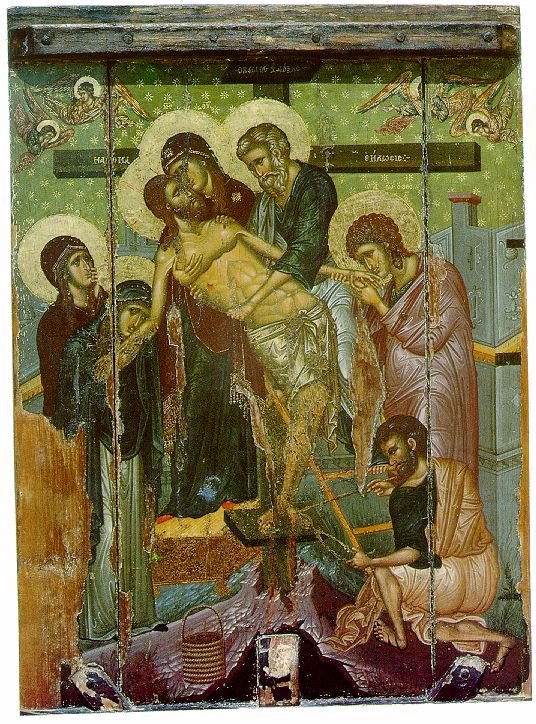
Byzantine art depicting Joseph of Arimathea and Nicodemus taking Christ’s body from the cross.

Beyond these misreadings, however, there were also further reimaginings of the nature of the Grail throughout its numerous literary treatments. For example it was at one point viewed as a book, written in blood by Jesus himself, kind of the ultimate Gospel written by the man himself. This interpretation appears to have been invented as the framing story of a thirteenth century French poem called the “Grand St. Graal,” in which Christ is said to have appeared to a hermit in the 7th century and given him the book, which contained the history of the Holy Grail, and making it clear that holding the book itself conferred the same effect as holding the Grail. Another reinvented version of the Grail comes from 13th-century German knight and epic poet Wolfram von Eschenbach, who in his work Parzival reveals the Grail to be a stone. In fact, when this is revealed, it seems more like a revelation of what the Grail holds, the thing which extends life, not the host here but a stone which can prolong youth and extend life, which is called lapsit exillis. This description of it as a stone that confers long life would, of course, cause alchemists to view von Eschenbach’s work as yet another coded hint regarding the Philosopher’s Stone, and it does make sense for alchemists to equate the Grail with the object of their perennial quest, which may be used to create an elixir of life. Indeed, they read von Eschenbach, and they suggested, much like the san graal/sang real misreading, that he must have written it incorrectly, because lapsit exillis means nothing in Latin. They will say that he must have meant lapis, which means stone, and that perhaps he meant the “stone of elixir,” or maybe lapis exilii, the stone of exile, or lapis ex celis, the stone from heaven, or even lapsavit ex celis, meaning “it fell from heaven.” This last view of von Eschenbach’s Grail stone has even led some to identify it with the Black Stone of the Ka’aba, thought to be a meteorite, about which I spoke in depth in my last patron exclusive minisode. The simple and disappointing truth of the matter, though, is that Wolfram von Eschenbach was, by his own admission, illiterate, his poems taken down by dictation. Likely he just made up a Latin-sounding term with no deeper meaning and most probably got the idea that the Grail contained a precious stone from a misunderstanding of Chrétien de Troyes, who described the Grail as made “of fine, pure gold; and in it were set precious stones of many kinds.” The truth that should be emerging here is that no one, not even the earliest of the poets who wrote about it, had a clear conception of what the Holy Grail should be, and so they just made stuff up.

Nevertheless, these disparate notions of the Holy Grail did eventually cohere, and the myth became so widespread and such a part of the medieval zeitgeist that real physical chalices began to crop up and be claimed as the genuine article. One is the Sacro Catino, or Sacred Basin, held at Genoa Cathedral. Another is the Holy Chalice of Valencia, an agate bowl mounted in such a way as it can be used as a chalice, which is kept at Valencia Cathedral. It is worth noting that the provenance of both of these relics cannot be confirmed to precede the grail romances, thus making it quite apparent that they were claimed to be the Holy Grail only after the literary tradition had become popular. This has not kept them from receiving some official recognition by popes, though, they have refrained from officially recognizing the relics as the actual cup of Christ. And there is even a contender in New York City, at the Met! The very fact that there are competing relics that only appeared after the birth of the legend goes to show that they are all most likely cases of pious fraud. The term pious fraud is used to refer to deception, such as the counterfeiting of miracles, meant to increase faith, with the idea that the ends justify the means, but in this context, we refer to the phenomenon of churches claiming to have sacred relics in order to bolster attendance and encourage pilgrimage for the principal purpose of boosting their earnings. Indeed, it appears that a chalice said to have been used by Christ at the Last Supper, along with a lance said to be the Holy Lance, was being displayed and drawing pilgrims from the British Isles to Palestine as far back as the 7th century, another possible origin for the legends, but likely also another case of pious fraud. I’ve spoken about this phenomenon before, most recently when I pointed out the any church that had possession of the actual Ark of the Covenant likely would not have kept it a secret, and more specifically when exploring objects such as the Veil of Veronica, the Guadalupe Tilma, and the Turin Shroud.

The Holy Chalice of Valencia

The legend or myth of the Holy Grail survives today not only in Italian and Spanish Cathedrals, but in fiction, in novels and films and television, and it has maintained the interest of readers and  viewers because of the inventions of conspiracy speculators who have further mythologized the Holy Grail as a secret kept hidden by shadowy secret societies, and especially the Knights Templar. As we saw with the Ark of the Covenant, the Knights Templar, or the Order of Solomon’s Temple, were a Catholic military order organized to protect pilgrims to the Holy Land during the Crusades, and they became a wealthy financial institution as well, forming a kind of proto-multinational banking system. In 1307, the order was suppressed by King Philip IV of France, who was indebted to them and leveraged rumors that they worshipped the devil in order to wipe them out and seize their wealth. The Knights Templar certainly kept a hoard of valuable items in their treasury, all of which was seized by the French crown, and the notion that they had acquired some religiously significant relics from the Holy Land seems believable enough, but history tells us that the treasure seized by King Philip was in part composed of coin, but was predominately in the form of land. Any valuable items that they held were being stored for clients, who deposited them with the order for safekeeping, since the knights could better protect them. Again, they were essentially a banking organization. There is no evidence that they dug up the Temple Mount and carried the Ark of the Covenant to France, and there is even less reason to believe that they had a real Holy Grail in their possession. First of all, we have no reason to believe that the Holy Grail actually existed, and if we think of it only as the cup used at the Last Supper, or the cup of vinegar and gall served to Christ on Golgotha, or simply as whatever early pious fraud was being displayed in Palestine as such a cup back in the 7th century, we have no reason to think it was kept at the Temple Mount by Muslims before Crusaders sacked it, or that it had been buried there centuries earlier, as is the legend of the Ark. But more than this, the timeline simply does not make sense. The very beginning of the idea of the Holy Grail began in the 1180s, when Chretien de Troyes wrote his poem, and the first concrete sense of the Grail as holy relic would not arrive until the First Continuation of his poem years later. Whereas the Templars were founded around 1120. If the Templars were indeed founded in order to protect the Holy Grail, as the legend would eventually claim, why was there no sense of this in the original lore? In the first Grail romances, it is protected by the Grail Family of the Fisher King, and when Robert de Boron fleshed out the myth in his 13th century adaptation, he has Joseph of Arimathea taking it out of the Holy Land long before the Templars ever existed. Thus, if we are to believe the Templars discovered it in Palestine, then we cannot believe the rest of the background about its relevance to the crucifixion story.

In fact, the first explicit connection of the Templars to the Grail legend seems not to have arisen until a hundred years or so after they were stamped out in France, in John Hardyng’s Chronicle, as he claimed that, when the fictitious Galahad learned the Grail secret and set out on Crusade to “achieve royal blood” and set himself up as a King in the Holy Land, he founded an order of knights, the order of the royal blood, based on Arthur’s Round Table, and the Templars, he said, were thereafter founded and modeled after them, and the Hospitallers after them in the same fashion. It was a clear attempt to draw some parallel between Catholic military orders and Arthur’s knights, and it probably doesn’t need to be said that Galahad and his order of the Holy Grail never really existed. This first explicit link between the Templars and the Grail is tenuous at best. Most conspiracists who are looking for a stronger link go back to the German poet Wolfram von Eschenbach, he who imagined the Grail to be a magical stone, for in his work Parzival, he mentions that, while the Grail was entrusted to a certain dynasty, it was kept at a certain temple, rather than in a castle as the previous romances had depicted, and he uses a certain word, templeise or templeisen, for the keepers of the Grail. It has been argued that Eschenbach actually meant Templar, but there is little reason to believe this. The Templars were not well-known in Germany at the time von Eschenbach was writing, and according to his description, there were women among these templeisen who took care of the Grail, which seems to make it quite clear that it wasn’t a fraternal order of knights he was describing. And it must be remembered that Wolfram von Eschenbach was illiterate, or at least said himself that he could neither read nor write. So like his faux-Latin term for the Grail, lapsit exillis, it seems likely that his templeise was just another nonce word, a fictional name for a fictional group, and Templar conspiracists have since read into it, seeing what they want to see. And that is an apt explanation of all the Grail lore, from the authors of the Continuations who imagined a more sacred nature of the Grail, to Robert de Boron who connected it to the apocryphal Gospel of Nicodemus, to Thomas Malory and John Hardyng who used Arthurian legend to reflect 15th-century English politics, and on from there, with, as we’ve discussed, ideas of German nationalism inspired by Wolfram von Eschenbach’s work and themes of spiritual and psychological significance found by New Agers and Jungian writers and conspiracy speculators assembling elaborate pseudohistories based on questionable readings of medieval poetry. In this way, the Quest for the Grail, as a quest for knowledge or understanding, is quite real, even if the secrets revealed at its conclusion may be, like the sources of the myth, more fantasy than fact.

*

Until next time, remember, it may seem silly that some have treated works of fiction like The Da Vinci Code as if they are reliable sources of accurate history, but we see that ancient works of fiction like the Grail romances have long been mistakenly treated like historical records, resulting today supposed non-fiction works of pseudohistory like The Spear of Destiny and The Holy Blood and the Holy Grail, which inspire movies like the Indiana Jones films and novels like The Da Vinci Code. It’s all simply part of the mythologizing of our past, and you have to look past the adventure stories and deeper into history to see through it.

 Further Reading

Barber, Richard. The Holy Grail: Imagination and Belief. Harvard University Press, 2005.

Callahan, Tim. “Holy Relics, Holy Places, Wholly Fiction.” Skeptic, 13 Sep. 2022, https://www.skeptic.com/reading_room/holy-relics-holy-places-wholly-fiction/

Goodrich, Norma Lorre. The Holy Grail. HarperCollins, 1992. https://archive.org/details/isbn_9780060922047/mode/2up

Nickell, Joe. Relics of the Christ. University of Kentucky Press, 2007.

The Hidden Ones: Sect of Assassins

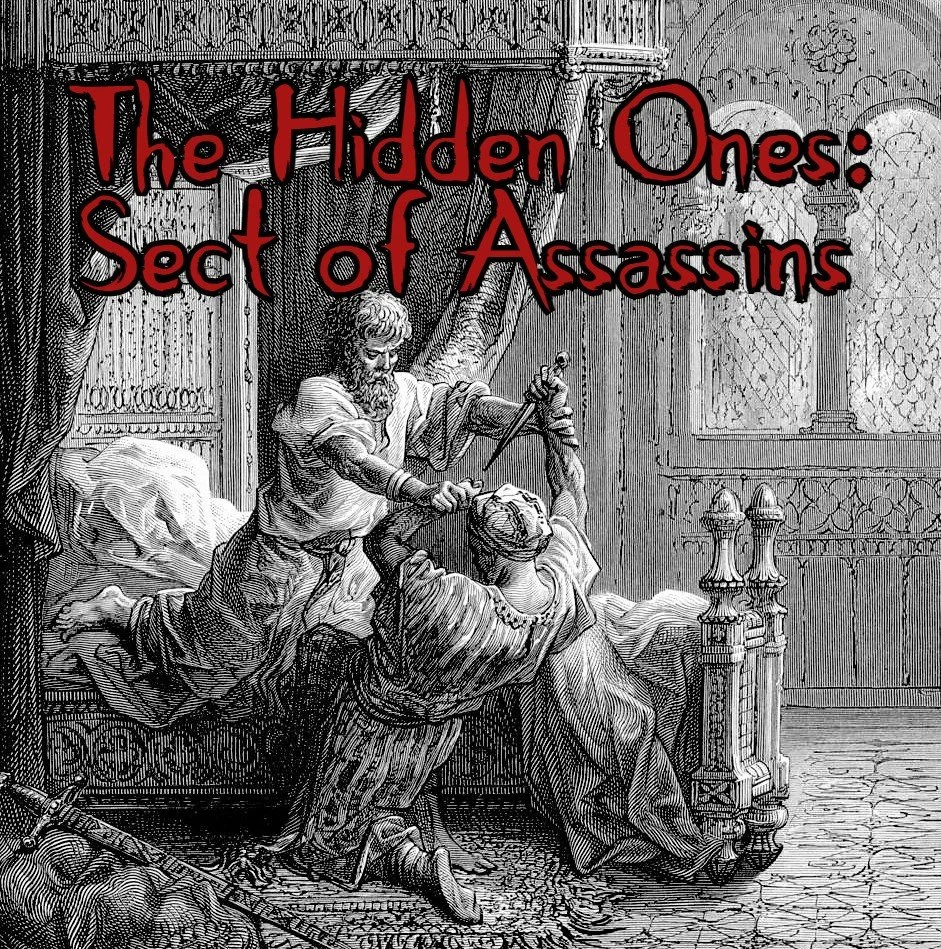
In the Middle Ages, contact between Islamic cultures and Europe introduced many new things to the West.  Along with luxury goods that were acquired, so too new words were brought to Europe, words such as crimson, saffron, jasmine, taffeta, and musk. Comfortable new styles of silken garb were imported, as was the word for them, pyjamas. And new sweets were discovered, along with the word candy. Alongside such commodities, tales were also imported to the West through this commerce. One of the first Europeans to travel the Silk Road, that superhighway of commercial and cultural intercourse, was Marco Polo, an Italian merchant and also a spinner of fanciful tales. One tale he told was of a certain group of Muslims who followed a mysterious old man, whom he said had created a veritable paradise on earth, a bountiful garden into which he had channeled canals that carried not only flowing water, but wine, and milk, and honey. According to Polo, the Old Man of the Mountain commanded the absolute loyalty of his subjects, who truly believed that they resided in paradise on Earth. And when the Old Man wanted something done about an enemy of his, he plied some youthful follower with a drug that caused them to sleep, at which point he would take the youth out of his paradise. Upon waking, the youth believed he had been ejected from heaven and was told that in order to obtain reentry, he would have to do the Old Man’s bidding, to kill his enemy. Thus, Polo explained, the Old Man drugged and manipulated his disciples and transformed them into his personal legion of murderers. This tale illustrated the growing lore surrounding a distinct group of Muslims whom Europeans had encountered throughout the Crusades, when members of this Order began killing or attempting to kill European Crusaders at their Grandmaster’s command. Europeans quickly learned to fear their daggers, just as the Order’s other enemies in the region long had, and a black legend was developed. These were fanatics, it was said, who kept their secret conclaves in impregnable castles. They were deluded, it was believed, by a heretic cult leader and kept mad with intoxication on hashish. This was the origin of their name, the hashishin, it was claimed, and thus another word entered our lexicon, derived from this word: assassin, a noun, but soon a verb as well, assassinate, to murder suddenly, using subterfuge or surprise, for religious or political reasons. This Order of Assassins was no fairy tale, as some of Marco Polo’s stories were, and they had long been quite successful in destabilizing and defeating their enemies purely through assassination. Many were the military commanders, viziers, emirs, Imams who fell beneath their blades. Among the most famous of those was Conrad of Montferrat, the Crusader King of Jerusalem. It is difficult to always be certain whether an assassination was carried out by them or perhaps by others, and this was actually one of the benefits of their assassinations, that they destabilized by creating paranoia and confusion, but among the rumored and real assassination plots attributed to them were attempts on the lives of a Mongol Khan; multiple efforts to kill Saladin, the sultan who spearheaded the Counter-Crusade, and even a failed attempt on the life of Edward Longshanks, Hammer of the Scots and future King of England, during the Ninth Crusade, called Lord Edward’s Crusade. Real though the Assassins were, though, that does not mean they weren’t surrounded by myths and misconceptions.

*

The reason I was drawn to discuss this topic directly after my post on the Thuggee should, I think, be quite obvious. It’s nothing to do with the era or the locale or the culture, as the strangler bandits of 18th and 19th century India have none of this in common with the 11th century Arab Muslim Order of Assassins active in Persia, Syria, and elsewhere for a few hundred years. Rather, I see a connection of theme. While the Thugs were not the organized, hierarchical religious cult that they were made out to be and the Assassins were followers of a specific creed who devoted themselves entirely to accomplishing the goals of their Imam, both were secretive brotherhoods among whom were members specially tasked with murder of a most intimate and gruesome sort. The names of both have entered the lexicon to represent those who commit similar crimes. And both became the storied boogeymen of European imaginations during the eras in which they were active. Indeed, it is the fact that Assassins have been so mythologized in fiction that they have become enshrouded in multiple layers of false history, much like Thuggee. The modern imagination has been quite drawn to the Order of Assassins, as they have appeared in numerous novels, by those of such vastly different talents as Umberto Eco and Dan Brown. They were the inspiration for the League of Assassins led by Batman’s nemesis Ra's al Ghul in DC comics, and they were the basis of the Faceless Men in George R. R. Martin’s unfinished A Song of Ice and Fire book series… that’s the assassin’s guild that little Arya Stark joins, as also depicted in the television series Game of Thrones. But the most in-depth treatment of the Order of Assassins in modern fiction, the reason it is so well-known today, and the source of the most creative fabrications about the group is the Assassin’s Creed video game franchise, from which I took the name of this episode. I’ll be the first to say I’ve enjoyed these games, and being a fan of historical fiction, I appreciate how they weave in real historical figures and events into their storylines. But if one were to confuse the story presented in these games as real history, one would believe that the Assassins were actually heroes fighting for freedom against the proto-Fascistic Knights Templar, and that actually both groups were, in fact, evolutions of even older secret societies going back to ancient Egypt, and that these groups were vying for control of ancient artifacts that contained the advanced technology of a long extinct species that was a pre-cursor to humanity. It’s a cool story, obviously science fiction/fantasy, not something to debunk but to enjoy. However, as it weaves in such myths as the existence of Atlantis and such mythical figures as Hermes Trismegistus, it might easily confuse someone as to what might be real, historically, and what false. But this question could have been asked about the Assassins long before the elaborate mythmaking of modern entertainment featuring them, as they were mythologized even from the beginning.

Marco Polo, mythologizer of the East.

A cursory understanding of the Muslim world and the conflicts within it must be achieved before anyone can really understand the origins of the Order of Assassins. I say cursory because this is a topic far too expansive and complicated to possibly do justice in one brief segment of one standalone podcast episode. So we will look, in admittedly broad strokes, at the background of the rise of the Assassins because we need the context. After all, the Black Legend of the Assassins propagated by Europeans purposely ignores the actual religious context of the sect and their beliefs. Before the Crusades, this could be explained by ignorance, but after the Crusades, when Europeans came to better understand the complex religious fabric of Islamic society, they then purposely ignored the distinctions between one sect or denomination and another, choosing to portray them all as godless infidels who worship an anti-Christ. This contributed greatly to the spread of myths about the Assassins, and we don’t want to be like Crusaders in this regard. We must first understand that the Prophet Muhammad unified the Arab world under the Islamic faith and also established a social and political order characterized by multiculturalism, religious freedom, and social justice, as represented in the Constitution of Medina. But we must further understand that, since his death, the Islamic world and faith had been long troubled by disunion and schism. Much of this had to do with disagreements over succession, as it was believed by many that the next ruler should be of Muhammad’s lineage, specifically his cousin and son-in-law, Ali, but instead the mantle of caliph passed to his father-in-law, Abu Bakr. This essentially political faction supporting Ali for the job, Shīʿatu ʿAlī, or “followers of Ali,” transformed through the years to become a doctrinal branch of Islam, Shīʿa or Shīʿism, the Shīʿite view being that Ali had been designated to succeed Muhammad as caliph and Imam, and that only those descended from Ali were divinely ordained to lead. Ali did eventually take up the role as leader, but this did not put an end to the internecine strife. A new Caliphate was established by the Umayyad clan in resistance to Ali’s sovereignty. The Umayyad Caliphate lasted about a hundred years before another revolution, led by the Shīʿite Abbasid clan toppled them and established a third Caliphate. Throughout these conflicts, the schism of Islam became more and more concrete, with Shīʿism on one side and Sunnism, a more orthodox camp who rejected the notion that Muhammad ever intended to establish a blood dynasty, on the other. But even within the Shīʿa branch of Islam, there was much diversity of belief and much disagreement, and it was from among these denominations that the Assassins would rise.

Many of the doctrinal disputes within Shīʿa Islam had to do, yet again, with the legitimacy of the succession of Imams. This was not only about Earthly power and legitimacy; it was about prophecy. During the Abbasid Caliphate, a number of secret religious societies appeared, and with them the notion of esoteric knowledge being present in the Quran. It was believed that the Islamic scriptures carried some secret, hidden messages, that only the true, divinely ordained Imam and his initiates could discern. Among the secrets of the Quran interpreted was the idea that there would only be twelve divinely ordained Imams, and the twelfth would be hidden away and mystically preserved, in Occultation, it is called, until such time as he returns, a messianic figure called the Mahdi, whose appearance will signal the end times. This remains the belief of Twelver Shīʿites to this day, and belief in the return of an Imam as the Mahdi has become a common feature of Shīʿa Islam generally. However, some other subsects have differed regarding the succession of Imams and the number of Imams. The second largest branch of Shīʿa Islam, after the Twelvers, believe that when the Imam Shīʿites recognized as the sixth true Imam died and passed the Imamate to the son recognized by Twelvers as the seventh Imam, it should have and indeed did actually pass to his eldest son, Isma'il ibn Jafar. The Isma’ili Shīʿa believe he was the true inheritor because of his great understanding of the hidden meaning of texts, and that he did not actually die, as was claimed, but rather was hidden away from the Abbasids. The fact that he was missing, presumed dead or in hiding, led some Isma’ili to believe that he was actually the last Imam, waiting in Occultation to return as the Mahdi, and they became known as the Seveners, as Isma’il was considered the seventh Imam. Whether proponents of Isma’il as simply the seventh Imam or as the last Imam and the coming Mahdi, Isma’ilism spread across the Islamic world through aggressive proselytizing. In the tenth century, an Arab dynasty called the Fatimids, who traced their lineage back to Ali and Muhammad’s daughter Fatima and were recognized as legitimate Imams by some Isma’ilis, began to wrest control of the Mediterranean coast of Africa and Western Asia from the Abbasids. The Fatimid Caliphate saw a further schism early in the 11th century, when upon the death of one Imam, the son whom he had publicly named as his successor, Nizar was thereafter prevented from succeeding to the Fatimid throne in Egypt as the next Caliph-Imam by a dictatorial coup. Thus the Nizari Isma’ilis were born. Nizar was later taken captive in battle against his usurper and executed, but one of his most devoted lieutenants, Hassan-i Sabbah, who had captured and made impregnable a castle called Alamut in the mountains of northern Persia, took Nizar’s son, whom the Nizari Isma’ili then considered the true Imam, under his protection and established a Persian Nizari Isma’ili state. Hassan-I Sabbah was the original Old Man of the Mountain who would enter legend centuries later, and his Nizari Isma’ili, a state with no army and many enemies, were the sect of Islam that would become known to the world as Assassins.

19th century engraving of Hassan-I Sabbah

The coup against Nizar in Egypt had been engineered by the commander of the armies there, and this has been seen as one of the principal reasons that Hassan-I Sabbah never gathered an army to the Nizari Isma’ili cause. Instead, he developed a three-pronged approach to war, the first being fortification. As Alamut Castle proved to be a safe refuge, he undertook to capture other castles and thereby expand his Imam’s territories without armed conflict. This he managed through the second prong of his approach, infiltration. There are numerous stories of the way that Hassan-I Sabbah captured Alamut. One is that he converted the owner to his creed, and another that he simply snuck so many of his men in that, slowly but surely and unnoticed by its current occupants, he was taking possession right under their noses. Such stories are impossible to credit with any certainty, but considering the kinds of stealth and subterfuge he would go on to utilize, such tactics must have been among his favorites. And his final approach to war was tactical murder, or what would be called today assassination. Hassan-I Sabbah did indeed train killers and send them out with daggers, directing them to use guile and disguise to get close enough to their targets to end their lives. And these agents did indeed expect to die in the completion of their tasks, and were indeed promised rewards in paradise upon their deaths. The policy itself, of effecting political and social change through strategic killings, can be seen to have evolved rather organically out of Islamic teachings and recent history. Passages in the Quran were long interpreted as approving of regicide in extreme cases, when leaders were wicked. And Hassan-I Sabbah was not the inventor of political murder. Indeed, of the first four Caliphs after Muhammad, the Rashidun Caliphs, three of them, including Ali, were assassinated. Hassan-I Sabbah was just the first to place such importance on assassination as opposed to field warfare, to strike terror into enemies who would gladly risk their lives in battle but feared an ignoble death in their homes. Hassan-I Sabbah did not invent assassination, but he perfected it.

Since I use the word terror to describe the effect that Hassan-I Sabbah’s tactics had on his enemies, I should address a certain analogy that has been made in modern times, likening his Order of Assassins to terrorists. The Assassins of Nizari Isma’ilism have not only been likened to Islamic terrorists, but also terrorists of the IRA, or Kamikaze bombers. Like the IRA, the Assassins relied on a constant threat of sudden violence to intimidate, and like the kamikaze, Assassins were fully expected and in fact intended to die in completion of their missions. But of course, the comparison to modern-day Islamic terrorists is the most obvious, being that they share cultural and religious backgrounds. There are other commonalities as well, in that, like the Assassins, suicide bombers intend to sacrifice their lives to get close enough to their enemy that they might inflict harm, again to intimidate and terrorize. Like the Assassins, they rely on this approach to warfare against militarily superior enemies, and they believe they will be rewarded in paradise for their acts of violence against those they see as the enemies of their faith. Like I said, the similarities seem obvious, even apt, but on closer consideration, the Nizari Isma’ili Assassins are far different, in both motivation and practice. First, as we have said, their choice to rely on assassination was part of a conscious refusal to gather armies and engage in traditional warfare, not resorted to because of military inferiority. And second, the Assassins used assassination out of a kind of chivalry that was borne out of Arabian culture. Even long before the rise of Islam, single combat was preferred to the destruction of war. “Pure” warfare, in the Arabian sense, avoided any unnecessary loss of life, and strictly prohibited the killing of women and children or the elderly. The Assassins were never known to target such vulnerable or innocent people, and in avoiding actual battlefield engagements, the Assassins were returning to the Arabian roots of pure warfare, eliminating leaders in a kind of forced single combat and thus saving the lives of the rank and file. This character of the Assassins’ tactics cannot be further from the reality of Islamic terrorism, which is all too accepting of collateral damage.

16th century depiction of the capture of the Assassin fortress of Alamut

One of the principal misunderstandings about the Assassins deriving from the myths surrounding them has to do with the group’s name. There was for a very long time a robust debate about the etymology of the word “assassin,” with numerous theories put forth to explain where the word came from. The word entered European languages via the Latin, assasinus, but it was long unclear where it had come from before that. One theory is that it was a corruption of the Arabic word for the weapon that Assassins chose as their sole means of killing, sikkin, or dagger. Another theory was that it was an application of the Arabic word for a night watch, asas. Others said it came from the ancient Persian word shahanshah, meaning “king of kings” in reference to their leader. Perhaps the most convincing is that the term was derived from the name of their first leader, Hassan-I Sabbah, such that the word is a corruption of the Persian hasaniyyun, or “followers of Hasan.” However, the truth of the matter was not figured out until the 18th century, by Baron Silvestre de Sacy, who in his study of Isma’ilis determined that the term was derived from the name of the drug they were said to use: hashish. Thus they were called the Hashishiyyun, or hashashun, literally “hashish-eater,” and the word simply evolved from there as it was taken into other languages. The fact of this etymology has done much to perpetuate the myth of the Nizari Ismai’ili Assassins as drugged stooges, as portrayed by Marco Polo and others. In fact, the use of hashish and other powerful narcotics, like opium, was widespread in Islamic society throughout the Middle Ages. But the truth is that this was a total misnomer. Crusaders and other Europeans heard the term being used not by the Nizari Isma’ili to describe themselves, but by the enemies of the Nizari Isma’ili. They read the term in anti-Isma’ili polemics written by Sunnis who despised the Nizari Isma’ili, not only for their success in converting Muslims to their creed, but also because they lumped all Isma’ili in together, whether Nizari or Sevener. Indeed there was one particularly militant subsect of Sevener Isma’ili, completely distinct from Hassan-I Sabbah’s Nizaris, called the Qarmatians, who in 930 CE sacked both Medina and Mecca, and who were hated for desecrating some holy sites and artifacts. Specifically, they are said to have dumped corpses into the Zamzam Well, which was said to have miraculously produced water during the time of Abraham, and they stole and held for ransom the Black Stone, a relic, thought to be a meteorite, that is said to have fallen from heaven to mark the place where Adam and Eve should build the first earthly temple. So Sunni writers generalized all Isma’ili as heretics bent on destroying Islam, and they used the term Hashishiyyun not literally, but rather to indicate that they were men of low social status and weak moral character. So we find that the word “assassin,” as a name for this sect, had nothing to do with the drugs and everything to do with an ad hominem attack on the sect. In fact, among the Nizari Isma’ili, only a select few were ever tasked with committing assassinations, and they called themselves fidai, meaning “devotee.”

So we see that the Black Legend of the Assassins was nothing but mythmaking all along. Even if we were to reject the evidence that Sunni polemics called Nizari Isma’ili “hashish-eaters” only metaphorically, logic tells us that any such accusation must have been a lie. The Nizari Isma’ili were highly disciplined and sober. The clearest evidence of their strict sobriety is that Hasan-I Sabbah is known to have actually executed his own son for drinking wine! Moreover, the fidai tasked with assassinations could not have been drugged-out pawns. Their role required a great deal of education, learning several languages so that they could infiltrate different cultural communities. And they had to be quick-witted, resourceful, and adaptable in order to get close to their targets. Indeed, there were some cases in which fidai insinuated themselves into the inner circle of their targets and posed as their closest advisors and friends for long periods of time before suddenly producing a dagger and revealing themselves to have been assassins all along. It is simply not credible that they were also abusing hashish the whole time. Some may hear hashish and think, “That’s not so powerful or harmful of a narcotic. It’s just cannabis.” But smoking a little hash today is quite different that eating hash back then. There is a 19th-century book called the Hasheesh Eater by Fitz High Ludlow in which he described his hallucinatory trips, ingesting higher and higher quantities of the drug, until, as he described it: “time [and] space expanded… The whole atmosphere seemed ductile, and spun endlessly out into great spaces surrounding me on every side.” All this to say, hashish eating would cause one to have an intense psychedelic trip, one that would certainly prevent anyone from competently disguising themselves and convincingly posing as someone else in order to get near a heavily guarded target. Like opium eating, it was more likely to cause someone to lie down than to leap into action. Anyone who has ever taken too many edibles knows exactly what I mean. So in the end we owe the legend of the Assassins to the ignorance of the Crusaders. The myth repeated by Marco Polo, of the Old Man of the Mountain and his earthly Paradise, reentry into which was promised in exchange for committing assassinations, would have been seen as obvious fiction if anyone spreading it had actually visited Alamut castle, the headquarters of the sect, which was no paradise flowing with milk and honey. And other such myths, such as that the Assassins were chosen as children, kept in isolation and manipulated their whole life, or that they would gladly leap to their deaths for no reason other than the simple command of the Old Man of the Mountain, could also have been easily dismissed if any European studying them had relied on written records other than those composed by the enemies of the Nizari Isma’ili. The problem was, the Nizari did not leave their own records behind. In 1256 CE, the Mongols massacred them, razing their castles, and burning their libraries. As a result, the Black Legend that their enemies had created about them would be accepted as truth for 700 years. And even today, with a new Assassin’s Creed video game releasing later this summer, the Assassins—if we want to still call them by that term, which they would have found offensive—live on in memory only through fantasy. 

*

Until next time, think about this: they say that history is written by the victors, but rather, I’ve found that it’s actually myth that they leave behind, and historians are able to set the record straight.

Further Reading

Daftary, Farhad. The Assassin Legends: Myths of the Isma’ilis. I.B. Taurus & Co., 2001.

Hodgson, Marshall G.S. The Secret Order of Assassins: The Struggle of the Early Nizârî Ismâî'lîs Against the Islamic World. University of Pennsylvania Press, 2005.

Waterson, James. The Ismaili Assassins: A History of Medieval Murder. Frontline Books, 2008.

The Myth of the Thuggee Cult

In American culture, the meaning of the term “thug” varies depending on your background and the cultural context. By its modern dictionary definition, the word refers to violent criminals, or some kind of vicious ruffian, but among many who identify with urban street life and Black hip-hop culture, the term has taken on a different meaning, reflecting the idea that systemic racism creates gang culture. This use of the term was championed by rapper Tupac Shakur, who touted a “Thug Life” as a kind of determined response to the setbacks and obstacles that the disadvantaged face. For Tupac, “Thug” was an acronym deriving from “The Hate U Give,” referring to the idea that so-called thugs are created by hate and inequality, and that their very existence is an inspiring show of resilience in the face of great adversity. Interestingly, the word “Thug” entered the English language from Hindi, where likewise it referred to a subculture of violent criminals viewed as a savage threat by English colonizers but viewed quite differently in many Indian villages. The Thug, those who perpetrated a class of crime called Thuggee, would become legendary, not just in India where, during the end of the 18th century and the beginning of the 19th, their crimes were perpetrated, but across the Western world, where the word Thug could hardly be spoken without a shudder. The crimes of the Thuggee became well-known after English authorities in India undertook the task of wiping them out, when the world learned that they were not just bands of highway robbers, but actually a murderous sect that put to death every person they robbed, leaving none behind to witness against them, not even women or children. More than just ragtag gangs of bandits, they were an organized conspiracy that acted as one, it was said, controlled by some central authority. And not just thieves with a bloodlust, they were a cult, it was claimed, devoted to Kali, the goddess of destruction. It was explained that they strangled all their victims so as not to spill their blood but would afterward mutilate their corpses in their evil sacrificial rituals. On the lawless roads of India, it was said that Thuggee claimed the lives of 40,000 innocent travelers every year, until the 1830s, when British authorities began to stamp them out. But even after their suppression, the Thugs of India would loom large over European and American imaginations. They became the fabled villains of many  a work of fiction, and their name entered the lexicon, such that even today we talk about “thuggery” as a class of criminal behavior. And just as today hip-hop culture suggests that thugs are misunderstood or misrepresented, so too revisionist historians have looked skeptically back on the idea of Thuggee in India and suggested that it may have been a colonial construction, an exaggeration or misrepresentation exploited by colonizers to seize greater control of India. This revisionist view even goes so far as to suggest, in some arguments, that Thugs did not really exist, that Thuggee was only ever a lie promoted by the British.

*

I am once again exploring a topic from the Indiana Jones film franchise in my quest to immerse myself in the real history and folklore behind the films ahead of what is likely the last film in the series this summer. When it comes to Indiana Jones and the Temple of Doom, the sequel to the 1981 film Raiders of the Lost Ark, which is actually a prequel, the macguffin itself, the Sankara Stones, are rather light on actual historical background, and at first I didn’t think I would make a full episode having to do with Temple of Doom, beyond perhaps a patron exclusive minisode. But that was before I started looking into depictions of India and Indian culture in the film. I was inspired to take a second look at the film because my wife, who is Indian by way of Fiji, has spoken more than once about how this film, which incidentally she loves, caused her some grief growing up in California because of its totally incorrect depiction of Indian culture. Specifically, she says that other kids would ask her if, because she is Indian, she eats monkey brains. This of course refers to the famous dinner scene in which Indy and his companions are disgusted by a dinner of live snakes and beetles, soup floating with eyeballs, and chilled monkey brains eaten directly out of the skull for dessert. Obviously the scene serves only as comic relief in the film, but a 2001 study conducted by the University of Texas does indicate that, as my wife experienced, a majority of Americans believed it to be an accurate portrayal of Indian cuisine. In fact, there is no historical evidence of such foods being eaten in India. Nor was my wife the only Indian to be troubled by this depiction, as the film was initially banned in India because of its misrepresentation of Indian culture, specifically because of the dinner scene. But as I looked further into the cultural representation in the film, a much larger problem revealed itself: that of the Thuggee cultists who served as the film’s villains. As indicated, there is historical debate over the very existence of such a group. I struggled a bit to access the research materials I needed to make this episode, but I was helped out by friend of the show Mike Dash, whose work on such topics as the missing lighthouse keepers of Eilean Mor, the Devil’s Footprints, and Spring-Heeled Jack I have relied on before, and whom I interviewed for the podcast some years ago. Mike Dash wrote an exhaustively researched book on this topic, Thug: the True Story of India’s Murderous Cult, and when I couldn’t get a copy in time, he generously sent me the galleys of the book. I really recommend listeners interested in this topic check it out for themselves. It is a fascinating read, and that is why it’s somewhat unsurprising that Steven Spielberg and George Lucas chose to feature the Thugs of India as the bogeymen of Indy’s second outing: they are and have long been a fascinating and terror-inducing group. Ever since the early 19th-century novel about them, Confessions of a Thug, appeared in 1839, they became a mainstay villain of literature. They appeared in the popular French novel, The Wandering Jew, and Sir Arthur Conan Doyle, creator of Sherlock Holmes, even featured them in a story. Most notably, a series of swashbuckling stories by Italian novelist Emilio Salgari cemented them as apt villains for an adventure tale. Into the 20th century, they continued to crop up in novels and were featured in numerous films, including the 1939 adventure film Gunga Din, in which characters discovered that the Thugee cult was still active even long after its supposed suppression. It is this film that appears to have inspired their use as villains in Temple of Doom, but really, if the filmmakers were looking for a villain in India as iconic as the Nazis in Europe, then Thugs were the obvious choice. But to what degree were the filmmakers, knowingly or unknowingly, perpetuating a historical myth?

The poster for Gunga Din

First, we must understand the context in which a Thuggee cult supposedly operated, which means a few words about India and the establishment of British imperial interests there. Before the rise of British power in India, the last great dynasty was that of the Mughals, Muslim rulers who built an empire of such wealth and grandeur that it grew to be too much for lesser rulers to handle. The last of the great Mughal emperors was Aurangzeb, and after his passing in 1707, the Mughal Empire disintegrated into a patchwork of rival princedoms, with the governors of rich provinces ruling as independent monarchs, paying only lip service to later Mughal emperors. This chaotic state of affairs was further complicated by the conquests of bellicose Hindu tribes from Central India called Marathas who began seizing territories for themselves. At this time, the merchants of the British East India Company, who had established themselves over the preceding centuries as buyers of spices and other goods and had establishecd a network of warehouses and forts across India, began to view all these recent civil wars as bad for business. With muskets and artillery at their command, they realized they could subdue the subcontinent and improve their bottom line, which they set about doing, taking possession of city after city and establishing themselves as an imperial power. In 1784, parliament passed the India Act, placing company directors under government supervision, and thereby nationalizing the entire colonial venture. Thus the British came to rule numerous cities and regions of India, collecting taxes and charging exorbitant rents of area villagers and essentially monetizing the populace. It was in one such town in northern India, Etawah, about 300 kilometers southeast of Delhi, that the British first caught wind of the dreaded Thug menace. Thomas Perry, a British Magistrate struggling to bring order to the lawless area, began to receive reports of corpses being discovered in wells and roadside pits. It was a mystery that he seemed unable to solve. He knew that there were highway robbers in the area, as there were on the roads throughout India, but this was unprecedented. These murderers seemed to be mutilating and hiding corpses, and leaving no one alive, for no witnesses could ever be found, and the bodies themselves, assumed to be those of travelers, could not be identified locally. The horrifying conclusion was that some band of prolific killers resided nearby, or even among them.

Perry and other British, as well as the Indian people they had essentially conquered, were perfectly familiar with the threat of banditry. As Mike Dash points out in his book, some of the earliest of Indian texts, such as the Sanskrit hymns the Vedas, which are some 3000 years old at least, portray a certain Hindu deity, Rudra, as the lord of all highway robbers. And in one of the first accounts written by a foreign visitor to India, that of the 7th-century Buddhist monk Xuanzang, we see a traveler nearly being killed by pirates who haunt the rivers. British merchants reported in the 1600s that they could not travel with their goods on the roads without a large contingent of armed men because the country was “so full of outlaws and thieves that a man cannot stir out of doors without great forces.” The kinds of highwaymen that they were accustomed to, however, did not murder entire parties and hide the bodies like this. There were, though, organized bands of thieves who would not shrink from murder called dacoits. These gangs of robbers typically attacked their victims in town, however. They would target a rich man and fall upon his house without warning, invading his home and terrorizing all the residents and servants within. Indeed, dacoits were active in the area around Etawah, and an increase in banditry could be blamed on the British themselves. There was a region nearby, the Chambal, a maze of ravines that was difficult to navigate unless you were native to the area, and the men of the Chambal had long worked as soldiers for hire because the land of the Chambal did not support much agriculture. With the coming of East India Company, though, who refused to hire them as mercenary soldiers, they had little choice but to turn to highway robbery and to join dacoit gangs to support their families. But like most highwaymen, these dacoits did not typically set out to murder. They used fear, and when they were forced to attack those who did not cooperate with their robbery, they aimed to injure rather than kill. Indeed, dacoity was considered an honest profession by many, as dacoits served as a kind of informal militia for some villages, and they tended to rob the rich and share with the poor. As Thomas Perry looked into the murders occurring in his territory, he was quite certain that they were not being committed by run-of-the-mill highwaymen or dacoit gangs. And eventually, he confirmed this conviction when some of the murderers were arrested and confessed, identifying themselves not as dacoits but as Thugs. 

A family of dacoits

Through Perry’s investigation and the confession of captured Thugs, as well as through the numerous East India Company records of later prosecutions, we can know a great deal about the practices of the Thugs. Unlike dacoits or other highway robbers, they worked in absolute secrecy. As already established, they left no one alive to witness against them, but they did not fall on their prey like a raiding party. Rather, they insinuated themselves, just a few at a time, into the travelling parties they targeted, convincing their marks that they were friendly and trustworthy fellow travelers and that it would be best for them to travel together to reduce the chances of highway robbery. This is one part of the horrific practices of the Thug, that they befriended and traveled with their victims, sometimes for days and weeks, always intending to murder them all when they could steer them toward an out-of-the-way location, at which time the rest of their band, which might be trailing behind on the road or even riding in advance, would converge to share the spoils. First, however, came their other horrible practice, the murder itself. Thuggee bands distinguished themselves again from other bandits in the methods of their violence, which were equally as intimate as their inveigling of targets: they strangled their victims to death. There were men among them whose specific job it was to do the strangling, cold-blooded killers who sometimes used nooses or special garrotes, but as these could easily identify a strangler, most instead began using scarves with a knot tied in it that could be used to mercilessly tighten it around a victims throat with a twist. Some wrapped a coin in their scarves that proved effective at crushing windpipes. These stranglers were callous executioners, murdering entire retinues and convoys full of people, whole families, men, women, and children, though sometimes a child would be kept alive and raised to become a Thug themselves. Strangely, they did not shrink from stabbing and cutting open their victims before burying them, but they only did this after they had strangled them to death, and this practice would be the cause of some myths about Thuggee, as will be seen. But the Thuggee were already, even among themselves, it seems, surrounded by myth. It became clear during the earliest investigations that Thuggee gangs had been operating beneath the nose of the East India Company for many years without their even being aware of the group’s existence. According to the oral traditions of the Thugs themselves, given under interrogation in later campaigns against them when many turned King’s evidence against their fellows, Thuggee tribes had existed since great antiquity, all the way back to the time of Alexander the Great, and they claimed to be descended from Muslim families of a high caste. However, the word “thug” does not appear to have been used to refer to murderers before the 1600s, and other traditions trace Thug tribes to 16th-century Delhi, when a clan was exiled by the Mughal Emperor for killing one of his slaves. Other ideas were that the practice of Thuggee started among destitute Mughal army soldiers, or among poor herdsmen driving cattle on the roads. In short, Thugs did not themselves agree on the origin of their way of life, but some of their boasts about their ancient heritage, and some of the consistent practices among even distant bands, such as their secret communication by coded phrases and signs, and their very particular murder rituals, fed into later claims that they were an ancient secret society, a murderous cult operating as one, its crimes coordinated by some sinister overseer.

The first of the campaigns against Thuggee gangs began in the Chambal ravine country, as British forces commanded by Magistrate Perry’s assistant followed some leads to that area, where they ended up being first poisoned by local villagers and then ambushed by Thugs in the ravines. Concerned about an all-out rebellion against their government, the British returned with artillery and leveled the Thug stronghold in the area. For several years, then, the British approach to Thugs was just to pursue them if they plied their grisly trade too close to British-controlled towns and cities. This seemed amenable to Thugs, who were travelers by nature and simply began murdering farther afield, on roads where it was safe to operate without rousing the ire of the British. However, the view of the threat they posed changed over the next several years as British citizens more and more became the victims of these highway killers, and as Thugs chose to target many soldiers-for-hire who had sold their service to the British, not so much because of who they served as because they were a perfect target when they took their leave and traveled home with all their back pay on their person. And when the Thugs began robbing the treasure parties of powerful Indian bankers, all tides finally turned against them. British Company men began pursuing and trying Thugs regardless of where they were operating, and one officer, William Sleeman, an ambitious man, saw in the hunt for Thugs the cause of a lifetime. He felt strongly about the evil of Thuggee and believed wiping them out entirely would be a boon to the Indian people, but he also saw that he could make a name for himself doing it and earn a comfortable political position. He threw himself into the campaign with religious fervor, greatly relying on a tactic he had seen was working elsewhere, that of turning captured Thugs into informers, or what were called “approvers.” This was somewhat necessary, since by the very nature of their crimes, Thugs did not leave witnesses alive. By promising that Thugs who turned King’s evidence could keep their lives, he found many eager to cooperate in identifying other Thugs. As he developed his tactics in 1829 and 1830, Sleeman jailed hundreds of alleged Thugs, but his suppression of Thuggee did not kick into high gear until he pursued and captured an influential young Thug leader named Feringeea, who had been raised a Thug and knew everything about how they worked. With Feringeea as his principal approver, Sleeman was able to identify and arrest more than 700 Thugs in 1831 and 1832, and more than that, Feringeea was able to predict the movements of Thug gangs like no other informant before him. By the mid-1830s, with Feringeea’s help, Sleeman had produced charts marking known Thug routes as well as their favorite places to dump bodies. And more than that, he had mapped the homes of all identified Thugs and, believing based on the confessions of Feringeea and other approvers that Thuggee was a hereditary profession, he compiled genealogies in order to identify and arrest Thugs simply for familial association. We begin to see here the potential for egregious miscarriages of justice.

An 1857 drawing in the Illustrated London News depicting Thugs and other classes of Indian criminals

It is easy to take the side of the British in this story, as on the surface, they are pursuing and bringing to justice bands of brutal murderers. But of course, we should also look at the entire imperial presence of the British in India as morally and philosophically wrong, and thus any law enforcement campaign of theirs, administered as it was on their unwilling subjects, as being inherently unethical. And that is the lure of historical revisionist views of the Thuggee, some of which deny Thuggee’s existence altogether and see it as a kind of witch hunt used as an excuse by the British to brutally crack down on those they had imperially dominated. From a postcolonial view, it is a tempting position to take, and it certainly illustrates well the true evils of imperialism. Indeed, revisionist historians are not even the originators of this view, as in the beginning of anti-Thug campaigns, even many British in India were skeptical, finding it hard to believe that such a mighty evil as Thuggee could possibly have been at work right beneath their noses for years without them knowing it. And just as historical revisionists focus on Sleeman’s reliance on the testimony of approvers, approver testimony was viewed as unreliable hearsay by many even at the time, and in the beginning, Thugs were usually acquitted simply because they categorically denied what approvers said about them. Much of what critics point out is absolutely accurate. The motives of approvers should be questioned. They turned King’s evidence to save their own necks, and they knew that, to receive clemency, they would need to provide what Sleeman was looking for, and that might have meant telling him what he wanted to hear. Moreover, there certainly were miscarriages of justice. Innocent and guilty alike were arrested in the sweeping anti-Thug campaigns of the 1830s. Sleeman’s genealogies of Thug families included men who had chosen not to become Thugs like others in their families, so certainly many innocents were detained. And he served warrants and prosecuted suspected Thugs based on hearsay evidence from known criminals with reliability problems. There is the clear possibility that approvers simply accused innocents of Thuggee because they had some personal ax to grind with them, much as in a witch hunt. All of this is true, but it does not amount to the British inventing the entire phenomenon.

Company records, which Mike Dash researched exhaustively, reflect that great care was actually taken to marshall convincing evidence due to the very fact that Sleeman had to overcome skepticism about Thuggee. His approvers must have been giving mostly reliable information, and there are a few indications. First, they viewed turning King’s evidence as a valid change in career path; just as previously they viewed Thuggee as a legitimate occupation, changing their allegiance to serve the British was viewed as just a change in profession, nothing dishonorable about it. Many, like Feringeea, appeared earnest and eager to serve Sleeman to the best of their abilities. And the threat of losing their privileges, or even losing their lives, hung over them if they were caught lying. Also, we know that they provided accurate information in most regards, as their depositions led to hard evidence. They routinely led Sleeman to the places where they and others had hidden bodies and helped exhume the remains of these victims to be identified. Likewise when they fingered fellow Thugs, stolen loot was frequently recovered from those they identified, confirming that they were indeed involved with Thug murders. Furthermore, as Mike Dash shows in his research, Sleeman and others did not trust approver accusations blindly; they pitted approvers against each other, cross-examining them to ensure their claims could be believed, and having each of them pick suspects out of line-ups, or identity parades as the British call them. And whatever we might say about the ethics and fairness of the British, their tactics certainly worked, for Thug murders plummeted amid the anti-Thug campaigns. Some historical revisionists who claim that there never were any Thugs, that the whole thing was made up as a cudgel to keep the Indian people down, might say the reduction of Thug crimes was a further lie, but their position is simply insupportable. Thuggee gangs certainly existed. The British were not alone in pursuing them, as Indian bankers had also undertaken anti-Thug campaigns. These bands of stranglers left a wake of bodies behind them, and the records of the East India Company attest to the discovery of these corpses even before the threat of Thuggee was properly identified. And early reports about and investigations into these highway murders demonstrate that this was no conspiratorial lie spread by the East India Company. The Thugs of the Chambal ravines were viewed as a local threat at first, but unbeknownst to Magistrate Perry at the time, about a thousand miles away to the south, near Madras or what is today Chennai situated on the Bay of Bengal, another Company administrator had been recording his own struggles to bring a tribe of highway murderers to justice, these called Phansigars, or “stranglers.” But while the existence of Thuggee stranglers cannot be denied, their nature was certainly misrepresented, and while Sleeman’s practices in bringing them to justice may have been effective, though unethical and imperfect, he certainly was responsible for the creation of the lasting myth of a Thuggee cult.

As William Sleeman waded through so many approver depositions and testimonies, learning all he could about Thuggee methods, including their customs and their beliefs, he latched onto frequent mentions of the goddess Kali as being protector of Thugs, and he developed a notion that Thug bands were not actually thieves, that their looting of corpses was an afterthought, and that in fact they were sacrificing their victims to Kali. In his mind, this explained why they did not shed blood until after they had strangled their victims, because they intended to offer that blood to Kali, thus the post-mortem stabbing and mutilation of corpses. This seed of an idea grew in his mind, added to with further speculation, until he imagined that all Thugs across the subcontinent served some central Thug priesthood, funneling money from their highway robberies to a certain temple that he believed was their headquarters. This notion was almost certainly engendered by the typical Christian British view of Hinduism as a barbaric religion. Many were the misconceptions about Hinduism among the British, who believed false claims that Hindu sacred texts actually encouraged some of the terrible things they heard about Indian customs, such as the murder of unwanted infant daughters, the sacrifice of children, and the practice of suttee, in which widows were thrown onto their husbands’ funeral pyres. In fact, these practices were uncommon, if they existed at all, and were forbidden by the tenets of the Hindu faith. But British could not get over their view of the Other as savage and backward. Every year they saw Hindus pushing massive wooden carts carrying gargantuan statues of Hindu deities to a temple in Puri on the Bay of Bengal dedicated to the god Jagganath, and often some faithful were crushed to death beneath the huge wheels of these wagons. Indeed these massive Jagganath wagons that rolled right over people are where we derive the English word “juggernaut.” The British learned of these deaths, and saw the sun-bleached bones that lined the roads to this temple, and believed that Hinduism encouraged a religious madness, murder, and suicide. In fact, the bones on the road were those of the terminally ill people who had died making pilgrimage to the temple, and crushing deaths beneath the wheels of juggernaut carts were rare and accidental. But the British came to view Hinduism as a death cult, and Kali, who is depicted with blood on her hands and a blood-drenched sword, wearing a necklace of severed heads, was the most horrifying aspect of the religion. Thus it is not that surprising that William Sleeman would latch onto mention of Kali by his approvers and invent this dark and horrifying backstory for the Thugs he pursued.

It seems, however, that William Sleeman was so steeped in the massive files and endless records he was keeping that he simply could not see the forest for the trees. Study of his own records, undertaken by scholars like Mike Dash and another academic whose work I’ve relied on, Kim Wagner, demonstrate that religious belief was not central to Thuggee culture. Certainly Thug approvers mentioned their belief that Kali protected them, but this was little more than common folklore. In fact, many Hindus thought of Kali as a protector, and that belief was especially common among criminals of all stripes. Nor was this the only kind of superstitious belief common among the Thugs, who put great stock in portents and omens that had nothing to do with Kali or Hinduism, such as believing that the movements or cries of certain wild animals, like owls, may mean bad luck, necessitating a change in plans. The Thugs had no official religious texts, no uniform ritual of worship; in fact, there was great religious variety among them, as some were Hindu but others were Muslim and Sikh. It is possible that some of Sleeman’s approvers emphasized the Thuggee connection to Kali as a kind of excuse for their murders, to suggest it was Kali who really killed, and not them, but the bulk of all testimony makes it abundantly clear that they killed in order to rob and leave no witnesses. There was even among the many confessions of Thugs a clear reason given for why they strangled and only afterward stabbed and mutilated corpses. In the Mughal empire, under Islamic law, murder by strangulation did not incur the death penalty, thus they likely strangled just so that they wouldn’t be put to death if caught. Afterward, they stabbed only to make sure their victims were dead, or in some cases, they disemboweled in order to minimize bloating during decomposition, which often caused the soil of the shallow mass graves they used to rise, revealing the hiding places of bodies. But even though Sleeman’s speculations about a Thuggee cult could be refuted by his own research, he became the mouth of the anti-Thug campaign and spread these rumors. He sent anonymous letters to the Calcutta Gazette, published as a series called “Conversations with Thugs,” and in it he promulgated his view of the Thugs as a vast secret religious society devoted to performing blood sacrifices to Kali. Soon his version of the criminal band was generally accepted among the British, and the 1839 novel Confessions of a Thug, inspired by Sleeman’s accounts and depicting Thugs as being somehow both Muslim and devotees of a Hindu goddess, became a bestseller in Britain. Thus the myth of the Thuggee blood cult, brought so vividly to life in Indiana Jones and the Temple of Doom, was born.

Image falsely depicting Thuggee as a cult of Kali.

By 1840, the practice of Thuggee had effectively been wiped out by the aggressive policing and prosecution of William Sleeman and other Company administrators. But there would always be rumors that some Thug enclaves, perhaps in the foothills of the Himilayas, had evaded capture. This is what served as the core notion of adventure films like Gunga Din and Temple of Doom, the idea that, after its supposed suppression, the cult had survived and remained secretly active. It is not unlike fiction in which escaped Nazis scheme to bring about a Fourth Reich in the 1970s, like the novel and film The Boys from Brazil, or the current streaming series Hunters. In truth, there are records that indicate some Thugs escaped the anti-Thug campaigns, but since Thuggee was not a cult that might grow in secret and rise again but rather an occupation resorted to due to socio-political and economic circumstances, when it was no longer safe nor profitable to practice Thuggee, former Thugs just went into other work, becoming soldiers-for-hire or even merchants. The real mystery that remains is not whether they survived their suppression, but how many victims they claimed. William Sleeman’s grandson published a book about a hundred years after the anti-Thug campaigns called Thug, or a Million Murders, in which he asserted that Thuggee claimed in the neighborhood of 40,000 lives a year, and since he believed the claims that Thuggee had been practiced since the 13th century, he claimed it must have been responsible for something like 20 million murders. Mike Dash, however, is skeptical. Pointing out that Thugs may not have really existed, as such, so long before the British noticed their trail of dead, and further pointing out that their activities were seasonal, only undertaken in the cold season, and that Thug confessions were extremely inconsistent vis-à-vis the number of dead, that they were possibly inflating numbers out of braggadocio or to please their captors, Dash estimates a far more conservative fifty to one hundred thousand victims… and yet this too is staggering and stomach-turning. In the end, we find multiple layers of false history surrounding the Thugs of the Temple of Doom. They were misrepresented by the British at the time in such a way as to mischaracterize and defame Indian culture generally, representing it as a cesspool of evil pagan blood cults, and then the historical reality of Thuggee was erased by revisionist historians who sought to use them as an example of the evils of imperialism, which of course can be easily demonstrated without resorting to historical negationism. And in between, they were made into the nefarious villains of a blockbuster eighties adventure film whose depictions of Indian culture should rightly cause us to cringe today.

Further Reading

Dash, Mike. Thug: The True Story of India's Murderous Cult. Granta Books, 2005.

Wagner, Kim A. Thuggee: Banditry and the British in Early Nineteenth-Century India. Palgrave Macmillan, 2007.

The Key to the Secrets of King Solomon (an Encyclopedia Grimoria volume)

The push today by the religious right to remove so many books from schools and libraries has many parallels throughout history, stretching much further back in time than any curriculum controversy I have previously discussed. While Nazis are known for their burning of books, their actions, at least in this regard, are likely dwarfed by those of the Catholic Church, whose history of inspecting libraries, removing offending literature, and banning and burning books is unparalleled. In 1966, Pope Paul VI discontinued a longstanding and frequently updated list of authors and works that were forbidden by the Catholic Church. This Index Librorum Prohibitorum included the names of many playwrights, novelists, philosophers, and theologians, specifically any whose works were deemed morally objectionable or heretical. This index, and others like it, have a long history, going all the way back to the Inquisition, when many of the works included in their earliest versions were more magical in nature. Many of the books banned by the Spanish inquisitor Fernando de Valdés y Salas in 1559, for example, were books believed to be instruction manuals for the practice of black magic—grimoires, they were called. Among the most popular of these magic handbooks was one attributed to the biblical King Solomon, the son of King David, thought to have reigned in ancient Israel sometime between 970 and 920 BCE. Indeed, there have been numerous books of magic attributed to King Solomon, each with a variety of different names, some said to be separate works and others believed to be variations of the same. In the 17th century, a book called the Secrets of Solomon was seized by the Venetian Inquisition and said to be a handbook for practicing witches. This may have been a version of the Lemegeton Clavicula Salomonis, the Lesser Key of Solomon, thought to have been authored in the 1600s, or it may have been a version of an earlier work, which inspired the Lesser Key, Clavicula Salomonis, The Greater Key of Solomon. This work appears to have been authored not in antiquity but during the Italian Rennaissance, in the 14th or 15th centuries. Certainly earlier pseudepigraphal works had inspired this one as well, such as the Hygromanteia or Magical Treatise of Solomon, which may date back even to the thirteenth century. Some version of this book, under the name “The Book of Solomon,” is said to have been ordered by Pope Innocent VI to be burned during the 1300s. The various versions of the Keys of Solomon provide instructions for the practitioner of magic, directing them in purification rituals and how to prepare the tools they will require. They collect incantations like recipes, demonstrating how to cast spells that invoke rain, conjure gold coins, make oneself invisible, instill love, and curse enemies. And perhaps most offensive to the Church, they name and describe many demons and teach the magician how to summon them and how to compel them to do their bidding. The question this begs is not why the church would ban such literature, but how the figure of Solomon, presented in the Bible as a wise and holy king favored by the Judeo-Christian God above all other men, came to be associated with black magic.

According to the lore of magic, King Solomon was not only a master magician, he was the originator of some magics. Just as Zoroaster is viewed as the first magus and inventor of astrology, and Hermes Trismegistus the first alchemist, King Solomon is thought of as the originator of more than one form of magic, such as Ars notoria, the magical art of supernaturally achieving knowledge, and perhaps most importantly, Ars goetia, the ritual magic used to summon and bind demons and thus obtain favors from them. As we will see, though, much like those of Zoroaster and Hermes Trismegistus, the legend of King Solomon’s contributions to magic prove impossible to credit upon closer examination. This should be apparent even at the outset, as we see the legend evolve into folklore about King Solomon that rivals even the most fantastical of fairy tales. Anyone who attended Sunday school knows that the wisdom of King Solomon is legendary, and we already know that he is associated with magical artifacts, for he had possession of the Ark of the Covenant, for which he built a permanent Temple in Jerusalem. But according to the magical myth of Solomon, which developed out of numerous traditions in multiple cultures, God granted him supernatural wisdom like a superpower, including even the ability to talk with animals and to command spirits. From angels he received four magical stones, one that gave him power over the animal kingdom, one that empowered him to move heaven and earth, one that granted him dominion over all angels, and one that enabled him to bind even demons to his service. Like Thanos, he united these stones into a ring that made him the most powerful human of all time. He possessed also the philosopher’s stone, it was believed by others, and thus was able to create gold and riches. And with this great wealth and power, he built many wonders, forcing demons to complete the labor on his behalf. Not only did he build the Temple of Jerusalem in this manner, but also mythical constructions like the walled city of copper, a vast and secret city built to contain all his treasures and books of arcane wisdom. Even if the city were ever found, as it is said has happened before, no mortal can penetrate its walls without dying of laughter. How King Solomon himself might have visited this marvelous place is clear, though, for like a tale out of the Thousand and One Nights, he rode a flying carpet, carried aloft either by the demons at his command or by the winds that he could tame, depending on what source you read. In total, he was an ancient superhero, and his legend would provide the background for quite the adventure story. But where does this all come from? As mentioned, those who only know Solomon from the Bible know him only as the wise king, a writer of songs, lauded for his clever judgments, the builder of the First Temple, arrayed in riches and luxuries, and known for his sexual escapades. Unsurprisingly, there is no biblical basis for these fanciful legends, but perhaps more surprisingly, there is little scriptural support for any claims of Solomonic magic. To find the origin of this pseudohistory, we must revisit these scriptures, the earliest of sources recording the life of Solomon, and trace the evolution of his legend from there.

A depiction of Solomon’s dream, when his celebrated wisdom was imparted by God.

The books of the Bible that give us a portrait of Solomon are the first book of Kings and the second book of Chronicles. Additionally, the book of Proverbs is attributed to him, as is, of course, the Song of Solomon. The story told of Solomon in the Bible centers around his wisdom and his building of the Temple, as well as his lusting after foreign women, like the Queen of Sheba. It is emphasized that his great sin was not so much his marrying of foreign women, but that he thereafter built temples for their foreign gods. This is given as the reason for the secession of the northern tribes and the division of his kingdom into the Kingdom of Judah, ruled by his son Rehoboam after his death, and the separate northern Kingdom of Israel, inhabitants of which would later be deported after its conquest, thereby creating the idea of the Lost Tribes of Israel, as I spoke about in my series on the subject. The image of Solomon in the Bible gives no indication of the esoteric magus he would later become, but there are present the seeds of the idea, which would later be developed through exegesis and adaptation to the values of future eras and cultures. For example, Solomon receives his wisdom in a divine vision, during which he requests it of God. Already here we find the idea that he was gifted some supernatural faculties in a kind of celestial encounter, and it is easy to see how this would later be transformed into the fantasy tales I have already described. While millennia later, this wisdom would be interpreted as arcane knowledge, in Kings and Chronicles, it is very clearly the practical wisdom to be a just ruler, depicted in the stories of his judgments, such as the famous example when two women come to him both claiming to be the mother of a certain child and Solomon suggests cutting the child in half simply to discern who the real mother is by their different reactions. But even these scriptures, the earliest of records about Solomon, cannot be relied on as accurate historical portrayals, as we already see a process of shaping his legend to suit the authors’ purposes and the tendency to attribute to him works he did not write. Scholars agree that the Book of Kings was not authored by the prophet Jeremiah, as tradition suggests, but rather was composed, compiled, and edited by the same authors as the books of Deuteronomy, Joshua, Judges, Samuel, and Jeremiah, during the Babylonian exile, hundreds of years after Solomon’s reign. There is even analysis of Kings that suggests it was redacted from some unknown source material, edited to depict Solomon as a kind of idealized universal king of all humanity, but also to emphasize his sin and blame him for the division of the kingdom. Likewise the book of Chronicles is believed to have been written by a single person even later, post-exile, during the Achaemenid Empire after Cyrus the Great liberated the Hebrews and allowed them to return to Jerusalem and rebuild. This author presents an even more mundane version of Solomon, idealizing him as the best of Jewish kings, but not so much as the perfect king of kings. As for the Book of Proverbs, which appears to display the preternatural wisdom of Solomon, and Song of Solomon, also called Song of Songs, which is basically an erotic poem that demonstrates Solomon’s lustful nature, debate rages regarding whether these were unified works or collections, with most scholars agreeing that they are certainly later pseudepigraphal works attributed to Solomon. Thus even in the Bible, among the very first pieces of writing related to Solomon, we already see him being credited with writing things he did not write.

This rewriting of Solomon’s life continued in the postexilic Second Temple period, when much “parabiblical literature” was produced that adapted the history and lessons of the Bible for Hellenistic sensibilities as the known world came under the influence of ancient Greece. Works such as The Wisdom of Ben Sira, Eupolemus’s work Concerning the Kings in Judea, and of course Flavius Josephus’s Jewish Antiquities again emphasize the wisdom of Solomon, but in a more Hellenized sense, this wisdom is conceived of not just as a practical political skill, but also as a knowledge of physical sciences and of divine and philosophical truths. We must remember that the Hellenized world was the hotbed from which emerged all the lore about the beginnings of magic. I traced the claims about Zoroaster’s invention of magic to the Hellenized Ptolemaic Kingdom of Egypt, and I further traced the lore of alchemy to the syncretistic transformation of the Egyptian god Thoth into the Greek figure of Hermes Trismegistus during the Hellenistic period. Likewise, in Second Temple literature and Hellenistic culture, the figure of Solomon was transformed into a kind of Hermetic sage. This reinterpretation of his character reflects the philosophical milieu of the late Hellenistic period, the 1st century BCE, and beyond. It can be seen in the aforementioned work of Josephus as well as in the deuterocanonical Book of Wisdom, also called the Wisdom of Solomon. Again, “deuterocanonical” means this work is part of Catholic and Eastern Orthodox canon but tends to be viewed as apocryphal by Protestants. In it, Solomon is not only wise, he is also a teacher of wisdom, a revealer of secrets. The secrets to which he is privy are those of the structure and elements of the earth and the heavens. We see here the root of later folktales in that he bears knowledge regarding the nature of animals and how to tame them, as well as sorcery in that he understands all there is to know about plants and what can be done with them. Thus in the Wisdom of Solomon, and also in Jewish Antiquities, he is depicted as a master of occult knowledge, and specifically two areas of knowledge: astronomy, which would further link him to the magical art of astrology, and demonic exorcism, which would contribute to the tales of his power to bend all spirits to his will.

A depiction of Solomon planning the Temple’s construction.

The 1st century BCE author of The Wisdom of Solomon and Flavius Josephus, writing about a hundred years later in the Common Era, were presenting reinterpretations of Solomon that were entirely extra-biblical. However, they were likely deriving their portraits of the king from Jewish traditions that had developed during the Second Temple period, especially among Jews in Hellenized Egypt. The portrait of Solomon as a powerful exorcist certainly goes hand in hand with the portrait of him as being endowed with esoteric knowledge like a hermetic sage, as his power over demons was said to come from his knowledge of their nature and their names. However, there already existed some Jewish traditions connecting kingship with exorcism in the story of Solomon’s father David, who in the Book of Samuel soothed an evil spirit in King Saul by playing his harp, thereby setting him on the path to succeed the king. This was likely not the only source of the depiction of Solomon as an exorcist, though. In part it must have been derived from the tendency in Hellenistic culture to portray kings as divine and capable of performing miracles. And in even larger part, it represents a syncretism of ideas that were very popular in the Hellenized world regarding the hierarchies of demonology and angelology. In short, it just made sense, if Solomon were a great king endowed with divine wisdom, that he be a demonologist and be capable of performing the miracle of exorcism. The oldest Second Temple literature portraying Solomon as an exorcist was not found until modern times, in a cave in Qumran. These apocryphal Psalms, which date to between 50 and 70 CE, read somewhat like instructions for casting out demons and talk of Solomon invoking the name of God and asking the name of the demon in order to command it. A few decades later, in the 90s of the 1st century CE, Josephus included in his Jewish Antiquities an account of an exorcism performed by a man named Eleazar who cast out demons in the name of Solomon, speaking incantations the text says were written by Solomon, and pressing a ring said to bear the seal of Solomon to the possessed man’s nose. Clearly by this point, the exorcism rituals attributed to Solomon had become a kind of folk healing remedy, and his name and seal an apotropaic protection against evil spirits. Interestingly, we see here a ring, though not the magical ring gifted by angels to endow Solomon with power over all things. Rather it seems perhaps many such rings may have been made and used in such rituals, their power thought to derive from the “seal” engraved on it. Here we find the myth of Solomon’s ring and his power over demons in its infancy. Over the following centuries, many apotropaic amulets would be inscribed with the names of demons, following the Solomonic exorcism ritual, and would even claim to bear the seal given to Solomon to ward off demons. Sometime after the first century CE, likely in the period of Late Antiquity between the 3rd and 6th centuries, we find this legend fully formed in the fragments later collected in the Middle Ages as the pseudepigraphal work called the Testament of Solomon, which not only has him wielding his magic ring but also compiles an entire demonology, with the names of each offending spirit, the nature of their activities, and specific prescriptions for exorcising them.

Present in the demonologies later attributed to Solomon are also some elements of astrology, identifying spirits with certain heavenly bodies. While incantations and seals for warding against and exorcising demons certainly was a kind of miracle and magic, and would develop through the centuries to be represented as a different kind of magic—the binding and commanding of spirits to do one’s will—it may seem rather less occult today, since priests still claim to cast demons out of people. Such is the case as well with astrology, a kind of divination magic, which as we discussed in my previous volume in this series, on Zoroaster, was thought to be one of the oldest forms of magic, invented by the magi, from whom we derive the word for magic. In the Testament of Solomon, the view of Solomon as astrologer is definitely present. In it, he refers to planets and their identification with demons, and he even refers to the signs of the Zodiac. The tradition is further developed in the Hygromanteia or Magical Treatise of Solomon, a work that appears to bridge the Hermetic sage and exorcist Solomon of Late Antiquity with the all-out sorcerer and alchemist Solomon of the Late Middle Ages and Renaissance. In some ways this portrayal of Solomon also has its roots in the Bible, as in 1 Kings 5:10, it is claimed that “Solomon’s wisdom excelled the wisdom of all the children of the East and all the wisdom of Egypt.” As Midrashic commentaries have emphasized, the wisdom of the East and Egypt was astrological in nature, so it would only make sense then that Solomon’s surpassing wisdom also partook of this kind of divination and augury. And in the Magical Treatise, we can even find evidence of the further evolution of this depiction of Solomon as magus. The Hygromanteia is a Greek work, but portions of it appear to have Italian influence and to have been added later, in the early Middle Ages. In these sections, Solomon is not only a practitioner of astrology, but also of other forms of magic, such as hydromancy, the summoning of demons in a water basin to create a kind of crystal ball that would show him things he desired to see. Here we have the notion of his control of demons that had evolved from the view of Solomon as exorcist combined with a form of divination evolved from the view of Solomon as astrologer, syncretized in such a way that we see Solomon compelling demons to do him favors. Thus the image of Solomon the commander of demons, master of Ars goetia, is forged.

A magic circle used in the summoning of demons, according to the Lesser Key of Solomon

Since by the Middle Ages, Solomon had already picked up these extra-biblical magical trappings, like a snowball gathering mass as it rolls downhill, growing from a wise king and builder to a magician endowed with a magical ring that allows him to bend spirits to his will, it is unsurprising that medieval alchemists and Renaissance magicians, many of them Christian, focused on Solomon as the originator of some of their esoteric beliefs and even attributed new works on magic to him. In Hellenistic Egypt, the alchemists and writers who immortalized alchemical lore looked not just to the mythological figure of Hermes Trismegistus as the progenitor of their art, but also to biblical figures. They were very familiar with the Greek translation of the Bible, and as their Hermetic perspective taught them to seek mystery and symbolism in everything, they looked to the scriptures, seeing in the Genesis narrative of Creation an analog for their Great Work of transmuting base metals into gold. They even went so far as to write the protagonist of their mythos, Hermes Tristmegistus, into the lineage of antediluvian heroes, claiming he was a grandson of Noah who preserved the ancient knowledge of alchemy revealed to mankind. This adaptation of the Bible to suit the purposes of alchemists began in Alexandria, toward the end of the 3rd century CE and into the beginning of the next, by Zosimos of Panopolis, a Gnostic mystic and alchemist who invented entire traditions in his prolific writings, which survive only in fragments today. Zosimos combined Hermetic ideas with the Gnostic view, prevalent during his time, that the secrets of the universe, including alchemy, had been shared with humanity by the fallen angels who lay with human women mentioned in Genesis as well as various apocrypha. If you want to learn more about Gnosticism, check out my post Gnostic Genesis, and for more on the wild traditions about these fallen angels, find my 2-part series No Bones About It, on giants, as well as my post on The Secrets of Enoch. Much of what we know of Gnostic tradition comes from the Nag Hammadi library, a trove of ancient codices whose discovery rivals that of the Dead Sea Scrolls, and some of the demonological and astrological material that has been attributed to Solomon seems to be echoed in or even have been derived from these Gnostic traditions about the spiritual forces in the world and their identification with certain planets. Thus already, in Zosimos’s time, the traditions surrounding Solomon were being incorporated into new belief structures. The writings of Zosimos, who combined Christian Gnosticism with Hermeticism and sought to tie the practices of alchemy to the Old Testament, talk of Solomon binding demons not with a ring or a seal or even in a water basin, but in sealed bottles that he specially made, on instructions from angels, by mixing silver, copper, gold, and a mystery metal called “orichalcum” into a magical kind of electrum alloy. Thus Zosimos takes the myth of Solomon the demon-binder and turns him into an ancient alchemist. He even in one work refers to some supposedly ancient and conveniently lost book purportedly written by Solomon that is said to have detailed the many uses of quicksilver. As the legend of Solomon grew among alchemists, they saw hidden meaning in every part of his story. His songs, they said, must have been incantations, and he must, they reasoned, have had possession of the Philosopher’s Stone, for only that could explain how rich in gold he was said to have been. So scouring the scriptures, they fell on a verse in 1 Chronicles that talks of King David collecting wealth for the future Temple Solomon was to build, which mentions “all sorts of precious stones,” whose original Hebrew referred to “stones of pukh,” a term whose true meaning has been lost to time, and they said that was the Philosopher’s stone. Alternatively, some looked at 1 Kings, which tells of the Queen of Sheba gifting him jewels or precious stones, and they invented an entire story about Solomon recognizing the Philosopher’s Stone among the jewels. Regardless of what version of this story they believed, the idea stuck. Solomon was not just a wise king, not just a sage mystic, not just an exorcist, not only a diviner, he was among the most powerful of wizards, an ancient practitioner of alchemy, and if you wanted the grimoire you were writing to be taken seriously and be copied down through the centuries, you might just want to slap his name on it.

The legend of King Solomon and his place in the vast myth complex about magic is a truly global phenomenon. It had its beginning in ancient Israel, with what must have been a real man, and his memory was edited and redacted for political and cultural purposes in the Second Temple Period. Thereafter, with the Greek influence on the Hellenized world, his legend continued to evolve, and to incorporate new views of wisdom and kingship along the way, until he came to be viewed as a kind of esoteric guru like Hermes Trismegistus, and an astrologer like the ancient Zoroaster, and an exorcist, like another great sage of the era, Jesus Christ. Indeed, the connections between Christ and these depictions of Solomon are many. Both were exorcists, and both were teachers of sage wisdom. Indeed, both were called the “Son of David,” Solomon because he was literally the successor of David and fruit of his loins, and Christ because he was said to be of Davidic descent. Indeed, some apocryphal texts go further in identifying the two, such as the Questions of Bartholomew, sometimes thought to be the lost Gospel of Bartholomew, which describes Christ binding demons in fiery chains and torturing them, and even name dropping Solomon as he does so. It has led some scholars to question whether the development of Christian lore may not have borrowed from the emerging lore of King Solomon in an effort to legitimize Christ as a kind of new Solomon, King of the Jews and king of kings. Certainly the evolution of the Solomonic legend is a story of one tradition borrowing from another throughout time, resulting in a syncretistic amalgamation. Other figures that are suggested to have been amalgamated with King Solomon are the legendary Indian king Vikramaditya, or the much mythologized Greek philosopher Apollonius of Tyana, whose legend has also been suggested to be the true origin of the story of Jesus Christ—a theory sometimes called the Jesus Myth Theory that I may have to explore in more depth in the future, perhaps in my annual Xmas episode. But the legend of Solomon does not belong to the Jews or even the Christians alone. Certainly the myth complex that depicted him as a mage and alchemist proved quite popular among Jewish mystics and Christian alchemists of the Middle Ages and the Renaissance, but from the hotbed of syncretism that was Hellenistic Egypt, his legend also spread to and was further developed in the Arab and Muslim world, where he was called Nabi Sulayman and was said to be master of their version of demons, the djinn. Indeed, the entire notion of Solomon keeping demons in a bottle and forcing them to do his bidding may explain much about the development of stories featuring wish-granting genies kept in bottles. But as with all mythology about magic, it is nearly impossible to discern if one legend gave birth to others or was itself born of them.

 Further Reading

Lecouteux, Claude. King Solomon the Magus: Master of the Djinns and Occult Traditions of East & West. Translated by Jon. E. Graham, Inner Traditions, 2022.

Schwarz, Sarah L. “Reconsidering the Testament of Solomon.” Journal for the Study of the Pseudepigrapha, vol. 16, no. 3, May 2007, pp. 203–37. EBSCOhost, https://doi-org.ezproxy.deltacollege.edu/10.1177/0951820707077166.

Torijano, Pablo A. Solomon the Esoteric King: From King to Magus, Development of a Tradition. Brill, 2002.