The Whereabouts of the Lost Ark of the Covenant
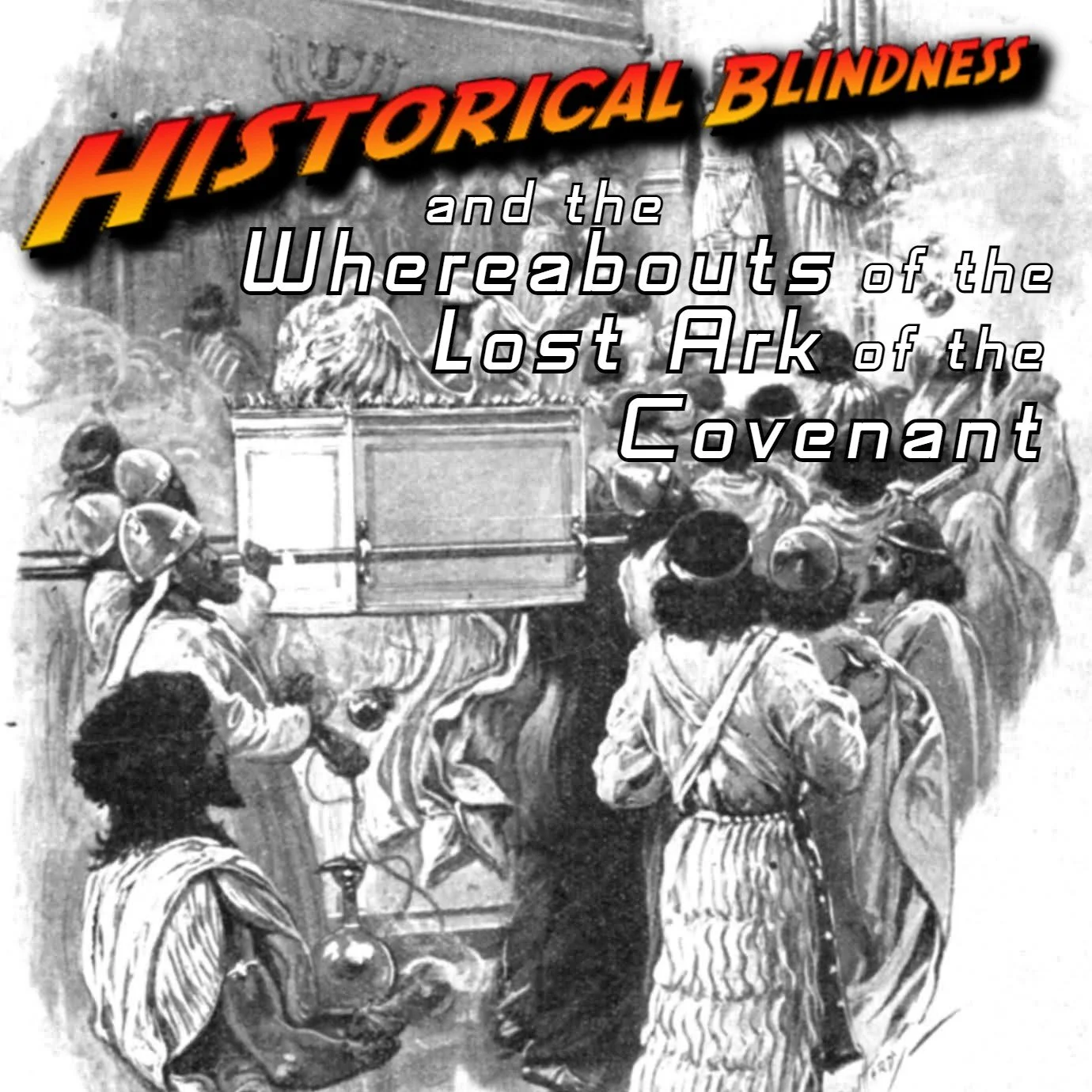
According to the biblical narrative, about a year after the exodus of the Israelites from Egypt, thought to be around 1200 BCE, God appeared to them at their encampment at the foot of Mt. Sinai. The description of His visitation sounds like little more than a thunderstorm to modern readers, but the Israelites believed Moses was called up the mountain to confer with God. After Moses ascended, he returned and explained that no one else was to likewise ascend the mountain in an effort to see God for themselves. He also told them that, on the mountain, God had given him a new law, not just the well-known Ten Commandments, but also an entirely new covenant, detailing a social and civil legal code. God even allowed some other priests to see him, and afterward it is said that Moses spent 40 days and nights on the mountain alone with God, during which time he was provided with further detailed instructions for priestly ordinances the Israelites were to keep as well as directions for how to design the Tabernacle, a portable sanctuary to be constructed as a place of worship. Along with these instructions were detailed designs for a cask to be built of acacia wood and overlaid with gold. This cask or chest was intended to carry the tablets of the law, which would be written by the very finger of god. On its lid, two cherubim were to be carved, facing each other, extending their wings so that the tips of them met above the center of the chest, and it was in this place, between the two cherubim, a place that was called the Mercy Seat, that God would reside, invisible. As the very throne of God, it was too holy an object to be touched by man, so rings were to be crafted on its feet, through which poles could be passed so that it could be carried aloft without being touched. This object, called the Ark of the Covenant, was considered the most sacred relic of the Israelites, kept in the Holy of Holies, the most secure central chamber of the Tabernacle, approached only by priests. Legend of the Ark grew over the ages. In the Letter to the Hebrews it is said that it contained not only the tablets of the law, but also the Rod of Aaron, a talisman endowed with the power to perform miracles, as well as a pot of manna, the supernatural substance that fell from the sky to sustain the Israelites during their travels in the desert. But most importantly, it was the very seat of God’s power on Earth, and as such, it was the symbol of their power as well. They carried it aloft before them as they marched into the Promised Land. It miraculously made victory possible for their armies on more than one occasion, drying up the River Jordan so that they could cross, and simply by carrying it in a circuit around the walls of the fortified city of Jericho, it made it possible to bring the walls crashing down with the just the sounding of several trumpets. But as mentioned, this artifact, which carried their invisible God aloft and housed their most sacred relics, was too powerful for a mere mortal to touch. At one point, the Philistines captured the Ark and reveled in the idea that they had stolen the Israelite God, but when plagues of rats and tumors were inflicted on them, they sent the Ark back, and in 2 Samuel and 1 Chronicles, it is described that one of the drivers of the cart carrying the Ark was struck down simply for laying a hand on it to steady it when the oxen pulling the cart caused it to lurch. Likewise, when the inhabitants of a certain city did not greet the return of the Ark enthusiastically enough, some seventy of them were struck dead, though by some interpretations, the Ark may have laid waste to something more like fifty thousand people that day. The Ark of the Covenant has grown in legend to become the most powerful sacred object in history, a talisman of untold power, a symbol that confers legitimacy, and a weapon. When King Solomon the Wise constructed his Temple, a permanent version of Moses’s Tabernacle, the Ark was placed in its Holy of Holies and was not officially ever heard of again. In 587 BCE, Solomon’s Temple was sacked, along with the rest of Jerusalem, by the Babylonians, and there are only rumors and conflicting accounts of what became of it thereafter.

*

I was inspired to cover this topic by one of my favorite films of all time, the first installment in the Indiana Jones franchise, Raiders of the Lost Ark. I credit these films and the character of Indiana Jones with my lifelong interest in historical mysteries and arcane knowledge. In fact, as the release of the fifth and likely final Indiana Jones film, the Dial of Destiny, approaches, I had the idea to focus in a series of episodes that won’t necessarily be contiguous, on the macguffins and historical mysteries central to the Indiana Jones films. A lot of the episodes of this podcast have already touched on notions from the films, most notably my series on Nazi occultism, but I haven’t entirely focused on the mysteries explored in the films, and of course, I had to start with the Ark of the Covenant. In Raiders of the Lost Ark, the stakes are high to find the Ark. As it was believed to be a supernatural weapon that could tip the balance of power, the Nazis are after it, and Indy must keep it from falling into evil hands. Today, the search for the lost Ark of the Covenant likewise carries far greater import than simple archaeological significance. Don’t get me wrong, though. If it were ever discovered that the Ark of the Covenant first of all was real and not just a fabled legend, and more than that, that it had survived to modern day like the Dead Sea Scrolls, it would be an earth-shaking revelation, academically speaking. Not all scholars agree that the Ark actually existed, or that it existed as described in Exodus, but many do, and its discovery would go a long way toward demonstrating the historicity of certain passages in the Bible, which of course would then be touted by biblical literalists as evidence for the historicity of the entire bible, even if it were shown not to possess supernatural powers. But more than this, the discovery of the Ark of the Covenant would have massive repercussions for peace in the Middle East. There are those who believe that discovery of the Ark would not only prove the truth of scriptures, but also the existence of God and the validity of Judeo-Christian faiths. Some orthodox Jews have hoped that its discovery might somehow heal the rift between Islam and Judaism by somehow proving the political legitimacy of Israel. However, as with most aspects of Middle Eastern conflict, the matter may not be so simple. While the discovery of the Ark in modern times might convince some to set aside their differences or even to convert, more likely it would exacerbate the conflict. One place where the Ark is rumored to have been hidden away is in a secret chamber beneath the Dome of the Rock, an Islamic shrine built atop the Temple Mount in Old Jerusalem, perhaps the most contested holy place in the region or on Earth. To both Jews and Muslims, this place is believed to be the site of the creation of the world. To Muslims, it bears further significance as the place from which Muhammad ascended into the heavens on his miraculous Night Journey, and it is their third holiest site, known to them as the “Farthest Mosque.” To Jews, it is the place where God created Adam, where He asked Abraham to sacrifice his son, and where the Holy of Holies in Solomon’s Temple was located, where the Ark, the seat of God on Earth, was kept. To really delve into this conflict and the significance of this site is beyond the scope of this episode, but what is important to know is that the rebuilding of the Israelite Temple on that site has been foretold as a precondition to the end of days, the resurrection of the dead and the last judgment for the Jews, Armageddon and the Second Coming for Christians. Indeed, there has long been a desire, among some Jews but perhaps even more so among Evangelical Christians, to relocate, or even to destroy, the Dome of the Rock in order to kickstart the end times by rebuilding the Temple. Certainly the prospective discovery that the Ark of the Covenant was real, that it had been recovered and was waiting to be restored to its place on the Temple Mount would raise the already high temperature of the region to a fever pitch. This scenario would prove the fiery power of the Ark, for it would be like tossing a match into a tinder-box.

The first photograph of the Dome of the Rock, c. 1842

This assessment of the explosive prospect of the recovery of the Ark of the Covenant is proven by an incident in 1911, when a British expedition intent on digging for the Ark under the Temple Mount nearly resulted in a Middle Eastern crisis. It began with a Finnish scholar named Valter Juvelius, who had convinced himself and others that by deciphering some ancient code in the Bible, he had discovered the location of the long sought after gold treasures of Solomon, including the Ark of the Covenant, believed by many to have been hidden away before the arrival of the Bablyonians. Juvelius engaged a wealthy English socialite, Montagu Parker, to help him bankroll his expedition, and in 1909, still some forty years before the State of Israel would be created, they traveled to Jerusalem, which at the time was controlled by the Ottomans. Excavation beneath the Noble Sanctuary Mosque on the Temple Mount was forbidden even then by the Sultan in Istanbul, but Juvelius believed that they could begin their dig outside the walls of the Old City and penetrate through to the ancient tunnels that would take them to the treasure they sought. It was the largest and most expensive excavation in the history of Jerusalem at the time, and indeed, they did break through into dark subterranean passages that honeycombed the area. What they did not find was any treasure beyond a few pieces of pottery. Finally, desperate to succeed after years of effort, in 1911, they bribed the sheikh in charge of the Noble Sanctuary Mosque to send his guards away to a ten-day festival that was then being held outside the city, and they set about digging numerous holes on the raised platform of the mosque, and even beneath the Dome of the Rock—the ultimate desecration. On April 12th, 1911, the tenth night of their secret dig, they were discovered, and word swiftly spread through the city that some Western Christians were despoiling their holy site. Muslims flooded the streets, enraged and searching for the offenders, and the Englishmen hopped on the first train out of Jerusalem, back to their yacht in Jaffa. Thousands of demonstrators continued to march the streets of Jerusalem, and Turkish soldiers had to be deployed to quell what looked like impending riots. Around the world, the leaders of Islam condemned the act. It was no exaggeration that they were on the precipice of a global holy war. Eventually, though, the sheikh who had accepted the bribe was arrested, as was the governor of the city, though he had had nothing to do with it. Investigators determined that nothing had actually been looted by the Englishmen, and trouble subsided. However, the expedition’s hasty retreat had led to numerous rumors, spread in the Western press, that Montagu Parker and his men had actually made off with the Ark of the Covenant. This was completely false, however, and indeed, Parker even tried to return later that same year to continue his excavations. Because of the scandal, however, he would never be tolerated to set foot again in Jerusalem. His expedition, though, would go on to inspire others who dreamed of digging up the Temple Treasure and specifically the Ark in Jerusalem, but they would never have the opportunity to excavate beneath the Dome of the Rock again. For about a month in 1967, during the Six-Day War, the site was wrested from Muslim control, but jurisdiction was ceded back before anyone attempted any organized search for the Temple treasure. Once, in 1981, a rabbi broke into a catacomb while constructing a synagogue beyond the Western Wall and organized a secret dig to reach the Holy of Holies, but the news media exposed their excavation and an angry mob put a stop to it, sealing the cavern. Besides these attempts, most other expeditions for the Ark of the Covenant sought the relic outside of Jerusalem, and some even claimed to have found it.

Perhaps the most outrageous of these adventurers was Ron Wyatt. This American nurse from Tennessee, a devoted Seventh Day Adventist, belongs among the biblical literalist fraudsters I previously discussed in my episode on the seekers after Noah’s Ark. He first entered the field of “biblical archaeology,” which is most of the time just amateur archaeology or often pseudoarcheology, because he believed that the Durupinar site, a kind of boat-shaped rock formation that I mentioned in that previous episode, was Noah’s Ark. Starting around 1977, he began organizing various Middle Eastern expeditions designed to recover biblical relics and thereby prove the historicity of the Bible. He had the idea of searching the bottom of the Red Sea for traces of Egyptian chariots, which he would tout as evidence of the scriptural account of the sea having parted for the Israelites and afterward swallowed the Pharaoh’s army. He claims that he discovered the exact place of the crossing and recovered the chariot remains of the army that he sought, but he provided no evidence that the artifacts had actually come from the bottom of the Red Sea, and professional divers have argued that he would not have been physically capable of diving to the depth he claimed. This is rather typical of Ron Wyatt’s adventures. When he provided evidence, it was always suspect, and he dismissed valid criticism as being the efforts of Satan to cast doubt on the truth. He claimed to find everything he looked for, and far too easily. He said he had discovered the true locations of Mt. Sinai, Sodom and Gomorrah, and even the site of Christ’s crucifixion. And here is where his most fantastical claims were made. According to Wyatt, the site of Christ’s crucifixion was just outside the Old City of Jerusalem’s walls, and he further claimed that an ancient earthquake had cracked the hill, an act of God to allow access to a chamber beneath, where the Ark of the Covenant had been hidden. By Ron Wyatt’s reckoning, God had opened the earth there to allow Christ’s blood to flow down onto the Mercy Seat of the Ark, making official the notion that Christ’s death was the ultimate sacrifice and marked the beginning of a new covenant between God and humanity. He further claimed to possess evidence of the find, including video and photographs and even samples of Christ’s blood, which remained upon the Ark and which through DNA analysis showing an absence of a Y-chromosome, proving he had been born of a virgin. But, with Wyatt, there was always an excuse. The Israeli government conspired, he claimed, to cover up the discovery, fearful that it would result in a mass conversion to Christianity. According to him, Israelis had been killing anyone who got close to discovering the site, and it was for this convenient reason that he could not release his evidence. But one day, he promised, he would reveal all to the world. Ron Wyatt passed away in 1999, and no such evidence has ever been shared.

Valter Juvelius, photographed during his and Montagu Parker’s excavations.

In 1946, Bedouin shepherds made the discovery of the century when they found numerous scroll fragments in the Qumran Caves of the Judaean Desert. This very discovery lends some hope to the otherwise far-fetched notion that an artifact like the Ark of the Covenant might be rediscovered today. In 1952, an archaeologist further searching the Qumran Caves discovered a scroll unlike the others in that it had been inscribed on a copper sheet. This “Copper Scroll,” as it has been called, was not a work of literature or a religious manuscript, but rather a list, detailing 63 locations at which gold and silver treasure had been hidden. Some scholars have suggested the scroll was a hoax, but as it has been dated to the 1st century CE, it would have had to have been a very ancient hoax, which doesn’t hold up to logical scrutiny. Some believe the Copper Scroll to be a list of treasures hidden by those at Qumran, others that it may be a key to the location of the treasure of the Second Temple, hidden away before the Roman invasion. But some, including John Allegro, the first scholar to study the Copper Scroll, believed it could refer to the treasure of the First Temple, taken out of the Temple by priests to prevent it falling into Babylonian hands. Allegro pointed to one passage that indicates a silver chest was buried under a hill “in the desolations of the Valley of Achor,” a location northwest of Jericho and thus far outside of Jerusalem, and that this chest contained “all the gold and silver of the Great Tabernacle and all its Treasures.” All the treasures of the Great Tabernacle certainly would include the Ark, but it is unclear how the Ark, which itself is supposed to be four feet long and 2 and a half feet wide and tall, would fit within another chest and still have room for further treasures. It would have to be quite a large silver chest indeed. Whether or not the simple question of how the Ark might fit within a silver chest puzzled him, he mounted a series of excavations to search for the Temple treasure in the West Bank and Jordan, following clues from the Copper Scroll. He never found a thing. Allegro would eventually go on to discredit himself in the eyes of many with some rather bizarre later work in which he claimed that Jesus had been a fictional character dreamed up by early Christians who were really just a sex cult that consumed a lot of psychedelic mushrooms, but Allegro’s work on the Copper Scroll would inspire others to search for the Ark in caves and other locations outside of Jerusalem.

One Vendyl Jones, an American archaeologist who had moved to Israel in the 1960s, claimed to have used the directions in the Copper Scroll to find some of the hidden treasures it told of, including a small jug of the oil used to anoint the kings of Israel, called the balm of Gilead. Vendyl Jones believed that the Copper Scroll was one key to the mystery of the Ark, but that another could be found in the book of Second Maccabees, a deuterocanonical book, meaning it is considered canon by Catholics and certain Eastern churches, but is disregarded as apocryphal by others, in this case both by Jews and Protestants. In Second Maccabees, it is stated that the prophet Jeremiah, having been warned about the impending Babylonian invasion, absconded with the Ark and hid it in a cave on Mount Nebo, well east of Jerusalem, past the Dead Sea, and that its location would remain unknown until the Gathering of Israel. This foretold event, also called the Ingathering of the Exiles, is an eschatological milestone, prophesied as a precursor to the reign of the Messiah, and so Vendyl Jones, who made some efforts to find the Ark, believed that when he discovered it, he would be ushering in the End of Days. Vendyl Jones claimed that he may have been the inspiration for the character of Indiana Jones, asserting that someone who had joined him on his digs wrote a screenplay about an archaeologist named Endy Jones based on him, and that the makers of Raiders of the Lost Ark had cribbed ideas from that script. This claim has been vigorously disputed, however, and Vendyl Jones’ involvement with Kabbalist mystics and fundamentalist rabbis seeking to re-establish a national rabbinical court in Israel, along with his inflated sense of himself as being the person who will usher in the end times by discovering the Ark, rather undermine his credibility as an archaeologist. For example, he announced in 2005 that he would bring forth the Ark on the anniversary of the Temple’s destruction in August of that year, but then didn’t, claiming much like Ron Wyatt and probably just to save face, that he had been prevented by the government, though not because of a conspiracy but rather because of some bureaucratic constraints.

The Copper Scroll.

The notion that the Ark was hidden away in a cave on Mount Nebo, where Moses is said to have died, was not a new one in the 1970s and 80s. Back in the 1920s, a Californian named Antonia Frederick Futterer followed the verse from Second Maccabees to Mount Nebo and claimed that he found a cavern entrance closed with stone and engraved with some sort of ancient glyph, which he claimed his Hebrew translator interpreted to mean “Herein Lies the Golden Ark of the Covenant.” The only evidence he ever offered was a sketch of the entrance, which of course is no evidence at all, and considering the fact that he could have reproduced the hieroglyph and named his Hebrew interpreter as corroboration and never did, it’s pretty safe to dismiss this as a hoax. But in the 1980s, another American, Tom Crotser, took Futterer’s claims seriously and mounted a new expedition to Mount Nebo in Jordan. Unsurprisingly, Crotser could not find the cave entrance described by Futterer, but on a nearby mountainside he claims to have discovered a ravine closed off with a tin metal sheet. According to Crotser, his team penetrated this barrier and discovered a crypt beyond, in which lay a gold chest that perfectly matched the description of the Ark of the Covenant. Unbelievably, he states that he only took photos of it rather than bringing it back with him. Crotser’s claims too can be easily dismissed based on his general lack of credibility. He has devoted his life to finding artifacts that prove the historicity and literal truth of the Bible, and he further claims, without convincing evidence, to have discovered the stone on which Cain murdered Abel, the Tower of Babel, and Noah’s Ark. Furthermore, he refused to make his photographs of the Ark of the Covenant public, only circulating them among a select few of his supporters. Eventually, he made the mistake of showing them to Siegfried Horn, a Bible scholar who was a genuine archaeologist and antiquities expert, and Horn promptly revealed that Crotser photos were of a brass-plated chest that appeared to have been manufactured in modern times using machine-cut materials, with a regular, modern-day nail protruding visibly from it. In short, it was just another hoax.

Many seekers after the lost Ark of the Covenant set their eyes farther afield than Israel, and there is some compelling reason to consider that the Ark was at some point in its history taken out of Israel. Some claims, however, are rather ludicrous. In my series on the Lost Tribes of Israel, I spoke of the failed excavations at the historic Hill of Tara in Ireland by Anglo-Israelists or British Israelites, who rather foolishly believed the Ark of the Covenant had been buried there and would prove that the British were descended from the Lost Tribes. In fact, they only damaged a historical site and found nothing, proving only that they were destructive and wrong. Other theorists point to the Knights Templar, a Christian military order organized to protect pilgrims to the Holy Land during the Crusades in 1119. I have spoken about the Templars before in a patron exclusive episode back in February of 2020 called Philip the Unfair and his Unholy War. In short, the Templars grew extremely wealthy over the nearly 200 years of their existence, and the French king Philip the Fair conspired to steal their wealth by making dubious claims about Templars being sodomite Satanists. In 1307, they were arrested, some of them burned alive, and their wealth seized by the crown. In that exclusive minisode, I refuted the notion that the Templars secretly survived in the Freemasons, but there are countless other conspiracy claims about the Templars, such as that they discovered the New World before Columbus, and that they removed the Temple treasure and brought it to Europe. This last claim derives from the fact that they made their headquarters at the Temple Mount. As the brotherhood became extremely wealthy, legend had it that they had dug up the treasure some believe was or is still buried beneath the Dome of the Rock. In fact, Templar wealth derived from the many donations made to the order across all Christendom, as well as the vast trade network they established. But rumor breeds myth, and today there is no shortage of conspiracists who will tell you with unfeigned certainty that the Templars brought back and hid away such mystical treasures the Spear of Destiny—about which I spoke in my series on Nazi occultism—the Holy Grail—about which I spoke in my episode on the Secret of Rennes-le-Château and Abbé Saunière's Riches and which I intend to explore further in our adventures into Indiana Jones lore—and finally, the Ark of the Covenant. Common is the speculation that the Ark may have been hidden in the south of France by the Templars, or even farther afield. One claim has it that the Templars carried it to the New World and buried it on Oak Island, and that’s a whole other rabbit hole that some patrons have actually requested I excavate. I do intend to dig into that morass of pseudohistory eventually, but for now, suffice it to say that there is absolutely no evidence whatsoever that the Templars found the Ark of the Covenant or stashed it anywhere. In fact, logic would dictate that if they had discovered it, they would have announced it to the world as a symbol that God was on their side of the conflict, just as they certainly would not have kept secret the discovery of Christian relics as important as the Holy Grail or the Spear of Destiny.

The photograph of what Tom Crotser claimed was the Ark. Reproduced according to the Fair Use doctrine.

And now we come to the seemingly more credible but, in reality, just as unreliable claims of Graham Hancock, who in his 1992 tome The Sign and the Seal also traces the paths of the Knights Templar and engages in speculation about their carrying of the Ark of the Covenant out of Jerusalem, though he focuses more on Africa. Several listeners have asked when I will be devoting an episode exclusively to refuting Graham Hancock’s claims, especially since his Netflix series premiered. The thing is, the ideas that Hancock resurrects in his pseudohistorical, pseudoarcheological Netflix series, which I won’t amplify by naming it, are old racist ideas that I already refuted in detail in my episode on the Myth of a Lost Mound Builder Race. Likely I will refute Hancock again whenever I get around to producing a series about Atlantis, which he has written a lot about, but in the meantime, I’ll just talk here about his Ark claims, which like his other claims are not original. He is not an archaeologist, and actual experts recognize him for what he is: a journalist engaged in popular writing. So to argue that he is a conspiracist or a fringe lunatic would be unfair. He writes lucidly about a lot of real scholarship, and in some ways he is an effective science communicator in that he makes very complicated and esoteric academic material digestible and accessible to wider audiences. The problem is that he is not as concerned as a real academic about credibility and truth. His are elaborate stories that err on the side of entertainment rather than fact, and as such, he tends toward the fantastical rather than the accurate, and in the process he resurrects and propagates sometimes harmful narratives, like the racist idea that Native Americans could not have constructed the American earthworks. In the case of the Ark of the Covenant, he finds himself part of a rich tradition that suggests the Ark of the Covenant was carried out of Jerusalem and into Africa, and not necessarily by the Templars. Indeed, this path was even suggested in canonical scriptures, as the Book of Kings speaks of an Egyptian king named Shishak assaulting Jerusalem and carrying away “the treasures of the House of the Lord.” Indeed, this verse is referred to in the film Raiders of the Lost Ark and is the reason its story is largely set in Egypt.

Although it made for a ripping yarn in the first Indiana Jones film, there is no evidence that the Ark of the Covenant was ever brought to Egypt, and in fact, the verse in Kings mentions only vague treasures. However, one mysterious document, the Tractate of the Temple Vessels, does appear to lend some credibility to the claims that the Ark and the Temple treasures were brought to Arabia by priests hoping to hide their most sacred object before the Babylonian invasion. It must be acknowledged, though, that the origins of the Tractate are extremely suspicious. It did not appear until the Middle Ages, the 10th century CE, to be more specific, and thus in all likelihood is a medieval fantasy. Graham Hancock favors more the notion that the Ark of the Covenant was carried out of Jerusalem a hundred years before the coming of the Babylonians, to protect it from a sacrilegious king: Manasseh, the fourteenth King of Judah. According to one of the several theories Hancock entertains, these priests would have carried it to the Egyptian island of Elephantine, where a replica of the Temple had been constructed. This too is pure conjecture, though, and even if it were true, 2 Chronicles records that Josiah, the 16th King of Judah, restored the Temple and specifically ordered that “the sacred ark” be put into it, indicating that if it had been taken to Elephantine during Manasseh’s reign, it would only have been as a brief sojourn and was back in Jerusalem before the Babylonian invasion. There is the further possibility that priests may have brought it to the Temple replica on Elephantine, again or for the first time, ahead of the coming of the Babylonians, but as one of my sources, The Lost Ark of the Covenant by Tudor Parfitt points out, the record that provides us with the most information about the ancient goings on at Elephantine, the papyri discovered in the 19th century by American journalist Charles Edwin Wilbour, makes no mention of the arrival of the Ark of the Covenant, and as Parfitt I think wisely points out, if the temple there had ever held such a relic, it would have been something they bragged about rather than hid. Such is the case with temples and churches generally. They tend to make a big deal about possessing miraculous objects in order to draw more visitors to them and thereby collect more money. So despite what Raiders may have led us to believe, all claims about the Ark of the Covenant residing in Egypt suffer for lack of evidence.
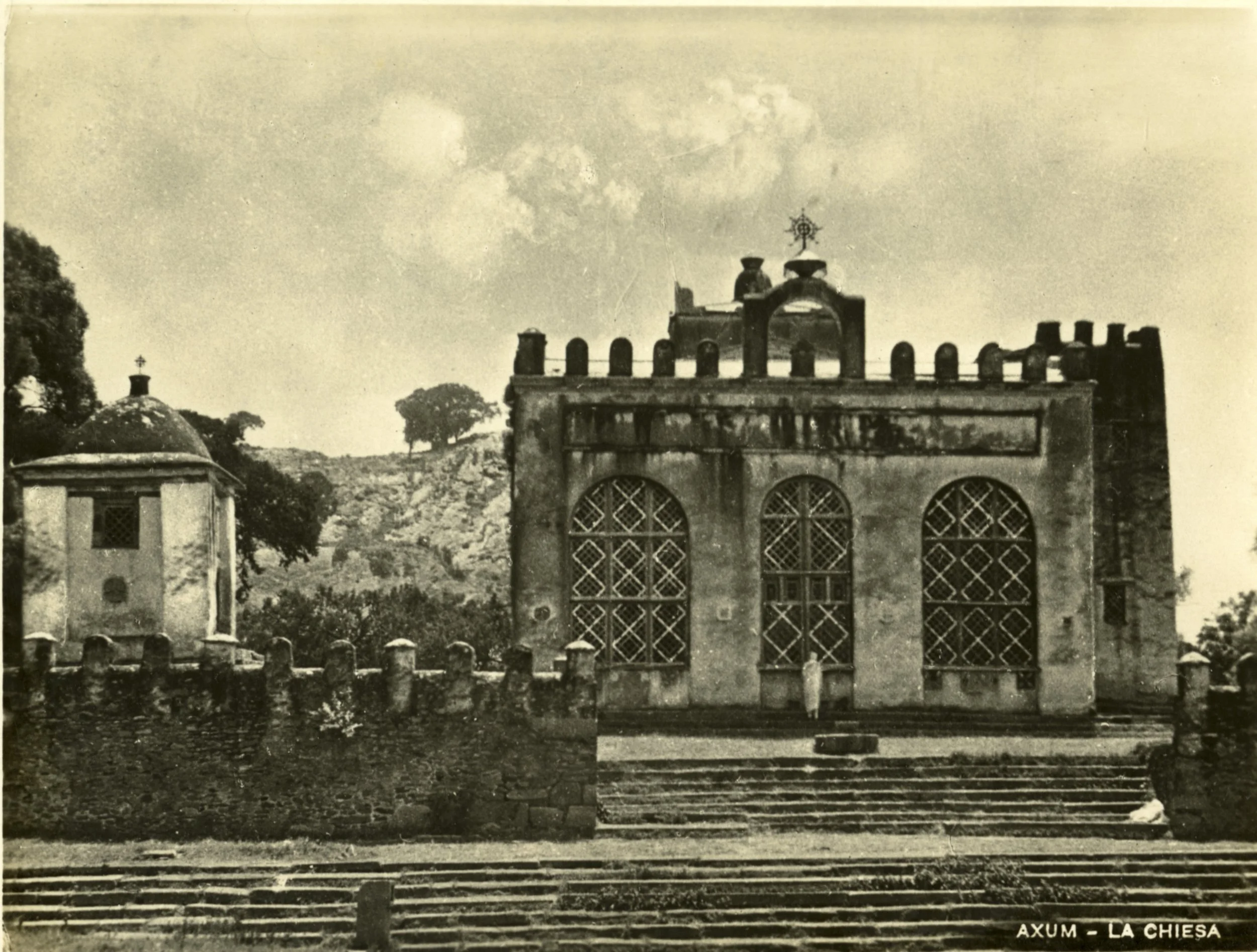
Historical image of the original church in Ethiopia believed by many to have housed the Ark of the Covenant. Courtesy The Digital Collections of the National WWII Museum.

Finally, because it is such a fun story despite reliability problems, Graham Hancock falls back on an age-old belief that the Ark had perhaps been stolen from ancient Israel long before the Babylonian sacking of the Temple or even before the reign of Manasseh or the invasion of the Egyptian king Shishak. By this telling, King Solomon the Wise, who built the first Temple to house the Ark, lost it to a thief who carried it to Ethiopia, where it has resided ever since. But it’s far more interesting than only that. So the tale goes, when the Queen of Sheba visited Solomon to partake of his wisdom, she lay with him and returned to her homeland—Ethiopia, according their national legends—pregnant with his son, whom she named Menelik. Menelik returned years later to meet his father, and in a show of alliance, Solomon sent the sons of members of his court back with Menelik in an effort to recreate the wisdom and greatness of Israel in Ethiopia, known as Abyssinia at the time. However, one of these young men, disgruntled at being sent away, stole the Ark and took it with him. Since the Ark did not destroy the thief or the rest of the party, it was believed that God willed for the relic to reside thenceforth in Ethiopia, and the claim is that, ever since, as kings of a Solomonic dynasty reigned and even as foreign invasions and modern revolutions changed the political landscape, the Ark of the Covenant has remained in the Church of Our Lady Mary of Zion at Aksum, protected by a virgin priest who is the only person alive who is allowed to see it. This narrative is supported by their national epic, the Kebra Nagast, or The Glory of Kings, which purports to be an account of a dialogue at the First Council of Nicaea that then shares what is ostensibly a far older tradition from more ancient sources. To be very clear, Graham Hancock’s work The Sign and the Seal is not a work of historical scholarship, but insofar as he supports the story of the Ark being in Ethiopia, it must be acknowledged that this is not a new tradition, and it is one that many faithful in the Ethiopian Orthodox Tewahedo Church believe in to this day. A detailed exploration of the evidence refuting this myth is far beyond the scope of this episode, but if you are interested in researching it for yourself, I recommend reading Stuart Munro-Hays’s The Quest for the Ark of the Covenant: The True History of the Tablets of Moses, or if you’re looking for something a bit easier to digest, listen to the Our Fake History podcast’s 2-part episode, “Does Ethiopia Have the Ark of the Covenant?” Suffice it to day here that historians and scholars mostly find that, first, there is no evidence that the Queen of Sheba ever existed except as a literary character; second, despite claims that the Kebra Nagast’s contents are a retelling of ancient traditions, there is no evidence that the work or the legends about Menelik and the Ark existed prior to the Middle Ages; and third, the story appears most likely to be a medieval fiction fabricated as propaganda to legitimize the divine right of Ethiopian kings and enhance the glories of the Ethiopian church.

Even if we were to credit the claims of Graham Hancock and the Ethiopian church, even by their own legend, the relic they revere as the Ark sounds less like the Ark itself and more like the stone Tablets of the Law the Ark was said to contain—or rather, their replacement, since Moses broke the originals and had to get God to remake them. Indeed, every church in Ethiopia possesses such tablets, or tabots, claiming they are replicas of the real ones that, of course, no one is allowed to see. And in their long history, they too tell of times when their priests took their Ark out of its Holy of Holies and hid it elsewhere in order to protect it from invaders, making it further questionable whether whatever it is they actually have now is what they claim it was long ago and whether whatever they had then may now also be lost. Further complicating the matter is the fact that they are not the only African people to claim to be descended from Hebrews or Jews. There are the Beta Israel and the Qemant, also in Ethiopia. There are the Lemba of Zimbabwe, and the Nyambo of Tanzania, the Igbo of Nigeria, and the Ibro of Somalia. Some of these groups have genetic evidence to support their claims of having being descended from Middle Eastern semitic peoples, and more than one has their own tradition about carrying the Ark into Africa long ago. Add to this further legends from Arabic texts that claim the Ark ended up in Mecca after Arabs defeated the Israelites in battle and that it was thereafter sealed in some cave somewhere in the Arabian desert, and we come to a dizzying conclusion that the Ark, if it ever existed, and if it survived the ravages of time, could be secreted almost anywhere: under the most hotly contested holy site on earth, buried somewhere in modern day Israel or Jordan, in some ancient Egyptian catacomb, or in some church anywhere from Ethiopia to the South of France. Rather than lead us to take any such claims more seriously, this preponderance of competing claims should cause us to view all of them more skeptically. Instead of driving anyone to take on a costly expedition that would in all likelihood end in failure and could very well disturb what fragile peace we may have in the world, it seems rather that it should be enough to convince us that, whether it’s ancient history or ancient myth, it’s certainly nothing to chase after now.

*

Until next time, remember, when it comes to legendary magical artifacts, it is far more likely that, if they ever existed, they weren’t magical, and they have likely been destroyed by people or the elements and in fact are not filed away somewhere among endless crates in a top secret warehouse.

Further Reading

Munro-Hay, Stuart. The Quest for the Ark of the Covenant: The True History of the Tablets of Moses. I.B. Tauris, 2005.

Parfitt, Tudor. The Lost Ark of the Covenant: Solving the 2,500 Year Old Mystery of the Fabled Biblical Ark. HarperCollins, 2008.

Ricca, Brad. True Raiders: The Untold Story of the 1909 Expedition To Find the Legendary Ark of the Covenant. St. Martin’s Press, 2021.

InfeKtion: Operation DENVER and the Engineering of AIDS Conspiracy Legends

(This blog post is not an exact transcription of the podcast episode, which contains a great deal of material from my interview of Dr. Douglas Selvage. I encourage you to listen to the podcast for a full sense of the what was discussed. Additionally, Patreon supporters have been granted access to the entire interview).

In 2020, early in the Covid-19 pandemic, the Trump administration, amid criticism of its response to the crisis, asserted without evidence that China was to blame for the virus. Certainly the original epicenter of the outbreak occurred in Wuhan, but as a way to deflect blame from their handling of the situation, the Trump administration promoted an emerging hypothesis that the virus had been released upon the Chinese population in a “lab leak.” Medical scientists and the scholarly community were quick to decry this assertion, as study of the virus, a variant of the coronavirus that caused the severe acute respiratory syndrome or SARS epidemic in the early 2000s, showed that it had likely crossed the species barrier much like its predecessor. What their research was showing was that what was most likely to blame were the conditions of the wet markets and the practices of the wildlife trade in China. However, the existence of the Wuhan Institute of Virology and the fact that it had been studying coronaviruses that cause respiratory infections ever since the 2003 SARS outbreak was viewed by many as a kind of smoking gun. Rumors about researchers at this institute falling ill with flu-like symptoms late in 2019 further encouraged the lab leak hypothesis, though there is no evidence that any researchers at the institute had Covid-19. Since that time, it has become a mire of conspiracy speculation, with the institute being depicted as a U.S.-funded bioweapons development site and with further claims that Anthony Fauci, a public health spokesman during the first year of the pandemic and chief medical advisor to the President during the first two years of the Biden administration, was himself personally responsible for “gain of function” research to develop a more transmissible virus. While the scholarly community and the intelligence community worked slowly but surely to assemble evidence for a natural origin, the conspiracist community latched onto any gaps in their evidence as if it proved the opposite. Most recently, a declassified report by the U.S. Department of Energy that claimed with “low confidence” that the lab leak theory was correct, along with the FBI director’s comments indicating that his agency agreed, has resulted in numerous major press reports that act like it had been proven, even though this conclusion runs counter to the findings of most other federal agencies and intelligence services and scientific consensus. The fact is that it is still too early to make draw such a conclusion, which is exactly why they have been drawn with “low confidence.” Even as I wrote this, President Biden signed the Covid-19 Origin Act to declassify intelligence on the subject, which has been deemed inconclusive. And this announcement came on the heels of a further revelation that samples deposited by Chinese researchers in a virology database show that the novel coronavirus was present in civets and racoon dogs sold at a Wuhan wet market. Yet these developments will not likely not be trumpeted with quite the same gusto by the press, which often amplifies conspiracy claims simply because it gets them clicks and views. When the recent conclusions of the Department of Energy were making headlines, a disgruntled listener who insisted he was “not an idiot,” emailed me to say that, since “COVID-19 is thought to have escaped a lab,” he hoped I would “reconsider the possibility of HIV having been foisted upon us.” But of course we know that the notion of HIV having been created as a bioweapon is a baseless conspiracy claim, widely spread by the KGB. Really, the story of how this myth appeared and was propagated for political purposes serves as the perfect example from history of why we must reserve judgment about the origin of Covid until the evidence is more conclusive.

*

Before I continue with this story, since I have heard that the best way to combat misinformation is not to tease the accurate information until later but to state the truth at the outset of your discussion, let’s start by talking about the natural origin of AIDS. Just as medical scientists have been studying the natural origin of Covid since its emergence, ever since the 1981 recognition of Acquired Immune Deficiency Syndrome as a new disease and the subsequent identification of the causative retrovirus now called the human immunodeficiency virus or HIV, scientists studied it and hypothesized about its natural origin. Early on, even though it seemed to have emerged in America, it was believed to have come “out of Africa” because of the discovery of its similarity to a simian virus known to affect primates in sub-Saharan Africa. With far more time spent studying this pathogenesis than has been spent studying Covid, it has been borne out with consistent evidence that HIV passed naturally to humans through a cross-species transmission, that it actually first appeared in west central Africa, then came to Haiti before emerging in America, all long before the years when it would subsequently be claimed that the CIA was developing it as a bioweapon. And the intelligence services that were responsible for legitimizing and spreading these baseless claims have since confessed! In 1992, the head of the post-Soviet intelligence service, successor of the KGB, explicitly admitted to the existence of the KGB’s disinformation campaign to convince the world that HIV was created by the U.S. as a biological weapon, and that same year, former members of the Stasi, the East German intelligence agency, further confessed to their participation in the campaign. As for hard evidence of the workings of the KGB’s program, and the Stasi’s involvement in it, that was lacking for a long time, causing some to doubt, but eventually, it was discovered in the archives of Bulgaria’s secret police. In the podcast episode, you can hear more about this from Dr. Douglas Selvage, historian at the Humboldt University in Berlin, who along with Christopher Nehring published a German language study irrefutably proving not only the existence of the KGB disinformation campaign but also the nature and details of the significant involvement of East German intelligence in spreading the myth. He has published major papers on the topic in the Journal of Cold War Studies, as well as on openDemocracy and the Wilson Center website. Dr. Selvage generously agreed to chat with me on this topic, and you can hear a great deal of additional information from him throughout the podcast episode, so I encourage you to listen and not just read this blog post.  

Dr. Douglas Selvage. Listen to the podcast for material from his interview. Check out the citations under Further Reading below for research and articles on this topic published by Dr. Selvage.

It would be inaccurate to suggest that Russian disinformation is entirely responsible for the invention of the conspiracy claim that HIV was developed by the U.S. government. Before the first known insertion of the narrative into the media by the KGB, some form of the conspiracy theory had already arisen among the community most affected by AIDS during the first years of the epidemic. More than a week before the first known use of the conspiracy claim by the KGB, Boston’s Gay Community News and New York’s Native, another newspaper focused on gay issues and the gay community, printed and repeated the erroneous claim that HIV was a variant of the African Swine Fever virus, and pieces in these papers argued, without evidence, that it had been brought across the Atlantic by the CIA for biological warfare purposes in Cuba. The fact that the conspiracy theory originated in a marginalized and oppressed community is no surprise. When the spread of AIDS elicited mostly homophobic sentiments by legislators and the Reagan administration seemed to be purposely dragging their feet in responding to the crisis, one can hardly blame them for beginning to suspect some sinister intentions. Likewise, as the Black community came to be greatly affected by AIDS later in the eighties, it seemed pretty reasonable to many that they may be the victims of some sort of “ethnic weapon,” especially since history showed the U.S. government was entirely capable of such atrocity, the most obvious example being the Tuskegee Experiment, the 40-year study in which 400 African American men were purposely infected with syphilis. Also fresh in the minds of the American public were the Church Committee revelations about Operations MKULTRA, the CIA search for mind control drugs, and MKNAOMI, which developed biological and chemical warfare technology. These revelations led to Richard Nixon’s 1969 executive order banning the military use of biological weapons. Certainly the Soviets had agents in America observing the media for any social and political conflicts they could leverage in their disinformation, and having recently been accused of developing biological weapons themselves, the opportunity to deflect such allegations and simultaneously discredit the Reagan administration by suggesting it had been ignoring this ban and engaging in biological warfare against America’s own citizens was too great to pass up.

If one looks up the Soviet AIDS disinformation campaign today, on the Internet, one finds that it is widely called Operation INFEKTION, when in fact, as Dr. Selvage has shown in his work, the campaign was actually called Operation Denver. There are a few reasons for that. The first is that one of the former Stasi members who first revealed that agency’s involvement in the operation, an individual whose other revelations have been shown to be mixed with falsehoods, thus discrediting him to some degree, actually claimed it was called Infektion. The other reason is that it’s just a better name. It is more evocative of the actual nature of the program, and it has led to a useful metaphor, describing the spread of conspiracy theories and disinformation as a kind of viral infection. Indeed, the New York Times even produced a great nearly hour-long documentary on the topic, complete with engaging animation, that calls the operation by this incorrect name and makes much use of that extended metaphor. It’s for that reason and for search engine optimization, that I’ve used it in the title of this episode, in order to catch those keyword searches. While he has argued against the incorrect designation of the program, Dr. Selvage has himself made clever use of the metaphor, acknowledging that conspiracy claims spread like a viral infection, especially on the Internet, where they spread as memes. He makes the fantastic point, however, that the KGB did not invent this “virus” but rather, since they modified conspiracy claims that had already appeared in order to make them spread more virally, it can be said that they engineered this claim to make it more infectious, a process Selvage cleverly calls “memetic engineering.” In order to draw a more modern parallel to the spread of Covid misinformation, it might be said that Soviet and East German intelligence performed “gain of function” research on existing conspiracy claims, and as a result, turned a small outbreak of conspiracy theory into a disinformation pandemic.

On July 17th, 1983, the very same month that this conspiracy claim appeared in newspapers serving the gay community in America, a newspaper in India called the Patriot, published an anonymous letter purporting to be from an eminent U.S. scientist. The letter claimed that the Pentagon had not abandoned its biological weapons program after Nixon’s executive order to do so, and that the CIA and the CDC had discovered and developed HIV at the U.S. Army Medical Research Institute of Infectious Diseases at Fort Detrick in Maryland, a facility known for its research into biological warfare and defensive countermeasures against it. This would prove to be the principal Soviet contribution to the conspiracy claim. The fact that the anonymous author claimed to be an anthropologist, not an infectious disease expert, and cited sources like the magazine Army Research, Development & Acquisition, not your typical reading for an anthropologist but just the sort of publication the KGB monitored, went a long way toward demonstrating that the letter was KGB propaganda, as did the poor English of the supposed American academic who wrote the letter. But beyond these tells, the intelligence community was aware that the KGB actually helped establish the Patriot in 1967 and regularly used it as their mouthpiece to circulate propaganda. This was a tried and true method for the KGB: plant the seed of a story in an Indian newspaper and watch it get picked up and spread in other papers. For example, in 1968, during the Vietnam War, the KGB likewise forged a letter claiming that the U.S. was using biological weapons in Southeast Asia, and they spread it by placing it in a Bombay newspaper. The Patriot story did not spread far, but a couple years later, as AIDS became a global crisis, and as accusations were made of the USSR engaging in biological weapons development themselves, the KGB resumed their campaign with a vengeance. In 1985, they published a story in the Literary Gazette, their principal mouthpiece, which cited the fake Patriot letter as if it were evidence. This article argued that HIV’s spread in America was the result of experiments on unsuspecting citizens, suggested AIDS victims should sue the CIA, and warned the nations of the world not to host the U.S. Armed Forces because American soldiers were surely carriers of the scourge.

Even though these news articles, which mixed fact with baseless conspiracy fiction, were illegitimate, they could then be cited to seemingly legitimize further articles, some likewise placed by the KGB and others written by people who were unwittingly helping them spread their narrative. But what the KGB campaign really needed was an academic to lend their claim scholarly clout, and their partner agency, the Stasi, or Ministry of State Security of East Germany, provided it to them. His name was Jakob Segal, a committed Communist who had been born in Russia and studied biology in Germany. As a Jew, he had been forced to flee Nazi Germany for France, where he completed his doctorate. When the Nazis invaded France, he joined the resistance, where he likely first came in contact with Soviet intelligence. He returned to Germany after the war, becoming the head of the Institute for Applied Bacteriology in East Berlin and, according to former Stasi agents, acted as an operative or informer for the Stasi. Likely at the behest of the Stasi and KGB, or perhaps just with their sly encouragement, Segal began to produce scholarly-style literature that argued against the African origin of HIV, suggesting that the virus was an artificial synthesis of the human T-cell lymphotropic virus and a retrovirus that affects sheep—even though the technology required to recombine parts of viruses did not exist at the time and those two viruses are too distinct to even be synthesized—and asserting with no evidence whatsoever the truth of a very specific scenario: that at Fort Detrick, HIV was tested on convicts, and because of its long incubation period, it was believed to have no effect, causing the subjects to be released into the population, whereupon they made their way to New York and spread the virus through sexual contact with others. His claims relied not only on complete speculation, but also on two dubious assumptions. First, he asserted that these ex-convict test subjects must have made their way from Fort Detrick in Maryland to New York City, where the first outbreak occurred, because they were criminals, and there simply was no criminal community to accommodate them in nearby Washington, D.C., when the truth is Washington’s crime rate was extremely high at the time. And second, he claimed that, because the test subjects must have been convicts who had spent a long time in prison, they must also have become homosexual, thus explaining why they introduced the virus specifically into the gay community. Considering the stereotypes relied on and the lack of evidence provided by Segal, it is unsurprising that the scientific community largely ignored him or scorned his claims, as was the case with one AIDS expert who called it “nothing but a hypothesis, and not a very original one at that” in popular German magazine Der Spiegel. However, while the academic world never took him seriously, the press in the third world and the tabloid press in the UK, became unwitting stooges for Soviet intelligence by spreading Segal’s thesis far and wide.

A brochure by Jakob Segal and his wife. Courtesy Dr. Douglas Selvage and the Wilson Center.

Meanwhile, in the U.S., some useful idiots did their part to strengthen the resolve of Soviet propagandists and promote aspects of their disinformation by spreading a variant conspiracy theory that blamed the Soviets for engineering HIV. Dr. Selvage cleverly calls this a different “strain” of the same viral conspiracy claim, and it was promulgated by Lyndon LaRouche. LaRouche is a fascinating character that everyone in America should know about, though I suspect he is largely forgotten. LaRouche became involved in far-left Marxist politics in the 1950s and ‘60s, while working as a management consultant in New York City, but as his conspiracist worldview evolved, he gradually drifted to the far-right, growing anti-Semitic. History might have forgotten him as just another voice on the lunatic fringe, if not for his surprising political career. Lyndon LaRouche ran for president in every election for about thirty years, from the mid seventies to the mid-aughts. While he never had the numbers to come close to a nomination, he had a devoted following, sometimes described as a cult, who in the mid-eighties infiltrated the Democratic party by winning some primaries for state office. Today, no less influential a figure than Roger Stone has expressed admiration for LaRouche, and I can’t help but find parallels between LaRouche and Trump, who himself drifted from the left to the right during the course of his political career and over the course of his several failed presidential campaigns and single successful campaign espoused numerous conspiracy claims. As for the LaRouchite cult infiltrating the Democratic Party, I find it very similar to Qanon wackos consuming the Republican Party from within, though the latter have proven far more successful, as they currently hold some sway over the Republican Majority Leader in the House of Representatives. LaRouche’s principal mouthpiece was his magazine Executive Intelligence Review, which in 1985 supported the claim that HIV was engineered at Fort Detrick, but with one crucial twist. It claimed that it had been developed by the National Institutes of Health and the World Health Organization, whom they asserted had been infiltrated by the Soviets, so it was not the CIA but actually the KGB who had developed the virus. Of course, this only launched a disinformation war, with the Soviets citing parts of LaRouche’s claims as further support for their own allegations. But LaRouche’s conspiracy mongering went further. Much like Covid conspiracy claims decades later, his AIDS conspiracy claims involved anti-vaccinationism.  Furthermore, his publications endorsed the notion that AIDS could be spread through even casual contact, like through insect bites, through the exchange of saliva in kissing, and the old myth about toilet seats. On the basis of these groundless fears, he organized support for a 1986 ballot initiative in California that, if it had passed, would have enforced the HIV testing of every Californian and resulted in the removal and forced confinement of those who tested positive. Frighteningly enough, almost a full third of Californians voted for this.

Eventually, the AIDS disinformation campaign seems to have been officially discontinued. When the disease began to spread more widely in the Soviet Union in the late eighties and suddenly the Kremlin was more interested in trading medical research about it, Mikhail Gorbechev found the U.S. Secretary of State less than cooperative because of the known KGB campaign to blame the disease on America. Suddenly official organs of the state, like the newspapers Izvestia and Sovetskaya Rossiya, disavowed the HIV-as-US-bioweapon thesis, and of course, within a few years, after the dissolution of the Soviet Union, the active measure would be admitted to, as I shared earlier. Nevertheless, Jakob Segal would continue to promote his claims until his death in 1995, and media outlets continued to amplify his misinformation through interviews. It is hard to imagine that he truly believed all the claims he made, such as that aspirin was the cure for HIV and the pharmaceutical industry was covering up this simple remedy. But there is a sense that many of those involved in the KGB campaign believed that, while they may have been spreading unproven claims, the claims were likely true or at least reflected a broader reality about the corruption and immorality of the U.S. government. Thus it is possible that, though he knew his thesis rested on assumptions, he still believed it likely, and looking at his later claims, we get the sense that eventually he came to truly believe his arguments and simply sank further and further into conspiracist delusions. For example, he would eventually finger a specific scientist, someone who had actually done a great deal to fight the AIDS epidemic, as the central villain of his narrative, responsible for the creation of HIV. Dr. Robert Gallo co-discovered HIV as the cause of AIDS in 1984 and during his long career, most of which was devoted to ending the epidemic, he developed the HIV blood test. But in Jakob Segal’s fevered imagination, since Gallo was head of the National Cancer Institute’s Laboratory of Tumor Cell Biology in the seventies, and since in 1971, after his ban of biological weapons, Nixon converted Fort Detrick into a cancer research center, Segal saw this as de facto proof that Gallo had synthesized HIV at Fort Detrick. In fact, the NCI was extremely transparent about the cancer research conducted at Fort Detrick, and the Soviet Union’s Minister of Health even toured their lab in 1972. Interestingly, Jakob Segal’s obsession with Robert Gallo, his scapegoating of a respected scientist who was fighting the disease as being the actual person responsible for the creation of it, seems to me to parallel the bizarre and insupportable Covid conspiracy claims that have surrounded Dr. Anthony Fauci for the last few years.

Lyndon LaRouche. Public Domain image.

Despite the fact that the inner workings of the Soviet disinformation campaign have been exposed and its thesis proven false, the conspiracy claim has gone on to do serious harm, especially in Africa, which was and is ravaged by the disease and because of that has proven to be fertile ground for the propagation of the myth. The fact that the consensus of the scientific community remains that AIDS spread to humans from monkeys in Africa has made Africans and even African scientists defensive and more open to alternative narratives that do not seem to lay blame on them, even though of course no blame is actually being placed on African peoples, since it was a matter of natural cross-species transmission. As AIDS has ravaged African nations, we again have seen the tendency of those most marginalized and most effected by an epidemic giving the most credence to conspiracy claims that offer some explanation of their suffering and lay blame on an oppressive villain. For example, one newspaper in Zimbabwe in 1991 added to the myth complex the wild allegation that the CIA had spread the disease by distributing “AIDS-oiled condoms” to other countries. Major African political figures and social activists even publicly promoted the notion that AIDS was an ethnic weapon created by white powers-that-be to destroy Africa, long after this was refuted, such as Zimbabwean President Robert Mugabe and Kenyan Nobel laureate Wangari Maathai. Of course, the continued spread of these conspiracy claims has variously discouraged safe sex practices and contributed to AIDS denialist claims that effective treatments like antiretrovirals are ineffective and alternative treatments, like Segal’s aspirin doses, are preferable. The fallout of these false conspiracy claims has been deadly.

Although the Soviet AIDS disinformation program was eventually ended and even acknowledged after the dissolution of the Soviet Union, Russian intelligence has continued to make similar claims about other diseases. Using the same playbook, epidemics such as SARS and Ebola were routinely asserted to have been engineered by U.S. scientists at Fort Detrick as bioweapons, and among the many justifications for his invasion of the Ukraine that Putin threw at the world to see what might stick, one was the accusation that U.S. sponsored biological weapons research was being conducted at Ukrainian facilities. In fact, it has even been claimed that Covid was developed by the U.S. at Fort Detrick, in what appears to be a Chinese disinformation campaign intended to throw the lab leak theory back in American faces. This long history of disinformation campaigns and false accusations lobbed back and forth, with nations accusing and counter-accusing each other of engineering and releasing diseases that actually spread naturally should teach us, if we aren’t affected by a bad case of historical blindness, that we should be cautious and disbelieve any such claims until there is irrefutable evidence about the actual origins of diseases. As Dr. Selvage expressed to me in our interview, any notion that the U.S. developed Covid, or that it was created as a bioweapon by China, or even that it leaked accidentally from their lab, really in a way exonerates the Chinese government for their secrecy about the initial spread of the disease and their lack of international cooperation since.

*

Until next time, remember, just because a newspaper prints a claim doesn’t make it true. But that doesn’t mean that claims about the free American press being controlled in a massive conspiracy of silence and official cover-up are the least bit tenable.

Further Reading

Boghart, Thomas. “Operation INFEKTION: Soviet Bloc Intelligence and Its AIDS Disinformation Campaign.” Studies in Intelligence, vol. 53, no. 4, Dec. 2009, pp. 1-24. Defense Technical Information Center, apps.dtic.mil/sti/citations/ADA514366.

Geissler, Erhard, and Robert Hunt Sprinkle. “Disinformation Squared: Was the HIV-from-Fort-Detrick Myth a Stasi Success?” Politics and the Life Sciences, vol. 32, no. 2, 2013, pp. 2–99. JSTOR, http://www.jstor.org/stable/43287281. Accessed 17 Apr. 2023.

---. “Were Our Critics Right about the Stasi?: AIDS Disinformation and ‘Disinformation Squared’ after Five Years.” Politics and the Life Sciences, vol. 38, no. 1, 2019, pp. 32–61. JSTOR, www.jstor.org/stable/26677588.

Selvage, Douglas. “Memetic Engineering: Conspiracies, Viruses and Historical Agency.” openDemocracy, 22 Oct. 2015, www.opendemocracy.net/en/memetic-engineering-conspiracies-viruses-and-historical-agency/.

---. “Operation ‘Denver’: The East German Ministry of State Security and the KGB’s AIDS Disinformation Campaign, 1985–1986 (Part 1).” Journal of Cold War Studies, vol. 21, no. 4, Fall 2019, pp. 71–123. EBSCOhost, doi-org.ezproxy.deltacollege.edu/10.1162/jcws_a_00907.

---. “Operation ‘Denver.’” Journal of Cold War Studies, vol. 23, no. 3, Summer 2021, pp. 4–80. EBSCOhost, doi-org.ezproxy.deltacollege.edu/10.1162/jcws_a_01024.

Selvage, Douglas, and Christopher Nehring. “Operation ‘Denver’: KGB and Stasi Disinformation regarding AIDS.” Wilson Center, 22 July 2019, www.wilsoncenter.org/blog-post/operation-denver-kgb-and-stasi-disinformation-regarding-aids.


Breaking News: The Hitler Diaries Fiasco

On April 20, 1945, while the stooped and shuffling Adolf Hitler, reticent to celebrate his birthday, received his usual regimen of injections and presided over a war conference in which he came to grips with his dire situation, Operation Seraglio was elsewhere underway. This operation was what many had been looking forward to, an evacuation of numerous members of Hitler’s entourage from the bunker, bound for Berchtesgaden. Aside from some evacuees, the operation was also packing up and flying out a fortune in valuables and a library’s worth of government documents. Around ten heavy trunks were carried out of the bunker and loaded onto a truck that day, and the convoy made their way to an airfield north of Berlin, dodging Allied air strikes along the way. These trunks with their mysterious contents were loaded onto a waiting plane, along with sixteen passengers. But their flight was doomed. No one knows exactly what struck them. Whether it was friendly fire from German anti-aircraft guns or an American fighter pilot who took them down, down indeed they went, crashing near the border of Czechoslovakia, outside a village called Boernersdorf. Villagers ran to the scene to find the transport burning and to hear the screams of one occupant inside. According to Hans Baur, Hitler’s pilot and one witness to his eventual suicide, when he informed Hitler of the disappearance of this flight, Hitler grew pale and appeared greatly disturbed, saying, “In that plane were all my private archives, that I had intended as a testament to posterity. It is a catastrophe!” After the fall of Berlin, the US Counter-Intelligence Corps, or CIC, searched for such private archives and documents, all of which would have great historical value. Some of these already resided in Berchtesgaden, at Hitler’s vacation residence, the Berghof, including Hitler’s love letters to Eva Braun, which had been hidden in a cave by Nazis. Eva had ordered them to be posthumously burnt, but instead a certain SS captain kept them. Additional correspondence stolen by this individual included letters between Hitler and Himmler. Despite the CIC catching wind of this document hoard and raiding the SS captain’s family home, they never recovered either set of letters. Afterward, rumors of the existence of Hitler’s personal diaries cropped up, and when the CIC investigated, they always considered it a possibility that the documents they were chasing were actually his letters to Eva Braun or Heinrich Himmler and not diaries. Historians came to the consensus that Adolf Hitler, who hated writing and much preferred to give dictation, never actually kept a diary, and as the decades passed, researchers learned of certain troves of dictated material that might also have sparked the rumors of Hitler having left private diaries behind. The first were the Bormann Notes, transcripts of conversations had at Hitler’s dinner table, published in 1953 as Hitler’s Table Talk. Some of these notes, covering 1943 to 1944, were missing, and considering their nature, with Hitler’s long and boring monologues on whatever topic arose, these could easily have been mistaken for diaries. Finally, in the 1970s, as journalist James O’Donnell researched the mysterious ten trunks lost in the plane crash for his book, The Bunker, he came to the conclusion that the historical documents that Hitler was mourning the loss of were likely the transcripts of his war conferences, which Hitler demanded be transcribed by stenographers in order to establish for posterity what he believed to be his military genius. But one particular passage from O’Donnell’s book would be latched onto and used to resurrect the rumor of Hitler’s diaries: “[D]ocuments have a way of surviving crashes,” O’Donnell wrote. “One is left with the nagging thought that some Bavarian hayloft, chicken coop, or pigsty may well have been waterproofed and insulated with the millions of words of the Führer’s unpublished, ineffable utterances, simply hauled away at dawn as loot from a burning German transport plane.”

Previously, I introduced the character of Hugh Trevor-Roper, the historian who was tasked by British intelligence with establishing the fate of Hitler, and whose work, The Last Days of Hitler, went a long way toward establishing the historical certainty of Hitler’s demise in his air raid shelter. Go back and read the previous blog post/podcast transcript, The Specter of Hitler’s Survival, for more on that. In the decades since the 1940s, Trevor-Roper had become one of the most respected historians and essayists in the world. His expertise was actually 16th and 17th-century England, but because of his work during the war, he remained an authority on Nazi Germany. He had taken the noble title of Baron Dacre of Glanton, and served as a director of the mostly respected British Times Newspapers. In the 60s and 70s, he began to seem like something of a dinosaur, receiving staunch criticism from postcolonialist historians about  some of his outmoded and frankly racist comments regarding African history. Thus, when the editor of The Times called him in 1983 to say the private diaries of Hitler had been discovered and they wanted him to authenticate them, he came to view it as a way to make himself relevant again. But at first, he thought it was a joke. It was April Fools Day, after all, and Trevor-Roper knew quite well that Hitler had stopped writing by his own hand for the last decade of his life, finding it actually painful. Thus he had always dismissed any claims of the existence of his diaries. When it became clear that the Times editor was serious, and that the paper’s new owner, the Australian newspaper magnate Rupert Murdoch, was prepared to pay a large sum for English publication rights of the diaries, Trevor-Roper began to see possibilities. After all, his most popular book since The Last Days of Hitler, The Hermit of Peking, had involved the debunking of a diary as a forgery. In the book, Trevor-Roper exposed oriental scholar Sir Edmund Backhouse as a fraud and specifically discredited one of his principal sources, a supposed Chinese diary describing the Boxer Rebellion firsthand, claimed to have been recovered from a burned building. And back in the fifties, when the Bormann Notes were discovered and authenticated, he was given the opportunity of writing the introduction for them when they were published as Hitler’s Table Talk. Thus, whether or not these supposed Hitler diaries were genuine, Trevor-Roper could benefit from being involved, either by debunking them or by introducing them to the world. So what at first he took for an April Fools prank he began to view as an opportunity.

Hugh Trevor-Roper (detail of an image dedicated to public domain, courtesy Dutch National Archives)

Hugh Trevor-Roper had no love for Rupert Murdoch. As a director of the Times, he had opposed the media mogul’s acquisition of the paper, fearing he would tarnish the reputation of the Times and the Sunday Times by turning them into tabloids like his other papers, which eventually he did. Indeed, when Murdoch was negotiating the purchase of the papers, Trevor-Roper and the rest of the directors forced him to sign a pledge to preserve the integrity of the publications, though this would prove entirely toothless. Despite his dislike for Rupert Murdoch, Trevor-Roper agreed to authenticate the diaries, but only as long as he wouldn’t be rushed. He was not fluent in German, so he would have to be given the complete transcript and be given time to evaluate the diaries’ contents. Of course, he was assured, he would have all the time he needs, but a week later, before boarding a flight for Zurich to see the diaries, he was informed that Murdoch was against the clock and competing with other newspapers for the publication rights and would require Trevor-Roper’s assessment of their authenticity immediately, which was not what they had originally agreed to. Nevertheless, Trevor-Roper remained hopeful that he could take advantage of the occasion. On the plane to Zurich, he examined a transcript of a portion of the diaries that were of especial interest. These entries appeared to settle a historical mystery, indicating that Hitler did indeed know about Rudolf Hess’s secret peace mission to Britain and Hitler’s intention to disavow knowledge of the effort only if it failed. Listeners may recall me talking about Nazi Party leader Rudolf Hess and his unauthorized 1941 solo flight back in my episode on supposed psychic spies, because of Hess’s reliance on astrology and the notion that British intelligence may have gulled him into flying off to arrange peace talks using phony horoscopes. The version of events contained in the diaries caused Trevor-Roper to be even more certain that they were a fraud, since he knew of multiple accounts recording Hitler’s shocked reaction to the news of Hess’s flight, all of them contradicting the notion that he knew about it beforehand. Yet despite all these doubts, when Trevor-Roper appeared to examine the diaries at a bank in Zurich, he was taken aback to find not only a diary, but 58 volumes of a diary, along with an entire trove of Hitler’s personal things, his paintings and sketches, even the helmet he wore in the First World War. The directors and editors of the German magazine Stern, who were selling the rights to publish the diaries to the English-speaking world ahead of their own publication of them in German, assured Trevor-Roper that the diaries were genuine, telling him that three handwriting experts had authenticated the writing, that they had confirmed the provenance of the artifacts, that they had been salvaged from the plane that had crashed in 1945 in Boernersdorf, that they had confirmed the identity of the diaries’ supplier, and that the paper of the diaries had passed chemical testing to demonstrate its age. Considering all of this, as well as the reputation of the magazine Stern, and further believing that no forger would spend so much time forging so many volumes when just a few would do the trick, Trevor-Roper began to believe. He signed a non-disclosure to the effect that he wouldn’t discuss the diaries with anyone, and when the Times editor called him at his hotel room later, he said the fateful words, “I think they’re genuine.”

Later that month, Trevor-Roper observed further red flags that should have piqued his suspicions when he returned to Germany to meet the investigative journalist from Stern who had turned up the diaries. This reporter, Gerd Heidemann, was an odd fellow. He waited for Trevor-Roper at the airport, and at first, Trevor-Roper mistook the man for his driver. After this awkward start, they drove off to view Heidemann’s archive of historical artifacts that he had turned up during his investigations. As it turned out, it was a massive collection of Nazi memorabilia. The historian in Trevor-Roper was delighted by all the seemingly genuine historical objects, and he remained enthralled as Heidemann presented his further collection of Mussolini artifacts. He didn’t start to realize Heidemann had an unhealthy obsession with violent despots until his host showed him a further object: the underwear of Ugandan dictator Idi Amin. Still, a fanatical collector like Heidemann, called “The Bloodhound” by his colleagues, would be just the sort of person to sniff out new finds like the Hitler diaries in the illicit Nazi memorabilia market. But when Heidemann began showing him photos of a man he claimed was Martin Bormann and saying he had spoken to him, that Borman was still alive, Trevor-Roper realized that Heidemann may have been something of a gullible fellow. It was Heidemann’s own magazine, Stern, that had recently proven to the satisfaction of the world that Bormann, Hitler’s personal secretary, had never escaped Berlin. Still, though, Trevor-Roper thought that surely Stern’s editors and directors knew Heidemann was this unreliable and had properly vetted the diaries. They had assured him of the handwriting’s authentication, the confirmation of the provenance, and the supportive chemical test results. Once he’d returned home, he received a phone call from Phillip Knightley, a respected special correspondent for The Sunday Times, who voiced serious concerns about the authenticity of the diaries. Knightley had written a memo after learning of the burgeoning story, urging caution, questioning how thoroughly the diaries had been examined by experts, questioning the narrative of their provenance, and reminding everyone at the paper, and specifically Rupert Murdoch, of times when journalists had been duped by similar forgeries in the past, hopeful that The Times would not now allow themselves to be made fools of in the same way. Murdoch had ignored the memo. Finally, when The Times was about to publish breaking news of the diaries’ discovery along with Trevor-Roper’s assertion that they were genuine, Knightley called him, mostly to be reassured by the venerable historian that his anxieties were groundless. Trevor-Roper obliged, assuring Knightley that the diaries were certainly real, but when he got off the phone, all his former misgivings reoccurred to him: Hitler’s known aversion to writing, the ludicrous notion that the cunning and obstinate Hitler would have approved of Rudolf Hess’s doomed solo mission for peace, and the indication that Heidemann, the man who had brought the diaries to Stern, was a credulous fool. Suddenly, Trevor-Roper had a sinking feeling that he’d made a terrible mistake, but already papers were coming off the presses linking his reputation to the diaries forever.

Gerd Heidemann. Image credit: AP (fair use)

When news of the diaries’ discovery was trumpeted to the English-speaking world, it was met with much skepticism, but this was to be expected. Indeed, one of the loudest critical voices was that of David Irving, a Holocaust denying historian whom I discussed in my episode on Holocaust denialism, “The Wrong Side of History.” In fact, David Irving was recognized as something of an expert at uncovering and authenticating historical documents, as well as debunking forgeries, so his qualms that he was aware of these diaries and that they were fakes should have been taken more seriously. However, Irving’s reputation as a historical negationist, using specious arguments to exonerate Hitler of his war crimes, meant that his objection didn’t carry the weight it might have otherwise. Behind the scenes, though, as The Sunday Times prepared their blockbuster edition, publishing actual excerpts of the diaries, Trevor-Roper, to his credit, had begun the painful process of backpedaling. He called the editorial staff just as they were celebrating the edition going to press and indicated, to their horror, that he not only had become uncertain about the diaries’ authenticity, but that he was “doing a 180-degree turn,” as those who remember the telephone conversation put it. Editor Frank Giles, stoic in the face of a great scandal, hung up and called Rupert Murdoch to tell him that their principal authenticator, the man on whose reputation their entire story was staked, Hugh Trevor-Roper, Lord Dacre, had changed his assessment of the diaries, and asked if they should stop the presses. Murdoch answered in his Australian accent: “Fuck Dacre. Publish.” That Sunday, as 1.4 million copies of the paper were circulated, Trevor-Roper flew to Hamburg to meet with Heidemann again and clarify some details about his discovery of the diaries. Heidemann had always insisted on keeping his source anonymous, and that in itself was understandable. Smugglers of Nazi documents might face consequences if their identities were divulged, and in the past, the sources of other finds, like the papers of Goebbels and Bormann, had remained unidentified to the public. But Trevor-Roper was further troubled when Heidemann actually changed his story about provenance and suddenly stated that the other items in the archive, the artifacts that had been displayed with the diaries and had gone a long way toward convincing Trevor-Roper of their authenticity, had come into his possession separately, from a different source. Trevor-Roper came away from the meeting even more certain that he had blundered in giving his assessment without taking the proper time to be certain. The next day, he attended a press conference at the Stern offices, and when he spoke, much to the discomfort of the magazine representatives present, he admitted that the provenance of the diaries was “shaky” and that he regretted that “the normal method of historical verification [was] sacrificed to the requirements of a journalistic scoop.” As if this admission were not explosive enough, suddenly the Holocaust denier David Irving burst into the press conference waving photocopies of the diaries that he had obtained and declaring them to be forgeries. He challenged Trevor-Roper and the editors of Stern to say whether the ink had been tested for age, a question that they could not answer. The reporters present began to chant the word: “Ink! Ink! Ink!” One can hardly imagine a more humiliating end to the career of Hugh Trevor-Roper than this, being made to look like a fool on television by a Holocaust denier.

Sure enough, the news came out shortly afterward. The diaries were a fraud, and as a further stain upon Trevor-Roper’s reputation, they weren’t even a very sophisticated fraud. The forger had apparently used regular school notebooks, the paper of which contained a whitener that proved it was not as old as it was purported to be. Moreover, it seems the forger had given the notebooks an artificial look of aging simply by dipping them in tea. But this was not the end of the obvious tells. The notebooks’ binding contained polyester and viscose, which did not exist at the time the diaries were supposedly composed, and the ink in which the entries were written, which David Irving had rightly insisted be tested, also proved to be of post-war manufacture. And numerous typed labels for volumes comprising thirteen tumultuous years had all been typed on the same typewriter. Hugh Trevor-Roper was immediately suspicious of the content of the single passage given to him in transcription, that of the Hess flight, but if he had been able to read the entire diary, the truth would have been utterly apparent. The forger clearly had no historical training, as the entries contained chronological inconsistencies throughout. As it turned out, nearly the entirety of the diaries was a first-person retelling of the events chronicled in one work, Hitler’s Speeches and Proclamations, 1932-1945 by Max Domarus, and reproduced the inaccuracies of that book. As for the handwriting, there is no doubt that the forger had mastered Hitler’s signature, but authentication of the handwriting by three experts was misleading. First of all, it was more like two experts, and unbelievably, these handwriting analysts had been given separate forgeries from the same source to use as comparison! Unsurprisingly, they found all these forgeries to be consistent because of course they were forged by the same hand. As the affair unraveled later, it turned out Trevor-Roper had been egregiously misled when he examined the diaries in the Zurich bank. The Stern editors told him the paper had been chemically tested, but that was not true. In fact, it was still in the process of being chemically tested, and preliminary results had shown that other items in the trove of artifacts, such as Hitler’s artwork, contained paper whitener and were thus forgeries. Indeed, this was why Heidemann had changed his story to suggest the diaries had come from a different source. And it was a further lie that the Stern editors had confirmed their provenance and the identity of their source. In truth, only Heidemann had dealt with this mystery individual, if he even existed.

The forger, Konrad Kujau. Image via Museum of Hoaxes.

When the diaries were revealed to be forgeries, Rupert Murdoch was unapologetic. He had increased the readership of his papers with an entertaining though false story, and now he could also refuse to pay Stern for the rights to the fraud. He buried an mea culpa blurb in the next edition and opted to shift all blame on Stern with a new headline, emphasizing the “Hunt for the Forger.” During the course of the Times investigation, a few conspiracist claims emerged about who was behind the diaries, many of them based on the fact that the contents of the diary tended to paint Hitler in a somewhat positive light. It was thought that the diaries were a plot by surviving Nazis to rehabilitate Hitler’s image, or that they were a plot to raise money by aging former SS soldiers who no longer had a pension, or they were a plot by East Germany to destabilize West Germany by stoking Neo-Nazism. Not to be outdone by such conspiracy speculation and always on the lookout to throw some disinformation that may color perception of their rivals, the Soviet media apparatus jumped in, insisting it was all a plot by the CIA to exonerate the Nazis. While this mudslinging went on, the disgraced editors at Stern went about the real business of tracking down the forger. Suspect number one was Gerd Heidemann himself. As Trevor-Roper suspected, his colleagues did indeed know he was a kook. He had begun his career as a photographer for the magazine, taking on the occasional dangerous assignment, but had transitioned into investigative journalism. He had a tendency to go off the rails and grow obsessive when digging into a story. For example, he previously worked on a piece about the anonymous German novelist who used the pseudonym B. Traven, and eventually came to the dubious conclusion, based on a resemblance in a photograph, that Traven was the son of Kaiser Wilhelm II. He likewise fell down the rabbit hole when he began taking an interest in Nazi memorabilia. It started when he bought Hermann Goering’s yacht, the upkeep of which proved to be very expensive, but the ownership of which put him in a peculiar position to draw out old, nostalgic Nazis and get them talking. He began hosting soirees on the yacht and recording his Nazi guests chatting over champagne, and he eventually convinced his editor that he was on to something, that he could maybe parlay this into a scoop about escaped Nazis. So he took money from the magazine, as well as from book publishers, buying memorabilia and coming to identify more and more with the Nazis he spent so much time with. Indeed, Stern’s managing editor had forbade him to continue his investigations, especially when Heidemann became so utterly convinced (again based on a dubious photograph) that Martin Bormann was alive even though Stern had proven his death. It seemed as though Heidemann had lost his mind, or that he had gone full Nazi. He’d even invited his elderly Nazi friends to his wedding, which was officiated by a couple of SS generals! Nevertheless, when Heidemann told them that he had come across the Hitler diaries during the course of his investigations into the Nazi collectibles market, one news editor in charge of historical stories secretly encouraged him and funneled more money his way. Gradually, as the affair grew larger and more money was required, other editors were taken into their confidence, until finally the magazine was entirely invested in the project despite some editors’ misgivings. And when the whole thing came apart, it was Heidemann they turned to, making it clear that he must reveal his source or it would appear that he had forged the diaries himself.

Heidemann, for his part, continued to insist on the authenticity of the diaries even despite all the evidence that they had been forged, and over the course of one grueling night, his bosses grilled him and wore him down. He claimed that he was in touch with someone who was communicating with Martin Bormann, and the elusive Nazi was going to fly to Germany from South America on a Lear jet to authenticate the diaries. But Lear jets at the time could not cross the Atlantic, and besides that, Bormann was dead, they angrily shouted at him. Obviously Heidemann was a fool who was being duped by con men. Eventually, Heidemann’s resistance began to fade and he gave them a name and address. He had received the diaries from an antiques dealer named Fischer who told him that they had come into his possession from an old villager in Boernersdorf, where the transport had crashed in 1945. In reality, this antiques dealer was an incorrigible criminal named Konrad Kujau, a deserter from the East German army and convicted counterfeiter and forger who had served time in prison for evading a jail sentence. It does seem that Kujau, who had been dutifully producing the diaries for years, undertook the forgery solely for the money, but just this year, the diaries were finally published in full, and it certainly does also appear that Kujau purposely depicted Hitler as not having planned the Holocaust. Whether he truly wanted to spread this denialist view of history or whether he simply thought it would make the forgeries more valuable, perhaps to someone like David Irving who wanted to believe such a thing, remains unknown. Kujau never spoke on this. As soon as he read in the papers that his work had been exposed as forgeries, he fled his home. But with the pressure on, and his forgery workshop having been raided, he eventually surrendered himself. Despite all the other forgeries they took out of his home, Kujau lied his face off, insisting that he was just the middleman and had no idea he was dealing forgeries. However, at one point, when his interrogators discussed the amount of money Heidemann had paid him, Kujau realized that Heidemann had been skimming off the top, embezzling from the funds that Stern had allocated to pay for the diaries. Knowing that he was on the hook for the crime while Heidemann, who also had profited, was out there free, he finally confessed. He had forged them, but, he said, intent on taking some revenge, Heidemann was in on it and knew they were forged all along.

Rupert Murdoch. Image credit: David Shankbone (CC BY 3.0)

The forgery of the Hitler diaries was perhaps the greatest hoax of modern times. Certainly it was one of the most successful forgeries in that it fooled many and was only exposed as a fraud when it achieved global attention. Stern paid nearly the equivalent of $4 million for them, which accounting for inflation would today be around $11 million, and that’s not even considering the money Stern almost earned from selling the rights to the fraud. The affair destroyed the reputation of many involved. For example, Frank Giles, editor of The Sunday Times, who boasted a long and illustrious journalistic career, died in 2019, and even though he can hardly be blamed for the scandal considering the farce of its authentication and Rupert Murdoch’s decision to publish despite rising suspicions that the diaries weren’t authentic, Giles’s obituaries were devoted almost entirely to the Hitler diaries fiasco. When he learned that the forger Kujau had implicated him, Gerd Heidemann’s first concern was for his own reputation. “I don’t want to be remembered as the man responsible for the greatest flop in newspaper history,” he confided to a friend. He and Kujau were tried together, and they both were sentenced to around four and a half years in prison, Kujau for defrauding Stern and Heidemann for his embezzlement. As for Hugh-Trevor Roper, even though it can be argued that he was lied to and forced to rush his judgment, he also suffered a grievous blow to his reputation as a shrewd and diligent historian. Indeed, his error in judgment in the Hitler diaries affair is frequently used by purveyors of the myth of Hitler’s survival as a way to somehow discredit all of his previous work investigating Hitler’s suicide. Thus the hoax had repercussions on history and misinformation far wider than one might expect. For example, while Heidemann was ruined, Kujau, the real culprit, parlayed his lies into a career. He opened a successful shop, selling his forgeries to the public as “genuine fakes,” and his forged artwork can still be found in books published after the scandal, attributing them falsely to Adolf Hitler. And worst of all, we find that Rupert Murdoch came out of the scandal entirely unscathed. He ended up losing no money on the forgeries and actually profiting from the affair, as his Times newspapers recorded a boost in circulation. One can tentatively draw a line between this affair, which seems to have taught Murdoch that entertainment trumps journalistic integrity and truth, to the propagandistic practices of Murdoch’s NewsCorp and specifically his FOX Corporation and Fox News Channel in America. The Hitler diaries showed him that he can knowingly publish falsehoods, ignore experts and science, and simply change the narrative when lies he has amplified are ultimately exposed. In his zeal for breaking news, he has broken the news. This same greed and cynicism was on full display when Fox News promoted election fraud lies even though Murdoch has said under oath that he thought such claims lacked merit. It remains to be seen whether the current defamation lawsuit in which he is embroiled will change the way he distorts reality with his media empire, but I, for one, am not holding out much hope.

Until next time, remember, if you or someone you love still clings to election fraud claims because Fox News promoted them, the Dominion Voting Systems defamation lawsuit has proven beyond doubt that neither Murdoch nor the worst of the Fox hosts, Sean Hannity and Tucker Carlson, ever actually believed these conspiracy lies. Not that definitive proof ever swayed folks from believing nonsense.
*Deep sigh.  

Further Reading

Harris, Robert. Selling Hitler: The Extraordinary Story of the Con Job of the Century—the faking of the Hitler “Diaries.” Pantheon Books, 1986.

McGrane, Sally. “Diary of the Hitler Diary Hoax.” The New Yorker, 25 April 2013, www.newyorker.com/books/page-turner/diary-of-the-hitler-diary-hoax.

Steers, Edward. Hoax: Hitler’s Diaries, Lincoln’s Assassins, and Other Famous Frauds. University Press of Kentucky, 2021.


The Specter of Hitler's Survival

In spring, 1945, as Allied powers encroached on German soil, Soviets from the east and the Western Allies from the west, Adolf Hitler and some of his closest advisors took refuge in the Führerbunker beneath the Reich Chancellery. At first, Hitler did not intend to remain underground there, in his small quarters with his lover Eva Braun. He intended to leave Berlin on his birthday, April 20th, and regroup in the more defensible Bavarian Alps near Berchtesgaden, but on the 19th, upon hearing that Soviet tanks had broken through the lines and were approaching Berlin, he changed his mind, enraged that his generals could be so incompetent and deciding that he would have to remain in Berlin in order to ensure the city would not fall. His birthday party, typically celebrated as a national holiday among Nazis, was a bleak affair as the fellow occupants of the bunker realized they may not make it out of Berlin alive. Shells shook the bunker faintly from their impact almost thirty feet overhead, and Hitler, who had once seemed supremely confident and commanding to his cult of followers now was stoop-backed, shaky, pale, and bleary-eyed. All of his lieutenants and officers feared telling him that hope was lost for Berlin, that the series of new counterattacks he initiated were all doomed to failure. Loyalists remained vigilant for any signs of disloyalty, which would have gotten them shot. Even leading figures of the party were deposed for some perceived treachery during Hitler’s final, paranoid days in the bunker—Hermann Göring, holder of the highest military rank in the Wehrmacht, a rank created just for him, was expelled from the party for even suggesting that Hitler may have been unable to lead from the embattled bunker, and Heinrich Himmler, Reichsführer of the SS, about whom I spoke in nauseating detail in my series on Nazi Occultism, was declared a traitor for attempting to negotiate a separate peace with Western Allies while Hitler remained in his bombarded bunker, unwilling to flee the city. As the military reality of their situation became apparent and formerly loyal party members appeared to be betraying him, Hitler began to openly talk about dying there in the bunker. “Now I shall remain in Berlin and die here,” he is reported to have stated. And it was more than just idle talk. Hitler began to talk to others in the bunker about using the cyanide capsules they had on hand to commit suicide when the Soviets came nearer the bunker, and as they did not have enough capsules for everyone, he spoke of some having to shoot themselves. He even tested the cyanide on his beloved dog, Blondi, forcing a broken capsule between the German Shepherd’s clenched teeth and watching her die. The more fanatical of his followers resigned themselves to sharing his fate. Chief Nazi propagandist Joseph Goebbels, though he was to be made the leader of the Reich after Hitler’s suicide, was such a deluded ideologue that he could not imagine a world without his Führer. He had brought his family into the bunker, and he and his wife Magda began to make arrangements not only to kill themselves, but also to murder their six children. Eva Braun was eerily reconciled to her fate, happy only that Hitler finally agreed to marry her, right there in the bunker, the day before they took their lives together. She told one woman present in the air raid shelter that she chose poison because she wanted to leave a beautiful corpse behind. We know that, as Allied forces took Berlin and pushed toward the bunker, Hitler and Eva Braun killed themselves in their private quarters, were carried, wrapped in blankets, out of the bunker, doused with gasoline, and burned in a bomb crater near the exit. Those present buried their remains before withdrawing back below ground to escape the shelling that continued. There, others, including the Goebbelses, also killed themselves, but not before ensuring that the Goebbels children were dead. We have knowledge of all these events from declassified files recording the interrogation of numerous eyewitnesses who were present and after the suicides tried to flee the city but were caught, as well as from several memoirs later written by the same witnesses. And yet, Hitler’s ghost would continue to haunt the world in the form of numerous rumors, persisting even to today, that he did not die in that bunker in 1945.

To many, it may seem like conspiracy theories and claims about Hitler’s escape from Germany are a relatively recent phenomenon. There is a reason for that. The Soviets were the ones who first reached the bunker, who captured most of the witnesses to Hitler’s final days, and who even claimed to have recovered Hitler’s remains, and much of the evidence and documentation of what happened was long locked up in Russian archives, with minimal access being granted to Western historians throughout the Cold War. This did not prevent British and American intelligence services from conducting their own investigations and interviews of witnesses, both in the aftermath of Berlin’s fall and ten years later, when Soviets released the last of their Nazi prisoners to face justice in German courts. The most prominent of these investigations, conducted by British historian and intelligence officer Hugh Trevor-Roper and published in 1947 as The Last Days of Hitler, determined without any need for physical evidence of his remains that Hitler had killed himself in the bunker. Trevor-Roper’s conclusions remained consensus history, with only some minor disagreement about whether Hitler had shot himself or taken poison. In the year 2000, after the collapse of the USSR and the rise of young KGB lieutenant Vladimir Putin to power, some effort was made to open the archives, specifically those relating to the death of Hitler, in order to remind the world that they had Russia to thank for his downfall. In a Moscow exhibition called “Agony of the Third Reich – the Punishment,” they displayed numerous Top Secret reports and photographs to recreate the events in the bunker, and their pièce de resistance, a skull with a bullet hole in it claimed to be Hitler’s, appeared to settle the matter of whether Hitler had shot himself. However, in 2009, on behalf of a History Channel program called MysteryQuest, University of Connecticut archaeologist Nicholas Bellantoni examined a fragment of this skull, provided by the producers of the program, and determined that it actually belonged to a woman. From there, the floodgates to conspiracy were opened. The most popular book to claim that Hitler escaped the bunker was and remains Grey Wolf: The Escape of Adolf Hitler, and its success has spawned others, like that of far-right conspiracist Jerome Corsi, prominent proponent of the swiftboat claims about John Kerry, birther claims about Barack Obama, and claims of Deep State conspiracy against the Trump administration, and most recently, a whole book full of climate change denialism, a book distributed by Simon & Schuster –come on, Simon & Schuster. If you’re going to sell harmful garbage like that, at least try to balance it out by giving me a book deal! And not to be outdone by conspiracist book publishers, the History Channel has been back in the game with Hunting Hitler, which they gave three full seasons and a feature-length special between 2015 and 2020. If there is anything that making this podcast has taught me, it’s that the History Channel is perhaps the world’s biggest promoter of pseudohistory and conspiracist nonsense, second only to that one aunty who shares fake news on social media, perhaps, but far more sinister because of their perceived authority. The truth of the matter is, though, that rumors of Hitler’s survival, many of which these books and programs repeat as though they represent evidence, go all the way back to the immediate aftermath of the fall of Berlin, and ironically, they seem to have originated with the very people who have claimed to possess physical evidence of Hitler’s death: the Soviets themselves.

The Fuhrerbunker before its destruction. Attribution: Bundesarchiv, Bild 183-V04744 / CC-BY-SA 3.0

On the 1st of May, 1945, Russians received an official message from Goebbels to the effect that Hitler had taken his own life and that power had been transferred others, including himself. He made no mention of the fact that he intended to kill himself as well. Stalin’s reaction is recorded in a reply message to his general in charge of the siege of Berlin: “So that’s the end of the bastard. Too bad he couldn’t be taken alive.” Efforts immediately turned to recovering his body. The next day, the Red Army finally penetrated the bunker and discovered the bodies of those who had killed themselves after Hitler and Eva Braun’s funeral: Generals Wilhelm Burgdorf and Hans Krebs, a head bodyguard of Hitler’s, Franz Schädle, and Joseph and Magda Goebbels. They also found the corpses of the six Goebbels children. The next day, they discovered more bodies in an oak water tank, and one of them, who had been shot right between the eyes, looked remarkably like Adolf Hitler, with the little mustache and everything. Soviets sent this corpse to Moscow, presuming it to be the Führer’s body. The day after that, as they sifted through the crater near the bunker exit, some legs were seen, but believing they had already recovered Hitler’s corpse, these burnt remains, which are now believed to have been Hitler and his wife, were covered back up. Only on the 5th of May did the search resume, after learning that the body they had discovered in the tank was probably that of Gustav Weler, a lookalike who had previously been arrested for impersonating Hitler and may have been executed and left as a decoy. So the burnt remains of a man and woman were removed from the crater. Russian intelligence services, who would capture and interrogate all the most important witnesses to Hitler’s death, would confirm that these bodies were those of Hitler and Eva Braun, and would collect further evidence, based on the testimony of Hitler’s dentists, to positively identify his corpse. Their forensic examination would assert that they both died of cyanide poisoning. All of this was kept as a state secret, however. The bodies themselves were spirited away by the Soviet counter-espionage group, SMERSH, and after their identification and autopsy, they were buried anonymously in the little German town of Rathenow. And then, strangely, despite accepting intelligence reports that confirmed Hitler’s death as well as the recovery and identification of his corpse, Joseph Stalin started telling the world that Hitler had escaped. He told the diplomatic representative of the new U.S. President, Harry Truman, that Hitler was in hiding, along with Joseph Goebbels and Martin Bormann, all of whom had escaped the bunker, something he must have known was certainly not accurate in the case of Goebbels. Then, at the Potsdam Conference in July, he suggested Hitler was hiding in Spain, or Japan, or perhaps in Chile or Argentina. His claims were carried to the world via sensational news reports. We see the birth of a myth here, as Stalin’s claims were thereafter trumpeted to the world by the eager press, and soon belief in Hitler’s escape from Berlin was widespread.

Why would Stalin start this rumor, knowing that his intelligence services believed they had discovered Hitler’s body?  Some have suggested that Stalin really believed what he claimed, that he doubted his own intelligence services’ reports or felt the autopsy results could not be relied on. However, the fact that he made similar claims about Goebbels, whose remains were certainly identified, and that he never even mentioned the existence of the remains as possibly being Hitler’s suggests he held some other motives. He treated the burned remains believed to be Hitler as a state secret from the beginning. His anti-espionage agency, SMERSH, actually stole the remains from the Soviet forces who had unearthed them, and the autopsy was conducted in secret. And later, he would have the remains secretly destroyed. All signs indicate that Stalin determined to use the knowledge of Hitler’s death as a disinformation tool. By suggesting he was being harbored by Franco in Spain or Perón in Argentina, he could direct the attention of his Western Allies against other dictators, fascist dictators that he disliked. At one point, when one of his generals slipped up and indicated that Hitler’s body had been identified, Stalin forced him to retract the statement, and had him instead state that “Now it is up to you British and Americans to find him.” He was purposely sending the Allies on a wild goose chase, keeping them busy and pitting them against other dictators. The Cold War was begun, and he wanted to destabilize his capitalist rivals. Eventually, Stalin even suggested that the British were harboring Hitler themselves in their zone of Berlin, and that was the last straw for British intelligence, who organized Hugh Trevor-Roper’s investigation in response. Even without the bunker witnesses, whom the Soviets still held, the British were able to discern that Hitler had killed himself and that the Russians were not telling all they knew. So they released their findings, hoping to force the hand of the Russians to acknowledge that they had evidence of Hitler’s demise. And it worked, though not exactly how they anticipated. The Soviet intelligence service, the NKVD, launched a new inquiry, returning to the Fühererbunker to photograph everything and search for further evidence. This initiative was called, in translation, “Operation Myth.”

The Fuhrerbunker after the fall of Berlin. Attribution: Bundesarchiv, Bild 183-M1204-318 / Donath, Otto / CC-BY-SA 3.0

The name of this Soviet operation itself has created plenty of confusion. Some have erroneously stated that “Operation Myth” was the name for Stalin’s disinformation campaign to make the world believe Hitler had survived, but that is not the case. Some suggest that the name indicate that the operation was intended to produce further disinformation, casting doubt on their findings, but more likely the name was meant to suggest that the operation would finally refute the growing myth of Hitler’s survival. In any case, their investigation collected further evidence of Hitler’s death, much of which contradicted the claims of their rival intelligence branch, SMERSH, who had asserted in their report that Hitler had killed himself with poison. They collected pieces of a couch with blood stains on it, which they tested and asserted were of Hitler’s blood type. Sifting through the earth of the crater from which the burnt remains believed to be Adolf Hitler and Eva Braun had been unearthed, they also discovered the skull fragment with the bullet hole in it that would cause such controversy years later. Finally, they hauled key witnesses out of their Soviet prisons to interrogate and cross-interrogate them again: Heinz Linge, Hitler’s valet, Hans Baur, his personal pilot, and Otto Günsche, his aide-de-camp. These were the witnesses in the bunker whom Hugh Trevor-Roper most wanted to question, and from them they confirmed that Hitler and Eva Braun had withdrawn to their room to kill themselves, that there was blood on the floor and wall afterward as well as the strong smell of almonds indicating the presence of cyanide poison, and that they afterward were carried out in blankets to be burned outside the bunker. Not all the witnesses recalled hearing a gunshot, but still, much of the evidence indicated perhaps some combination of poisoning and self-inflicted gunshot wound had occurred. But this did not accord well with SMERSH’s supposed autopsy findings that both had poisoned themselves, which findings may only have been what they believed Stalin wanted to hear, that Hitler had taken a coward’s death rather than a more soldierly death. When the NKVD operatives conducting Operation Myth requested access to the burnt remains so that they could conduct a new autopsy, their rivals in SMERSH refused, and since the remains would later be destroyed on orders from the Kremlin, it seemed it would be impossible to ever discern whether the skull fragment with the bullet hole in it found outside the bunker was indeed from the burnt remains discovered in the same place. And so, despite his own intelligence services conducting two separate investigations that both demonstrated that Hitler and Eva Braun killed themselves, using either poison or a pistol or both, Joseph Stalin single-handedly created the myth of Hitler’s survival, and Russia would not share its findings until long after the myth had spread across the world.

Starting later that summer, the Hitler survival rumor turned into something of a hysteria across the Atlantic, when Americans, believing the sensational news reports about Hitler’s escape filtering in from overseas, began suspecting everyone around them of being Hitler. The man next most responsible for the spread of the Hitler survival myth after Stalin was J. Edgar Hoover, who since we last left him had built up his BOI into a very powerful domestic surveillance and policing organization that had been renamed the FBI. As I noted in my previous episode on the Business Plot, Hoover was a fearmonger, constantly building up anxieties about an “enemy within” the country to justify his bureau’s existence and expand its investigatory powers. Some have suggested that he really was a paranoiac, citing his interest in UFOs, his promotion of the second Red Scare, et cetera, but it is not at all clear whether he really was paranoid about these supposed threats or if he only viewed them as useful threats he could point to when justifying the powers of his FBI. Like Stalin before him, it’s not certain whether he really believed Hitler was still alive or just used the rumor for propaganda purposes. What we do know is that as newspapers began printing articles about Hitler sightings in America, he devoted a great deal of manpower to investigating them, and when everyday people started writing to him personally about their supposed sightings of the Führer, he responded to them and investigated. He tasked something like a thousand agents with running down these supposed leads on Hitler, many of which can be read today from declassified FBI files obtained through Freedom of Information requests. Some were as simple as pet theories, like someone’s hunch that Hitler must be in New York because that would be a good city in which to hide, and some were just the sharing of newspaper articles that speculated about his survival. The National Police Gazette, which was something of a combination of what today we would consider a men’s lifestyle magazine and a tabloid rag, was the biggest purveyor of these theories and sightings. Then there were genuine leads, from people who claimed to know someone who had seen him or helped him, or to know where he was, though he looked different, having shaved his signature mustache or undergone plastic surgery. Conspiracy books like Grey Wolf make much use of these declassified FBI reports, as if each provides evidence of Hitler’s escape, when in fact, each contradictory report goes to prove that such sightings were false. And while conspiracists love to point to the tips the FBI received, they don’t typically follow up by discussing the FBI’s findings. Agents ran down every lead they received and never found convincing evidence of Hitler’s presence in the U.S. Rather, as with their intelligence services counterparts, who were also investigating such rumors, they found that each lead could be attributed to hysteria, a desire to create a sensation, a sympathy for Nazism leading to attempts to create a myth about Hitler triumphing by surviving, a hope of receiving money for false information, the intention to falsely accuse someone that was disliked as in a witch hunt, and good old-fashioned mental illness.

Photo of the skull fragment purported to be from Hitler’s remains. Courtesy University of Connecticut.

Many of the supposed Hitler sightings from that era and the conspiracist scenarios that abound in media today revolve around Argentina, where the dictator Juan Perón, who had received money from the Nazi regime, might have been amenable to harboring them, and where there was a thriving German expatriate community in place. So numerous were the rumors that Hitler had been smuggled by submarine to Argentina and was living in lakeside luxury in Patagonia that J. Edgar Hoover actually sent FBI agents to Argentina to investigate. On its surface, this theory hold some merit because there were known escape routes, known as ratlines, for Nazis fleeing Europe, and Argentina did harbor some extremely high level Nazis, including Adolph Eichmann, a major architect of the Holocaust, and Joseph Mengele, a ghoulish doctor who performed horrifying experiments on concentration camp prisoners and was called the Angel of Death. However, in order to even entertain the notion that Hitler escaped via ratline to Argentina, we must disregard the evidence for his suicide that came to light following Hugh Trevor-Roper’s investigation and has continued to come to light ever since, which I will try to sum up shortly. It is true that some present in the bunker did flee after the suicides, but none actually escaped. For a long time, it was rumored that Martin Bormann, the head of the Nazi party chancellery, who did indeed flee the bunker, had escaped the Allies. Because of this, he was tried for war crimes in absentia at Nuremberg, but eventually, this rumor too was laid to rest with the discovery of his remains in 1965, remains that were confirmed by DNA testing to be Bormann’s in 1998. Thus there is no evidence that Hitler or other major figures present in the Führerbunker escaped to Argentina, and as the FBI and historians since have determined, all the accounts of Hitler’s presence in Argentina were unreliable hearsay reports about some suspicious German expatriate or other, perhaps even an escaped Nazi like Eichmann or Mengele, but not Hitler himself. Yet that has not stopped conspiracists like the authors of Grey Wolf or the producers of Hunting Hitler from spinning yarns about Hitler and Eva Braun settling in some picturesque lakeside mansion and raising a daughter together while Hitler plotted a “Fourth Reich,” all of which is pure fantasy.

The evidence overwhelmingly favors Hitler dying by suicide and being burned outside his bunker, as Linge, Baur, and Günsche all independently swore under grueling interrogation to have happened. Beyond this eyewitness testimony, though, there is the further record of Hitler’s will, dictated inside the bunker and recovered by British and American intelligence in the aftermath of the fall of Berlin, which specifically states his intention to die, or “to choose death voluntarily,” rather than be taken by enemies and being tried in some sort of “a spectacle arranged by Jews.” Witnesses in the bunker also describe Hitler’s dread at learning what had become of Benito Mussolini, whose corpse had been hung by its feet in Milan and mutilated, a fate that, according to Hans Baur, he greatly feared. Psychologically, it seems, Hitler was quite capable of suicide. As we have seen, he encouraged it among his followers. Surely Joseph and Magda Goebbels, for example, would not have taken their lives of their six children and killed themselves if they were not certain that their beloved Führer was already dead. And this Nazi tendency to suicide was not just a product of the dreadful situation within the bunker. The SS were known for their use of cyanide ampoules, and Hitler even encouraged soldiers on the front to turn their weapons on themselves rather than surrender. Suicide was viewed as a loyal act by the Nazis. Add to this Hitler’s unimaginable ego, which many believed would not allow him to go from being the belligerent dictator of millions to living the obscure life of a country hermit, and we may see the further appeal that suicide held for him. Lastly, Hitler was not a well man, and the statements of witnesses in the Führerbunker emphasize his dramatic deterioration during his last days. He had long suffered from digestive problems, perhaps due to IBS or colitis, and there are indications that his tremors, his stooping, and his shuffling walk may have been the result of Parkinson’s or late-stage syphilis. These issues cause us to doubt that Hitler was physically well enough to escape by fleeing through the city, beset as it was by Soviet forces. We further know that he was something of a hypochondriac and drug addict, taking a great many narcotic medications, including cocaine solutions and intravenous methamphetamines, along with testosterone injections, which in combination could very easily have contributed to suicidal ideation under these extreme circumstances.

Images of the teeth and jaw fragment held in Russian archives. Fair Use.

Finally, we must remember that, despite those who cry “produce the body,” the fundamental right of habeus corpus actually refers to producing the body of a prisoner being detained to allow claims of unlawful imprisonment. It does not mean that physical remains are the only way to prove a death. Nevertheless, even though Soviets destroyed the remains believed to be Hitler and Eva Braun, Soviet records of the bodies remain, as do some crucial pieces of physical evidence. First, the skull fragment with the bullet hole. It is true that we haven’t absolutely confirmed this fragment belonged to one of the corpses recovered, but it’s also true that the 2009 claim that it belonged to a young woman has been challenged. Russian archivists assert that the History Channel was never permitted to handle or take a sample of the skull, even providing evidence in the form of their visitor logs, and History Channel representatives have been cagey about the provenance of the sample tested by University of Connecticut archaeologist Nicholas Bellantoni. Moreover, famed French paleopathologist Philippe Charlier did later examine the skull fragment, as chronicled in the 2018 work The Death of Hitler: The Final Word, and rejected the notion that Bellantoni could possibly determine the sex or age of the remains based solely on the density and sutures visible on the skull fragment, and confirmed that the bullet hole looked consistent with an exit word from a bullet being fired into the temple, as Heinz Linge had stated, and that the skull fragment showed definite signs of having been burned at high temperatures and buried beneath soil for some time. He also determined, based on the witness testimony, the photographic evidence, and analysis of the blood spattered furniture fragments in Russian archives, that evidence from the scene of the suicide corroborates the idea that Hitler shot himself in the side of the head, further suggesting that there may be a way to make certain of this and to determine once and for all whether the skull fragment belonged to the burned corpse that had been destroyed decades earlier.

As it turns out, the teeth and a portion of the jaw taken from those burned remains that were recovered from the crater and identified by Hitler’s dentist as belonging to him remained in a separate archive of Soviet records, further demonstrating how divided the investigation had been between rival Soviet intelligence agencies. Charlier suggested that the teeth could be matched to the skull fragment, and if there were no trace of gunpowder on them, a case could be made that Hitler shot himself, not in the mouth as some said, but in the temple as Linge had said, and that the teeth could further be tested for traces of cyanide. With the help of the authors who had worked to get him access to the separate archives, Charlier was able to examine the teeth and jaw fragment as well. His findings were published in 2018 in the European Journal of Internal Medicine. Morphological analysis showed that the jaw may belong to the same remains as the skull fragment, that no gunpowder residue was present on the teeth, and that there is evidence consistent with the interaction of cyanide with the fillings. These findings are not certain, as DNA testing would be required to determine with any certainty that the skull fragment and jaw were from the same individual, and that individual’s cause of death still cannot be pinpointed as either self-inflicted gunshot or cyanide poisoning, but it must be remembered that the teeth were identified, in detail, by Hitler’s dentists, who drew pictures of not only his teeth but also the unusual dental prosthesis they installed for him. Furthermore, Charlier was able to compare them to x-rays of Hitler’s face that had since been discovered, allowing him to confirm they were Hitler’s teeth and jaw. This, in conjunction with the overwhelming amount of witness testimony, is enough to prove to any but the most congenitally distrustful that Hitler did not effect some daring or triumphant escape, but rather that he died a coward’s death in a hole in the ground, taking women and children with him. And it is very telling that Bellantoni, the archaeologist who claimed to have debunked the skull fragment, as well as the “experts” interviewed on Hunting History, all publicly denied actually believing that Hitler survived the bunker after the 2018 publication of Charlier’s findings. According to them, they weren’t actually saying Hitler had escaped. They had been careful not to say that. Rather, they were just happy to pour fuel on the fires of conspiracy delusions and to enjoy the publicity and the money with which the History Channel rewarded them.

The x-ray of Hitler that allowed the final definitive identification of his remains. Courtesy the National Library of Medicine.

Until next time, remember that the History Channel can be ranked alongside Joseph Stalin as one of history’s biggest promoters of lies. Come at me, History Channel… unless you want to give me a lucrative programming deal. Then let’s talk.

Further Reading

Brisard, Jean-Christophe, and Lana Parshina. The Death of Hitler: The Final Word. Translated by Shaun Whiteside, Da Capo Press, 2018. 

Charlier, Philippe, et al. “The Remains of Adolf Hitler: A Biomedical Analysis and Definitive Identification.” European Journal of Medicine, vol. 54, no. 2, May 2018, DOI:10.1016/j.ejim.2018.05.014. ResearchGate, www.researchgate.net/publication/325220862_The_remains_of_Adolf_Hitler_A_biomedical_analysis_and_definitive_identification.

Daly-Groves, Luke. Hitler’s Death: The Case Against Conspiracy. Osprey Publishing, 2019.

Evans, Richard J. The Hitler Conspiracies. Oxford University Press, 2020.

McHale, Donald M. Hitler: The Survival Myth. Scarborough Books, 1983.

The Lindbergh Baby Kidnapping - Part Two: Cemetery John

In September of 1934, a bank teller in the Bronx checked a gold certificate he’d received against the key provided by the Bureau of Investigation and discovered that it was one of the Lindbergh kidnapping ransom bills. He contacted the BOI. This was not in itself a major break in the Lindbergh case. Numerous gold certificates had been passed in Manhattan, Brooklyn, and the Bronx, such that investigators had a map of New York City up and had placed pins in all the places where the kidnapper seemed to have spent the ransom money. Most had been in either the Bronx or Upper Manhattan. What made this incident different was that a license plate number had been written on the bill. It had been passed at a gas station, and BOI investigators assumed that the attendant had been following the instructions sent out earlier that year to take down the license of anyone passing a bill whose serial number matched the list of ransom bills. In fact, when they spoke to the attendant, he actually hadn’t checked the note against the key to see if it was a ransom bill. He had written down the license number merely because he didn’t see many gold notes anymore and suspected it could be counterfeit. Either way, authorities had the license, and it led them to Richard Hauptmann, a German-born carpenter living in the Bronx. Everything fit. They knew that Cemetery John spoke with a German accent, and they suspected, based on the pattern of where the ransom bills had been spent and the fact that he had chosen Condon as intermediary presumably after reading Condon’s ad in the Bronx Home News, that he lived in the Bronx. They even suspected that he may have been a carpenter, because of the homemade ladder and the drawing he had provided for the construction of the moneybox for the ransom payoff. In fact, a forensic botanist had even traced the wood used to make the ladder to a lumber mill only 10 blocks from Hauptmann’s address, and his home was very centrally located in regards to all the meeting places that Cemetery John had chosen. They obtained a warrant and staked out Hauptmann’s home, waiting to arrest him when he left the house in hopes that he may have some ransom bills on his person. They followed his Dodge sedan as he drove toward Manhattan, and then stopped him, pulling him from behind the wheel and searching him at gunpoint. Sure enough, he had one of the ransom bills on him. “I was afraid of inflation, like in Germany, so I saved them,” he said regarding the gold certificate, private possession of which had become officially illegal back in December. Taking Hauptmann back to his home, the officers commenced searching the residence while Hauptmann’s frightened wife demanded to know what he had done. It was only because of some gambling trouble he had run into, Hauptmann reassured her in German, unaware that one of the police officers present could understand him. Hauptmann and his wife had a nearly one-year-old boy, whom his wife, Anna, took to a neighbor’s house while investigators ransacked his nursery. While they searched the house, Hauptmann’s landlady turned over some more ransom bills that he had passed to her, explaining that he had been paying his rent in gold certificates for around nine months. This would prove to be just the tip of the mountain of evidence that would eventually be accumulated to convict Richard Hauptmann. And added to it was the fact that he looked strikingly like the facial composite sketch based on John Condon’s memory of the man they called Cemetery John.

Those who believe Hauptmann to have been innocent point to the fact that the case against him was circumstantial, that John Condon would not identify him in a lineup, and under grueling and endless interrogation, during which he was denied food and sleep, he maintained his absolute innocence and gave a ready answer for anything investigators had on him. However, much of what was learned about Richard Hauptmann, whose first name was actually Bruno, seemed to cement his guilt. He had come to America from Germany, after more than one failed attempt, by stowing away on a ship. He insisted he had no criminal record in Germany, but eventually the German authorities informed investigators that he had been arrested numerous times for burglary and had done time in prison for grand larceny. Indeed, one of his burglaries involved using a ladder to climb into the second story window of a well-known person’s home, the house of the mayor of Bernhruch. In America, Hauptmann found work as a carpenter, and indeed, he admitted that he had for a time worked at the lumber mill to which the wood used to make the ladder had been traced, and that he had also bought wood from there. He told interrogators that he was doing carpentry work at a hotel on the day of the kidnapping, but investigators discovered that he actually didn’t start working there until 20 days after the kidnapping and that he quit on the very day the ransom money was paid to Cemetery John. Moreover, Hauptmann himself admitted that he had not worked as a carpenter since then but instead had been investing money in the stock market. It was his broker’s office in Manhattan to which he so frequently had driven. He had invested some $25,000 into stocks, money he supposedly had come by in buying and selling furs with a partner named Isidor Fisch, another German who conveniently could not corroborate Hauptmann’s explanation, as he had recently died of tuberculosis back in Germany. This mysterious Fisch fellow would prove to be very important to Hauptmann’s defense

Hauptmann smiling for cameras in his jail cell.

These simple circumstances of Hauptmann’s life may have looked quite bad for him, but worse than these were the pieces of hard evidence discovered in his home. He claimed never to have built or used a ladder in his work as a carpenter, but investigators found a sketch of his depicting a design for just such a ladder, showing how a rung might be attached to two rails. Moreover, police later discovered that in Hauptmann’s attic, one of the floor planks had been cut, and the wood grain matched one of the rails of the ladder used in the kidnapping: it appeared Hauptmann had scavenged some of the wood for the ladder from his rental. In his tool chest, Hauptmann had a set of chisels like the one found at the scene of the kidnapping, and more than that, the three-quarter inch chisel, the very size found beneath the nursery window, was missing from his set. Police seized notebooks with many examples of Hauptmann’s handwriting and had him write out numerous samples while in custody. It was apparent by the way his handwriting was inconsistent even within the same paragraph that he was trying to disguise his writing style, but regardless, more than one handwriting expert declared with certainty that he had written all the ransom notes, including the one left at the scene. And on the side of a closet door frame in his home, the smudged telephone number of John Condon was discovered, written in pencil. But of course, most damning of all was his possession of ransom bills. Investigators had found only a few on Hauptmann’s person at the time of his arrest, but were given a few more by his landlady, and knew he had passed one bill at a gas station. Hauptmann claimed the bills must have come into his possession through his business dealings, so it was important to tie him more unambiguously to the rest of the ransom money or by witnesses to the ransom payoff or the crime itself. While Condon equivocated about identifying Hauptmann in a lineup, the box office attendant at a theater where some ransom notes had been passed did positively identify him, as did the taxi driver who had delivered one of Cemetery John’s messages to Condon’s house. Moreover, two witnesses from Hopewell who claimed to have seen a vehicle near the Lindbergh property with a ladder in the backseat both identified Hauptmann as the driver. But the coup de grâce came when investigators searched the detached garage in which Hauptmann kept his car. He had painted the building fresh and padlocked it, and he had even run a wire from the garage all the way to his bedroom, where he could flip a switch and illuminate the little structure, seemingly as a kind of alarm. Investigators suspected the ransom money was in this garage from the start, as Hauptmann kept glancing nervously out the window at it while they were searching his home. At first, finding loose floorboards and disturbed soil beneath, they thought he had buried the money, but they found only an empty jar there, perhaps a former hiding spot for some of the money. Eventually, though investigators noticed some boards attached between joists, behind which had been constructed hidden shelves holding parcels of gold notes, wrapped in newspaper or hidden in cans. And later, after dismantling much of the garage, they found a two-by-four with holes drilled into it containing a pistol and more ransom bills, all in all totaling more than $14,000. When Hauptmann had been arrested and interrogated, the general belief had been that he was probably just one member of a kidnapping gang, but as his assets were tallied, including his stock market speculations, his bank deposits, the bills known to have been passed and circulated already, and the thousands found in his garage, it appeared that the entirety of the $50,000 ransom had been in his possession, making it very likely that he was the sole kidnapper.

When confronted with his possession of the ransom, Hauptmann said that it belonged to the enigmatic Isidor Fisch, his partner in fur trading. He said that when Isidor had gone to Germany, he had left behind a shoebox full of the gold notes, and that Hauptmann had only been spending money from it that Fisch owed him from loans. No one was buying this story, though, which since Fisch’s death in Europe could not be corroborated. Even confronted with so much evidence, Hauptmann remained steadfast under continued interrogation and did not confess. But by this time, authorities felt they had a strong enough case against Hauptmann even without a confession. The Trial of the Century began less than four months after Hauptmann’s arrest. The prosecution presented the evidence of the ransom money in his possession, the proof that he had constructed the ladder, the evidence that he had written the notes, which relied not only on handwriting analysis but also linguistic evidence in the form of Hauptmann’s consistent misspelling of words, and his positive identification by numerous witnesses—including Condon, who waited until the trial to identify him. Although a defendant found guilty of kidnapping would not typically have been sentenced to death, the prosecution argued that, even if the child’s death were accidental, since it had occurred during the committing of what was essentially a burglary, Hauptmann should be found guilty of first-degree murder. Hauptmann’s defense team challenged the validity of witness testimony and handwriting experts, further alleging police negligence in the investigation. Concentrating on his alibi, Hauptmann claimed that, though he wouldn’t actually start his job at the hotel for a few weeks, he had reported there on the day of the kidnapping, now saying he had mistaken his start date, which his employer could not confirm. To explain why he quit this job the same day Lindbergh paid the ransom, he said it had been due to a dispute over his salary. As for his whereabouts on the night Condon handed the money to Cemetery John, he said he was home playing music with his wife and a friend, which his wife and the friend confirmed, though under cross-examination his wife seemed less convincing and his friend admitted he wasn’t certain of the exact day. The defense insisted that police had coerced Hauptmann into creating the handwriting sample that would match the notes, though many of the samples used had been taken from existing pieces of writing and even in the courtroom Hauptmann continued to misspell words in such a way that they matched the ransom notes. The ransom money in his possession had been Isidor Fisch’s, he maintained, and in addition to Fisch, the defense named others they believed were more likely to be conspirators, such as the nursemaid, Betty Gow, or perhaps a certain servant at Anne Morrow Lindbergh’s family estate in Englewood, Violet Sharpe, around whom had swirled numerous rumors. And lastly, what about John Condon, the retired schoolteacher who had insinuated himself into the case and had been the only one to actually see Cemetery John, who had refused to identify Hauptmann in a lineup but then during the trial had changed his tune and fingered him as Cemetery John. The doubts cast by his defense team did not work on the jury, who found Hauptmann guilty of murder, but they convinced some following the case that he may indeed be innocent, such as Eleanor Roosevelt and Harold Hoffman, the Governor of New Jersey, who would postpone Hauptmann’s execution, urging further investigation. Eventually, though, more than a year after the verdict, Hauptmann’s appeals all failed and he was executed by electric shock.

Newspaper clipping with picture of witnesses who came from Germany to testify that Isidor Fisch had nothing to do with the kidnapping.

Hauptmann’s claims about Isidor Fisch have been roundly refuted. While the defense managed to find some witnesses to suggest he might have been Cemetery John, it was clear that the feeble, ailing Fisch did not match Condon’s physical description of the man who could so agilely jump graveyard fences and take such fast flight when spooked. Meanwhile, the prosecution produced multiple witnesses who swore that Isidor Fisch was at a certain friend’s house on the night of the kidnapping. Moreover, in the spring of 1933, when he would have been riding high on the hog like Hauptmann certainly seems to have been, Fisch appears to have been destitute. Fisch’s landlady testified that he consistently had trouble paying his rent and the BOI discovered that he had been sleeping on Manhattan park benches. Thereafter, increasingly ill, he left the country for Germany, and his sister, who also testified at Hauptmann’s trial, swore that he arrived in Leipzig with little money and only a few belongings. Add to that the fact that no ransom bills ever turned up in Germany, and it becomes an impossible-to-believe claim. It was not just far-fetched that Fisch had been involved, but also extremely implausible that he had absent-mindedly forgotten to take all of the ransom money with him when leaving the country. Even if he knew he was dying, you’d think he would take it with him to leave to his sister, who was taking him in. And Fisch’s poverty casts further doubt on Hauptmann’s claims of having made significant money with him, speculating in furs. And what’s more, the Fisch story falling apart proves that Hauptmann was coolly lying not only under interrogation, but under examination at the trial as well. His casting of doubt on John Condon, however, is a bit less easily dismissed. Many had been and continue to be suspicious of John Condon, who insinuated himself into the drama and then became the only person to have seen Cemetery John. Indeed,  police at one point leaned on Condon, trying to get him to confess to lying about the whole ransom exchange and the phantom boat, the Nelly, which had never been found. Patrons of the show know from a recent exclusive minisode that another man, John Hughes Curtis, who had also claimed to be in contact with kidnappers and had similarly led Lindbergh on a wild goose chase after a schooner off the coast of Virginia, did confess to having perpetrated a hoax. However, unlike Curtis, Condon had received letters with Hauptmann’s telltale handwriting and spelling errors, signed with the distinct symbol to prove it was from the kidnappers. Moreover, after the payoff, there is no evidence that Condon ever had any of the ransom bills in his possession or was passing them, whereas there is ample evidence of Hauptmann having received the ransom, spent much of it, and hidden the rest. Even if Hauptmann was not suggesting Condon was involved, though, he was making much of Condon’s refusal to identify him, claiming this proved he was not Cemetery John. However, there is some explanation of this. Condon actually did indicate during the lineup that Hauptmann resembled Cemetery John, but he declared that he would hold his identification “in abeyance for the present,” which of course, is not how police lineups work, which officers told him, one of them shouting, “Either you can pick the man or you can’t!” One possible reason for this refusal to cooperate is that Condon, known to be melodramatic and to enjoy attention, wanted to wait for the trial so as to provide a sensational moment in the courtroom when he did finally identify Hauptmann. Another is that he was exacting some measure of revenge against the authorities who had not long ago treated him as a suspect. And lastly, there is the distinct possibility that Condon, who had spent the last year and a half examining an endless number of similar German-speaking suspects in mugshots and lineups, simply wasn’t certain. But this is not evidence that Hauptmann was not Cemetery John, especially when other witnesses, like the taxi-driver used as a message courier, did positively identify him. Rather, it just meant that Condon was simply not that strong an eyewitness.

Among the several persistent doubts about the case today is the idea that Hauptmann was only one member of a kidnap gang. From the very beginning, it was presumed by many that there had been more than one kidnapper. In fact, we hear it stated in newsreels as though it is fact. One persistent myth is that there were two sets of footprints at the scene of the crime, but in fact, the report of the New Jersey State Police who examined the scene does not mention two sets of footprints at all. Some have claimed that the ladder was too difficult to assemble and use alone, that Hauptmann must have had someone there to help him and perhaps hold it in place. However, one may assume that the man who built the ladder would be capable of assembling it, and examination of the crime scene showed, based on rubbing marks below the nursery window, that only two sections of the ladder were used. Moreover, there was evidence that the ladder broke and the kidnapper may have fallen, perhaps in the process killing the baby, which would further accord with the idea that no one else had been present to hold the sections of the ladder in place while the kidnapper descended. Nevertheless, the persistent assumption that the kidnapper did not act alone has led to many elaborate theories. Take the 2012 book Cemetery John by Robert Zorn. In it, the author presents a complicated case that two other German residents of the Bronx were Hauptmann’s co-conspirators, based mostly on the fact that his father, who had been neighbors with the men as a teen, recalled hearing the two men talk to a third man in German, and remembered them using the words “Bruno,” Hauptmann’s actual first name, and “Englewood,” the town where the Lindberghs usually stayed with Anne’s family, the Morrows, while their Hopewell home was being built. From this conversation, remembered in the 1960s and only shared with the author in the 1980s, Zorn weaves a large web, claiming that his father’s neighbor was Cemetery John, because, among other things, he was named John, because he lived in the Bronx just like Hauptmann, because his handwriting and accent also matched, and because he left America for Germany after Hauptmann was arrested and did not return until after his execution, at which time he opened some delis. He presumes a connection to Hauptmann without evidence, assuming they might have looked each other up because they were both from the same town in Germany. He makes a convincing case that his Cemetery John matched Condon’s description better than Hauptmann did because of a certain fleshy mass on his thumb, though when you realize that his evidence comes down to a blurry photo and a niece confirming privately to him the presence of a growth on his thumb, you start to realize his evidence is not ironclad. He presents the man’s trip to Germany as a kind of panicked flight, but in reality, he didn’t leave until the day of Hauptmann’s conviction. If he were really concerned about Hauptmann dropping the dime on him, why wouldn’t he have left five months earlier, when Hauptmann was arrested? And the man’s opening of some delis upon his return from Germany is presented as evidence that he was spending ransom money, but it must be remembered that no other person was ever caught in possession of the ransom money like Hauptmann was, and there is strong indication that the majority of the ransom money had either been spent by him, invested by him, or hidden by him. Add to that the fact that no ransom money was ever discovered to have been passed in Germany, and after Hauptmann’s trial and execution no further ransom money ever turned up, and it is clear that Zorn’s claims, while intriguing, lack much merit. 

The image Robert Zorn claims in Cemetery John shows clearly that his suspect had the lumpy thumb that proves he was the real culprit. Reproduced under the doctrine of “fair use.”

Both at the time of the initial investigation and ever since, many suspected that a household staffer must have been an accomplice, perhaps telling Hauptmann that the Lindberghs would be at their unfinished estate that week, identifying which window would give him access to the nursery and what time to make the attempt. However, witness statements indicate that Hauptmann may have been casing the Hopewell mansion, and staff testimony indicates that, if he had been watching, he would have had no trouble figuring out which was the nursery window. It seems that, the day before the kidnapping, Mrs. Lindbergh had been strolling the grounds and stopped to toss some pebbles at the nursery window to get the nursemaid Betty Gow’s attention. Indeed, an additional, smaller footprint that appears to have caused some of the confusion about multiple sets of footprints was believed by police to have been left by Mrs. Lindbergh. Hearing the tap of the pebble, Betty Gow came to the window, carrying the baby, and moved his little arm to make him wave down to his mother. So it was entirely possible for Hauptmann to have spied out which window to enter without ever colluding with any servants. But unsurprisingly, as she had been in the nursery the most and had discovered the crime, Betty Gow became the person the police were most interested in at first. She had received a phone call from her boyfriend a half hour before the kidnapping. Had that been a signal? Had she hastily sewn together the baby’s flannel undershirt to ensure he would be warm when taken out into the cold? They questioned Gow, determining that she had no ties to the organized crime syndicates involved in the so-called “snatch racket,” and they interrogated her boyfriend, finding only an empty milk bottle in his car to suggest he might have had a baby in it, which he explained by saying he simply liked to drink milk and often emptied a bottle while driving. In short, there was nothing on Gow. Likewise, as if to indulge in the trope of the butler having done it, the good names of the Whateleys were dragged through the mud in newspaper stories suggesting their involvement, even though the investigation turned up no reason to suspect they had anything to do with the kidnapping. The suspicion then spread beyond the Hopewell staff to the staff of the Morrow household in Englewood, where the Lindberghs had been staying, with the idea that a servant there may have known when they were staying in Hopewell. Suspicion fell especially on Violet Sharpe, who seemed nervous and evasive in her first interview, though she explained her demeanor herself, expressing resentment that they were even questioning her about the crime. Because of her reaction to initial questioning, though, Sharpe became a principal suspect early in the police investigation.

Police suspicion was further piqued by the fact that Violet Sharpe had been out on a date to the movies with a man she said she barely knew on the night of the kidnapping. When pressed for his name, she claimed not to remember it, as she had only met him on the street the day before their date and had not seen him since. Indeed, she even resisted naming the movie they had seen or even describing it, saying they had no right to pry into her private life. In her second interview, she changed her story and said they had gone to a speakeasy, but couldn’t remember just where it was. This time she recalled that her date’s first name was Ernie. Police eventually came to believe that her Ernie was a certain known thief named Ernie Brinkert, whose business card they had discovered in Sharpe’s room, and Violet actually positively identified him, but police were baffled when this Brinkert produced an ironclad alibi, proving that he was neither the kidnapper nor the man who took Violet out that night. Following the discovery of the baby’s remains, Violet was interrogated further, grilled more and more harshly. Eventually, saying she would not endure further interrogation, she killed herself, drinking cyanide chloride, which was kept in the house to clean silver. Of course, at the time, and ever since, her suicide was looked at as proof that she was involved or knew more than she was saying, as is always the case with deaths surrounding much-debated and publicized crimes like this. The fact is, though, that police would go on to track down her Ernie, who confirmed her story that he had taken her to a roadhouse called the Peanut Grill that night, and police further confirmed this alibi with others present at the speakeasy. It became clearer and clearer that Violet Sharpe had only lied and been evasive in her first interview because she didn’t want it known that she was frequenting speakeasies. And afterward, when she incorrectly identified Brinkert, police had been interrogating her against her doctor’s wishes just after a surgery to remove infected adenoids and tonsils. She had been weak, having wasted away and become thin during her hospitalization, and was even running a fever. In addition, she was greatly depressed following the news that the baby had been killed, and had even written a letter to a friend in England saying that “life is getting so sad I really don’t think there is much to live for any more.” Add to that the humiliation and emotional distress of being roughly interrogated by police and made to feel that everyone believed she was responsible for the baby’s death, and we might better understand why she was driven to take her own life. Even though the Morrows and the Lindberghs continually insisted that neither Violet nor any other household staff member was involved, the police kept pushing Violet Sharpe until she was over the edge. She is often considered the second victim of the Lindbergh Kidnapping Case.

An example of the news coverage of suspicion of Violet Sharpe. Reproduced under the doctrine of “fair use.”

Claims of conspiracy within the family’s household have not remained limited to the staff, either. Some have gone so far as to theorize that the Lindberghs themselves might have been involved, and that the kidnapping was a hoax. Among the first to make such claims were Gregory Ahlgren and Stephen Monier in their 1993 work, Crime of the Century: The Lindbergh Kidnapping Hoax, in which they suggest that Lindbergh, who was fond of rough play and practical jokes, may have accidentally killed his own son and then concocted the kidnapping as a cover-up. They offer no actual evidence for the claim, relying only on insinuation, suggesting that Lindbergh had his baby’s remains cremated quickly in order to avoid an autopsy, when of course the baby’s remains did undergo an autopsy, conducted by Dr. Charles H. Mitchell of the county coroner’s office. Next came novelist Noel Behn’s 1994 book Lindbergh: The Crime, which retreads a conspiracy claim that first appeared during Hauptmann’s appeals, when he had the New Jersey governor’s ear and numerous alternative theories were being bandied about to see what stuck. The claim is that the Eaglet, or Baby Lindy, as newspapers frequently called him, was actually killed in an act of revenge by Anne Morrow Lindbergh’s emotionally troubled sister, Elizabeth, who had apparently been in love with Charles and felt spurned when he chose to marry her sister. Yet again, though, the work is short on actual evidence, citing records that show Elizabeth, an emotionally unstable family member, was being sheltered from press scrutiny after the kidnapping, which of course is hardly surprising. The claim that she had hurt the boy originates from a lawyer who was investigating the matter for the governor, who at 93 years old confided in private discussion with the author that another Morrow household servant had implicated Elizabeth, though in all the extensive police interrogation of the staff, there is no record of this. And finally, there is Lise Pearlman’s 2020 book The Lindbergh Kidnapping Suspect No. 1: The Man Who Got Away, which posits, unbelievably, that Charles Lindbergh purposely sedated his child and surrendered him to a fanatical surgeon for eugenicist experimentation. Certainly Lindbergh knew this surgeon, and certainly the doctor’s influence would lead him to embrace eugenicist thought, which in turn would eventually lead to Lindbergh’s well-known Nazi sympathies and anti-Semitism, but again, there just isn’t evidence to support it, and in fact, there is ample evidence from Anne Morrow Lindbergh’s letters to demonstrate how much Charles loved his son. All of these conspiracy claims suggest that, to cover up the death of his child, Charles Lindbergh launched a nationwide news sensation, which seems rather counterproductive. They claim that Lindbergh personally taking over the investigation before the discovery of his son’s remains was a way for him to control the cover-up, yet he doggedly followed every lead and tirelessly saw every wild goose chase through to its conclusion. And all reports indicate the extreme emotional distress that he and Anne were suffering during this time. Think, for example, of Condon’s description of Charles’s hands trembling when he opened Cemetery John’s letter to find out the location of his son. Furthermore, for any of these conspiracy theories to have been true, it would mean that numerous people, including the household staff who had been so thoroughly interrogated that one of them was driven to kill herself, were in on it and took the secret to their graves. I have little sympathy for the Nazi apologist that Charles Lindbergh would eventually become, but I sympathize with him immensely as a parent who lost his infant child, and none of these outlandish claims, all of them cooked up to sell books, do I find the least bit convincing.

Many of the claims that Hauptmann was innocent rely on assertions that the police investigation was flawed or negligent or even a fraud. There is no reason to believe that, for example, police planted evidence in Hauptmann’s home. Hauptmann claimed that he had not written Condon’s phone number on his closet wall, but of course the really damning evidence was the ransom money that Hauptmann had stashed around his garage, and he never claimed police had planted that. He copped to possessing it, offering only the lame excuse that it belonged to a friend. However, it should be acknowledged that there were definite missteps in the police investigation. Because there was no discernible tread in either the footprints or the nearby tire tracks, police just photographed them and didn’t bother making plaster casts, but they didn’t properly record their measurements, instead eyeballing them using a flashlight for scale. After the baby’s remains were discovered so near the Lindbergh home, critics questioned why the police had not properly searched all the woods in the few square miles around the house, or why they had not used bloodhounds. The head of the State Police said dogs had not been available, but this was shown to be untrue. The real reason was that he incorrectly believed that the crowds and the rain would have prevented the dogs from picking up a scent. But Hanlon’s razor, “Never attribute to malice that which is adequately explained by stupidity,” should show us that this is not evidence of a police cover-up. The police were often blamed for heedlessly destroying evidence at the crime scene, with one writer, Henry Morton Robinson, claiming they were “trampling every clue into the March mud, systematically covering with impenetrable layers of stupidity every fingerprint, footprint, dust trace on the estate.” But this is a myth. They were in some regards neglectful, but otherwise made every effort to preserve evidence before the arrival of the real culprits, the throngs of reporters and looky-loos who almost certainly did corrupt the crime scene. Additionally, when Hauptmann was put in a lineup for Condon and others to identify, authorities appear to have simply thrown their suspect in among a group of policemen who looked nothing like him in build or features, providing another reason why perhaps Condon was at first loath to identify him, if it seemed the police were trying to rush the identification. However, none of these criticisms overturn the persuasive evidence of the ladder, the handwriting, and his possession of the ransom money.

Handwriting evidence from the trial, via HistoricalTrialTranscripts.com

Trial evidence of from Hauptmann’s attic, proving he had assembled the ladder, via HistoricalTrialTranscripts.com

A concession should be made that there is some compelling reason to entertain the idea that Hauptmann may have had an accomplice whom he never gave up. Around the deadline for surrendering gold certificates to the treasury, about $3000 in gold notes from the ransom payoff were passed by someone who wrote the name J.J. Faulkner on a deposit slip. The address provided had been fake, and no description of the person was ever obtained. We might simply presume that this was Hauptmann, except for the fact that the handwriting on the deposit slip did not match Hauptmann’s. Of course, this has led to extensive theorizing, especially since, during Hauptmann’s final appeals, a letter to the governor arrived, signed by J. J. Faulkner, claiming Hauptmann was innocent. Now, there are claims that the handwriting in this letter matched the deposit slip and matched the ransom notes, but these claims were made by a private eye working to exonerate Hauptmann and were not supported by handwriting experts. Moreover, it makes no sense to claim that the writing in the Faulkner letter matched that in the Faulkner deposit slip and the ransom notes, since it was determined that the handwriting on the deposit slip and the ransom notes did not match. One has only to read Faulkner’s letter to the governor, with its florid, sophisticated language and lack of the ransom notes’ telltale misspellings, to discern they were written by someone else, and the fact that photos of Faulkner’s deposit slip signature had appeared in newspapers made it highly likely that the eleventh-hour letter to the governor was a forgery and a hoax. This has not stopped a grand conspiracy from emerging that J. J. Faulkner was actually a certain international spy who had masterminded the kidnapping plot, and that Hauptmann was only guilty of purchasing “hot” currency from the kidnapper at a markup in order to pass it himself and make a profit. Of course, this theory completely discounts the clear handwriting evidence, and lacks logic, for if that were all Hauptmann was guilty of, why would he go to his death rather than confess it and clear his name of child murder? If the Faulkner deposit was made by an accomplice of Hauptmann’s, they must have played a small part in the crime, having only received a small portion of the ransom. But just as likely, Hauptmann could have asked someone else, someone who didn’t know who he was, to fill out the deposit slip for him. It has been pointed out by those who believe Hauptmann had accomplices that a few bills of the ransom payoff were identified as far away as Michigan, but it must be acknowledged that, when money enters circulation, it travels. We don’t know whether those who passed a bill received it in some private transaction from someone else, so whoever carried these few bills to Michigan may have had nothing to do with the crime. In the end, since Hauptmann denied everything to his last breath, we will likely never know if he acted alone.

Hauptmann certainly was guilty of involvement in the kidnapping. Numerous times, the police caught him lying, about his employment and whereabouts on the day of the crime, about how much of the ransom money he possessed, and about how long he had been in possession of it and aware of it. The earliest bills discovered in circulation, back in 1933, had been folded distinctively into eighths, and when Hauptmann was arrested, a bill on his person was folded the same way, convincingly demonstrating that it had been he who was passing the ransom bills all along. If he had played only a small part in the crime, as a go-between or an underling, as he had tried to make it out to seem when speaking to Condon in the graveyard, then one imagines he would certainly have tried to cut a deal for a further stay of execution in exchange for information that might lead to the other perpetrators, especially since he had the ear of the governor, who was actively looking for a reason to pardon him. Instead, he went to the electric chair insisting on his innocence, likely because, if he couldn’t beat the charges, he did not want his wife and son to remember him as a confessed child killer. Nevertheless, there is certainly a case to be made that a miscarriage of justice occurred. With the distinct possibility that Charles Lindbergh, Jr., was accidentally killed during the kidnapping, and with no evidence that Hauptmann ever intended to purposely murder the child, the typical requirement for a first-degree murder charge—proof of intent, premeditation, or malice aforethought—was not met. To convict Hauptmann of first-degree murder, then, they had to rely on the common law doctrine of felony murder, that a death, even an accidental death, that occurred during or because of the commission of a felony crime, constituted first-degree murder. The problem was, kidnapping at the time was not a felony in New Jersey, so they actually charged Hauptmann with burglary, or more specifically, the theft of the child’s clothing. After that, the Lindbergh Law made kidnapping a federal crime, and now many states have a felony murder rule on the books that would make any accidental death during a kidnapping into a first-degree murder. Many argue that the felony murder doctrine is used to justify extreme sentencing, out of proportion with the severity of the crime, and certainly there is no sentence more extreme than that which Hauptmann received. One wonders, if he had been sentenced to life instead of death, if we might have eventually discovered more about the kidnapping or even obtained the confession he refused to give while the eye of the nation scrutinized him. Or perhaps, like James Earl Ray, he would only have further encouraged from his prison cell the outlandish conspiracy claims that developed through the years, such as the numerous assertions of people who claim that the remains discovered were not actually those of the Lindbergh baby, and that in fact they are the Lindbergh baby. More on that in an upcoming exclusive patron minisode. To conclude this series, let’s just say that, much like the JFK assassination, despite the muddying of the waters by conspiracy speculators and the press, when the sediment settles, it’s pretty clear to see that they did catch the right guy and he probably did act alone.

A photographic composite depicting Hauptmann being prepared for execution, courtesy The Met.

Until next time, remember, conspiracy speculation, no matter how untenable, draws the interest of the media far more than rational analysis. Back in the 30s, it made for an attention-grabbing headline at the newsstand, and today, it makes for tempting clickbait links. The more things change, the more they stay the same.

Further Reading

Behn, Noel. Lindbergh: The Crime. The Atlantic Monthly Press, 1994.

Fisher, Jim. The Lindbergh Case. Rutgers University Press, 1987.

---. The Ghosts of Hopewell: Setting the Record Straight in the Lindbergh Case. Southern Illinois University Press, 1999.

Milton, Joyce. Loss of Eden: A Biography of Charles and Anne Morrow Lindbergh. HarperCollins, 1993.

Stout, David. The Kidnap Years: The Astonishing True History of the Forgotten Kidnapping Epidemic that Shook Depression-Era America. Sourcebooks, 2020.

Zorn, Robert. Cemetery John: The Undiscovered Mastermind of the Lindbergh Kidnapping. The Overlook Press, 2012.