The Lindbergh Baby Kidnapping - Part One: The Eaglet

In 1924, Richard Albert Loeb and Nathan Freudenthal Leopold Jr., two wealthy University of Chicago students who fancied themselves intellectuals, abducted and murdered a 14-year-old Chicago boy simply to prove that they were smarter than authorities and could pull off the perfect crime. The trial of Leopold and Loeb for what the press at the time called the “crime of the century” became a media sensation, inspiring great outrage when famous lawyer Clarence Darrow’s impassioned 12-hour summation in their defense saved them from the electric chair. Besides Leopold and Loeb, most headline-grabbing crime in those years had to do with underworld gangsters, much of it revolving around the bootlegging of liquor during Prohibition. Nine years after the Leopold and Loeb verdict, however, the Wall Street Crash marked the start of the Great Depression, and as authorities struggled to enforce the Volstead Act during a time when Americans needed a drink more than ever, support for Prohibition waned. Shortly after taking office, FDR famously said “I think this would be a good time to have a beer,” and not long after signed a bill permitting the manufacture and sale of beer and wine. Bootlegging as a lucrative criminal enterprise had been on the decline for years as enforcement of Prohibition grew more and more unpopular. But at the same time, more and more Americans were becoming jobless and drawn to criminal endeavors. So what lucrative crime could these desperate individuals pursue? The answer came from the famous Crime of the Century: kidnapping, but for ransom, not for the thrill of getting away with murder. An epidemic of kidnapping developed in the late 1920s and early 1930s that was eventually recognized as “a Rising Menace to the Nation” by the New York Times. This forgotten backdrop is detailed in David Stout’s The Kidnap Years. One metropolitan police chief collected statistics from all over the nation and learned that in 1931 alone, there had been nearly 300 confirmed kidnappings, and of course likely many more, since it was typical for victims’ families not to inform the police of such crimes, as kidnappers usually instructed them. There had been famous cases of abduction and murder during the preceding years, of Marion Parker in California in 1927, and Grace Budd in New York in 1928, the latter killed by the notorious serial murderer Albert Fish. But in 1931, it seemed to become a standard business model. Among the biggest cases that year were the ransoming of the 13-year-old heir to the Anheuser-Busch beer fortune on New Year’s Eve 1930, the abduction of prominent St. Louis surgeon Isaac Kelley in April, and the kidnapping successful fashion designer Nell Donnelly in December. In March of 1932, a year before FDR would take office, a spate of kidnappings occurred. On March 2nd, the son of a wealthy contractor in Ohio was snatched, and on the 14th, a Peoria, Illinois, doctor was kidnapped by a crew of plotters consisting of a petty criminal, a Sunday school teacher, and a former mayoral candidate. Certainly one or both of these kidnappings would have captured the public’s interest had not they been so dramatically overshadowed by another kidnapping that had occurred on the first of March: the abduction of an American hero’s baby boy right out of his nursery, a case that would quickly take the title of “Crime of the Century” away from Leopold and Loeb, becoming a media sensation unlike any mystery before it, and spawning numerous pet theories and alternative views of what happened even after the crime had apparently been solved.

A full accounting of the kidnapping of the Lindbergh baby, called by journalist H.L. Mencken “the biggest story since the Resurrection,” requires first an understanding of Charles Lindbergh’s celebrity, which itself requires a general understanding of his accomplishments as a pilot. Let us therefore begin with a brief description of Charles Lindbergh’s career and life preceding the events in question. Charles Augustus Lindbergh, nicknamed Slim, was a tall and slender young man of 25 when he earned his great fame. The son of a Minnesota congressman, he had been an Army Air Service cadet and later an airmail pilot. It was during this service that he began to dream about being the first person to fly non-stop across the Atlantic. For years, since 1919, there had been a standing prize offered: twenty-five grand would go to the first pilot who flew an airplane specifically non-stop from New York to Paris. Numerous trans-atlantic flights had already been accomplished by dirigibles and by planes if they flew the shorter distance between Newfoundland and Ireland or made a stop at the Azores on the way to Europe, but no non-stop plane flights from New York to France. That was actually impossible, many said, due the weight of the fuel that would be required to travel that distance without stopping, and supporting this assertion was the well-publicized failure of Paul-René Fonck, whose plane was so weighed down that it crashed on take-off. Indeed, there were several such crashes, a few of which resulted in the deaths of pilots. Nevertheless, Charles Lindbergh believed it could be done, with the construction of a custom aircraft. It would have to be a single engine plane in order to reduce weight, and additional fuel tanks would need to be built into the nose, which would block his view from the cockpit, requiring him to use a periscope to see ahead of him. He managed to get the aircraft built with the promise of paying back his financers with his prize money, and on May 20th, 1927, he took off in the custom-designed plane, which he had christened the Spirit of St. Louis. Already the press was following his attempt, and as he flew, listeners heard breathless reports of his progress on the radio. The next day, by the time he triumphantly landed in France, greeted by a cheering crowd, he was already world-famous. His life changed instantly, becoming a series of parades and parties, encounters with royalty and movie stars, and constant badgering by news reporters. More than just a celebrity, though, Lindbergh was thought of as an American hero, winning respect for U.S. aviators during a time when their achievements were largely overshadowed by Europeans. He was knighted in Belgium and awarded numerous different honors, trophies, and medals, including the Congressional Medal of Honor, which had to be awarded by a Special Act of Congress since it typically was only awarded for acts of valor in battle. Lindbergh commenced touring Europe and then the U.S., showing off his plane and waving to adoring crowds. The interest of the press only increased, and as he was an eligible bachelor, much attention was given to his personal life and romantic interests. When in 1929 he married Anne Spencer Morrow, daughter of a U.S. ambassador to Mexico, they had to conduct the ceremony in secret to preserve their privacy. In 1930, when Anne bore his son, Charles Jr., and the newspapers began giving the boy nicknames like Baby Lindy and the Eaglet, they finally decided that they’d had enough of life in the spotlight, and they bought 400 acres outside the little township of Hopewell, New Jersey, about 14 miles north of Trenton, thinking that the distance from the hubbub of the city might afford them more privacy. Little did they know they were about to be thrust into the spotlight far more even than before, and for horrific reason.

Lindbergh posing next to the custom-built Spirit of St. Louis.

On the night of Tuesday, March 1st, 1932, the Lindberghs were at their nearly complete new home in Hopewell, having come to stay for a weekend getaway. Present that evening in the two-story, 10-room stone house secluded in the woods overlooking Hopewell Valley were Lindbergh himself; Anne and little Charles Jr., who both were getting over colds; Oliver and Elsie Whately, who served as the family’s butler and cook, respectively; and Betty Gow, a young nursemaid recently engaged by the Lindberghs to look after Charles Jr. Because of the baby’s sniffles, when it had been time to put him to bed, his mother rubbed him with Vick’s Vaporub, and then she and Betty pulled two shirts over him to keep him warm, one of them a flannel garment Betty had hastily cut out and sewn together, before buttoning him into his onesie sleeping suit, placing him in his crib and pinning his blankets down to keep him well tucked in. At around 9:00 p.m., Charles would later recall hearing a clatter and assuming that an orange crate had fallen to the kitchen floor. At around 10:00 p.m., while Charles was in his library and Anne preparing for bed, Betty Gow went to check on Charles Jr. and, not hearing his breathing, she approached his crib and found he was not in it. She rushed madly to find Anne, to see if she’d taken the baby, and finding she hadn’t, she ran downstairs to see if the child with his father. Answering that he did not have the baby, and sensing Gow’s urgency, he went to a closet to find his rifle. They searched the nursery and, experiencing every parent’s true nightmare, found it empty. Charles noticed specifically that the blanket was still pinned down, such that the baby could not have gotten out on his own, and he further saw that the southeast window was up and its shutter open. That’s when his eyes fell to the sill, where he saw an envelope that he immediately suspected was a ransom note. “They’ve stolen our baby!” he cried. Anne ran to another window and peered outside. She thought for a moment that she heard the cry of her child, but Elsie Whately assured her it was only the wind. Charles warned everyone not to touch the envelope, as he wanted it fingerprinted first, and went outside to search the road, where he saw nothing. By 10:40 p.m., Hopewell police officers responded to their telephone call, and by flashlight, the first of the evidence was discovered: footprints in the mud, two deep impressions as from a ladder, and some 75 feet from the house, the ladder itself, a homemade affair separated into three sections. Lastly, a chisel was discovered beneath the window, a tool presumably used to force open the shutters. Upon closer examination of the ladder the next day, it was clear that it had been crudely made, though ingeniously designed so that it could be disassembled and fit into an automobile. Indeed a set of tire tracks had been discovered east of the property, but with no clear tread pattern. What’s more, the side rails of the ladder had split, causing Charles to suspect that the noise he had heard had been the kidnapper’s ladder breaking as he descended with the child. Other than these things, the biggest piece of evidence was the note, which demanded $50,000 in certain denominations and stated that the kidnapper would be in contact within a few days with the location to which they were to deliver it. The letter contained numerous spelling errors, and it concluded with a strange circular symbol with interlocking rings and holes punched into the paper. The kidnapper indicated that this symbol would appear on all future correspondence so that the Lindberghs would know the communication was truly from their son’s captor.

The house in Hopewell that the Lindberghs had hoped would be a peaceful refuge had turned into a circus. Police photographers flashed photographs well into the night outside as well as in the nursery, where they discovered some mud presumably tracked in by the kidnapper. And by the morning, word of the crime having reached the press overnight, their property was swarmed by reporters and even just interested onlookers. Before police were able to control the growing crowd, it is very likely that evidence not noticed in the dark of night was destroyed by their careless trampling the next day. Police efforts were swift and thorough, though. They questioned neighbors, notified hospitals, established roadblocks and checkpoints, and rounded up known criminals and suspicious individuals across New Jersey. No reliable leads turned up, but false leads abounded. Many were the reports of mysterious cars near the Lindbergh estate, or drivers asking directions to their home, or conversations about the baby being overheard, but nothing panned out. Likewise, forensic examination of the evidence yielded nothing. No fingerprints could be lifted from the note, the ladder, or the chisel, and just as no tread pattern was discernible in the tire tracks discovered, so too no tread pattern was visible in the footprints, but as the pattern of some kind of woven fabric could be observed, they suspected the kidnapper had wrapped his shoes in cloth. Concerned that the authorities, whom the kidnapper had stated must not be involved, could make some misstep that would result in harm to his son, Charles Lindbergh insisted that he be in charge of the investigation, an unusual demand, but considering who he was and the extraordinary nature of the case, one to which police investigators agreed. Lindbergh wanted to make contact with underworld figures, thinking they might be able to discover the kidnapper’s identity. Indeed, he brought a local racketeer into the investigation who suggested that the kidnappers were associated with Al Capone’s Chicago mafia organization, and there was even some communication with Capone himself, who was in jail at the time for tax evasion, and teased that he could help find the baby if only he were released. Detectives were doubtful, however, believing that they were dealing with an amateur kidnapper, as a professional would have demanded a far larger ransom. When these efforts also gleaned nothing, it seemed they could only wait for the kidnapper to mail them the next communication. The problem was that the Lindberghs had begun receiving mass quantities of mail, including useless leads from people who thought they were helping, mystical accounts of dreams and psychic visions that were likewise worthless, and new ransom letters that were clearly phony, lacking the kidnapper’s signature symbol. Lindbergh took to placing prominent statements in the newspaper, appealing to the kidnapper to begin communications. On March 4th, the next genuine ransom letter finally came. In it, the kidnapper, who as in the first letter used the collective first-person pronoun “we,” suggesting more than one person’s involvement, expressed anger at the Lindberghs having involved police and made the kidnapping public and demanded an additional $20,000, saying they were forced to involve “another person.” Not only was this letter signed with the unique symbol, it contained many of the same misspellings as the letter left on the nursery windowsill. After that, another letter was sent to the Lindbergh’s attorney, this one demanding some go-between to ensure there would be no police interference in their communications, and in a message published in the papers, the Lindberghs named two bootleggers and speakeasy owners as their representatives. Lindbergh had made their acquaintance during his underworld inquiries, and when he named them as his representatives, thinking the kidnapper would be more comfortable dealing with fellow criminals, it sparked a great deal of public criticism. When no word came from the kidnapper for more than a week, Lindbergh feared that he had made a terrible misstep and that communication had totally broken down.
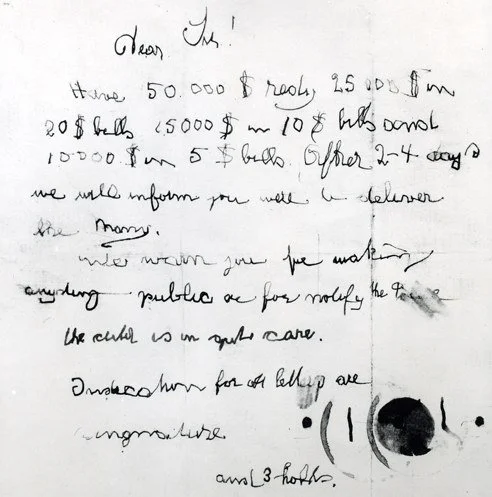
The ransom note, with the kidnapper’s symbol, left in the nursery on the night of the kidnapping.

In the Bronx, meanwhile, an elderly retired grade school principal named John Condon had been following the news. He revered Charles Lindbergh and thought the crime a terrible disgrace, and after the furor over the intermediaries Lindbergh had named, he took it upon himself to offer his own services as intermediary. Condon was known to be a hardworking educator, and a patriotic and religious fellow, to the point that some thought him an arrogant and haughty busybody, making a show of his principles. In a letter published in the Bronx Home News, he made the offer and sweetened the deal by saying he would add one thousand dollars of his own money to the ransom. Many thought he was attention seeking by sticking his nose in the Lindbergh case. His detractors were quite as surprised as he was when the Lindbergh kidnapper sent him a letter accepting his proposition, enclosing another letter for Condon to deliver to Lindbergh. When Condon telephoned Lindbergh, who had him open and read the enclosed letter, Lindbergh did not seem to take it very seriously until Condon described the symbol at the bottom of the page. That night, Lindbergh made immediate arrangements to meet with Condon. The letter directed Lindbergh to put the ransom money in a custom made box, and included a sketch like something a carpenter might draw. Condon was to be given the money and await word on where to take it. Meanwhile, Lindbergh was to keep an airplane ready for when he was given the location of his son. They made arrangements, the Lindberghs putting messages in the newspaper to the effect that they accepted Condon as intermediary—though they called him by the code name Jafsie, based on his initials J.F.C., in order to keep the press from identifying him. Condon took some toys from the nursery, hoping to present them to the child if the boy were present at the meeting, and thereby confirm his identity by his reaction to them, and he also took the pins from the crib blanket, planning to ask the kidnappers whether they could say where they had seen them before and thus likewise confirm that he was indeed dealing with the genuine abductors. After the message was printed in the papers, Condon received a phone call from a man with a German accent who instructed him when to be at home and expect further instructions. Condon believed he heard the caller talking to someone else during the call, further supporting the belief that there were at least two kidnappers. By March 12th, Condon had in his possession the custom built box they’d made to the kidnapper’s specifications. It was empty, however, as they would not have the ransom money on hand for another several days. At the appointed time when he had been told to always be home in order to receive further communication, a man rang his doorbell. He was a taxi driver who had been approached by a man with a German accent and given an envelope to deliver. In it were directions on where to go with the ransom money, and instructions to be there within 45 minutes.

In a panic, John Condon drove to the location in the letter, a certain porch near a hot dog stand where the letter stated further instructions awaited. His only hope was to meet with the kidnappers and explain the situation, that he did not yet have the money to give them, that he needed more time. At the location, he found a note directing him into a cemetery across the street. Condon went alone into the cemetery, and finding no one, he thought at first that something had gone wrong. Eventually, though, he saw a man signaling him from afar by waving a white handkerchief. Condon approached the man, who wore a dark overcoat, pulled a hat pulled down over his eyes, and held his handkerchief to his mouth and nose to hide his face. He spoke with the same thick German accent Condon had heard on the phone, asking if Condon had the money, and Condon told him he could not bring it until he saw the baby. Seeing a security guard, the man in the overcoat became spooked, leapt over an iron fence and bolted. Condon chased after him, calling to him, and eventually the man stopped running and allowed the 72-year-old Condon to catch up. Explaining his sudden flight, the man said, “It was too much risk. I would get thirty years if I am caught. And I am only go-between. I might burn.” Condon seized on this remark, asking what he meant that he might burn. “What if the baby is dead?” he replied. “Would I burn if the baby is dead?” Condon demanded to know if the baby was in fact dead, and the man reassured him the baby was well. Condon then sought to confirm his identity as the actual kidnapper, producing the safety pins, which the man in the overcoat readily identified as the pins that had fastened down the baby’s blanket in his crib, contradicting his previous claim of being a mere go-between. That is when the man opened up. He said his name was John, that he was part of a six person gang, the leader being a “high-level government employee.” He stated that Charles Jr. was aboard a boat moored some six hours away. Condon offered to be taken hostage so that he could be shown the baby, but John, who would come to be called Cemetery John, refused, promising instead to send the baby’s sleeping suit as proof.  A few days after this initial meeting, the baby’s pajamas were indeed mailed to Condon.  In good faith, Lindbergh collected the ransom money. However, on the advice of the IRS investigator who had famously put Al Capone away, he recorded the serial numbers of all the bills, and the bulk of the money would be in gold certificates, for already it was believed that the country may soon end the gold standard, at which point the kidnapper would draw attention when spending them or would have to exchange them, affording some further chance of apprehending him.

John Condon, aka Jafsie, the volunteer intermediary.

The Lindberghs continued to communicate with their child’s abductor through vague newspaper ads and received several more, increasingly impatient letters from Cemetery John, or from his superior in the gang, each containing the same familiar spelling errors and circular symbol. It would take another two agonizing weeks to prepare the ransom package and communicate their readiness to make the payoff. On April 2nd, at the specified time, another cab driver left another envelope at Condon’s doorstep, this one directing him to carry the ransom to a certain florist’s greenhouse, where he would find a further note. This time, Charles Lindbergh came with Condon, and he was armed. Upon their arrival, the note once again told him to walk alone to a graveyard located nearby, which Condon did, though he disobeyed the instructions to bring the money with him. He was cagey, realizing that he might be murdered for being the only person who had seen Cemetery John’s face. He skirted the graveyard, looking for an ambush, and eventually, Cemetery John called out to him. They walked to meet one another, and Cemetery John, crouching behind a shrub, demanded he go and get the money. When Condon came back with the ransom, Cemetery John checked it and then gave Condon an envelope, instructing him not to open it for six hours. Condon and Lindbergh then drove some distance up the road before Condon convinced Lindbergh to stop and open the envelope. His hands trembling, Lindbergh read that his son was being cared for by two innocent women aboard a boat called “Nelly” moored near the Elizabeth Islands. That very night, at 2am, he drove to an airfield and took off in a large, amphibious Sikorsky aircraft to search for the boat. For six hours that morning, he scoured the waters surrounding the Elizabeth Islands, buzzing dozens of boat, none of which matched the description of the Nelly provided by Cemetery John. He would continue for days to search the coast for the boat containing his son, to no avail. Thinking themselves double-crossed, they left new messages in the newpapers, but there was no answer. As they waited, the U.S. treasurer distributed a pamphlet to banks everywhere containing the serial numbers of the ransom bills, and a couple days later, the press sleuthed out that this meant Lindbergh had paid the ransom but not received his child in return, and they made it front page news. The press further discovered that Condon had been the Lindberghs’ intermediary and began hounding him, making him useless as their go-between if the kidnappers decided to initiate communication again. These developments caused the Lindberghs to despair of ever seeing their child again. But six weeks later, after continuing to chase false hope in the form of hoax claims, they did see their baby again, though only in the most awful way. A truck driver hauling timber near the Lindbergh’s Hopewell property happened to stop to relieve himself on the side of the road, and as he made his way into the woods to do so, he discovered the remains of Charles Lindbergh, Jr. The Eaglet could be positively identified, as his blonde curls and dimple were discernible despite decomposition and the activity of scavenger animals. But more than that, the baby remained in his undershirts, including the one his nursemaid had sewn for him out of flannel on the night of the kidnapping, while his sleeping suit was missing, because of course his kidnapper had removed it and later mailed it to Condon. Detectives also found a burlap sack near the road in which some blonde hairs matching the babies had been discovered. It appeared that the Eaglet whom all the world was searching for and hoping to find alive had actually been dead more than ten weeks, killed on the very night of the kidnapping by a fracture of the skull, according to the autopsy, and dumped less than two miles from the bed out of which he had been taken.

Following the discovery of the remains, the Bureau of Investigation under J. Edgar Hoover took a more active role in coordinating the search for anyone spending the ransom money, which more and more looked to be the only legitimate avenue that the investigation had left, besides the continued interrogation of Lindbergh household servants and further fruitless searches for a boat called Nelly. A year after the kidnapping, Franklin Delano Roosevelt took office and initiated his sweeping New Deal programs, which included his proclamation to return to the U.S. Treasury all gold as well as all gold certificates like those given to Cemetery John, which meant that about $40,000 of the ransom money would soon become rare and even more noticeable when spent than it already had been. After his first hundred days, Roosevelt centralized the investigation within the Department of Justice, giving exclusive jurisdiction to J. Edgar Hoover’s BOI. As resentment over Roosevelt’s reforms developed, and the suspicion of anti-Semites that he was part of some Jewish Communist conspiracy grew, FDR was actually accused of having something to do with the Lindbergh kidnapping. To many in the Depression, a crime against a wealthy individual like Lindbergh must de facto be a Communist plot, and wherever one cried Communist, another cried Jewish. Incredibly, an anonymous, widely-circulated pamphlet that alleged Roosevelt was protecting the murderer of the Lindbergh baby supposedly because he was Jewish. In fact, Roosevelt had done far more than his predecessor to ensure the killer was caught. In early 1934, as the second anniversary of the child’s abduction loomed, the BOI demanded close scrutiny of all bills being passed in New York, where the ransom currency was turning up at a rate of about $40 a week. Beyond just banks, they provided the booklet with the ransom money’s serial numbers, as well as handy key cards to help identify ransom bills quickly, to nearly every employee handling money in New York City, from grocery store clerks to postal employees, from department store cashiers to gas station attendants. Moreover, a New York City police detective assigned to the case sent letters to every gas station urging attendants to take down the license plate of any customer spending a gold note. That September, two and half years after the crime, these efforts would finally pay off, and an arrest would be made. To most, this would prove the final resolution of the mystery, but to many others, the mystery would never seem to have been solved.

*

Next time, I will discuss the apprehension of the man believed to be Cemetery John, the Trial of the Century, and the several alternative theories and conspiracy claims that still surround the case today.

Further Reading

Behn, Noel. Lindbergh: The Crime. The Atlantic Monthly Press, 1994.

Fisher, Jim. The Lindbergh Case. Rutgers University Press, 1987.

---. The Ghosts of Hopewell: Setting the Record Straight in the Lindbergh Case. Southern Illinois University Press, 1999.

Milton, Joyce. Loss of Eden: A Biography of Charles and Anne Morrow Lindbergh. HarperCollins, 1993.

Stout, David. The Kidnap Years: The Astonishing True History of the Forgotten Kidnapping Epidemic that Shook Depression-Era America. Sourcebooks, 2020.

Zorn, Robert. Cemetery John: The Undiscovered Mastermind of the Lindbergh Kidnapping. The Overlook Press, 2012.

 

The Business Plot - Part Two: The Bankers Gold Group

Much like the phrase “fake news,” “fascist” is an adjective that has been diluted through overuse as a political barb. It has become synonymous with “totalitarian” and “authoritarian” in accusations of dictatorial overreach. It is lobbed by those on the right against leftists about as much as it is by those on the left against far-right extremists, such as those who originally coined the term. Fascism as a political ideology sprang up in 1915 Italy when Benito Mussolini, formerly a journalist and politician, abandoned Socialism for nationalism and founded a paramilitary organization to fight in the first world war. Afterward, his fascists, so-called after the fasce or bundle of sticks that is stronger when bound together, turned their violence against what he saw as the remaining threat to Italy, socialists. After strong-arming King Victor Emmanuel III into surrendering the country’s government to his dictatorial control, Mussolini assigned great importance to propaganda. As a former journalist, he knew that he had to exert absolute control over the press in order to maintain his authority. And it was not only Italian journalism he sought to influence with regard to how his regime was portrayed. He felt it important to export propaganda as well. One country in which his propaganda efforts had been quite successful was the United States of America. As the Great Depression worsened, many Americans came to believe that what the country needed was a “strongman” leader like Il Duce, as Mussolini was called. This sentiment was especially strong among the wealthy, who greatly feared a Communist revolution in their troubled times. They lapped up the image of Italian Fascists as patriots fighting a socialist threat and of Mussolini himself as a hero who saved his country from ineffective parliamentary rule and ensured prosperity even in the midst of economic calamity. This portrait of Mussolini, which turned a blind eye to the domestic terror campaigns of his so-called “action squads,” made many a Wall Street financier and conservative politician into self-avowed Fascists back before the world had learned to recoil from the word. In the summer of 1932, in fact, as FDR and Hoover vied for the presidency, Republican U.S. Senator David Aiken Reed stood in the Capitol and unashamedly stated, “I do not often envy other countries and their governments, but I say that if this country ever needed a Mussolini, it needs one now.” The capitalists openly admiring Fascism in those years had been swayed not always by firsthand observation of the goings-on in Italy, but rather by the American press, which had taken part in Mussolini’s propaganda efforts with alacrity, some even accepting payment to do so. Perhaps the most influential of these was William Randolph Hearst, a newspaper mogul and no stranger to using his media empire to influence politics. Starting in the late ‘20s, Hearst actually ran columns written by Benito Mussolini on a regular basis, just as later he would print columns penned by Nazis like Goebbels, Goering, and even Hitler himself! Nor was Hearst alone in his amplification of Fascist propaganda. Richard Washburn Child, editor of The Saturday Evening Post, took money from Mussolini and served as the editor of the dictator’s memoirs, which he also published. And esteemed New York Times foreign correspondent Anne O’Hare McCormick wrote glowing accounts of Mussolini’s charisma and his efficient regime, purposely not reporting on its brutality or corruption. And this is to say nothing of Fascism’s boosters in other industries, such as those on Wall Street, like Thomas Lamont, a partner at J. P. Morgan and frequent economic advisor to the Hoover White House who accepted $100 million from Mussolini and described himself as “a missionary” for Fascism, using all his considerable influence to push America toward a Fascist future. This distinct faction of American high society was on the lookout for the rise of our own potential Fascist leader, whom they called “the man on the white horse,” a savior figure ironically named after one of the Four Horsemen of the Apocalypse associated with war and the end of days. And if Franklin Delano Roosevelt did not turn out to be the dictator they wanted, they thought they just might have to follow the example of Mussolini, who had seized power by marching his paramilitary army on Rome and demanding the king’s resignation. 

As mentioned in Part One of this series, many among Franklin Delano Roosevelt’s own patrician class hoped, despite his campaign rhetoric and progressive promises, that FDR might turn out to be the American Mussolini. After all, Mussolini himself had begun as a socialist before turning right. Indeed, William Randolph Hearst, who had not previously supported Roosevelt, later threw the weight of his media machine behind the president elect and even produced a Hollywood feature that was little more than a propaganda piece promoting the idea of a president who would do the country good by turning despotic. The film was entitled Gabriel Over the White House, and it depicted a president who is visited by the Archangel Gabriel and the ghost of Abraham Lincoln after a car accident. Thus divinely inspired, he goes on to seize dictatorial control of the U.S. government in order to accomplish his benevolent agenda. Roosevelt himself encouraged the propaganda, hoping to soften the shock when he sought unprecedented emergency powers after his inauguration. However, as I discussed in part one, regardless of one’s view of the executive and legislative power that FDR wielded during his first hundred days and afterward, what he used it to do, specifically bringing an end to the gold standard and demonizing the rich for gold hoarding, caused the Fascist fanboys on Wall Street as well as in the press to turn on him. And these were not the only reasons they had for giving up hope that FDR was their yearned for “man on the white horse.” Planters in the South and sweatshop operators in the North complained that their mistreated workers were leaving them for jobs created by Roosevelt’s New Deal programs, and industrialists bemoaned the passage of the National Industrial Recovery Act in June of 1933, which regulated wages and protected the collective bargaining rights of labor unions. The admirers of Italian Fascism had imagined their strongman leader would likewise favor corporatism over labor interests, and when Roosevelt did not, they thought they smelled socialism, or worse, the dreaded Communism. Later that year, when Roosevelt recognized the Soviet Union diplomatically, exchanging embassies with them, these critics who would have welcomed a Fascist coup declared that FDR was an outright Bolshevik actively transforming America into a Communist nation. Among many of these same critics, the activities of Eleanor Roosevelt also represented an affront to the American way. After her husband had basically invented the modern White House press conference, the First Lady began holding her own and insisting that only female journalists attend. She was an activist for women’s equality, and perhaps even more unforgiveable to the enemies arraying against her husband, she publicly declared that Fascism was a far more pressing danger to the world than Communism.

As I have discussed before, the Bolshevik revolution and the spread of Communism generally has always been associated with the conspiracy delusion and lie about a Jewish world domination plot. This destructive falsehood can most directly be attributed to the plagiarized forgery The Protocols of the Learned Elders of Zion, which alleged that international Jewish financiers led the nonexistent conspiracy to control all nations and people. Thus, even though FDR was making enemies of bankers and financiers, since he had formerly palled around with them, and since he was initiating social reforms that looked a lot like redistribution of wealth, and more specifically because he had begun official relations with Soviet Russia, the critics of FDR folded anti-Semitic conspiracy speculations into their attacks on his administration. Taking America off the gold standard became, in the eyes of the paranoid and hateful, a scheme to give Jews control of all the gold in the world. Anti-Semites scrutinized Roosevelt’s appointees and used math to argue that the President favored Jews. Only 15% of Roosevelt’s appointments were Jewish, but anti-Semites argued that this was out of proportion to America’s Jewish population, which comprised only 3% of its total. One wonders if these individuals would have accepted the logical extrapolation of their own argument, that Roosevelt’s appointments should have matched national demographics in this way, which would have meant some 10% of his appointments should have been Black. But of course, we know they would have been against this, for as Eleanor Roosevelt observed, critics of the New Deal, and especially those anti-Semitic critics who called it the “Jew Deal,” were overwhelmingly against ameliorating the condition of Black Americans. As context, it must be remembered that Hitler and his Nazis were coming into power in Germany at the time, spreading a pernicious racialist political ideology. While many Americans admired and supported Mussolini, fewer knew what to make of Hitler, whose chancellorship was officially ratified the day after FDR’s inauguration. Even as reports of Nazi book burnings and violence against Jews filtered into the U.S., many believed him simply a peculiarity and a European problem, though the First Lady collected newspaper clippings on him, recognizing the global threat he represented. As Nazism metastasized abroad, in America, anti-Semitic conspiracy delusions involving the Roosevelt administration spread as well. In something like the Birther conspiracy claims spread by Trump about Barack Obama, leaflets were printed and circulated depicting the Roosevelt family tree and tracing his lineage back to a Dutch family then called “Rosenvelt” in Holland. This family tree was accompanied by speculation tracing that Dutch family through numerous name changes, Rosenthals, Rosenblums, Rosenbergs, back, allegedly, to a supposedly Jewish family called Rossacampo that had been expelled from Spain in the 17th century. This conspiracy claim relied on the idea that this Jewish family took the Dutch name Van Rosenvelt, which means “of a rose field,” but of course, FDR could just as well have been descended from Dutch Van Rosenvelts. FDR himself traced his family back only as far as Dutch immigrants to America, and was very open, in a letter replying to a Jewish newspaper editor who had inquired about the rumors, that he didn’t really care if he was Jewish, writing, “In the dim distant past they may have been Jews or Catholics or Protestants. What I am more interested in is whether they were good citizens and believers in God.” And of course, whether or not Roosevelt had Jewish ancestry still proves nothing about any involvement in a global conspiracy, let alone that such a conspiracy existed, but since leaflets depicting the Roosevelt family tree were often accompanied by pamphlet reproductions of The Protocols of the Learned Elders of Zion, the anti-Semitic propaganda went a long way toward stirring up populist resentment against the President.

The growing Fascist sympathizers and converts in America, unsurprisingly, looked to what Mussolini had done in Italy, and what Hitler was now also doing, and took notes. One major commonality was the use by these dictators of paramilitary organizations to build power and seize control. Mussolini had his Voluntary Militia for National Security, known as Blackshirts for their customary attire, and Hitler, following suit, had his stormtroopers, known as Brownshirts. The authenticity of the Fascist threat in America can likewise be discerned by the appearance of numerous such paramilitary armies in the U.S. One of them, formed by Ku Klux Klansmen in Georgia, simply called themselves Blackshirts as well, while others differentiated themselves, but only by the colors of their shirts. Tennessee had their Christian extremist White Shirts, bent on taking over local government, and New York had their Gray Shirts, whose focus was removing leftists from teaching positions. Metaphysical writer, Christian nationalist, and Fascist William Dudley Pelley was among those who pushed the conspiracy claim that FDR was secretly Jewish, and he founded the Silver Shirts, a massive militia active in most states that stockpiled weapons and even stole rifles from a California naval airbase. Then there were the Khaki Shirts. Among the Bonus Army had been one fascistic leader, Walter Waters, who after General MacArthur’s destruction of their Hooverville had tried to form his own Fascist army, which he called the Khaki Shirts, but his fellow veterans were mostly uninterested, and his efforts fell apart quickly, such that the Khaki Shirts were not even involved in the next Bonus march on Washington. However, in 1933, one vet, Arthur Smith, reinvigorated the Khaki Shirts as an openly Fascist paramilitary organization with avowed intentions to overthrow Roosevelt, seize control of Washington, and even to “kill all the Jews in the United States.” Smith called himself a general and claimed he commanded 1.5 million men. However, it appears his movement was never that widespread, and during the summer following Roosevelt’s first 100 days, Philadelphia police arrested all of them for alleged plans to storm a National Guard arsenal. The Khaki Shirts collapsed after Smith held a rally in New York attempting to organize another march on Washington and anti-fascists confronted them, leading to one Khaki Shirt murdering a student counter-protester. Smith would eventually do prison time because of this act of violence, and would afterward abandon the group, absconding with twenty-five grand of their funds. The Khaki Shirts would eventually coalesce with Father Charles Coughlin’s militant Christian Front organization. As context for the astounding revelations of the Business Plot, however, suffice it to say that America was no stranger to Fascist movements bent on overthrowing the democratic order and marching on Washington to force Roosevelt’s resignation, and at least some of them were inspired by or grew out of the legitimate and overall peaceful protest of the Bonus Army marchers. And in response to this fascist groundswell, one Democratic representative from New York, Samuel Dickstein, who had witnessed violence erupting against his fellow Jews firsthand, convinced Congress to organize the House Un-American Activities Committee, or McCormack-Dickstein Committee, specifically with a mandate to investigate Nazi propaganda and fascist threats in the U.S.

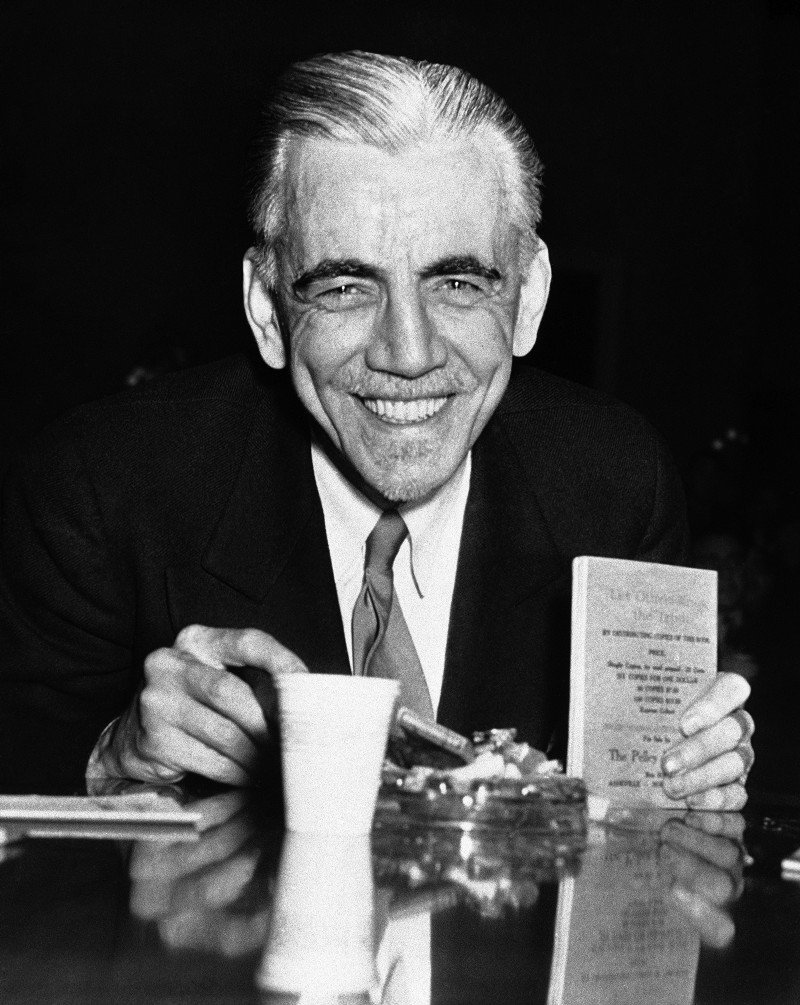
William Dudley Pelley, leader of the fascist Silver Shirts.

This was the state of the country when Smedley Darlington Butler, the retired soldier’s general and veterans affairs activist who had supported Roosevelt and encouraged the Bonus marchers, received an odd visit at his Pennsylvania home from some strange men claiming to be wounded veterans, as he would later testify. One of these callers was William Doyle, and the other a bonds salesman named Gerald MacGuire, or Jerry MacGuire, if you like. Butler was immediately skeptical of the men because they arrived in a limo and sported expensive bespoke suits. They represented American Legion departments in Massachusetts and Connecticut, they told him, and they’d come, purportedly at the behest of numerous Legionnaires who disliked American Legion leadership and were concerned about Roosevelt’s treatment of veterans, to ask for Butler’s help in reforming the veterans’ organization. Butler was by then a popular public speaker and had been vocally critical of the American Legion, so this part of the men’s proposal, to place him in a leadership position in which he could effect change, interested him. However, he disagreed with their assessment of the President’s treatment of veterans, so he remained cautious, and his suspicions were further aroused, according to his later telling of the story, when MacGuire claimed that the White House had barred them from inviting him as a distinguished guest to an upcoming convention. Butler considered Roosevelt a friend and found the claim hard to believe, making him suspect that MacGuire was trying to plant a seed of enmity between him and the President. MacGuire explained that, in order for Butler to attend the American Legion gathering, he had arranged for him to be falsely credentialed as a Hawaiian delegate, and this was all too much for Butler, who refused to entertain the cloak and dagger scheme and sent the visitors away. MacGuire and Doyle returned with a different plan a month later, suggesting that Butler gather a few hundred Legionnaires--something that would be easy for him to do, considering the esteem in which veterans held him—and bring them to the convention, where they could initiate a cheer demanding that Butler be allowed to speak, at which point Butler could deliver a speech they had prepared for him. Butler protested that veterans couldn’t afford the train fare and lodgings they would need to attend the convention, to which MacGuire responded by whipping out his bank depositor’s book, which showed funds of more than a hundred grand that he said could be used to pay these expenses. That is equivalent to about 2.2 million dollars today. Butler’s suspicions only increased with this boast of exorbitant funding, and he thereafter became convinced that MacGuire was a mere front man for some extremely wealthy interests when he read the speech that had been written for him. He was surprised to find that it was essentially a call for Roosevelt to return to the gold standard so that veterans’ bonuses would not be paid in worthless paper currency. Believing that the average veteran understood and cared little about such matters as the gold standard, Butler carefully pushed MacGuire to reveal the backers of the scheme, and MacGuire assured him that the scheme had nine very wealthy financers, but that he could only reveal two of them: a Wall Street bigwig veteran, Grayson M.P. Murphy, whom Mussoliini himself had awarded an honorary Italian military title, and Robert Sterling Clark, heir to the Singer Sewing Maching fortune, with whom Butler had served and of whom he had a low opinion. When Butler craftily expressed doubt that MacGuire’s venture really was so well-funded, MacGuire responded by producing a stack of thousand dollar bills and offering them to Butler. Keep in mind that in 1933, the thousand dollar bill, a denomination that would be discontinued in 1969, was equivalent to more than 20 grand today. Thus proffering a stack of them would be the same as whipping out a billfold of more than a million bucks. Butler was reportedly aghast and reacted like someone being extorted, telling MacGuire, “You are just trying to get me by the neck,” and ending the conversation abruptly, saying, “I am not going to talk to you any more. You are only an agent. I want some of the principals.”

After his last strange encounter with MacGuire, Butler realized that he should try to collect evidence of whatever was being plotted by MacGuire and his backers, so he began to play along. He wrote to MacGuire, creating a paper trail, pretending to have come around, and requesting a meeting with the Singer heir that MacGuire had named as a backer, Robert Sterling Clark. During that subsequent meeting, Butler expressed his confusion about the contents of the speech the group wanted him to give, and Clark revealed that it had been written by the chief counsel of J. P. Morgan and Company at the behest of Morgan himself. Very quickly, Clark transitioned from talking about how a return to the gold standard would benefit veterans when they receive their bonuses to talking about how it would benefit the wealthy, like himself, outright admitting that he was spending so much of his money to back this scheme because “I have got 30 million dollars and I don’t want to lose it. I am willing to spend half of the 30 million to save the other half.” Finding this attempt to force public policy changes by manipulating veterans entirely distasteful and doubting that Roosevelt would even prove as compliant as the plotters believed, Butler refused to attend the American Legion convention. When it was convened, however, Butler read in the papers that its delegates were swayed by an inundation of telegrams to pass a resolution endorsing a return to the gold standard. Thinking the matter concluded, Butler was surprised when Macguire kept bothering him. For the rest of the year, he repeatedly invited Butler to veterans’ gatherings and offered to pay him to speak about returning to the gold standard, and in 1934, every time Butler arranged a speaking appearance, MacGuire would show up and offer him three times his speaking fee to include some remarks about the gold standard in his speeches. Finally, in the spring of 1934, MacGuire met again with Butler and revealed to him that he had recently been overseas, visiting foreign nations to better learn how Fascist movements used veterans’ organizations to seize control of governments. He explained how he had visited Mussolini’s Italy, Hitler’s Germany, and Stalin’s Russia and discovered that veterans organizations or citizen armies proved to be the “real backbone” of each dictatorship. He didn’t think that Americans would accept such coups as Mussolini and Hitler had conducted with their private armies, but he said he saw in France a perfect model for what he and his backers hoped to achieve in America. On February 6th, 1932, a demonstration of far right nationalist groups turned violent, and due to the involvement of veterans’ organizations, like the anti-Semitic Croix-de-feu, or Cross of Fire, it was dubbed the Veterans’ Riot and viewed as a fascist coup that did not result in a dictatorship but did successfully topple the left-wing government. MacGuire insisted to Butler that the same could be accomplished here in the U.S. if Butler, who had the ear of every soldier, would encourage them to band together and march peacefully on Washington demanding change—a bloodless coup. Moreover, their coup would be entirely constitutional, he assured the increasingly alarmed general. “We have got the newspapers,” he declared, presumably referring to Fascist sympathizer William Randolph Hearst’s papers, “We will start a campaign that the President’s health is failing.” With pressure from the veterans’ armies like that which was previously exerted by the Bonus Expeditionary Forces, MacGuire said that Roosevelt, to ease the burdens of his office, would appoint someone to a new cabinet position, Secretary of General Affairs, who would in effect act as the chief executive, making FDR a mere figurehead. The entire scheme was clearly an imitation of Mussolini’s March on Rome and handling of the King of Italy. If Roosevelt didn’t agree to the arrangement, MacGuire explained, he would be compelled to resign, and one by one each person in the line of succession would decline the office for reasons MacGuire explained with eerie confidence, as if it had already been arranged, until by the laws of the time, the office would pass to their new man in the cabinet, the Secretary of General Affairs, regardless.

Symbol of the fascist Croix-de-Feu veterans organization that MacGuire believed could be emulated to affect a coup in America. Image Credit: Fauntleroy (CC BY-SA 4.0)

As soon as their group, which Butler would thereafter refer to as the Bankers Gold Group, had the reins of government, they would bring back the gold standard, and MacGuire insisted they had all the capital they would need to accomplish their objective, with three million dollars currently available and a total budget of $300 million. According to the worth of today’s dollar, that’s an astonishing $6.7 billion in financing, according to the American Institute for Economic Research’s Cost of Living calculator. Butler played it cool, saying he would need to think further on it, and MacGuire told him that if he read the news, he would soon get a sense of who his powerful backers were, as their superorganization was about to be publicly announced, and “[t]here will be big fellows in it.” Two weeks after those foreboding words, Butler read about the formation of the American Liberty League, an organization founded to protect property rights and bolster free enterprise, which came out the gate swinging at Roosevelt for “fomenting class hatred.” Among the financial supporters of the organization were the two names MacGuire had already given Butler, Grayson M.P. Murphy and Robert Sterling Clark. The rest of the names included conservative Democratic rivals of Roosevelt, Republican opponents, Wall Street royalty, and titans of numerous industries. Some of the more recognizable names present were financier E. F. Hutton, two du Pont brothers who had served as Presidents of the multinational chemical company, and Samuel Colgate, president of the soap company that bore his family name. Executives active in the mining, automotive, oil, and retail industries were listed alongside them, as were more than one of the builders of the Empire State Building. It was a veritable Who’s Who of American business and politics, and according to Butler, it caused him great worry about how he should proceed. Eventually, he decided to contact the press before going to the J. Edgar Hoover or to the President. The editor of the Philadelphia Record assigned investigative journalist Paul French to look into it, and Butler, who misrepresented the reporter as a newspaperman sympathetic to their cause, managed to get MacGuire to agree to speak with him. Astonishingly, MacGuire went ahead and confirmed the entire story to the journalist, including the information about his trip to observe Fascist armies abroad, adding the further tidbit that the du Ponts had arranged to arm their army of veterans with Remington rifles. The reporter quoted MacGuire as saying, unironically, “We need a Fascist government in this country to save the Nation from the communists who want to tear it down.” To cap it off, MacGuire actually told French that the country could easily resolve their unemployment problems by doing what Hitler had done and placing the poor into forced labor camps. Thus armed with journalistic evidence of the plot, Butler finally told MacGuire what he really thought of the plan being enacted by the Bankers Gold Group, or the American Liberty League, as they chose to style themselves, stating, “If you get 500,000 soldiers advocating anything smelling of fascism, I am going to get 500,000 more and lick the hell out of you, and we will have a real war right at home.” He then went, in the fall of 1934, to J. Edgar Hoover with the story. Disappointingly, Hoover claimed there was little his Division of Investigation could do, since there was no federal offense, even though there was clearly a case for sedition, inciting a rebellion or insurrection, and treason, and he had been tasked by Roosevelt himself to look into domestic Fascist threats. Instead, true to form, Hoover used this threat to further seize control of domestic intelligence, leading to the formation of the FBI. He did, however, spread word of the alleged plot around Washington, and soon the House Un-American Activities Committee contacted Butler and his reporter, French, to appear before them and answer some questions.

Paul French published his exposé of the Bankers Gold Group and their Wall Street Putsch two days before the two of them spoke to the committee in a secret executive session, with the headline “$3,000,000 bid for fascist army bared.” The story was picked up by major papers all over the nation, so the proceedings commenced with intense press scrutiny, such that the committee was obliged to assure the papers that they would go public when the revelations of the committee warranted it. In the meanwhile, those implicated by French’s exposé were widely quoted in the press categorically denying the allegations. Grayson M.P. Murphy suggested it was libel, and Robert Sterling Clark only admitted to urging Butler to endorse “sound currency,” which at the time was just another way of saying a return to the gold standard. Meanwhile the committee seemed to have lost steam, calling fewer witnesses than expected, and the “Public Statement on Preliminary Findings” they eventually published was lackluster. It started with a statement that it “has had no evidence before it that would in the slightest degree warrant calling before it” several of the more prominent politicians, military officers, and corporate executives implicated in the testimony. The intention, it seems, was not to give in to sensationalism and to avoid the Inquisition-like practice of acting on hearsay, but the result was that the committee appeared to be saying there was little to the accusations, and to some it seemed a cover-up was underway. However, the rest of their statement, as well as the public hearing that followed, and the official report published months later showed that in fact they had ample evidence of the plot. Not only was Smedley Butler’s testimony corroborated by the reporter Paul French, but they managed to acquire correspondence between MacGuire and his superior, Murphy, showing that he had indeed been studying Fascist military organizations abroad, and they further acquired bank records indicating that MacGuire had been given access to large sums of money for which he could not account. All of this disproved the common defense that it was just idle talk, a “cocktail putsch,” and the fact that MacGuire actually offered the money to Butler further disproves the alternative explanation that MacGuire was actually conning his Wall Street backers, since approaching Butler shows he was earnestly attempting to arrange the coup. However, despite the McCormack-Dickstein committee’s final conclusion that Butler had been truthful and there had been an unsuccessful attempt by wealthy and powerful men to stage a Fascist coup, the committee’s report purposely omitted mention of the American Liberty League and the names of the major plotters, and though they stated their intention to get to the bottom of the matter, their investigation petered out and their House Un-American Activities committee was dissolved until 1938, when under a new chair it turned its attention to Communist Party infiltration. To Smedley Butler, it seemed the committee had shrunk from doing their duty, but as a rumor suggested that President Roosevelt himself had met with the committee and quashed their investigation, and since the plot itself seemed at least to have been thwarted, Butler came away appeased. What proved to be more aggravating than the committee proceedings, however, was the fact that while the Fascist plotters did not have their names dragged through the mud, General Smedley Butler did.

Almost all contemporaneous press coverage of the Business Plot treated the allegations as something laughable, lacking any evidence and manifestly untrue. Time magazine called it a “plot without plotters,” and likened Butler to George Custer for “publicly floundering in so much hot water.” The New York Times asked, “What can we believe? Apparently anything, to judge by the number of people who lend a credulous ear to the story of General Butler’s 500,000 Fascists in buckram marching on Washington to seize the government.” And if a news outlet didn’t play down the story like this, they often as not simply chose not to write about it at all. Perhaps, knowing what we know about the aforementioned Fascist leanings of the American press at the time, it is not surprising that the press treated Butler’s accusations as a farce. If we do not want to view national newspapers as being in on a conspiracy, however, since as I have argued time and again, massive conspiracies simply cannot be credited, we might find other reasons for their doubt. For example, it certainly does seem at first blush that Smedley Butler would have been the worst possible candidate to recruit for such a scheme. I spoke previously about his disillusionment with America’s foreign capitalist adventures and wars of empire, which of course are hallmarks of fascism. And he was a prominent supporter of FDR, even considering himself a friend of the president. More than that, he had recently been in the news for making anti-Mussolini, and thus anti-Fascist, remarks. In 1931, he stated in a speech that a friend of his had been riding with Benito Mussolini in his Fiat when the dictator struck and killed a child, and without stopping, belittled the importance of a single life. To give a sense of how strong the sympathy for Fascism and admiration for Mussolini was at the time, Butler had actually been arrested and almost court-martialed for the remark, something that had not happened to a general since the Civil War. Some contemporaries and historians have suggested that Butler might have lied about this hit-and-run incident to smear Mussolini, since it appeared to be an unsubstantiated rumor, and that this shows he may have also been lying about the Business Plot. However, the friend whose story he had been repeating, Cornelius Vanderbilt IV, eventually corroborated the story in his memoirs, though by his telling Mussolini had not explicitly denigrated the value of a single life, but rather simply told him to “never look back.” After all is said and done, Butler looks like an honest man whose claims were corroborated again and again. For example, another person identified as in on the plot, a national commander of the VFW, likewise denied involvement but confirmed the plot by revealing he had also been approached by “agents of Wall Street” regarding a plan to stage a coup. In fact, rather unbelievably, the very next year, Smedley Butler claimed that Father Charles Coughlin telephoned him, trying to recruit him to lead a paramilitary force in an illegal attempt to overthrow the Mexican government and further suggested that an armed insurrection was being planned in the U.S. as well. It beggars the imagination that, after Butler’s revelation of the Business Plot, Father Coughlin would try to recruit him for another such conspiracy, and some have suggested that it was a hoax on Butler, but Butler also claimed to have evidence that Coughlin’s men in New Jersey had stolen firearms from a U.S. arsenal. Furthermore, Butler himself recognized that his claims would never be believed again and still felt so strongly about it that he chose once more to inform J. Edgar Hoover about the matter, though privately this time, not taking it to the press at all. Whether or not this supposed plot of Coughlin’s was genuine, the allegations were certainly prescient, as we know Father Coughlin did build a paramilitary organization, the Christian Front, and in 1939, numerous New Jersey members were arrested and charged with stealing munitions and conspiring to overthrow the U.S. government.

From another view, the choice of the Bankers Gold Group to bring in Smedley Butler makes perfect sense. Robert Sterling Clark apparently told Butler that he was not their first choice, that in fact, many of the financial backers wanted to approach General Douglas MacArthur with their proposition instead. The fact that they ended up contacting Butler shows that they were following the playbook of other Fascist movements. Clearly Butler, the soldier’s general who was universally admired by veterans, who spoke regularly at veterans’ events, and who had already been critical of the existing leadership of the American Legion, was the perfect person to take control of the organization and lead their army. Vets would remember that Butler had been for their cause when the Bonus Army was in Washington, whereas MacArthur had driven tanks over them. Clearly what was most important, in their mind, was Butler’s ability to muster and inspire and lead the rank-and-file vets, as that was what had brought Mussolini and Hitler into power, as MacGuire had reported from his fact-finding mission in Europe. The downfall of their plan was that they presumed everyone, including Butler, had come to hate Roosevelt as much as they did, and if not, that they could always buy a change of heart and allegiance with stacks of thousand-dollar bills. And just as they misjudged Butler, they also misread public sentiment, much like the January 6th insurrectionists, likewise deluded by propaganda in the news they consumed, misjudged what the nation’s reaction to their storming of the Capitol would be. Just as MacGuire and the Bankers Gold Group modeled their proposed coup on their Fascist and Nazi predecessors, so too the similarities with January 6th are striking. The paramilitary organizations involved this time around, the Oath Keepers and the Proud Boys, whom all of America saw Donald Trump personally commanding on national television when he directed them to “stand back, stand by” during the debates, are largely comprised of military veterans. The majority of the Proud Boys indicted on seditious conspiracy are vets, and the trial of Oath Keepers founder Stewart Rhodes revealed how he manipulated veterans into joining their cause. The lesson of the Business Plot remains as important today as it might have been before January 6th, 2021, as chapters of the Proud Boys have surged all over the country since then. And now, in Brazil, we find that Bolsonaro, a Trump admirer and purveyor of similar false claims about voter fraud in Brazil, has encouraged another coup attempt modeled on those that have come before it. The old sentiment that “it can’t happen here” is now so thoroughly refuted that its alternative, “it can happen here,” has become trite. What we must remember is that it has happened here, and we must be prepared for it to happen again.

Until next time, remember, there is a difference between conspiracy speculation, which typically lacks irrefutable evidence and relies on fallacious logic, and actual conspiracies, which do occur. The difference, usually, is that the latter, inevitably, are publicly uncovered and proven to exist. The story of Smedley Butler goes to prove that someone always talks.

Further Reading

Archer, Jules. The Plot to Seize the White House: The Shocking TRUE Story of the Conspiracy to Overthrow FDR. Skyhorse Publishing, 2015.

Denton, Sally. The Plots Against the President: FDR, a Nation in Crisis, and the Rise of the American Right. Bloomsbury Press, 2012.

Galka, Bradley M. The Business Plot in the American Press. 2017. Kansas State University, Master’s Thesis, https://krex.k-state.edu/dspace/bitstream/handle/2097/38255/BradleyGalka2017.pdf.

Katz, Jonathan M. Gangsters of Capitalism. St. Martin’s Press, 2021.


The Business Plot - Part One: The Bonus Army

There was a great and immediate controversy when a congressional committee was formed to investigate the recent attempt by the powerful and wealthy to manipulate populist discontent and foment a coup against the United States government. Still fresh in the memory of the public mind were the indelible images of the marchers on Washington, DC, the “rioters,” as they were called, a motley army of them, who were also called “insurrectionists,” indicating their intention to overthrow the American democratic order, amassing on the lawn of the U.S. Capitol building as the representatives within conducted a certain business in which these marchers wanted to intervene. Many wondered what might have resulted had that ragtag army of thousands not been foiled in their undertakings, and during the later House Committee investigation, they heard what may have happened. For it came out in committee hearings that there had been an overt and credible conspiracy to incite a popular uprising for the purpose of supplanting the power of the duly elected President, and raising an explicitly Fascist dictatorship in place of our representative democracy. Especially inflammatory were the allegations that it was those in high places, men of great wealth, privilege, and political power who had been behind the plot overthrow the U.S. government. The findings of the committee were not universally believed, but many saw the truth in them, knowing that our populace had been subjected to foreign propaganda for years and that many among the elite believed a dictatorship more friendly to their interests would enable them to retain and grow their fortunes. However, many others viewed the committee as a witch hunt and believed those implicated in the plot when they denied everything even in the face of clear evidence. In the press, however, the committee’s findings were roundly mocked, with the New York Times saying “The whole story sounds like a gigantic hoax” and that “[i]t does not merit serious discussion.” Perhaps this was because newspaper magnates were themselves implicated as conspirators, or perhaps it was because the populist insurrection being discussed in the House committee was completely unrelated to the very real march on Washington that had recently taken place and in this case had only been proposed and never actually occurred. Sorry, you seem confused. What do you mean the New York Times hasn’t viewed the Capitol Insurrection skeptically? What newspaper magnates are implicated? I’m referring to William Randolph Hearst. Oh… I see the confusion. You think I’m talking about the controversy surrounding the findings of the House Select Committee to Investigate the January 6th Attack on the United States Capitol. No, no, no, I’m describing the proceedings of the 1934 House Committee on Un-American Activities, which convened in the years after one controversial march on Washington to investigate the claims of an alleged conspiracy by Wall Street fat cats to astroturf another march in an attempt to seize control of the reins of government. But actually, now that you mention it, I suppose I can see the similarities.

Constant readers will realize that I discussed the Business Plot, or Wall Street Putsch, in my post “The Perils of American Democracy,” but I gave it terribly short shrift there with only about half a paragraph, and it has been a topic that I have greatly wanted to explore in more depth for a number of reasons. One is, of course, the anniversary of the January 6th insurrection. Last year, on the first anniversary, I wrote a two-part post that drew parallels between January 6th and the Wilmington insurrection of 1898. I think that my examination of that incident showed a strong parallel between the use of fake news propaganda in galvanizing such insurrections and gaslighting the larger public to misrepresent the true nature of the situation, and I think it’s lessons about white supremacy and institutional racism remain vital. Go and read the Coup on Cape Fear parts 1 and 2 if you haven’t. But I find the story of the Business Plot perhaps even more instructive when it comes to contextualizing January 6th. We are talking about a nation in economic crisis, inundated by foreign propaganda, which drove a cabal of wealthy and influential titans of industry to orchestrate a martial uprising against the seat of American government in imitation of a more organic and well-intentioned but much-maligned protest movement, all of which is clearly revealed by congressional investigators whose findings are thereafter widely disbelieved and dismissed, leading to no real justice for those who enacted the plot. As I wrote and recorded this episode, the Department of Justice had charged nearly a thousand people in connection with the Capitol Attacks, most of them rank and file participants, and only a few with actual charges of seditious conspiracy. The DOJ has maintained an impressive 99.8% conviction rate in these cases, but it can be argued that they haven’t held the ringleaders, the congresspeople and executive cabinet members who incited the attack, to account. On Monday, December 19th, the January 6th panel did refer charges against former president Donald Trump to the DoJ, including one charge of “inciting an insurrection.” However, it remains to be seen whether Merrick Garland’s DoJ will indict him, what defense he may make, and what the outcome of that indictment might be. Furthermore, the fact that his indictment and trial won’t prevent his concurrent campaign to regain the presidency further complicates matters. If he were both reelected and convicted and an attempt was made to bar him from taking his elected office, one can certainly see the current partisan Supreme Court bench considering this constitutional crisis and inevitably finding in his favor, and the fact remains that any sitting president, be it Biden or some other 2024 challenger, has the power to pardon him. So clearly the resolution of the January 6th insurrection remains up in the air, and I believe the story of how the Business Plot shook out in the end to be supremely educational and sadly, perhaps prophetic. Lastly, I was inspired to produce this series by the fantastic 8-part series Rachel Maddow Presents: Ultra. I don’t care what your opinions are of Maddow or MSNBC; this was a well-researched, lucid, fascinating, and astonishing account of a time when sitting members of congress were complicit in both a Nazi propaganda scheme and a conspiracy to overthrow the U.S. government, leading to the largest sedition trial in American history. You can consider this 2-part series a kind of unauthorized prequel to Ultra, which I hope you’ll listen to at your earliest convenience. This isn’t a paid endorsement; I just think that it’s a very important podcast that everyone should hear.

Just as the story of the January 6th insurrection must be seen in the context of the recession resulting from necessary Covid restrictions and the widespread racial justice protests of 2020, with which the Capitol Insurrection is frequently and speciously compared, so too the Business Plot must be placed in the context of the Great Depression and the march of the Bonus Expeditionary Forces on Washington, DC. It began with a crash. Rebounding from a previous economic depression, the value of stocks had inflated beyond their worth between 1921 and 1929, prompting the Federal Reserve to raise interest rates in order to slow the inflation—something we saw them doing again just last year. The resulting plummeting of stock prices in October 1929 led to the panicked sell off known as the Great Crash. But the Wall Street crash did not at first worry many or greatly affect the overall economy, since only a wealthy fraction of the populace invested in the stock market. However, a severe drought across the Great Plains, which would later come to be known as the Dust Bowl, soon led to America’s farmers facing major challenges, and a series of bank panics in the autumn of 1930 led to the “crisis of confidence” that then-President Herbert Hoover identified as the true culprit of the Great Depression. President Hoover had himself contributed to this crisis of confidence, as he had signed an international tariff act against the advice of economists that further strained the global economy and banks, especially those that provided loans to struggling farmers. All of this is a very simplistic description of the triggers of the Great Depression, but the result was that gold, upon which our currency was still based, began to leave the American economy as it was withdrawn from banks and hoarded or sent overseas by the wealthy. The very real consequence of this loss of capital was the closure of banks, the failure of businesses, mass unemployment, and hunger. Thus we get the immortal symbols of the Depression: men, women, and children, destitute, walking American roads and highways barefoot with no refuge. Soon, these symbols took on the name of the man seen as directly responsible for this catastrophe, President Herbert Hoover, who was ironically known for great humanitarian efforts overseas but remained staunchly against what he called the dole, or government assistance paid out to those in need, here at home, believing it made people lazy. Thus the carts that these Depression homeless pulled all their belongings in were dubbed Hooverwagons, and their encampments famously called Hoovervilles. Many of those affected were U.S. military veterans who had served their country bravely overseas and now could not survive in the broken economy at home. An idea arose, a lifeline for these desperate and starving veterans, that if they could just be paid their bonus early, it would mean the difference between life and death. Back in 1924, with the passage of the Bonus Act, these veterans had been promised a substantial payment for lost wages in the Great War, but in 1931, in the depths of the Depression, that bonus wasn’t to be paid for another 14 years. Veterans argued that it should be called the Tombstone Bonus, then, for most would not live to receive it.

When Hoover vetoed the immediate payout of the bonus, veterans’ organizations like the American Legion and the Veterans of Foreign Wars helped to mobilize destitute veterans all over the country into a massive protest movement. Calling itself the Bonus Expeditionary Forces, or the Bonus Army, they marched on Washington, DC, and tried to bring a petition to the White House, where they were barred at the gate. Leaving without incident, the Bonus Army would return in even greater numbers the following summer of 1932 to camp out on the lawn of the Capitol building when another bill authorizing early payment of their bonus that had been passed by the House of Representatives was being voted on by the Senate. When debate on the bill was tabled until the following year, many expected violence from the Bonus Army, but they merely sang “America the Beautiful” as they returned to the massive Hooverville that they had constructed from garbage across the river, within view of Capitol Hill. Most of the demonstrators left the city after that, but more than 8,000 of them stayed in their shantytown, the largest such Hooverville in the country. The following month, they were visited by a retired Major General who will be very important to this story. Smedley Darlington Butler was at the time a supporter of Franklin Delano Roosevelt, Herbert Hoover’s rival in the ongoing 1932 campaign for the presidency. Over the course of his career in the Marines, he had led men in various American imperial campaigns throughout the Caribbean, Central America, the Philippines, and China. During the course of his career, he had seen firsthand how the military was used abroad to further the business interests of American financiers and bankers, later describing war as a racket and himself as a “gangster for capitalism.” Smedley Butler entered the Bonus Army’s Hooverville camp and expressed great sympathy for their cause. Over and over, he warned them against lawless acts, assuring them that they had “the sympathy of 120 million people in this nation,” and that they’d lose it if they rioted. But otherwise, he listened to all of their complaints, staying with them into the early hours of the morning, and encouraged their continued demonstration, reminding them that they “didn’t win the war for a select class of a few financiers,” and urging them to “[h]ang together and stick it out till the gate bars of hell freeze over.” Butler had a reputation as a soldier’s general, rather than a general’s general, in that he was far more popular among those he commanded than among those who commanded him. The stark difference between Butler and other generals would soon be demonstrated with terrible clarity.

Bonus Army protesters raise their hands to confirm they are Americans who served overseas.

A striking parallel can be seen between Hoover’s response to the Bonus Army in the summer of 1932 and Donald Trump’s response to Black Lives Matter protesters in the summer of 2020, both incidents precursors to an organized coup attempt perpetrated by those who had vehemently opposed the preceding, legitimate protest movements. All of us should remember the George Floyd protests during the summer of 2020, and how Donald Trump and his extremist boosters called the protesters “thugs,” “anarchists,” and “terrorists.” In June of 2020, peaceful racial justice protesters in Washington, DC, were tear gassed and fired on with rubber bullets as Trump threatened to “deploy the United States military and quickly solve the problem.” In a remarkable instance of history rhyming, Herbert Hoover, back in 1932, likewise believed that the Bonus Army marchers were dangerous and was considering the same measures. The nation’s top cop, J. Edgar Hoover, head of the Bureau of Investigation, precursor to the FBI, was whispering in the President’s ear that the Bonus marchers were Communist terrorists, all of them highly trained, armed with machine guns and airplanes, none of which was true, but J. Edgar Hoover was a fearmonger—that was how he built and funded the FBI, by manufacturing panic about domestic enemies. U.S. Army intelligence and General Douglas MacArthur were also telling Hoover that the Bonus marchers weren’t what they claimed to be, that they were “rabble-rousing insurrectionists and Communists” bent on revolution, which of course led to claims that they were all Jews, and that they weren’t even veterans, as they claimed. In truth, the Bonus marchers, whom MacArthur had begun derisively calling Boners, were a remarkably diverse group composed of about equal thirds white, Jewish, and Black Americans. MacArthur’s claims that they weren’t veterans were simply lies that the press amplified. The Veteran’s Administration had surveyed the Bonus Army and recorded that 94% of them were indeed vets, the majority having served overseas, and almost a quarter of them disabled in the line of duty. It’s true, maybe half of them were Communist or sympathetic to Communism, or at least with Socialist leanings, but this was not unsurprising at the time, as many in the Depression-era U.S. were more and more enamored with Communism, Socialism, and even Fascism, as we will further see. Indeed, in that very election year, the Socialist presidential candidate garnered three times the number of votes he had received in the previous election year. Certainly Communists would have liked to turn the entire Bonus Expeditionary Forces to their cause, but the fact was, most of the Bonus Army were just destitute and starving victims of the Hoover economy. In fact, they routinely destroyed Communist literature that was being circulated among them, and many embraced the mantra, “Eyes front—not left.” Just as with the BLM protests, some violence did erupt in clashes with police. When, on the President’s prompting, some veterans were evicted from derelict buildings that the police chief himself had previously arranged for them to camp in, they pushed back, some bricks were thrown, and the tousle resulted in one policeman shooting two veterans dead. Despite the fact that this was a pretty clear case of police failure to control a volatile situation, and it resulted in the deaths of demonstrators, not police, the incident was used to justify the unconscionable brutality that ensued.

General MacArthur convinced President Hoover that the situation warranted military action. MacArthur, along with his aides, future general George S. Patton and future president Dwight D. Eisenhower, were directed to expel the veterans from the city. Eisenhower and Patton apparently thought the entire thing too political and distasteful, but MacArthur appeared to relish the chance to bring the might of the U.S. Army against unarmed American citizens. In full military dress, he deployed infantrymen with fixed-bayonets, cavalry with drawn sabers, a machine gun detachment, and even five tanks onto the streets of the U.S. capital. The poorly-timed operation took place just as many federal employees clocked out for the day and entered the streets, such that crowds of Bonus Army veterans mingled with crowds of onlookers who mistook the military forces for some kind of parade. The cavalry charged the crowds, trampling men, women and children, while the infantry advanced on them, bayonet tips pressing the crowds back. Bonus marchers and city residents alike fled in abject terror as tanks ran them down and cavalrymen struck them with the flats of their sabers. Tear gas grenades burst in their midst, igniting fires and completing the transformation of the nation’s capital into a warzone. Within hours, all the Bonus Army vets had retreated to their shantytown outside the city, and despite the fact that President Hoover had ordered the military not to enter their encampment, MacArthur sent tanks, machine guns, and troops to surround the Hooverville. The veterans waved a white flag of surrender and asked for an hour to get their families out. MacArthur granted them this, and when the hour had elapsed, he sent his forces in to burn their shacks and lean-tos to the ground. President Herbert Hoover stood at a window in the White House and watched the fires. What he saw destroyed that night was not only the homeless encampment that bore his name. He was also watching his chances for reelection go up in smoke. Perhaps more than his handling of the economic crisis, his handling of the Bonus Expeditionary Forces provided his opponent, Democratic candidate Franklin Delano Roosevelt, all the ammunition he needed to win his campaign.

The burning of the Bonus Army Hooverville at Anacostia Flats.

Perhaps few words are needed to introduce the next major character in our story, FDR, as he is widely known and considered by many to be the best or at least the most influential U.S. President of the 20th century. We know FDR principally as the architect of progressive New Deal legislation that helped America begin to recover from the Great Depression and programs that provided a social safety net for the future, and as the wartime leader who shepherded us through World War II, the mobilization for which would be what finally ended Depression. We remember him as the first president to enter our homes and reassure us in his Fireside Chat radio addresses. And we remember him seated on a wheelchair, paralyzed from the waist down by infantile polio, and therefore an inspiration to all overcoming physical disability. FDR was not, however, exactly as one might imagine him. He did not, for example, contract polio as a child, as the term “infantile polio” suggests. In fact he was a vigorous outdoorsman, enjoying sailing, horseback riding, and fishing up until the day he became ill at 39 years old, and indeed, he remained athletic after his paralysis, as his physical rehabilitation regime was robust. He became an avid swimmer and even had a pool installed at the White House. Despite his good health, his critics unsurprisingly used his paralysis against him to insinuate that he was ill or diseased or even unable to discharge the duties of the offices to which he was elected. Likewise, the circumstances of his birth were often used against him. He was not of such a background as one might expect for a social reformer. He had been born into great wealth and privilege, of the Hyde Park branch of the Roosevelts, former president Teddy Roosevelt his first cousin. We might credit the influence of his father, who instilled in him the importance of working to help the suffering and the poor, for the causes he would later champion, and we might further credit Eleanor Roosevelt, his cousin, whom he married, who regularly performed volunteer work in New York slums and worked tirelessly to improve the conditions of poor women and children. FDR was never a Communist or Socialist, however, as his critics on the far right would paint him. In fact, he was an inveterate capitalist, devoted to salvaging the economy rather than changing the economic order, as those on the far left would have preferred. And those on the far left did not claim him as their own, believing that he favored fat cats with his reforms and did not go far enough in redistributing wealth. The opposition of Huey Long and Father Charles Coughlin, those two populist firebrands that history has deemed demagogues, reveals just how moderate FDR really was despite the revolutionary liberal reforms he would enact in his first hundred days. Both had supported Roosevelt in his campaign against Hoover, but in the terrible interregnum, as conditions further plummeted under the lame duck and Roosevelt—who was dutifully making plans for his first hundred days—went yachting, both turned against him, but for far different reasons, which illustrate the fact that FDR was no extremist. It happened that FDR was joined on his yachting excursion by one of the richest men in America, Vincent Astor, as well as several other wealthy members of the New York Yacht Club. Long and Father Coughlin both saw FDR as revealing himself to be a puppet of Wall Street, despite his rhetoric. To Long, this meant he served the elite, the financial powers that be, who hoarded wealth, rather than the people who were suffering without it. Father Coughlin too took FDR’s actions to indicate he was in the pocket of bankers, but as Coughlin’s ideology evolved, international banking interests came to mean an international Jewish conspiracy, which in turn meant Communism. So somehow, FDR being friendly with wealthy bankers made him a Communist, if that makes any sense. But of course, it doesn’t make much sense, for FDR had denounced bankers in particular, in no uncertain terms, as the “unscrupulous money changers” responsible for the banking crisis. And in his first hundred days, he made good on the promises of his campaign, such that those he formerly yachted with would come to view him as a “traitor to his class.”

When he took office, Roosevelt immediately declared a national bank holiday to stave off runs that would force further bank failures. In his first Fireside Chat, FDR successfully convinced many Americans to trust the banks again because of the changes he had pushed through Congress with the passage of his Emergency Banking Act, and banks saw a billion dollars returned to them over the ensuing weeks. If this was all the Emergency Banking Act had done, Wall Street would certainly have thought Roosevelt on their side. He was, after all, from a wealthy family. Surely he had a vested interest in protecting the wealthy classes. In fact, the way that Roosevelt was seizing broad executive powers in his efforts to right the ship of the American economy sat very well with many in his wealthy class, among whom Mussolini, the strong leader of Italian Fascism, had become more and more popular in recent years, in large part due to a widespread propaganda campaign in America that we will examine further in part two of this series. Many had high hopes that FDR would prove to be another Mussolini, whom they viewed as a benevolent dictator taking bold action to set his country in order. The Emergency Banking Act, however, also gave the Secretary of the Treasury the power to seize gold in an emergency. One of the principal concerns leading to the failure of the economy was the outflow of gold from the country during the ongoing crisis of confidence, and Roosevelt felt he needed the means of curtailing that if necessary. When his new executive powers suddenly enabled him to take their gold, that changed things for the wealthy. Roosevelt had assured the public that the gold standard was safe, but a couple of days after taking this power to seize gold, he signed an executive order forbidding banks to make gold payments in a further effort to prevent hoarding. This was taken as a signal that he absolutely intended to abandon the gold standard after all and resulted in even more hoarding by the very wealthy, the financiers and bankers whom FDR had been accused of serving. FDR then felt compelled to do exactly what he had promised not to, and a month and a half after taking office, he signed an executive order requiring all Americans to surrender their gold money to the U.S. government in exchange for paper currency. This was meant to be a temporary emergency measure to shore up the American gold reserves, but the wealthy, the very gold hoarders causing the emergency, worried that if they converted all their fortune into currency, rampant inflation would destroy their fortunes. To make matters worse, Roosevelt seemed intent on publicly shaming them for their gold hoarding. FDR had been pointing at gold hoarders as unpatriotic social enemies for some time, and when he took office, he threatened to have the names of all those who had recently withdrawn gold from the nation’s banks published by the press, prompting many to redeposit their gold just to avoid such disgrace. Then, Roosevelt threw his support behind the Pecora Committee, a senate subcommittee devoted to investigating and revealing to the public all the unethical and reckless practices of Wall Street insiders and financial institutions in manipulating the market, an investigation that, later that year, bolstered the passage of the Glass-Steagall Act which cleaved investment firms from banks and insured bank deposits. It is safe to say that, for every powerful enemy among the ultra-wealthy that chief counsel Ferdinand Pecora made over the course of his investigation, President Roosevelt made one as well.

Hoover and Roosevelt on the latter’s inauguration day.

On May 9th, 1933, exactly two months after his inauguration, Bonus Army marchers returned to Washington, DC. These poor veterans remained angry over the violence the former president had inflicted on them, and rightly so. They further had some gripe with the new president, FDR, who had recently slashed veterans’ benefits in order to reduce the deficit. Roosevelt, however, took a very different tack in resolving their grievances. He directed the veterans to be housed at an abandoned Army camp in Virginia, where they would be provided medical care, fed well, plied with hot coffee and even treated to concerts by the Navy Band. It was a major humanitarian effort, and to top it off, Eleanor Roosevelt, the First Lady of the United States, visited the camp and gave the protestors a sympathetic ear. This gesture was not lost on them: “Hoover sent the army,” they said, “Roosevelt sent his wife.” While Roosevelt did not work to award the vets their bonus, he did work to resolve their unemployment. One of his principal New Deal programs was the Civilian Conservation Corps, putting young, unmarried men to work planting trees and laying telephone poles. In order to help the members of the Bonus Expeditionary Forces, Roosevelt waived the original age requirement of the corps and put thousands of the disaffected veterans to work. This all seems like something of a happy ending, but there were forces conspiring against Roosevelt. I have argued in the past against conspiracy theories about so-called “smoke-filled rooms,” but here certainly, considering what we know about what followed, some such secret meetings must have been convened. The powerful enemies that Roosevelt had made were seeking a way to remove him, despite or perhaps because of all the good he was doing the country. They sought to preserve their own wealth above all else, the rest of humanity be damned, and they saw in the veterans’ organizations that had mobilized a dissident army to march on the capital a tool that in their hands could give them everything they wanted.

Until next time, remember the famous Mark Twain quote, “History Does Not Repeat Itself, But It Rhymes.” And further remember that Mark Twain never actually said or wrote that. As near as the wonderful online sleuth at Quote Investigator has been able to determine, that quote first appeared in 1970 and was later misattributed to Twain. However, Twain did once write “History never repeats itself, but the Kaleidoscopic combinations of the pictured present often seem to be constructed out of the broken fragments of antique legends,” and that’s just as true, if not quite so quotable.

Further Reading

Archer, Jules. The Plot to Seize the White House: The Shocking TRUE Story of the Conspiracy to Overthrow FDR. Skyhorse Publishing, 2015.

Denton, Sally. The Plots Against the President: FDR, a Nation in Crisis, and the Rise of the American Right. Bloomsbury Press, 2012.

Galka, Bradley M. The Business Plot in the American Press. 2017. Kansas State University, Master’s Thesis, https://krex.k-state.edu/dspace/bitstream/handle/2097/38255/BradleyGalka2017.pdf.

Katz, Jonathan M. Gangsters of Capitalism. St. Martin’s Press, 2021.


A Very Historically Blind Xmas: The Iconic Christ

For the last 20 years or so, conservative commentators have convinced the Christian Right that there exists a “War on Christmas,” in that secular society is moving away from what they consider the “true” meaning of Christmas. I don’t intend to retread once again the true origin of the holiday; I encourage everyone who hasn’t listened to go back and listen to the first three of my Very Historically Blind Christmas specials for more insight into the historical and folkloric basis of the holiday. But I want to start our conversation this year by looking at the outrage over taking the Christ out of Christmas. We hear it almost every year, when some media company or retail chain wishes us an inclusive Happy Holidays rather than a very explicitly Christian Merry Christmas. Perhaps the most outrageous controversy occurred in 2015 when café juggernaut Starbucks toned down the seasonal imagery on their red cups. But a great example of the historical blindness of these claims is the argument that the common abbreviation of the word “Christmas” as “Xmas” is a clear representation of this supposed anti-Christian trend, in that it literally crosses out the word Christ. In reality, the letter X has long stood for the word or name “Christ.” In Greek, the original language of the New Testament, the word for Christ, Christós, is spelled starting with a big old capital “X” and an “r.” Constantine the great, the 4th century CE Roman Emperor who famously converted to Christianity, is said to have popularized the letters “XR,” or chi and rho, as an abbreviation of Christ’s name emblazoned on his military banner. The “R,” or rho, looked like a P in Greek, and the first Anglo-Saxon usage of the abbreviation to shorten the word Christmas dates to 1021 CE, written as “XPmas.” The shortening became more common through the centuries, with Google Ngram showing spikes in usage in the 16th and 18th centuries, and a gradual upslope in the 1800s, when many examples of it can be found in literature. Indeed, Ngram shows that its use had actually dropped significantly by the 21st century. But never mind the actual truth of the matter that history shows, I guess. In the same way, we can see episodes in history when there really was a literal War on Christmas, and that historical perspective refutes those who claim that plain red cups and wishing people Happy Holidays is a suppression of their religious observance and should make them feel rather silly. After all, Christmas only started to become a legal holiday in U.S. states in the 19th century. Back in the 17th century, in New England, Puritans had outlawed it, and even after the Crown brought it back, it was out of favor for a long time. The objection was that Christmas encouraged a Catholic sort of worship, which Puritans considered pagan in character, and idolatrous. This view can be traced back to Europe and the Reformation. First, Lutherans did away with the celebration of saints’ days, keeping only Christ Mass to honor Jesus, but Calvinists did away with Christmas and Easter too, reasoning that only the Sabbath was acceptable to observe, as it was the only holy day mentioned in scriptures. This view was further popularized in Great Britain among Presbyterians who banned Christmas in Scotland in the 16th century, and among Puritans in England, who outlawed it during the 17th-century Civil War. Clearly the long history of carousal and topsy-turvy, anything goes partying during the holiday contributed to the Puritan distaste for the celebration, but a large part of the Protestant resistance to the holiday resulted from their iconoclasm. Calvinists especially criticized the Catholic veneration of saints and Mary through portraits and statuary as a form of idolatry and paganism, and it seemed to them that all the trappings of Christmas smacked too much of a Catholic-style religion. Indeed, this debate is occasionally raised even today, as Catholics call Protestants hypocrites for criticizing them over their veneration of Jesus, Mary, and Joseph in statuary when they put up nativity scenes in their homes every Christmas. Who knew that the image of baby Jesus in the manger could cause such controversy? Well, the answer to that should be most people—Christian apologists, theologians, biblical scholars, historians, art scholars, and even just your average Christian—for many and various are the robust debates and controversies about the image and likeness of Christ.

To begin our study of popular imagery of Christ, and to more concretely anchor the discussion as a holiday topic, let us look more closely at depictions of the Nativity. The first thing that may jump out to a critical mind when examining most nativity scenes is that the Christ child is very often pictured as a lily white babe. But we will get to depictions of race or ethnicity in icons of Christ. Here at the start, let us examine how the image of the Christ child became so tied up with Christmas imagery. I have spoken at length about the origin of midwinter celebrations and how they came to be viewed as a commemoration of Christ’s birth despite the fact that he most certainly wasn’t born during that time of year. This notion of the birth of baby Jesus being celebrated in December led to some odd adaptations of former traditions during the Reformation. Gifts had formerly been given to children on December 6th, the feast day of St. Nicolas, but Martin Luther, seeking to move away from the veneration of saints, insisted on focusing on Christmas Eve as the day of gift-giving. This led to a notion of a visiting gift-giver other than St. Nicolas, which Luther told children was Christ himself, or rather the Christ child, or Christkind. The legend of a gift-bearing Christ child visiting households on Christmas eve spread among Germans and evolved. Unsurprisingly, this Germanic Christkind was depicted like a little blonde white boy. On Christmas Eve, children were sent to their rooms to await the Christkind, whose arrival was announced by a ringing bell, but when the children raced out to see, the Christkind has already gone, leaving their presents behind. Over the centuries, the depiction of the Christkind evolved, such that the little boy became a little girl, and eventually a little white female angel. Likely this is because the figure of the Christkind, also called the Christkindl in the diminutive, was conflated with the angel characters that accompanied him in Christmas parades. The iconography is most distinctive in antique Christmas postcards, with the Christkindl depicted as a little girl carrying a bell or lantern, bearing a basket of presents across a snowy countryside. The figure of the Christkindl was even folded into the myth of the gift-giving St. Nicolas, or Santa Claus, who would sometimes himself be called Kris Kringle, a corruption of Christkindl, and on some postcards both can be seen pictured together, Santa cradling the Christkind angel child in his arms as both beam. And where is the image of Christ in this? It is the perfect example of how iconography evolves and adapts to other cultures until it is absolutely unrecognizable from its original subject.

A typical image of the Christkindl from a vintage Christmas card.

So let us move to modern depictions of Christ and begin our journey back through the ages to better understand how images of Jesus have likewise evolved to the point that they cannot be viewed as legitimate portraits of the historical man. To begin with, we must start with the most popular of images of Christ. It may surprise many that the most widely used image of Christ today, called the Head of Christ, can in no way be considered an accurate portrait. Also called the Sallman Head, the portrait was drawn in 1924 by an American, Warner Sallman, who sold it to a devotional magazine and later reproduced it as a painting. After the image was popularized, having been provided to soldiers in World War II for them to carry around and meditate on, the artist claimed to have sketched it from a miraculous vision late one night after beseeching God in prayer, but that rather sounds like mythmaking after the fact. The image has been venerated by the Coptic Orthodox Church since 1991, when it credited the report that a boy in Texas miraculously recovered from leukemia after seeing the portrait shedding tears. It is no surprise that the portrait was around in the nineties for that young leukemia patient to contemplate, as since the reproduction was painted, a company devoted to marketing lithographic prints of the portrait made it into the single most popular portrait of Christ, rivaled only by the Divine Mercy Image, a painting commissioned by a Polish nun who claimed to have received specific instructions from Jesus about what it should look like during a 1931 vision. Since both images are claimed to be divinely inspired, some might claim that they represent accurate portrayals of Christ, and there are some real similarities between the images, a white robe, long wavy brown hair and trim beard, long nose, high forehead, and white skin, or at least a light olive complexion, depending on how one perceives the tone and lighting. Importantly, we cannot compare the images to written descriptions of Christ in the scriptures, as those are glaringly absent from the New Testament and even from apocryphal works. Lacking any textual description, then, do we have any way of checking the authenticity of these supposed products of divine inspiration? Well, they are not the first images of Christ, of course, so we may begin by comparing them to predecessors to see how they fit into the genre of Christian iconography.

Interestingly, the Divine Mercy Image shares some striking similarities with a famous work of the High Renaissance called Salvator Mundi, or Savior of the World—not just in the likeness of Christ but even down to the position of Christ’s hands. This work is either an original work by Leonardo Da Vinci, or it is a copy of a lost work by Da Vinci. This in itself is something of an interesting mystery, but it opens to our discussion the work of Da Vinci and how his portrayals of Jesus Christ might be viewed as the invention of the modern image of Christ. Da Vinci’s depictions of Christ would certainly be influential on Christian iconography. That cannot be reasonably argued against. However, there are some odd claims that must be addressed made about the work of Da Vinci and who he used as the model of his portraits of Christ, including Salvator Mundi and The Last Supper. One notion is that since Da Vinci is believed to have used his young pupils and assistants, Gian Giacomo Caprotti and Francesco Melzi, as models, that one of them may have served as his model for Christ. Since these young men were intimate companions of Da Vinci’s, this theory has sometimes been used to troll conservative Christians by saying their image of Christ was modeled on a homosexual, but in truth, we don’t have concrete evidence about the nature of Da Vinci’s relationship with these men or whether either served as a model for Christ. Another tale has it that he used a fine-looking young man named Pietro Bandinelli as his model for Christ in The Last Supper, and years later, as he continued work on the fresco and it came time to paint Judas Iscariot, he went looking for a wretched looking beggar, and that model turned out to also be Pietro Bandinelli, who had fallen on hard times and whose beauty was marred by a sinful life. This story appears to have been wholly invented by a 19th century Presbyterian evangelist named John Wilbur Chapman for a sermon intended to show the harms of sin. Lastly, there is the claim, virally circulated as a meme on the Internet, that the modern image of Christ was modeled on Cesare Borgia, son of the controversial Pope Alexander VI, and that Borgia’s father commissioned images of Christ by Da Vinci and others and commanded that his son’s likeness be used. To this is added the claim that the pope did this to rid the world of images of a semitic Jesus, and even ordered all such other images be destroyed. The problem with this claim is that there is no evidence for it. Novelist Alexandre Dumas, of The Three Musketeers and The Count of Monte Cristo fame, is credited with recording this “fact” in his essay on the Borgias, but Snopes debunked this, finding no evidence of the claim in Dumas’ work. We know who Da Vinci’s patron was for The Last Supper, and it wasn’t a Borgia or a pope. Moreover, images of a European-looking Christ predate the Renaissance. There may be some kernel of truth present in this that has nothing to do with the model Da Vinci may or may not have used, in that there is reason to believe Da Vinci was influenced in his depictions of Jesus by an effort to Europeanize Christ’s image, even if he may not have been aware of it.

Salvator Mundi, attributed to Leonardo Da Vinci

In the latter half of the 14th century, some 35-40 years before Leonardo Da Vinci began work on The Last Supper, a curious letter was published and circulated around Italy. Purported to be a missive written by a Roman official identified as the governor of Judaea, or sometimes as the governor of Jerusalem, the letter’s purpose is to inform the Senate of Christ’s existence and his activities, specifically the miracles he was performing, such as curing disease and resurrecting the dead. Curiously, though, these momentous reports are mentioned only briefly, rather offhandedly, and the bulk of the letter is devoted to a physical description of Christ. The Letter of Lentulus says he is tall, with a respectable countenance. More specifically, it says his hair is the color of “an unripe hazelnut,” or light brown, is parted in the middle and straight until his ears, at which point it falls curly to his shoulders. A beard, too, is described, full, also brown, but not long, and forked at the chin. Even the color of his skin is suggested with a line about its “slightly reddish hue,” indicative of a certain cheerful disposition according to the medieval notion of bodily fluids, or humors, determining temperament, but also hinting at a very European lightness of skin tone, in which ruddy complexions are more common. The circulation of the Letter of Lentulus in Italy during the High Renaissance offers a clear and convincing explanation of the origin of modern images of Christ. In Da Vinci’s Salvator Mundi and The Last Supper, as well as in later variations like the Divine Mercy Image, we see it all, the good looks, the mild expression, the pale skin, the light brown hair, long and parted in the center, and even the forked beard. However, this image was certainly a 15th century invention, as scholars agree that the Letter of Lentulus is not genuine. It identifies one Publius Lentulus as the praeses or governor of Judaea or Jerusalem depending on the version, and putting aside the problem that there was no governor of the city of Jerusalem, other than a military commander, the actual term praeses as an honorific designating a governor would not be used until the 3rd century CE, and thus is anachronistic. Moreover, some of the earliest versions of the letter give the name of an emperor who would not have been in power at the time the letter was supposedly written, an error that was amended in future versions. But the biggest tell that this was a fabrication is the simple fact that the letter’s entire purpose seems to be to establish that Christ looked like a European. Simply put, it was a piece of fake news, a hoax artifact, designed to rewrite history by representing an ancient Middle Eastern Jew as European-looking, and it succeeded, not only by inspiring many works of art, but also, later, by inspiring white supremacists.

From the 19th century onward, the Publius Lentulus Letter has been resurrected and touted by those who argue Jesus was white. Long after it was discredited as a forgery, it began to gain credence among whites in America and Britain, where most acknowledged that it was a fraud but nevertheless felt that it rang true or wanted it to be true. In the U.S. especially, where Judeo-Christian scriptures were used to bolster first chattel slavery and later Jim Crow oppressions, the Lentulus Letter gradually went from being a known forgery, to being disseminated in the Gilded Age as a true eyewitness description of a white Jesus. Later, the Nazis would follow suit. Their Institute for the Study and Eradication of Jewish Influence on German Church Life put great effort into promoting the notion of an “Aryan” Jesus, promulgating the false history that Galilee was peopled by nothing but converted Gentiles or non-Jews, so it stood to reason that Christ, who was from Galilee, was himself a Gentile. This, however, is pure speculation, and misrepresents the ethnic demographic of Galilee. Roman-Jewish historian Josephus does mention forced conversion when Judaea expanded just before the time of Christ, but to suggest the populace of Galilee was comprised only of Gentiles is insupportable. Indeed, all passages touching on his ethnicity in canonical scriptures clearly indicate he was a Judaean Jew. In Galatians, it is said he was born under Judaean law, which is matrilineal, in that his mother, Mary, was Jewish, and in Romans, it is said he was of the seed of David, and not metaphorically, clarifying that this was “according to flesh.” Later in Romans, again, it specifies that Christ was descended from the “root of Jesse,” the father of David. Essentially, Christ was descended from the royal lineage that had formerly ruled Judah. While it’s true that the gospels indicate this Davidic line of descent from Joseph, who was not his biological father according to the doctrine of Immaculate Conception, and that there were traditions in the 2nd century CE suggesting Christ’s real biological father was a soldier named Panthera, there is no claim that Panthera was not himself a Jew. In addition to his Jewish status as the son of a Jewish woman, there is the further evidence that, in John, it’s said of the Jews in Jerusalem that “his own did not accept him,” and when the Romans crucified him, the sign hung on his cross to define his crime said he was killed for being “King of the Jews.” All signs point to Jesus being a Jew, and any who argue otherwise do so with some bias or agenda.

A so-called “Black Madonna” portrait, appearing to depict the Christ child with darker skin.

White supremacists are not alone in misrepresenting Christ’s likely skin color, though. In the 19th century, a dubious connection was made between the story of Christ and the Hindu god Krishna by English antiquarian and reformer Godfrey Higgins, who suggested that their names were derivative, and that Krishna, typically depicted as blue but whose name means “black” or “dark blue,” originated as the god of a black people, therefore making Christ black. This claim has evolved over the last two centuries, such that atheists and critics of Christianity will delight in claiming that the story of Christ was stolen from the ancient Hindu story of Krishna, claiming that Krishna too was born on December 25th, of a virgin, in a manger, lived only 30 years, and was crucified, and rose again after three days, none of which is true. Even the etymology of their names is known to be completely unrelated, as the name Christ is derived from a Greek word approximating the Hebrew word for messiah. The notion of a Black Jesus would rise again, as it were, championed Black American ministers, starting with George Alexander McGuire in 1924, who pointed out that, since Christ is said to have been descended from David, and David counted among his forebears some ancestors of Hamitic descent, and Ham was widely thought to have been cursed with dark skin, making him the origin of the Black race, then it meant that Christ was at least of mixed race Black heritage. Of course, the entire notion that Blackness is a curse put on Ham and his descendants by God is a pernicious claim that was long used to justify slavery and racist oppression. Although it must be admitted that McGuire’s turning of this logic against white supremacists is admirable, as a basis for a real inquiry into Christ’s appearance, it is not sound. Starting in the 1950s, civil rights activists and radical theologians continued to preach against the notion of a white Jesus and argue instead for a Black Jesus, but not typically on grounds previously cited. The first major champion of the movement in the Civil Rights era was Albert Cleage, Jr., a Detroit minister whose black separatist message was based principally on revolutionary anti-racist sentiment. He wrote numerous books claiming that Jesus was literally, ethnically Black in his effort to remake Christ as a messiah more closely identified with the Black Church. Mostly Cleage relied on the claim that Christ’s people, Judaean Jews, were a people who, having come out of Egypt, had mixed with dark-skinned African peoples, and his evidence was itself just as problematic as any evidence of Christ’s whiteness in that he relied on the numerous Black Madonnas, or statues and paintings of Mary and the infant Jesus that seem to depict them with dark skin. These works are typically Byzantine in origin, and depictions of people with darker skin are common in such Greek style works of that era. Additionally, many of them are believed by art scholars to have darkened with age and exposure to candle smoke. The argument for a Black Jesus would be further developed in the 1960s by James Cone, but his Black Liberation Theology was not focused on arguing that Christ literally was African. Rather, his was more of an iconoclastic theology, calling out White Jesus as an idol that ought to be smashed. Later developments of the Black Jesus doctrine suggested that Christ’s identification with blackness had nothing to do with the color of his skin but rather the parallels of the historical suffering and oppression of both the Jews and Black people. Despite the fact that no strong literal argument has been put forward with historical source evidence to support the notion of Jesus as a Black man, the idea, both literal and figurative, stands as an admirable challenge to white supremacists and remains popular. Recently, an image claiming to show the earliest known depiction of Christ, revealing him and all of his apostles to have dark brown skin and hair, went so viral that it was even picked up and spread by the the Daily Mail. In reality, however, the painting, which hangs in the Coptic Museum in Cairo and depicts Doubting Thomas placing his finger in Christ’s wound, dates only to the 18th century. Like the Black Madonnas, the darker skin tones of figures in it can be attributed to the Byzantine style and darkening because of age and smoke. As of now, the artistic work that holds the record as the earliest depiction of Christ is called “The Healing of the Paralytic,” a Syrian work dating to 235 CE that pictures Christ beardless, with short hair, in a sketch that makes it impossible to determine skin tone.

So the conundrum is apparent. In a world in which the racial identity of this religious figure has become an important point of contention, we really have no clear sense of what he looked like. Most early images show a shorter haired man, and the bearded Jesus doesn’t seem to have shown up until centuries later, but even the earliest images of him as a short-haired, beardless man originate from more than two hundred years after his death. So after all of this, essentially we find that all works of art depicting Christ prove inadequate and untrustworthy in credibly portraying what Christ the historical man may have looked like. However, the faithful will tell us that we should not look to the works of man for an accurate depiction of Christ, but rather to the portraits made without hands, acheiropoieta, icons supposedly formed miraculously, through some supernatural impression. I have spoken a great deal about such artifacts in the past, such as in my investigation of the Guadalupe Tilma. More germane to our topic today, I devoted an entire episode to the Shroud of Turin, in which I raised numerous issues such as its carbon dating and indications of pigment having been added to the blood present in the image. When I researched and wrote that episode in 2018, I left it somewhat open-ended because of recent evidence published in PLOS ONE that the iron particles present in the blood traces on the shroud’s fabric are consistent with the blood of a human enduring trauma. However, since that time, that paper was retracted. Furthermore, I’ve come around to the possibility that the staining may have been accomplished through the suffering of a person purposely imitating Christ’s suffering as a kind of penance, a not uncommon practice in the Middle Ages, which would be consistent with the carbon dating. So we can rule out the Shroud of Turin. Additionally, in a patron exclusive, I spoke of another acheiropoieta, the vernicle or Veil of Veronica, a supposed miraculous impression of Christ’s face made when he wiped his bloody sweat upon a woman’s veil on his way to crucifixion, and in both my episode on the Turin Shroud and my minisode on the Vernicle, I spoke about the Mandylion, or the Image of Edessa, another supposedly miraculous image of Christ’s face on cloth. Both, it turns out, began as legends, and only much later did actual portraits appear purporting to be the legendary images, with many competing versions, all of which are manifestly works of art. Neither are these the only acheiropoieta to discuss. There is the Ancha icon, called the Keramidion and said to have been miraculously copied from the Mandylion through contact with it. This artifact is actually just a hot wax painting. Then there is the Kamuliana, once venerated in Constantinople, which was supposedly an image of Christ imprinted on a piece of linen and discovered in a well by a pagan woman who had previously doubted Christ’s existence.  Except it was actually painted on canvas, and it turned out to be big business for the churches built to house it and charge people admission to view it. Lastly, there is the image of Christ in the Sancta Sanctorum within the Lateran Palace in Rome. This image, unlike the others, was never claimed to be anything other than a painting; however, at the time of its first veneration, it was claimed that it was painted by angels. Afterward, it was said that St. Luke sketched it and angels finished it. Eventually, it was just said that St. Luke painted it, which would suggest it was an original portrait by a biographer of Christ, but in truth, there is no record of the image until the 7th century CE, and it is further useless as evidence of Christ’s appearance since it long ago faded to become indiscernible and was replaced by a different silk painting of Christ. In the end, all these supposedly miraculous images turn out to be mere works of art, just as untrustworthy as any other painting, none of which can be relied on as accurate portrayals of Jesus. 

The Ancha Icon, or Keramidion, said to be a genuine acheiropoieta, or miraculously created image of Christ.

If no image can be trusted, we are forced to rely on the written record. With the Publius Lentulus Letter revealed to be a fraud, we look to the Gospels, which as I have already said, are curiously silent about Christ’s stature, facial features, hair color and style, and his clothing. They give us absolutely nothing to work with. And why is that? It is a remarkably curious omission. It is not a matter of physical description merely being uncommon in ancient works of biography. As Joan Taylor, author of my principal source, What Did Jesus Look Like?, points out, most ancient Greek biographies give ample details about the appearance of their subjects. This was even true of ancient histories focused on Moses, and elsewhere in New Testament scriptures, descriptions are not withheld, so why did the writers of the Gospels resist telling us what the most important figure in their religion looked like? Strangely, the closest we get to a description comes after Christ’s resurrection, when he appears to the Apostles and they fail to recognize him! This episode would go a long way toward supporting the theory I discussed in my recent patron exclusive that perhaps it was not Christ who was crucified, or that it was another, such as his own brother, who appeared to disciples after the crucifixion claiming to be a risen Christ. Some early Christian scholars and Gnostics, however, took this as further evidence of the notion that he was polymorphous, a shape-shifter who might appear differently to those who looked on him depending on the quality of their souls. But regardless of the value of either of these hypotheses, this passage raises the idea that Christ may have been so very unremarkable that it was difficult to describe him, and perhaps even difficult to recognize him. What would a biographer say if he was not tall nor short, not handsome nor ugly? Taylor points out that if he were handsome, it may have been something the authors of the Gospels would have emphasized, as attractiveness was commonly thought to be typical of royalty, and this would have demonstrated Christ’s kingly heritage. But if conversely, he were unattractive, this might have been emphasized as well to drive home the point that he was a longsuffering servant of his Father. Indeed, in later years, citing a passage in Isaiah thought to prophesize the appearance of Christ as a “Suffering Servant,” it would be said that “he had no form of majesty that we should look at him, nothing in his appearance that we should desire him. He was despised and rejected by others; a man of suffering and acquainted with infirmity, and as one from whom others hide their faces.” Indeed, not counting prophecies believed to be speaking of him, the earliest known genuine physical description of Christ, from 2nd century philosopher and critic of Christianity Celsus, tells us that, “as they say, [he] was little and ugly and undistinguished.” Celsus’s description has variously been criticized as malicious name calling by a critic or as yet another identification of Christ with Isaiah’s Suffering Servant, but as Taylor points out, the wording “as they say” indicates he is sharing what others at the time said about Christ, opening the possibility that he had heard an accurate description passed down from one who had seen or known Jesus. The notion of a short and ugly messiah lines up with the image of Jesus as a philosopher, she points out, suggesting he may have been a kind of unkempt wandering sage, and this may account for many of the aspects of the image of him we have received, such as his being bearded and clothed raggedly in robes. The fact remains, though, that none of Christ’s biographers specify these details of his appearance. Taylor suggests that they might have been stuck, not wanting to portray him either way, as good-looking or ugly, and so purposely avoided the matter. Many faithful would say this had something to do with modesty or focusing more on matters of the spirit than on the physical, but of course, a simpler explanation comes from the consensus view among scholars that the writers of the Gospels weren’t there and didn’t know Christ and therefore could not accurately describe him. What are we left with, then? Simply the knowledge that he was a Judaean Jew, living around the turn of the Common Era, and that he may have been exceedingly average in his looks. And that, it turns out, is enough.

Running with the aspect of Celsus’s description of Christ as “undistinguished,” Taylor sets out to develop the thesis that Jesus was exceedingly average, an ordinary-looking man for his time and place and ethnicity. A more accurate image of Christ can then be extrapolated based on a scientific understanding of the circumstances of his birth and life. From the ample data on the measurements of human remains kept by the Israel Antiquities Authority, as well as other osteological records, she calculates an average height among Judaean Jews of his locale and age as five feet, five inches tall. She cites expert biohistorian Yossi Nagar who asserts that, based on historical knowledge of intermarriage or lack thereof and analysis of chromosomal pools, the extant people today who appear most like ancient Judaean Jews are Iraqi Jews, which fills in with relative certainty several prominent features of the historical Christ. He must have had black or dark brown hair and brown eyes. As for the much debated color of his skin, it likely was some shade of olive or honey, though of course there would have been variation in any community, such that his complexion may have been dark or light within that certain range. What we know about the common practices among Jews at the time when it came to hair, practices governed by religious codes as well as by the need to keep oneself free of lice, Christ likely had short hair and a beard but not a long one. As for his dress, the notion of a robe is not that distinguishable to us today from the traditional Jewish garb he actually wore, a mantle, called a tallith, wrapped around the body and slung over a shoulder. Here we have as precise and credible a description of Jesus Christ as we are likely to ever find, and still, we cannot know the exact tone of his skin or the features of his face. In 2001, a BBC documentary famously attempted a computer modeled approximation of a Judaean man’s face from a skull in an effort to see what Christ may have looked like, but the shape and arrangement of soft tissue features like lips and nose and eyebrows can only be guessed at in such models, and even if it were accurate for that skull, to suggest that all Judaean Jews of the era must have had similar faces is the very definition of stereotyping. So after everything, we don’t, we can’t know what Christ looked like, not really. But we can determine that the innumerable popular images of Christ are inaccurate, no matter their age or whether they are claimed to be miraculous depictions. We see a clear tendency in all art depicting him and all cultures in which he is venerated to remake Jesus in our own image, just as we are said to have been made in God’s. The inclination is so strong that it is etched into people’s brains, such that they think they see the image of Christ everywhere they look, in clouds, shadows, trees, frying pans, toast, tortillas, and once, in 2011, on a dog’s butt. In reality, though, this Jesus, only ever existed in their heads.

Until next time, remember, when you fry up a grilled cheese sandwich, it’s not Jesus you see on its toasted side, but rather a politicized and racialized iconographic representation of a historical figure who you probably wouldn’t recognize if he showed his face on your dinner.

Further Reading

Ambrosino, Brandon. “The X in Xmas Literally Means Christ. Here's the History Behind It.” Vox, 14 Dec. 2014, www.vox.com/2014/12/14/7374401/jesus-xmas-christmas.

Armstrong, Dave. “How Protestant Nativity Scenes Proclaim Catholic Doctrine.” National Catholic Register, 17 Dec. 2017, www.ncregister.com/blog/how-protestant-nativity-scenes-proclaim-catholic-doctrine.

Flesher, Paul V.M. “UW Religion Today: Who Was Against Christmas?” University of Wyoming, 9 Dec. 2015, www.uwyo.edu/uw/news/2015/12/uw-religion-today-who-was-against-christmas.html.

Jones, Victoria Emily. “Instead of Santa, Christkindl.” The Jesus Question, 14 Dec. 2015, thejesusquestion.org/2015/12/14/instead-of-santa-christkindl/.

Kidd, Colin. The Forging of Races: Race and Scripture in the Protestant Atlantic World, 1600-2000. Cambridge University Press, 2006.

Taylor, Joan E. What Did Jesus Look Like? Bloomsbury, 2018.

Lilith, The Phantom Maiden (An Apocryphal Catechism)

In William Peter Blatty’s 1971 religious horror novel, The Exorcist, as well as the classic 1973 film based on the book, a demon named Pazuzu possesses a young girl and must be cast out by a stoic and dutiful Catholic priest. In the beginning of both the book and the film, the titular exorcist is present at an archaeological dig in Iraq, at which is uncovered a statue of Pazuzu, ancient Mesopotamian King of the lilu, or wind demons. This demon appears to be a chimera, with wings, bulging eyes on a canine face, feet like the talons of a bird of prey, and a serpent wound around his phallus and leg. A surface reading of the book or viewing of the film might cause one to think that the exorcist himself was ironically responsible for somehow freeing the demon by digging up the statue, but what was intended seems more like a portent of the imminent confrontation the exorcist will have with Pazuzu, whom he has struggled with before. However, it would seem that, maybe, Blatty chose poorly or researched only shallowly when deciding what Assyrian demon should be his antagonist. Pazuzu, in one aspect, was a domestic spirit of the home, and even in its more fearsome aspect, as depicted in the statue, was considered a protector. The lilu wind demons were considered evil spirits, it’s true, and Pazuzu chief among them, in that they were related to destructive winds and locusts that brought famine. But they weren’t associated with danger to youth. Quite the opposite. Pazuzu was called upon to drive off other demons. His statue was used as an apotropaic, an amulet, especially to protect the young from one particular demoness, Lamashtu. This she-demon, sometimes viewed as an evil goddess, was depicted much the same as Pazuzu, with talon feet and sometimes holding a snake, but hairier, without wings, and with the head of a lioness. According to Mesopotamian lore, she brought disease and nightmares, harmed women giving birth, abducted and slayed children, drank their blood, and chewed on their bones. Now there’s a villain Blatty might have made the torturer of a possessed child. But the lore of ancient Mesopotamian demons is all confused now. It has been combined and recombined with other folklore, evolving as the basis for new superstitions, incorporated into religion after religion, as the lines between what must have once seemed real figures have been syncretistically blurred. Here we see the protector become the ravager, but so too we see the evolution of Lamashtu, who eventually became identified with the lilu, her nature rewritten through the ages, reinvented by medieval Kabbalists who gave birth to an apocryphal legend.

As with my previous post on superstitions, this topic occurred to me rather organically while researching my Halloween series on vampire lore. Claims that lore about vampires extends all the way back to ancient myth are common. I looked into the assertions about links to Greek myth and the so-called “vampire bible,” the Delphi Scriptures, and found it utterly unconvincing and lacking support. I mentioned that at the end of my series. However, there are other prevalent claims that the lore and superstitions about vampires can be traced back to the figure of Lilith, and before her, Lamashtu. Unlike the supposed myth of Ambrogio, there is a lot of real history and folklore to unpack here, tangled up in syncretistic iterations, and I was not prepared to discuss its impact on vampire lore then. I am now. The connection seems clear enough. It is said that Lamashtu drank the blood of children. However, we know that the original vampire lore, deriving from claims about revenants, often had little to do with blood drinking. Also, to claim that Lilith was the prototypical vampire really doesn’t work, since she was known more for strangling that drinking blood, as we’ll see. Moreover, vampires are and always were the risen dead, humans transformed because of the circumstances of their death and burial, or due to the influence of the Devil. Their nature can be attributed to the various aspects of a decomposing corpse dug up by those who suspected its posthumous activity. In no way does this correspond to these spirits and deities, who were never human and appear as animal hybrids. Yes, I’ll get to the claims about Lilith’s human origin, but that’s irrelevant here, since according to her origin, as you’ll see, she was not a human, or undead. Moreover, revenants were never known to attack only children. The entire claim seems predicated on the detail about Lamashtu’s blood drinking, like someone went looking for the first ever thing thought to drink blood and then made the unsupportable assertion that there was some direct line of folkloric descent from that legend to vampires. A more logical but equally insupportable claim would be that the blood drinking aspect of vampires derived from other parasites known to suck blood, like leeches, or mosquitoes, which also spread disease like malaria, dengue fever, and yellow fever, though we didn’t know it back then. But on another level, there are some clear parallels between folklore and superstitions about vampires and those about Lamashtu and Lilith. As with revenants, Lamashtu was a scapegoat, blamed for the spreading of disease, likely blamed for sleep paralysis since she was thought to bring nightmares, and held responsible for any number of illnesses that might result in a child’s death or the death of a mother during childbirth. Lamashtu was even said to kill the unborn, so she appears to have been the scapegoat for stillbirth as well. It is clear that the figure of Lilith descended in some ways from the demoness Lamashtu, and it is clear that she too served as a scapegoat for a number of misfortunes, some similar and some quite different, but her myth took on ever more strange aspects, and she developed amazing importance in more than one religious tradition. So let’s begin with a look at the first real appearance of Lilith, not as a creature but a woman, the so-called “phantom maiden.”

A Pazuzu statue like the one shown in The Exorcist. Image credit: Lamiot (CC BY-SA 3.0)

I have spoken at some length, in my series on giants and my series on Flood Myths and Noah’s Ark, about the Epic of Gilgamesh. In case this is your first episode or you missed those others, the Epic of Gilgamesh is an ancient Mesopotamian epic poem that may have served as the source material for numerous biblical traditions. I spoke about the Flood Myth of Utnapishtim serving as the basis of the story of Noah, but additionally, there appear to be parallels and connections to the Genesis story of Adam and Eve in Eden. For example, the eating of the forbidden fruit appears to correspond to the Sumerian god Enki eating forbidden flowers and being cursed by his goddess wife, Ninḫursag, and dying. Each part of his body died, and when Ninḫursag relented in her curse, giving birth to goddesses who would each heal a part of Enki’s body, especial focus is given to his rib, and the goddess Nin-ti, or lady of the rib. Indeed, the Sumerian word for rib, ti, apparently also meant “to make live,” so Nin-ti meant both “the lady of the rib” and “the lady who makes live.” Some scholars believe that this ancient pun may be the origin for the part of the story of Genesis in which God makes a woman live from the rib of Adam. This aspect of the Genesis narrative will be very relevant to our discussion of Lilith later, but right now, what is more relevant, is the story of the Huluppu Tree, which some see as a parallel of or perhaps the origin of the story of the Tree of the Knowledge of Good and Evil, in which dwelled the Serpent. In the Epic of Gilgamesh, the goddess Inanna finds a primeval tree growing on the Euphrates River. In its roots, a snake or dragon nested, and in its uppermost branches, a massive, fire-breathing bird. Inanna wants to make a throne and bed of the tree, but these creatures stood in her way, and worse than they, in the trunk of the tree, so the poem states, Lilith, the phantom maiden, made her home. The word translated as Lilith here is Lillake, meaning ghost or phantom. In the Sumerian King List, an ancient chronicle kept to legitimize and delegitimize the reigns of various rulers, it is said that Gilgamesh, the basis of the poem who likely was a real king, was himself the son of a lilu demon. There is a strong sense among scholars that gradually, the monstrous she-demon Lamashtu and the evil lilu wind demons like Pazuzu, who were called lilitu in the feminine form, gradually came to be viewed as similar or the same. Such that the Lillake described in the Huluppu Tree was described as a ghostly young woman, a phantom maiden. Here is an inflection point in the development of the myth of Lillith. Gilgamesh drives the serpent from the tree roots, the great bird from its branches, and the phantom maiden from its trunk, and it is said that she flees from there into the wilderness or desert. It is there where we next find her.

Only once in all of the Bible is Lilith mentioned, and even then, the mention is dubious and demonstrates the nature of the figure as well as how she changed through the ages. In the book of Isaiah, chapter 34, verses 13 and 14, as the 8th century Israelite prophet, speaking of God’s judgment on nations and listing the many misfortunes that will befall a nation being divinely judged, talks of wild beasts and other creatures overrunning it: “Thorns shall grow over its strongholds, nettles and thistles in its fortresses. It shall be the haunt of jackals, an abode for ostriches. Wildcats shall meet with hyenas; goat-demons shall call to each other; there also Lilith shall repose and find a place to rest.” There is some debate about the historical context of the book of Isaiah, as well as its authorship, owing to changes in style and anachronisms that suggest everything after chapter 39 or 40 may have been written by a different, later author, but this chapter that makes mention of Lilith, quoted here in the New Revised Standard translation, is believed to represent the words of Proto-Isaiah, the prophet himself, who lived in the 8th century BCE in the Kingdom of Judah. A closer look at the original Hebrew and a comparison of the various translations may help us better understand this reference. The word lilit, taken in some translations as a proper name, is in other versions translated as night-spirit, night-monster, night-demon, night hag, night animals (plural), night bird, and screech owl.  Some versions even change the name entirely to Lamia, an analogous child-eating female spirit from Greek myth who seems to be yet another iteration of the original Lilith figure, likely itself derived from the ancient Lamashtu. But this is a leap, for the Hebrew word being translated is lilit. I find the New Living Translation’s choice to refer to a plural, night creatures, as apt, since otherwise the verses in question are referring to plural beasts taking residence in the desolate nation. Remember that the original basis for the name Lilith seems to have been the plural word for Mesopotamian wind demons, lilu in the masculine, and lili or lilitu in the feminine. Thus the verse may not be referring to a singular figure, as many have believed, but rather a class of demons. Many translations view the previous creatures mentioned as goat demons, sometimes translated as satyrs; therefore, the verse would be describing both wild creatures and demons making the judged nation their abode. Other translations have it, however, that these verses are only describing wild creatures, specifically wild goats, and they translate lilit as a kind of bird, or specifically a screech owl. This seems questionable to me, since a few verses earlier, in verse 11, an entirely different word is widely translated as screech owl. However, the mythical Lilith, or particular female examples of the class of demons called lilitu, had long been associated with owls. One terracotta relief out of Babylon, the Burney Relief, has been discovered depicting her as a beautiful nude woman with wings and the feathered talon feet of an owl. And this image of her as a chimeric hybrid appears contemporaneous with the account in Isaiah, as on a 7th-century BCE tablet out of Syria, the Arslan Tash amulet, she is depicted as a kind of winged sphinx creature. Thus she may have been viewed as both a demoness and a wild creature, as she had previously been portrayed nesting in a tree in the Epic of Gilgamesh. Strange then that she would later be viewed as so human, less beastly and more beautiful.

The Burney Relief, depicting a monstrous Lilith. Image credit: Aiwok (CC BY-SA 3.0)

To make a clear and striking juxtaposition, Lilith today is viewed as a dark and beautiful woman with long hair. When we aren’t hearing about her as the progenitrix of vampires, she is thought to be the mother of all demons. Rather than originating as an offspring of a god, as did Pazuzu and Lamashtu, making her a kind of demigoddess, as were the demons from which her lore derives, she instead is claimed to have originated in Paradise, when the Judeo-Christian God created man and woman. She in fact is said to have been the first wife of Adam, formed from the dust just like him and therefore equal to him, not formed from a part of him like Adam’s second wife, Eve, and thus not subservient to him. Because of this aspect of her myth, she has become something of a feminist icon, representing an empowered and coequal gender, whom Adam rejects for not acquiescing to his domination. Thus Lilith, spurned but also defiant, sprouts wings and flies to freedom. In some depictions of her, like Pazuzu before her, she is associated with a serpent that winds itself around her, and as her myth developed, she became associated with the the figure of Satan. Some tellings have it that she returned to Eden to tempt Eve, whom she resented, with the forbidden fruit of the Tree of the Knowledge of Good and Evil. Thus we see again Lilith nesting in the tree in paradise, as in the Epic of Gilgamesh. Other versions focus on her insatiable sexual appetite and after her fall make of her more of a succubus demon who returns to Adam to have intercourse with him, and from her unholy unions with Adam as well as with other men, she conceives and gives birth to other demons, an entire race of succubi and incubi, called lilin, and so once again we return in a roundabout fashion to the notion that Lilith is not unique but rather one of an entire race of demons with similar attributes and behavior. But how did we get from the notion of Lilith as the later version of Lamashtu, a wild, animalistic demoness, part bird, who devours children, to the notion that she was one of God first creations, made in his image in Paradise? The answer is that it was invented, whole cloth, during the Middle Ages in an apocryphal work of Aramaic and Hebrew proverbs.

The Alphabet of Ben Sira is believed to have been composed anonymously between 700 and 1000 CE. The work was clearly inspired by a Hebrew collection of ethical lessons written in Jerusalem in the 2nd century BCE by one Ben Sira, but scholars believe the medieval work to be more of a satire. The author likes to address topics such as sexual intercourse, masturbation, urination, and flatulence. In fact, fair warning, any discussion of this composition, as well as certain aspects of Lilith, will get a bit bawdy and weird. It has been suggested that the Alphabet of Ben Sira may have actually been written by a Jew as a kind of burlesque comedy poking fun at his own traditions, or by a non-Jew as a kind of mockery of Judaism. One example of the parodic nature of the work is that its protagonist, Ben Sira, is said to be the grandson of the prophet Jeremiah, whom God had commanded not to marry or have children. Well, according to the Alphabet of Ben Sira, Jeremiah did have a partner, and had a daughter with her, but in an effort to obey God’s command, would apparently practice Onanism, or coitus interruptus—which, at the risk of being crude, is basically pulling out to spill one’s seed. According to the author, the prophet Jeremiah did this once in bathwater that his daughter afterward bathed in, resulting in his impregnating his own daughter, making Ben Sira both the grandson and son of the prophet Jeremiah. One can see why this work is apocryphal and rejected even back in the Middle Ages by Jewish philosophers and rabbis. The passage in which the author invents the modern legend of Lilith occurs when King Nebuchadnezzar asks Ben Sira to heal his son, and Ben Sira blames Lilith for the boy’s illness and makes an amulet for his protection. He then explains who Lilith is to Nebuchadnezzar, saying God created her for Adam so that Adam wouldn’t be alone and made her out of earth just as He had made Adam. However, they began to argue over sexual positions, with Lilith refusing to be on the bottom, and Adam insisting that he was superior and therefore must be on top. Lilith protests that they are, in fact, equal, being made from the same stuff, and when Adam denies it, she abandons him, sprouting wings and flying away to the sea. Adam, of course, complains to God that his woman has run off, so God sends angels to bring her back. Lilith, however, refuses to return and claims she “was created only to cause sickness to infants.” The story concludes with Ben Sira explaining that, because of the deal she struck with the angels sent after her, the amulet he had made would be effective at driving her off. The story further indicates that she is the mother of demons, many of whom are doomed to perish every day. The tale given in the Alphabet of Ben Sira is the first known suggestion of her creation in Eden as Adam’s wife, but the notion of her as a bringer of misfortune to children, which is also present, was likely inherited from her forerunner, Lamashtu. How she came to be known as the mother of demons is not especially clear, but it would come to define her persona.

Adam clutches a child in the presence of the child-snatcher Lilith.

The next development of the Lilith myth came in another medieval Jewish text, the Zohar. This work was said to have been composed actually long before the Alphabet of Ben Sira, in the 2nd century CE, supposedly by the famed sage Rashbi, or Shimon ben Yochai, but this claim appears to only have been made by the man who first promoted the text, Moshe ben Shemtov, or Moses de León, a Spanish rabbi and Kabbalist, a kind of traditional mystic. The problem is that Moses de León was known to compose pseudepigraphal Kabbalistic tracts, meaning he falsely attributed his writings to other, typically ancient and more authoritative sources, which increased their value. In other words, he was a forger. Indeed, de León’s widow, according to one report, explicitly revealed the Moses de León wrote the Zohar himself in the 13th century and attached Rashbi’s name to it in order to make it more valuable. Nevetheless, within fifty years, it was considered a core sacred text among many Spanish Kabbalists. Regardless of the authorship controversy, the book purports to be a collection of the teachings of the sage Rashbi, as well as commentaries on the Torah and allegorical narratives. In it, Lilith is discussed some sixty times, and in other Kabbalistic writings, her myth is further expanded. The notion that she was created of dust the same as Adam is reinforced, but in some Kabbalistic works, it is claimed that, for some unclear reason, when God made Lilith he formed her not of good, clean dust or soil, but rather of unclean filth. The idea that she fled Paradise after a quarrel with Adam remains. However, in the Zohar, we learn that Adam actually impregnated Lilith before she fled, and that when she bears his children, they are demons or spirits, thus clarifying Lilith’s role as a mother of demons. A further aspect clarified is her perpetual yearning for male companionship, such that when she fled from Paradise, at one point she found herself near God’s throne, which was surrounded by Cherubim, and since cherubs looked like little boys, she attached herself to them. But it was Adam she longed for, and Kabbalist tradition tells us she returned to the garden, but finding Eve with him, she schemed to be rid of her by tempting her, thereby contributing to Adam’s Fall as well. But Kabbalist tradition is far more intricate than this. Kabbalist mystics actually rewrote much of the origin story of Lilith, suggesting that rather than a creation of God she was a spontaneously generated divine creature, a kind of manifested aspect of God, an emanation from beneath his throne, which kind of sounds like a fart to me. By this alternative version, she was only part of an androgynous, dual entity, Lilith being the female half and Samael, a rebel angel and adversary to God identified with Satan, was her male counterpart. Thus, Lilith and the Devil were one and the same, so she was the Serpent in the Garden just as much as he was. Despite this development of Kabbalistic lore that has Lilith being more of a demoness from the start, she is always depicted as longing for Adam and for the company of all men. After the Fall, she copulates with Cain, bearing many demons. And Adam, upon finding out that their expulsion from Paradise and the murder of his son may have had to do with his connubial relationship to Lilith, decides to be celibate and not even lie with Eve for a whopping 130 years. However, during these many years, it’s said that Lilith comes to Adam in his sleep, stealing his seed, and begetting many demons, an entire demonic race, in fact: the Lilin, a plague upon mankind that are said to lurk in dark places, such as doorways and wells and in pits used as latrines. Thus, in the Middle ages, a tale that likely began as satire was expanded upon by forgers and mystics into the full-fledged myth of a separately created woman, a nymphomaniac spirit who caused the fall of man and became a succubus that mothered an army of demons.

A simple explanation for the popularity of this growing and changing myth is that, much like her folkloric precursor, Lamashtu, Lilith served as a useful scapegoat and superstitious explanation for a variety of misfortunes and embarrassing or baffling experiences. While the philosophers and mystics spoke of her origin and nature, the everyday people only feared her and blamed her for things. Her nature as a succubus who stole the seed of men to give birth to demons meant that Lilith was commonly believed to be the cause of nocturnal emissions. Whenever a male had a wet dream, it was said that Lilith had come to him in his dreams and succeeded in arousing him to the point of impregnating her. Perhaps the men or boys who had these nocturnal emissions and were embarrassed by them or confused were consoled by this superstition. Men also likely claimed to their wives that they had better engage in frequent intercourse with them or it would be their fault when Lilith came to them, and it was thought that when Lilith succeeded in seducing a man, she gained some rights of cohabitation in the household. Thus later artifacts that bear the name of Lilith, like incantation bowls and other charms, are inscribed as literal writs of divorce, declaring that Lilith had no rights there. The danger was even thought to exist when a man slept with his wife, whether he spilled his seed outside of her on purpose, if you’ll excuse the frankness of my remarks, or even if some of his semen was lost accidentally. Lilith was thought to lurk in the bedsheets, waiting to steal it, and rather comically, men would shout out at the moment of orgasm, “Release, release! Neither come nor go! The seed is not yours!” Nor were men alone the supposed victims of Lilith or her other succubi children, for some of her demon offspring were male incubi and were said to visit women in their sleep and impregnate them. Of course, one can easily imagine this scapegoat being quite handy if a woman needed to explain a seemingly inexplicable pregnancy. And it must also have been used as a defense by rapists, who could easily blame a woman’s violation on some incubus. But this idea of the incubus seducing or assaulting women in dreams returns us to the notion of sleep paralysis and the “incubus phenomenon,” the sleep disorder in which one feels pressure on them and even has a vision of a dark figure or night hag—the origin of the word nightmare. So Lilith and her brood can be seen as a superstitious explanation of those hypnopompic hallucinations, another parallel with revenants or vampires. And also like revenants, they were blamed for inexplicable deaths or illnesses. It was said that Lilith attacked pregnant women because of her resentment of Eve and her partnership with Adam. Thus when a woman died in childbirth or afterward, from the all too common childbed fever, it was said Lilith had taken her. Likewise, Lilith, like her antecedent Lamashtu, was said to prey upon children, blamed for stillbirths and miscarriage, and was also blamed when children died in infancy. She was sometimes said to drink their blood, which aspect had likely been carried down through the centuries from superstitions about Lamashtu, but mostly she was said to strangle babies in their cradles. As one might imagine, then, Lilith took the blame when the terrible and seemingly incomprehensible tragedy of crib death, or what we might today call Sudden Infant Death Syndrome, occurred. Indeed, even adults who died in their sleep were said to have been taken by Lilith or her Lilin; it was said that after a succubus or incubus demon successfully seduced someone, they might change form and kill them. Thus, Lilith evolved to become a kind of catch-all superstition, a scapegoat for most mysterious phenomena related to sleep, maternity, and infancy.

Illustration of Lilith’s involvement in the temptation of Eve and Adam in the Garden of Eden.

As we have seen, through syncretism, dubious satirical texts, pseudepigraphal forgeries, and mystical apocrypha, the myth of Lilith grew through the ages. But how, some may rightly ask, could an orthodox believer, a modern Christian or Jew who credits only canonical scriptures, ever come to believe in the figure of Lilith when she is only explicitly mentioned in Isaiah and even then only in some versions? The answer comes in a unique interpretation of the Genesis Creation story. The book of Genesis actually appears to have two versions of the story of God’s creation of mankind, in chapters 1 and 2. In chapter 1 verse 26, it says, “Then God said, ‘Let us make humans in our image, according to our likeness…’” and concludes in the next verse, which states, “So God created humans in his image, in the image of God he created them, male and female he created them.” Then in chapter 2, it tells a slightly different version of the story, having God make man first, saying in verse 7 “then the Lord God formed man from the dust of the ground and breathed into his nostrils the breath of life, and the man became a living being.” Only later, beginning in verse 18, is woman created: “Then the Lord God said, ‘It is not good that the man should be alone; I will make him a helper as his partner’… then he took one of his ribs and closed up its place with flesh. And the rib that the Lord God had taken from the man he made into a woman and brought her to the man.” This double telling of the story is easily explained if one views Genesis as a combination of traditional texts which vary in their particulars. After all, Chapters 1 and 2 have distinctly different styles, present the events of Creation in a different order, and even use different words for God. The orthodox view of the separate accounts is just that Chapter 1 represents a larger overview of the cosmological events of Creation and Chapter 2 zooms in for a more human focus. But if one is wanting to find evidence of Lilith in Genesis, one will certainly be inclined to view the first Creation story as being the Creation of Adam and Lilith, and the second as being an explanation of the reason for Eve’s later creation. When God says it’s not good for man to be alone, it must be because Lilith has fled from Adam, for God is omniscient and must have known such things even before Creation. It’s an interesting interpretation, but one can creatively interpret scripture in many such ways to find evidence of things that aren’t there. Consider the “Gap Theory” or gap creationism. To reconcile the Genesis story of Creation with the geological time scale, theologians have suggested that each day of creation actually represented an entire age, whereas others have said that some extended gap occurred between the creation of the heavens and earth in verse one and the rest of the creative acts that are listed starting in verse two. Such an interpretation allows believers to trust in a literal interpretation of the Bible without denying many of the findings of modern science, such as the age of the earth, and the fossil record, dinosaurs, etc. However, it has also led some to believe that, since there was a first creation, and later a second creation that included mankind, that there must have existed some first attempt at creating humans, a so-called “pre-Adamic” race. Unsurprisingly, in the 19th century, this notion was latched onto by racists looking for some religious support for their ideas that non-white people are inferior, suggesting they are the descendants of a separate Creation, a failed dry run at humanity. All of this from literally reading between the lines, a mythos of hatred born from the blank space between the first two verses in Genesis. We see how these ideas spread and evolve, and how they are used to justify superstition and false beliefs. The development of the apocryphal myth of Lilith is much the same, syncretistically adapted from ancient pagan folklore, fictionalized and expanded on through the inventions and interpretations of charlatans and mystics, until even modern theologians find arcane reasons to credit it because they want to. It seems like it should be enough to cause any honest critical thinker to lose faith in such claims and interpretations.

*

Until next time, remember, ancient texts are often a mish mash, a collage of pieced together traditions, compilations of copied manuscripts, a palimpsest through which can be discerned traces of previous writings and ideas, often falsely attributed to some famous figure when they were actually composed by some faceless scribe. Can’t we just appreciate them for what they are, a priceless cultural artifact that teaches us about our past, without insisting they’re actually some monolithic divine pronouncement?

Further Reading

Blasdell, Heather L. “‘...And There Shall The Lilith Repose.’” Mythlore, vol. 14, no. 4 (54), 1988, pp. 4–12. JSTOR, http://www.jstor.org/stable/26812954. Accessed 21 Nov. 2022.

Kramer, Samuel N., and W. F. Albright. “Enki and Ninḫursag: A Sumerian ‘Paradise’ Myth.” Bulletin of the American Schools of Oriental Research. Supplementary Studies, no. 1, 1945, pp. 1–40. JSTOR, https://doi.org/10.2307/20062705. Accessed 21 Nov. 2022.

Patai, Raphael. “Lilith.” The Journal of American Folklore, vol. 77, no. 306, 1964, pp. 295–314. JSTOR, https://doi.org/10.2307/537379. Accessed 21 Nov. 2022.

Soza, Joel R. Lucifer, Leviathan, Lilith, and Other Mysterious Creatures of the Bible. Hamilton Books, 2017.