
False Prophecy: The Mark of the Beast - 666

La_Bête_de_la_Mer.jpg

I previously thought that, in my blog post on Anti-Vaccinationism, written about 6 months ago, I had said all I felt compelled to say about anti-vaxxer movements. With the recent FDA approval of some COVID vaccines, I had hoped that the protests of many who remained vaccine hesitant had been addressed and we would see wider vaccination rates. Instead, we see goalposts moved and refusals doubled down on, and we find renewed opposition to vaccination mandates on the grounds of individual and religious liberty. On one hand, considering the long history of organized protest to compulsory vaccination, which I discussed in depth in my April blog post, I am not that surprised at the resistance to vaccine mandates, although in most cases organizations and governments are not even currently discussing the enforcement of compulsory vaccination and are instead offering the alternative of weekly testing to accommodate vaccine holdouts, making most of their rhetoric and bluster effectively moot. I suppose what I do find surprising is the outrage and shock at the mere idea the government might consider the coercion of safeguards to protect the public against this deadly virus and the suggestion that it amounts to some kind of unconstitutional medical tyranny. This viewpoint, which is popular right now (I have even seen it espoused by some otherwise rational and educated individuals who work in academia) demonstrates an ignorance of American history and a basic misunderstanding of the ideals of liberty on which our country was founded. The coercion of precautions against infectious disease and infringements on individual liberties for the sake of community safety can be traced all the way back to the first quarantine laws in Massachusetts colony, 1647, leading in the 18th century to the empowerment of the government to forcibly remove sick individuals from their homes in order to isolate them and mitigate the harm they did to others. Anyone who has served in our Armed Forces and received so many jabs they don’t even know what they’re all for will tell you that compulsory inoculation has long been practiced by our government, and this goes all the way back to the Continental Army and General George Washington. Indeed, Washington was at first resistant to instituting a smallpox inoculation mandate, but his own soldiers convinced him that they had more to fear from the disease than they did from their enemy’s swords. After the advent of the vaccine and the first vaccine mandate law was passed in the U.S. in 1809, opposition to compulsory smallpox vaccination entered the courts, as I have written about previously. The final word on the constitutionality of vaccine mandates came in 1905, in the Supreme Court case Jacobsen v. Massachusetts, in which a Cambridge City mandate was challenged. The Supreme Court upheld the law, finding that our individual liberty does not extend to putting others at risk. Since then, when the issue has come up again, specifically in cases regarding vaccine mandates for children in schools, courts have consistently looked back at Jacobsen v. Massachusetts and considered the matter settled. Thus, the idea that governments, or organizations, instituting a vaccine mandate is somehow illegal, or even an overreach, is simply false. For those who might protest that it’s not a matter of the letter of the law but rather the spirit, and that the Framers of the Constitution would never have countenanced such a disregard of individual freedoms, let us look to the wording of the Constitution’s preamble, in which the Framers wrote explicitly that their intention in formalizing our constitutional rights was not to make individual rights sacrosanct but rather to “provide for the common defense” and “promote the general welfare.” And American history in particular has also shown that the best way to promote general welfare during an epidemic, the best defense against an infectious disease, is robust vaccination, and that mandatory vaccination laws work. Comparing smallpox infection rates in states with and without vaccine mandates between 1919 and 1928 reveals that states without vaccine mandates saw as many as 20 times more cases. However, what I find really complicates the issue is the notion of religious dissent to vaccination mandates. If a religious doctrine truly holds that the faithful must not be vaccinated, then there is little left to argue, except the validity of that doctrine and the reasoning behind it, which is a losing game, especially when the most prevalent religious objection to vaccination relies on a creative interpretation of an ancient prophecy about the end of the world.

I am writing this post as one final attempt to use historical insight in order to refute the logic of vaccine critics. Specifically, I want to address the claims that getting the vaccine, or requiring proof of vaccination, somehow fulfills the prophecies of John the Revelator about the so-called Mark of the Beast, and the argument that this interpretation of a few verses in Revelation constitute grounds for the religious exemption of Evangelicals, who comprise about a quarter of the U.S. population. Before we can really address this notion, though, we need some foundation of understanding. In case any listener is unfamiliar, the verses of Revelation in question are in Chapter 13—already an unlucky number. In it, the author describes a vision of a beast rising out of the sea with numerous heads and horns with crowns. This beast is described like a chimera, with elements of different animals, and is described as having great power and authority, and is said to miraculously survive a deadly wound. Now don’t be mistaken. This is just the first beast in Revelation 13. The next beast described by the revelator also rises to the same heights of power, and furthermore performs wonders and forces the world to worship the first beast, executing any who refuse.  Verses 16 through 18 are of especial interest here: “And he causeth all, both small and great, rich and poor, free and bond, to receive a mark in their right hand, or in their foreheads: And that no man might buy or sell, save he that had the mark, or the name of the beast, or the number of his name. Here is wisdom. Let him that hath understanding count the number of the beast: for it is the number of a man; and his number is Six hundred threescore and six.” These verses mark the beginning of the legend. Understandably, the beasts of the vision are interpreted in terms of power structures. The beast with multiple heads and crowns, one of whose heads survives a killing blow, has traditionally been interpreted in broader terms as a nation or empire or religion, while the second beast who forces worship of the first and institutes the Mark, is usually seen as a specific world leader. Not all interpretations of these verses look to the future. Many have looked to the past, to world powers and figures at the time it was written. We will get to that. What’s important to understand now is that Evangelicals take a Futurist view of prophecy, believing it to be a blueprint of the end times. In their view the second beast is typically the Antichrist, and the Mark is a milestone that they are always on the lookout to identify. Anything that might be clocked as the Beast’s Mark helps them to characterize their own times as the End Times, and importantly, allows them to demonize any political leaders or cultural trends they want to resist.
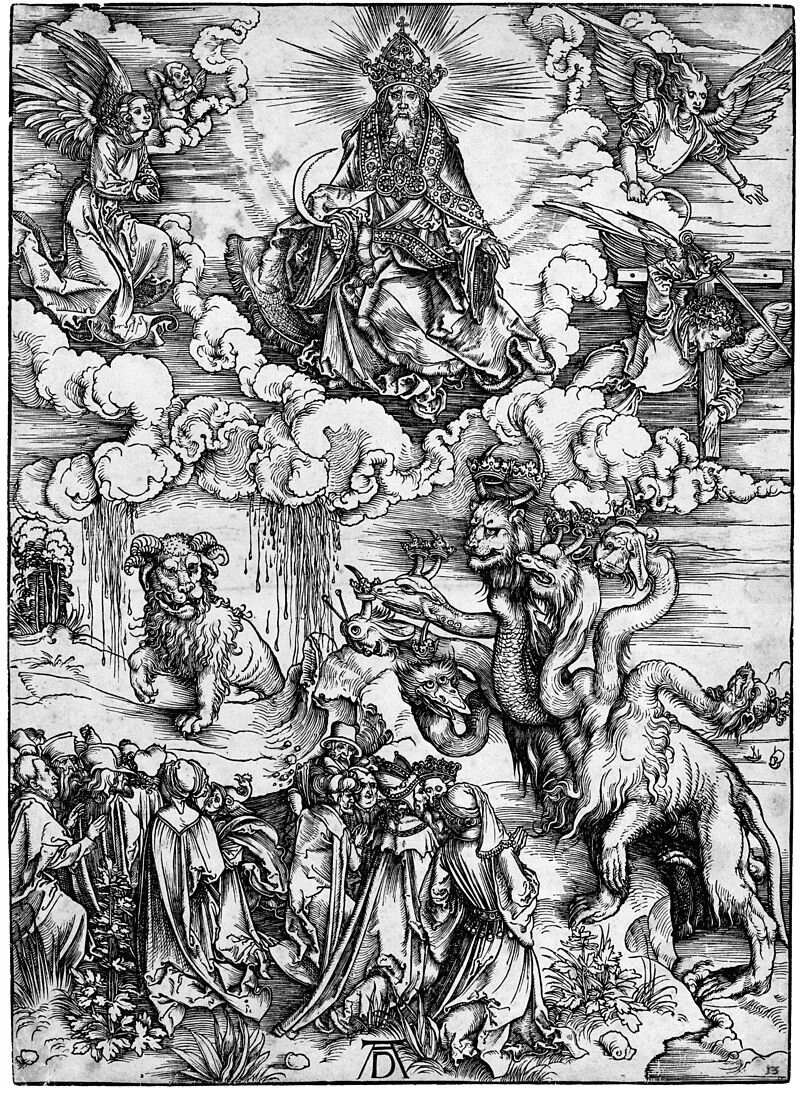
A woodcut by Albrecht Dürer depicting the Beast of Revelation. Public Domain.

A woodcut by Albrecht Dürer depicting the Beast of Revelation. Public Domain.

The current iteration of the Mark of the Beast legend—the conspiracy theory that the vaccine itself or vaccine documentation are really the forced mark that will make of any otherwise faithful Christian a damned heretic, effectively erasing their name from the Book of Life and denying them their eternal reward—actually involves the unlikely figure of Bill Gates. That’s right, a software developer whose career has taken him from working on computers in a garage to his philanthropy efforts on the world stage, Bill Gates is currently viewed by many as the Beast, or at least as the man behind the Beast’s Mark. It seems to have begun when Gates, a proponent of vaccination in the developing world, suggested that by helping children survive into adulthood, vaccines could help slow population growth because with fewer fears for their children’s survival, families may end up having fewer total children. The misunderstanding and purposeful misuse of this statement turned into the conspiracy theory that Bill Gates and the Bill & Melinda Gates Foundation was intentionally thinning populations using vaccines that kill. The conspiracy theory intersected with the Mark of the Beast legend when a digital identity initiative called ID2020 announced in 2019 that it was joining forces with a vaccine alliance with which the Bill & Melinda Gates Foundation partners in order to spearhead a digital identity program in developing nations. This was misinterpreted as an announcement that Bill Gates was putting microchips into people under the guise of vaccine injections. From there, it was only a skip and a jump to identifying Gates’s vaccine initiatives with the Mark of the Beast. Fears that vaccines might be the Mark of the Beast were, after all, not exactly new. Some early resisters of the smallpox vaccine saw the mark it left on the arms of the vaccinated and also cried Mark of the Beast.

The notion of an implanted microchip being the Mark of the Beast was also not new. It does seem, after all, the most logical and modern way to explain why this mark would be necessary for buying and selling, as in the imaginations of the public, it would be like an identification and a credit card that you’d never misplace. The makers of the VeriChip, a silicon microchip promoted in the early 2000s as a medical identification device or as a tracking solution such as we use on dogs, can certainly attest to the difficulty of convincing the public that their product was not the Mark of the Beast; it was one of the principal obstacles they struggled with in launching their product and probably the reason why it didn’t really take off. Never mind the fact that such microchips are subcutaneous, injected under the skin rather than into muscle tissue, and need a much larger gauge needle than is used in vaccinations, and require programming for each individual subject, which obviously isn’t happening before each jab of a vaccine dose. The pieces all seemed to fit, and the more conspiracy theorists looked, the more pieces they seemed to find. For example, in 2019, Microsoft applied for a patent for a system that rewards the fulfillment of tasks verified by the sensing of physical movement with cryptocurrency—a patent for something that sounds like an exercise app on a smartwatch, but which was erroneously claimed to be a patent for an injectable microchip… something that has certainly already been patented, since the VeriChip has been around for two decades. The really unfortunate thing is that the proposed patent was numbered W02020060606, taken by conspiracy theorists as the Number of the Beast, and thus confirmation of their theories. And how was this is all tied to the COVID vaccine in particular? Bill Gates did not develop COVID vaccines, despite what many a conspiracy theorist might tell you. Rather, the Bill & Melinda Gates Foundation took part in a pandemic simulation in 2019, called Event 201, in which a thought experiment was discussed as to what the response might look like if, for example, a novel coronavirus crossed species to infect humans. This event has been presented like it was a shadowy Illuminati meeting, when it was in fact a well-publicized and widely attended event, and not the first of its kind, since virologists have feared such a virus emerging for a long time. So rather than a vast conspiracy in plain sight, this appears to be a series of rather unfortunate coincidences that has now resulted in a massive and baseless conspiracy theory responsible for many avoidable deaths.

An implantable RFID chip. Image by Amaal Graffstra, licensed under Creative Commons (CC BY-SA 2.0)

An implantable RFID chip. Image by Amaal Graffstra, licensed under Creative Commons (CC BY-SA 2.0)

Before fears about injectable microchips were the fears about RFID, or radio-frequency identification technology generally. Christian apocalypticists have been raising the alarm about these so-called spychips being the Mark of the Beast since they first started being implemented in cattle tagging and, in the early 2000s, when major retailers began installing EPC, or Electronic Product Codes, on most merchandise in order to track inventory and product information online. In fact, anxieties about injectable RFID chips today seem rather pointless, since most of us already carry a credit card with an RFID chip in it. It’s kind of like worrying about corporations using smartphones to record your conversations when they don’t really need to because they mine far more actionable data just by monitoring browsing and social media habits. These fears about the RFID-enabled EPC tags echo even earlier fears about UPC or barcodes potentially being the Mark of the Beast. When UPCs were widely adopted, many Evangelicals were certain that what would come next would be barcode tattoos on the forehead or the right hand, thus fulfilling the prophecy. And credit cards also didn’t need a chip in them for Evangelical Christians to fear that they were the Mark of the Beast. Indeed, it seemed anything with a number might be considered the dreaded Mark. Bank routing numbers have 9 digits, which is 6 upside down. Your full zip code, too, is nine digits. Uh-oh. Well what is one to do, if you’re a God-fearing Christian and want no part of this forced worship of the beast? Clearly you must take your money out of the banks. And you must get yourself and your family off the grid. There were many Evangelicals in the late 1970s and 80s who did indeed feel that the only way to be a true Christian was to go full outlaw mountain man. This had been widely encouraged by the bestselling book The Late Great Planet Earth, which predicted a specific end times scenario, most likely occurring before the end of the 1980s. One such Christian American influenced by this apocalyptic culture was Randy Weaver, who believed that credit cards and the computer systems that networked them were the Mark of the Beast. In order to resist what he saw as Revelation come true, he moved his family to a cabin in remote Idaho, and began to associate with the only other well-armed group of professed Christians resisting the government and living off the grid out there, the Aryan Nations. To illustrate the danger of such apocalyptic thought, things did not turn out well for the Weaver family. When the ATF failed in their plan to use a firearm charge to coerce Weaver into informing on the white supremacists’ activities, the result was an infamous shootout and standoff at Ruby Ridge, the Weavers’ home, during which a Deputy U.S. Marshall and Randy’s son and wife were killed.

It's important to note here that a lot of these interpretations of the Mark of the Beast inherently rely on metaphor. If it’s not an actual barcode tattooed on you, than it’s not really a literal interpretation of a visible mark on the hand or head. An injected microchip, one might argue, could maybe be noticed as a bump; and others have pointed to a verse in Revelation about those with the Mark being afflicted with a sore to suggest that a subcutaneous chip might result in some kind of dermal ulceration, but this too takes liberties with the scripture, which is clearly referring to the sore and the Mark as separate things. Purchasing RFID tagged products, having credit card debt on record, opening a bank account or just living on the grid, these interpretations clearly have nothing to do with a literal mark on the right hand and head, and certainly neither does receiving a vaccine or having a vaccination record. This freedom from literal interpretation characterizes many of the explanations of this prophecy throughout history. It has long been associated with non-conformity and resistance to cultural norms as well. In fact, Pentecostal critics of World War One believed that nationalism was the Mark of the Beast, using the idea to support their political views. During the Reformation, this meant interpreting the visions of John the Revelator so as to see Roman Catholicism and the Papacy everywhere: signified in the heads and crowned horns of the first beast; represented by Babylon the Great, the corrupt city of the Antichrist; and embodied in the figure of the Whore of Babylon. In the 17th century, using some creative calculations, various biblical scholars suggested that the year in which the Antichrist would fall would be 1666, a year whose number further explained the Number of the Beast. This became a common fear, dreaded by many European Protestants during the decades preceding the so-called Year of the Beast, and for those in London, who suffered a plague and a devastating fire that year, it seemed that their interpretation of the prophecy had been confirmed. This notion of the infamous riddle that was the Number of the Beast would be echoed 333 years later, when worries about computers and Y2K led many, once again, to fear that the year 1999 would somehow fulfill the terrible prophecy of the Number of the Beast. Revelation is clear that the Mark of the Beast is one and the same as the Number of the Beast, and it is never satisfactorily explained by these interpretations how or why a calendar date might be received on the right hand or the forehead, even metaphorically.

Anonymous oil painting of the Great Fire of London in 1666. Public Domain.

Anonymous oil painting of the Great Fire of London in 1666. Public Domain.

Revelation further states explicitly that, rather than a date, the Mark is “the number of a man,” and more specifically “the number of his name,” which is why the bulk of the scholarly interpretations of the text treat it as a kind of cryptogram, a code that, once solved, will reveal the literal name of the beast, the identity of the Antichrist. Some of suggested, for example, that it was simply a matter of the number of characters in a name, thus it could be claimed that the number of Ronald Wilson Reagan’s name was 666 because each name contained six letters. Others have looked to Roman numerals, which of course correspond well with English letters. Typically, though, those who have tried to decrypt the Number of the Beast in earnest make their attempts using gematria, an arcane Kabbalistic method of interpreting scriptures in which each Hebrew character corresponds to a specific number. There is a real historical case to be made that the 666 cryptogram does refer to gematria. It was certainly in use in that part of the world and was known to be used for calculating the number of a name, as we see in an Assyrian inscription from the 8th century BCE that King Sargon II built a certain wall to a certain measurement “to correspond with the numerical value of his name.” Gematria is originally used with the Hebrew alphabet, but that hasn’t stopped some theorists from applying the numbers 1-26 to the English alphabet and applying that alphanumeric code to find out the identity of the Antichrist. During World War One, again, Penetecostal writers used this English version of gematria to suggest that the Kaiser was the Antichrist because his name and titles, William von Hohenzollern, King of Prussia, Emperor of all Germany, converted quite nicely to the number 666. At the advent of the World Wide Web, anxious Christians used gematria to suggest that using the Internet was taking the Mark of the Beast, for right there at the beginning of every URL was www, which corresponded to the 6th letter of the Hebrew alphabet. Among ancient scholars, like Irenaeus and Andreas of Caesarea, using gematria to solve the 666 cryptogram led to the listing of random names, like Evanthas, Lateinos, and Teitan, not the names of specific figures, but names maybe to be on the lookout for, since their number was equivalent to the Number of the Beast. The problem was that there were and are far too many variations in method. First, if  you don’t like the numerical value you get using gematria, you can always massage the numbers. One method of gematria involves integral reduction: say you get the number 231 from a name. By adding its integers—two, three, and one—together, you can reduce it to the number 6. This is the suppleness of such numerology. Beyond that, there is the problem of transliteration, as each interpreter might make a different decision regarding which Hebrew letter corresponds to whatever language’s letters they are using, since gematria requires that a word or name be converted to its Hebrew equivalent before its numbers can be determined. This was a problem going all the way back to ancient scholars who wrestled with the 666 cryptogram, many of them writing in Greek. Hebrew, a Semitic language, does not lend itself to simple transliteration with European languages, since its phonemes, or distinct sounds, and its orthography, or spelling system, are so different, providing the translator with a lot of choices and making this anything but an exact science. This leads to the rational question of whether the author, John the Revelator, himself writing in Greek, actually intended his readers to perform such an esoteric decryption.

So then, who was John the Revelator, also called John the Theologian and John the Divine, author of the Book of Revelation? Christian tradition would have us believe he was one and the same as the author of the Gospel of John, but this is not exactly a precise identification since the identity of that gospel’s author is also widely disputed, which I spoke about in my episode entitled, The Beloved Disciple and the Authorship of John. What the Book of Revelation tells us is that the author wrote it while on the island of Patmos, a Greek island in the Aegean Sea. Thus the author’s other appellation, John of Patmos. Many biblical scholars place its composition between 81 and 96 CE, during the reign of Roman Emperor Domitian, suggesting that whoever this John was, he went to Patmos seeking refuge during Domitian’s legendary persecution of Christians. However, other scholars have suggested that there is little contemporary source support to actually confirm the truth of Domitian’s supposed persecution of Christians, which were only first mentioned by Eusebius of Caesarea hundreds of years later. An alternative dating, based on the writings of Irenaeus, whose Against Heresies, written about 180 CE, is one of the earliest exegeses, or critical interpretations, of the scripture, is that it was written during the time of Nero, who reigned as Roman Emperor from 54 to 68 CE. With this dating in mind, we must consider the possibility that John of Patmos was not at all referring cryptically to some far flung future events and figures in his Revelation but was instead speaking figuratively about contemporary events. This would be to take a so-called Preterist view of Revelation. In this view, Babylon the Great is Imperial Rome, and the Beast, the number of whose name is 666, was Nero. Indeed, according to the gematria calculations of preterists who espouse this view, the name Nero, transliterated from Greek to Hebrew, yields numbers that do indeed add up to 666. But more than that, one problem that has plagued many an interpretation is the fact that some early versions of Revelation actually have a different Number of the Beast, identifying 616 as the “number of his name.” Funny enough, though, Nero Caesar, transliterated not from Greek but from Latin into Hebrew, yields the gematria result 616, thus explaining the deviation in some versions of Revelation. And more than just the fitting of his name with the Number of the Beast, Nero and Rome can be made to fit other descriptions of the beast. The first beast, with many heads and crowns, might be seen as Rome, and the mortal wounding of one of the beast’s heads may refer to the assassination of Julius Caesar, which the Beast survived in that the empire survived, and the making of the world to worship the Beast may refer to Roman deification of their Emperors, starting posthumously with the cult of divus Iulius, making a god out of Julius Caesar. Or maybe after all the Number of the Beast refers specifically to the first beast, not the second (which is not exactly clear in the scripture) and the head of the beast who survives his mortal wound and is to be worshipped is a reference to Nero, for there was a legend after Nero’s suicide called Nero redivivus that said Nero did not really die or that he would soon return.
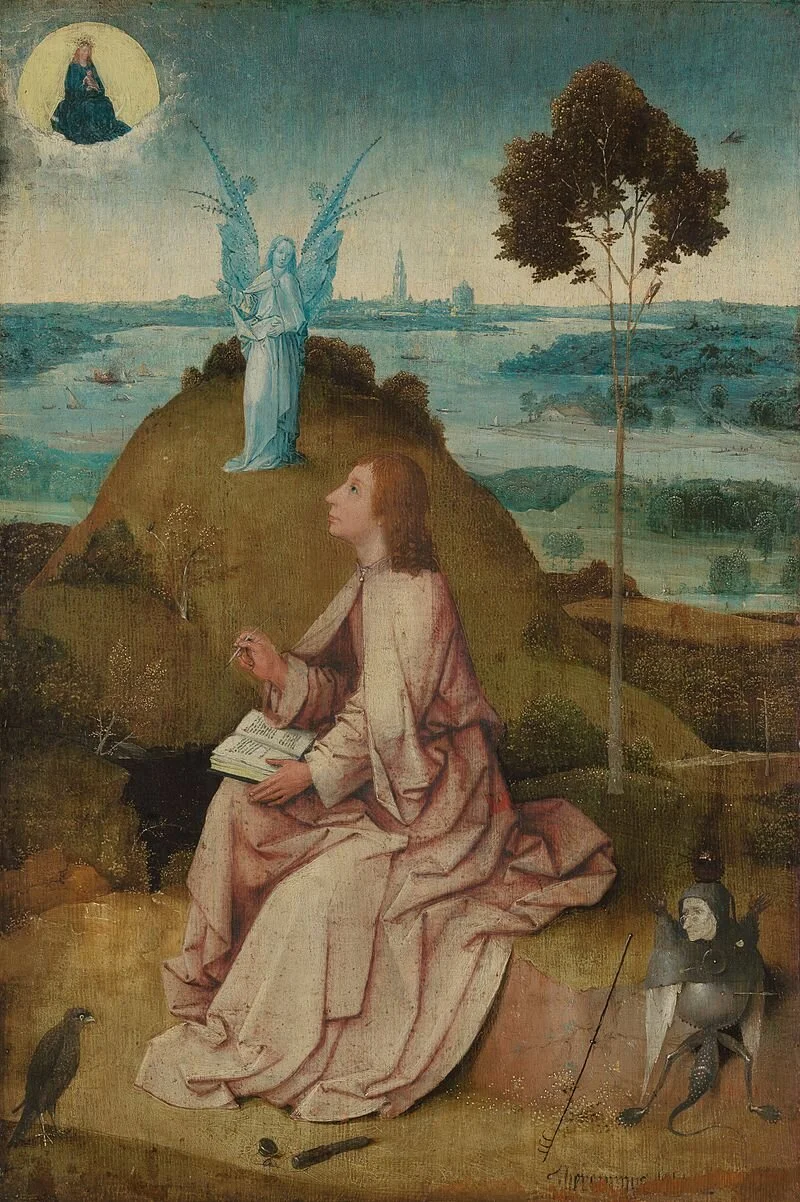
John of Patmos, depicted by by Hieronymus Bosch, 1505. Public Domain.

John of Patmos, depicted by by Hieronymus Bosch, 1505. Public Domain.

The Preterist view, in my mind, best explains the strange visions described in Revelation as well as the cryptogram Number of the Beast, and I encourage listeners to look into it further, as it is far more intricate than I can do justice in outline here. Still I am left with certain questions, such as the specific meaning of the statement that the Mark of the Beast would be received on the hand or forehead. This, I think, is the perennial problem with prophetic texts like these. One might compare them to, for example, the poetry of Nostradamus. Works of prophecy are so chock full of evocative but abstract and surreal imagery that they can be twisted to apply to whatever you want. So, purely as a thought experiment, let’s say I wanted to turn the political tables on Evangelicals and started suggesting that the prophecies of Revelation clearly point to figures or movements on the Right. Obviously the head of the beast that recovers from a mortal wound might refer to Donald Trump, who came down with COVID during his reelection campaign but recovered, or perhaps it could refer to his defeat in the election and the insistence by Qanon that he will return to office. If Trump were the Beast, then what is his Mark? Perhaps the alt-right hand gesture we sometimes hear about, or perhaps his MAGA hats, which place his symbol on his followers’ foreheads. And the flexibility of gematria allows us to turn his name into the Number of the Beast. Using a simple online gematria calculator, I get the value of 159 for Donald, a name with six digits. If I apply the integral reduction method, adding 1, 5, and 9, that six-letter name’s value reduces to 15, and one and five add up to, you guessed it, another six. Likewise, Trump yields the number 726, whose digits add to 15, which can again be reduced to six. I think you get the idea. Do I believe that Trump’s political career was predicted by John of Patmos thousands of years ago. No. If anything, this is just evidence that all claims about the Mark of the Beast are preposterous, especially considering all the many times they have been wrong—which is every time so far—and furthermore, it just goes to show that interpretations of prophecy should not be taken so seriously, especially if they are cynically used as a specious argument for religious exemption from a life-saving public health initiative like vaccines.

Further Reading

Astor, Maggie. “Vaccination Mandates Are an American Tradition. So Is the Backlash.” The New York Times, 9 Sep. 2021, www.nytimes.com/2021/09/09/us/politics/vaccine-mandates-history.html.

Batniji, Rajaie. “Historical evidence to inform COVID-19 vaccine mandates.” Lancet, vol. 397, no. 10276, 2021, p. 791. U.S. National Library of Medicine, www.ncbi.nlm.nih.gov/pmc/articles/PMC7946603/.

Brady, David. “1666: The Year of the Beast.” Bulletin of the John Rylands Library, vol. 61, no. 2, 1979, pp. 314-36. The University of Manchester Library, www.escholar.manchester.ac.uk/api/datastream?publicationPid=uk-ac-man-scw:1m1813&datastreamId=POST-PEER-REVIEW-PUBLISHERS-DOCUMENT.PDF.
Gumerlock, Francis x. “Nero Antichrist: Patristic Evidence for the Use of Nero’s Naming in Calculating the Number of the Beast (Rev 13:18).” Westminster Theological Journal, vol. 68, no. 2, Fall 2006, pp. 347–360. EBSCOhost, search-ebscohost-com.ezproxy.deltacollege.edu/login.aspx?direct=true&db=a9h&AN=23498834&site=ehost-live&scope=site.

Johnson, David R. “The Mark of the Beast, Reception History, and Early Pentecostal Literature.” Journal of Pentecostal Theology, vol. 25, no. 2, July 2016, pp. 184–202. EBSCOhost, doi:10.1163/17455251-02502003.

Joyce, Kathryn. “The Long, Strange History of Bill Gates Population Control Conspiracy Theories.” Type Investigations, 12 May 2020, www.typeinvestigations.org/investigation/2020/05/12/the-long-strange-history-of-bill-gates-population-control-conspiracy-theories/.

Klein, Adam, and Benjamin Wittes. “The Long History of Coercive Health Responses in American Law.” Lawfare, 13 April 2020, www.lawfareblog.com/long-history-coercive-health-responses-american-law.
McGovern, Celeste. “Invisible ‘Mark of the Beast’?” Report / Newsmagazine (Alberta Edition), vol. 29, no. 7, Apr. 2002, p. 46. EBSCOhost, search-ebscohost-com.ezproxy.deltacollege.edu/login.aspx?direct=true&db=ulh&AN=6412102&site=eds-live&scope=site.

McNeile, A. H. “‘THE NUMBER OF THE BEAST.’” The Journal of Theological Studies, vol. 14, no. 55, Oxford University Press, 1913, pp. 443–44, www.jstor.org/stable/23947355.

Merlan, Anna. “The Desperate Search for the Mark of the Beast.” Los Angeles Review of Books, 2 June 2019, www.lareviewofbooks.org/article/desperate-search-mark-beast/.

“RFID: Sign of the (End) Times?” WIRED, Condé Nast, 6 June 2006, www.wired.com/2006/06/rfid-sign-of-the-end-times/.

Rojas-Flores, Gonzalo. “The Book of Revelation and the First Years of Nero’s Reign.” Biblica, vol. 85, no. 3, GBPress- Gregorian Biblical Press, 2004, pp. 375–92, www.jstor.org/stable/42614530.

Sanders, Henry A. “The Number of the Beast in Revelation.” Journal of Biblical Literature, vol. 37, no. 1/2, Society of Biblical Literature, 1918, pp. 95–99, doi.org/10.2307/3259148.

Stewart-Peters, Ella, and Catherine Kevin. “A short history of vaccine objection, vaccine cults and conspiracy theories.” The Conversation, 9 July 2017, theconversation.com/a-short-history-of-vaccine-objection-vaccine-cults-and-conspiracy-theories-78842.

Thomas, Elise, and Albert Zhang. ID2020, Bill Gates and the Mark of the Beast: How Covid-19 Catalyses Existing Online Conspiracy Movements. Australian Strategic Policy Institute, 2020, http://www.jstor.org/stable/resrep25082.

Vanden Eykel, Eric M. “No, the COVID-19 vaccine is not linked to the mark of the beast – but a first-century Roman tyrant probably is.” The Conversation, 7 April 2021, theconversation.com/no-the-covid-19-vaccine-is-not-linked-to-the-mark-of-the-beast-but-a-first-century-roman-tyrant-probably-is-158288.
Walter, Jess. “Visions of the Mark of the Beast. (Cover Story).” Newsweek, vol. 126, no. 9, Aug. 1995, p. 32. EBSCOhost, search-ebscohost-com.ezproxy.deltacollege.edu/login.aspx?direct=true&db=a9h&AN=9508247700&site=ehost-live&scope=site.

The Rise and Fall of the Society of Jesus: Part Two - The Man Beyond the Mountains

800px-Societas_Iesvitarvm_Electa_Regnis_Portvgalliae_Lege_Regia_III_Sept_MDCCLIX_-_Museu_de_Lisboa_(MC.PIN.1295).jpg

While the Jesuits had been banned from more than one country for short periods of time before, in the mid-18th century, after their reputation for financial chicanery and political machination had developed into the full-fledged Black Legend of a clandestine and occult order bent on nothing less than subjugating the world to the Vatican, the tide would finally turn on the Society of Jesus. When it turned, it happened relatively quickly, over the course of only about a decade. It started with a terrible earthquake in Portugal, which in conjunction with the resulting fires and tsunamis killed several tens of thousands in Lisbon and destroyed King Joseph I’s palace. The Jesuits were not blamed for this catastrophe, but they were blamed for an attempt on the king’s life during the aftermath, when the king was living in a tent outside the devastated city. The assassination attempt resulted in a witch hunt focused on the Távora family, relatives of the king’s mistress, whose Jesuit confessor was also implicated in the affair. Within a year of burning the family’s Jesuit confessor at the stake, the king expelled all Jesuits from the territories he controlled. Meanwhile in France, things were also coming to a head. Ever since their brush with being again banned for supposedly plotting regicide in the assassination of the first Bourbon king of France, Henri IV, they had kept their heads down and slowly but surely accumulated wealth and influence while avoiding the teaching of controversial doctrines about tyrannicide. They became the strident orthodox opponents of Jansenists and even triumphed over them in their suppression of the cult at Port-Royal abbey and the persecution of Jansenist clergy under the papal bull Unigenitus, all of which I discussed in detail in my series “The Jansenist Miracles of Enlightenment France.” But Jansenism survived in the underground convulsionnaire movement, and the enemies of the Jesuits, which included the anti-clerical Philosophes and Encyclopédistes of the Enlightenment, would eventually find their opportunity to turn all of France against the Jesuits. In the 18th century, several events provided the pretext they needed. First, Jesuits were accused of swindling an old man named Ambroise Guys out of his fortune in a scandalous court case. Then came the controversial Cadière Affair, when a Jesuit priest named Jean-Baptiste Girard was accused of sexually assaulting and corrupting a young woman, a court case that, as I explained in my patron exclusive “The Stigmatic Maiden and the Wanton Jesuit,” was used by the enemies of Jesuits to argue that all Jesuits were morally bankrupt and a corruptive influence. Finally, in 1757, an unstable man made a lame attempt at assassinating King Louis XV with a penknife, and even though the assassin appeared to be angry that French Catholic clergy were not providing the holy sacraments to Jansenists, anti-Jesuits linked him to the Society of Jesus because he worked as a servant in a Jesuit college. Following Portugal’s lead a few years later, these incidents, as well as the litany of sins attributed to the order by their Black Legend, served as the ammunition their enemies in government needed to dissolve the society in France and banish any Jesuit who would not renounce the order. In Spain, King Charles III was somewhat disposed to favor the Jesuits. However, after a law forbidding the wearing of long cloaks and broad-brimmed hats touched off a mob revolt in Madrid, rumor had it that the Jesuits had orchestrated it as a coup, despite—or more accurately because of—the fact that Jesuit priests were the ones who talked the mob down. As difficult to confirm as the truth behind the rumors of Jesuit riot incitement is the tale that anti-Jesuits who had already driven the order from France and Portugal convinced King Charles III of Spain to suppress them by forging a letter to make it seem like the Superior General of the Jesuits was claiming Charles was illegitimate. No matter the truth of Charles III’s motivations, another huge domino had fallen, and in 1767, the Jesuits were expelled from Spain and all of her colonial territories in the Americas. Pope Clement XIV, reading the room after the expulsion of the Jesuits from so many European countries and their extended empires overseas, finally ordered the abolishment of the Society of Jesus once and for all. It was a true sea change, a dramatic change of fortune for the most influential arm of the Catholic Church and a severe blow to papal power generally. Thus the fact that within fifty years the Jesuits would return and reaccumulate the influence and wealth that had been taken from them cemented forever the notion that the Jesuits were a nefarious and scheming cabal that had never been defeated and had only gone dark until such time as it could rise again to power.

Pope Clement XIV who officially suppressed the Jesuits after their expulsion from many European nations. Public Domain.

Pope Clement XIV who officially suppressed the Jesuits after their expulsion from many European nations. Public Domain.

Before we can discuss the resurrection of the Jesuits decades after their papal suppression, it is important to clarify that the Jesuits did not disappear. Many, it is true, became refugees in Italy when they were expelled from other European countries, while some renounced their vows and were permitted to remain. In Prussia, Frederick the Great at first resisted the papal suppression, and in the United States Jesuits continued establishing schools and instructing students. In Russia, Catherine the Great defied the order’s suppression and encouraged their continued operation, even eventually obtaining papal approval of the continued existence of the Society of Jesus in Imperial Russia. But for the most part, the order had been extirpated in Europe. Still, this did not curtail the suspicion that Jesuits remained lurking among the clergy and the laypeople, hiding in plain sight, manipulating the political situation and waiting until the optimal moment to strike. In England, despite—or perhaps because of—their long history of Catholic persecution and anti-Catholic hysteria, sentiment began to swing more toward toleration among the middle and upper classes in the late 1770s, and legislation was passed to reduce some of the penalties previously enacted against papists. However, rumors still ran rampant, including the claims that an army of Jesuits was gathering in tunnels beneath London, planting explosives in a plot to detonate the banks of the River Thames and flood the city. The passage of legislation that many believed would make England a gathering place for Jesuits and enable their treasonous plotting led to the most destructive mob rampage in English history, the Gordon Riots. Throughout the long history of anti-Jesuitism and anti-Catholicism generally in England, the Catholics were viewed as a Fifth Column, a population working together, in concert and secrecy, to achieve the goals of the country’s enemy, the Pope. This is the doctrine at the heart of Jesuit conspiracy theories, even today. A more precise term for this loyalty not to one’s own country but to a foreign religious authority is Ultramontanism. It is derived from a medieval ecclesiastical term, papa ultramontano, referring to a pope elected from outside of Italy, beyond the Alps. However, it later became a term referring to those whose loyalty belonged only to the man beyond the mountains, the supreme pontiff, the Pope. Eventually, ultramontanism would come to describe not only religious faith and political leanings, but a more defined political movement favoring a return to theocracy, a movement closely associated, in the minds of anti-Jesuits, with the Society of Jesus.

Before counter-revolution would have to come the revolution itself. Anti-clericalism was a major component of the French Revolution. The revolutionary regime declared that all clergymen would have to swear allegiance to their National Constituent Assembly, and clerics who resisted were locked up or exiled. Persecution of Catholics increased, to the point that women would be caught on their way to Mass and assaulted in the streets. This evolved into an organized dechristianization program, in which revolutionaries established a non-religious Cult of Reason to replace the Church, and seized churches to convert them into Temples of Reason. During the Reign of Terror, tens of thousands of clergy were exiled and hundreds executed using the guillotine, a contraption, ironically, invented by a former Jesuit. This was the era in which the left-right spectrum of politics was conceived, as I spoke about in part one, and as those on the right began to formulate their paranoid view of current events, seeing secret societies at work everywhere, so too did those on the left take a paranoid view of politics. The Reign of Terror in France was perhaps the worst outgrowth of the paranoid style of politics, with the mistrust of a conspiratorial enemy becoming institutionalized and resulting in the campaign of murder. Revolutionaries saw conspiracies to overturn their new political order everywhere, and during the Terror, it was considered a civic duty to accuse any you suspected of conspiring against the Revolution. It was claimed one hero of the revolution, Napoleon Bonaparte, especially disliked the Catholic Church because the Jesuits had supposedly ruined his family financially. During the French Revolutionary Wars, as Napoleon ostensibly fought to spread the ideals of the Revolution, Pope Pius VI opposed its spread and even considered restoring the Society of Jesus as a counterforce to the Revolution. Pius VI would die while imprisoned by Napoleon’s invading forces. The restoration of the order would fall to his successor, Pope Pius VII, who struggled continually against Napoleon after his seizure of power and establishment of a military dictatorship. After surviving his own imprisonment by Napoleon, Pius VII promptly issued a bull authorizing the reestablishment of the Jesuit order in all nations, believing the Society of Jesus to be the most effective bulwark against the forces of revolution. Many who were pushing for the restoration of the Jesuits appear to have believed the conspiracy theories of Abbé Barruel that the forces of revolution were orchestrated by secret societies like the Masons and the Illuminati, so it is tempting to suggest that their belief in the Jesuits as the best defense against them confirms the notion of the Jesuits as a similarly conspiratorial order, but just because some of their proponents believed this about them doesn’t mean this is what they believed about themselves. And it must be remembered that the chief ministry of the Jesuits was education, and one prong of the supposed conspiracy believed to have fomented the French Revolution was the godless Enlightenment philosophy spread by philosophes. In other words, it may have just been Jesuit education that was viewed as the best defense against revolutionary ideology. 

Pope Pius VII, who restored the Jesuits after his imprisonment by Napoleon Bonaparte. Public Domain.

Pope Pius VII, who restored the Jesuits after his imprisonment by Napoleon Bonaparte. Public Domain.

The restoration of the Jesuit order coincided with the fall of Napoleon and the beginning of the Bourbon Restoration period of French history, during which the brothers of the king executed during the Revolution, Louis XVI, took back the French throne as a constitutional monarchy. This period was marked by a struggle between the supporters of the Revolution and the forces of counter-revolution, with the principal political questions being what revolutionary reforms should be retained and what aspects of the Old Regime should be restored. Under the first Restoration Bourbon monarch, Louis XVIII, a variety of political factions emerged. Those  on the far left, calling themselves Republicans and Socialists, and liberals of the center-left pushing to keep or restore democratic reforms of the French Revolution and resist any movement toward absolutist monarchy or theocracy. On the center-right, favoring the balance of monarchical power and the parliamentarism set forth in the new Royal Charter, were the so-called Doctrinaires, and on the far right were the Ultra-royalists, among whom were counted Ultramontanes, who would have liked to do away with revolutionary reforms altogether and restore entirely the old political and social order, the Ancien Régime. It was during this period that those on the Left resurrected the Black Legend of the Jesuits as a kind of whataboutism. When it was argued by the Right that the politics of the Left seemed to lead inexorably to bloodshed and regicide, those on the Left protested by raising the age-old specter of Jesuitical regicide, suggesting that it was the Jesuits and their Ultramontane political allies who were the real threat to the new Bourbon monarch, just as they had been to the very first Bourbon Monarch, Henri IV. Pointing fingers at a supposed Jesuit conspiracy behind Ultramontane politics was also a simple retort to accusations that Liberals were the front for an Illuminist conspiracy. In fact, this equivalence even led some to suggest that they might have been one and the same conspiracy, acting under different guises through different sorts of agents to accomplish the same goal of overthrowing power structures and seizing control. The growth of anti-Jesuitism on the Left in this time represented concerns about the influence and success of Ultra-royalism and Ultramontanism and the counter-revolution’s efforts to roll back democratic institutions. Therefore, when the elections of early 1824 resulted in a conservative, Ultra-royalist government, and a new monarch, Charles X, favorable to Ultramontane politics, acceded to the throne, and together they passed a spate of conservative new laws, the Liberal presses began to sound the alarm that Jesuits were no longer an underground threat but rather had seized power and become a tyrannical regime.

During the reign of Charles the X, the paranoid anti-Jesuit rhetoric of some on the Left was transformed by Liberal newspapers into a public outcry. Claims of a secret conspiracy appeared to be confirmed by the revelation that a secret society composed principally of Catholics called the Chevaliers de la Foi, or Knights of the Faith, had played a significant role in achieving the recent Ultramontane domination of the government, and that many of the Knights of the Faith had been involved with La Congrégation, or the Congregation of the Blessed Virgin, a lay religious association founded in Rome by a Jesuit professor. These facts were transformed by the anti-Jesuit press into a vast conspiracy of lay people who were supposedly secretly beholden to the Society of Jesus. The term “the Congregation” became the watchword of every conspiracy-minded polemicist, used to accuse any member of government or public official who could not be concretely tied to the Jesuits through known associations, regardless of whether they had ever actually been associated with the charitable Roman association or the Ultra-royalist Knights of the Faith. If someone acted against the democratic principles of the Revolution or enacted any ultra-royalist program, they were branded a member of the Congregation, a secret servant of the Jesuit conspiracy. The term became as loosely and frequently cast about during those years as the term Deep State is carelessly flung today by conspiracists on the Right. This rhetoric, which argued that the entire government was just a front for the Jesuits, only quieted for a time after Liberals were successful in getting the government to forbid Jesuit education just to appease them. However, the conspiracy claims peaked again after Ultra-royalist Jules de Polignac, a man supposedly known to be a member of the Congregation and thus a servant of Jesuits, rose to the position of Prime Minister. The Liberal press kicked their conspiracy-mongering into high gear again, reporting on an unsubstantiated rumor spread by a German naturalist who claimed to have overheard a secret Jesuit meeting at a traveler’s hostel in the Alps at which the members of the order indicated that their man in France, Polignac, would help them enact their final counter-revolution through another violent reign of terror. Thereafter, when Polignac enacted a series of repressive and anti-democratic ordinances in July 1830, suspending the freedom of the press, dissolving the government, and limiting the franchise before arranging a new election, the conspiracy rumor seemed confirmed. The result was the July Revolution, three days during which Jesuits were widely persecuted and King Charles X and his Ultra-royalist government were overthrown, resulting in the July Monarchy, which saw the Royal Charter of 1814 revised to establish a “Citizen King” rather than a kingship by divine right.

A romanticized depiction of the July Revolution, which in many ways was precipitated by conspiracy theories about Jesuits. Public Domain.

A romanticized depiction of the July Revolution, which in many ways was precipitated by conspiracy theories about Jesuits. Public Domain.

The struggle between Revolution and counter-revolution continued to be waged through the Revolutions of 1848 and beyond, and the specter of the Jesuits was raised again and again to characterize ultramontanist and monarchist politics. And this culture war spread across the Atlantic, to America, which had long been kept out of such controversies. Perhaps this was a result of our founding principle of religious tolerance, or perhaps because Catholics, and even specifically Jesuits, had proven themselves patriots in the American Revolution. While it is true that some Founding Fathers, specifically John Adams, were known to have harbored suspicions about the Jesuits and the spread of Roman Catholicism in America (as they might resent the influence of any European power in the young republic), among their cosignatories on the Declaration of Independence was a Jesuit-educated Catholic named Charles Carroll, whose Jesuit priest cousin, John Carroll, would become the first Bishop and Archbishop of the United States during the period of the order’s suppression. John Carroll was a champion of republican ideals, but after the restoration of the order, an influx of European Jesuits and lay Catholic immigrants brought ultramontanist attitudes that would eventually lead to the 19th century anti-Catholic conspiracy theories I have already spoken about in various episodes. In 1834, mobs destroyed the Ursuline Convent in Charlestown, Massachusetts. In 1835, Samuel Morse’s Foreign Conspiracy Against the Liberties of the United States was published, and the following year, The Awful Disclosures of Maria Monk became the most widely read book in the country, perpetrating a hoax that would deal lasting harm to the image of Catholics in America. The 1840s saw nativist riots and anti-immigrant violence, and the 1850s brought the founding of the nativist Know-Nothing political party by a secret society called the Order of the Star Spangled Banner. This party’s candidates regularly accused their political rivals of being crypto-Catholics, raising fears of the election of an American President who might be the puppet of the Man Beyond the Mountains.

Then came the US Civil War and Abraham Lincoln’s assassination, and after the capture of assassin John Wilkes Booth, it came out that there was a Catholic connection. Booth and his co-conspirators apparently met to plan the assassination at a boarding house owned by the Catholic Mary Surratt, who let rooms mostly to Catholic boarders. Her son John, a conspirator in the assassination, afterward escaped to seek refuge in a Montreal rectory and was helped to join the Papal Zouave, a kind of Catholic Foreign Legion, under a false name. This discovery led to conspiracy theories that the whole plot had been yet another example of Jesuit assassination. The more investigators looked for Catholic connections, the more they saw them, for a Catholic doctor had set Booth’s leg, broken when he had leapt to the stage after shooting Lincoln, and Catholic priests acted as character witnesses for Mary Surratt. But of course, to a less conspiracy-addled mind, none of this proves anything. Naturally Catholic priests witnessed on behalf of their parishioner. The Catholic doctor’s part in the plot remains unclear; he was convicted for conspiracy in a murder mainly because he didn’t report Booth’s injury for a day, but the fact remains he did report it, and eventually he received a Presidential pardon. But even if he was complicit in the assassination, there is nothing to suggest his religion was a motivating factor. Furthermore, there is no evidence that the priests in Montreal who helped John Surratt knew what he had done, and when he was recognized while serving in the Papal Zouave, he wasn’t protected but rather had to flee through sewers to avoid arrest. In the end, though this further stirred up Jesuit conspiracy claims in America, there is no evidence that Catholicism had anything to do with their reasons for murdering Lincoln, and certainly none that a single actual Jesuit was involved. The entire conspiracy theory appears to have been single-handedly cooked up by Charles Chiniquy, a former Catholic priest turned anti-Catholic nativist conspiracy monger, whose credibility we might logically question.

A newspaper drawing of Mary Surratt receiving comfort from one of the priests permitted to visit her in her prison cell. Public Domain.

A newspaper drawing of Mary Surratt receiving comfort from one of the priests permitted to visit her in her prison cell. Public Domain.

Within a few years of Lincoln’s assassination, Pope Pius IX gave many who feared the influence of the Man Beyond the Mountains legitimate cause for concern when at the First Vatican Council he moved to dogmatize the doctrine of papal infallibility. This sparked Otto von Bismarck’s Kulturkampf, or cultural struggle, and the expulsion of Jesuits in some German states, such as Bavaria, as I recently discussed in my series on Ludwig II. And as I explained in my patron bonus episode, the Myth of the Iron Chancellor, Bismarckian politics would later be exploited by Hitler, who espoused anti-clerical rhetoric as well, partly because of his affinity for neopaganism, as discussed in my series on Nazi occultism. Unsurprisingly, given Hitler’s tendency to see enemies conspiring everywhere, he particularly hated the Jesuits. Conspiracy theories about the Society of Jesus, while originating from leftist rhetoric, had always appealed to some on the right, for many royalists in the 19th century also feared their reputation for regicide, but in Nazi Germany, it was taken to new levels. Jesuits were interned alongside Jews in the priest barracks of concentration camps like Dachau, and many died. They have been persecuted alongside the Jews and accused of the same sort of far-reaching world domination plots. They were the counterpart to the fabled Illuminati, said to use the same methods of intrigue and terror to achieve similar ends. They have even been likened to the Knights Templar as a secretive militaristic religious society that had gathered wealth before being suppressed, and surviving their suppression. So in the modern era, the Jesuits have entered the realm of elite conspiracy lore, mentioned breathlessly as being one and the same as the Knights Templar, the Illuminati, and the Jewish World Conspiracy. Look to the insane ramblings of one such as Eric Jon Phelps, whose website and book Vatican Assassins blames just about everything on the Jesuits. The Holocaust was their fault, he’ll say, despite the fact that Jesuits died in camps alongside Jews. They killed JFK, he’ll claim, even though JFK was our first Catholic president. They run Hollywood and the international banking system. And they even have underground military bases in which they perform genetic experiments, creating a class of hybrid creatures to pilot their antigravity aircraft—that’s right, the Gray aliens and their UFOs are also the work of the Society of Jesus. Surely Phelps lost his mind, what little of it he had left, when in 2013 a Jesuit priest was for the first time elected pope. It is hard to logically reconcile the idea of a Jesuit conspiracy bent on world domination and a return to theocratic rule with the moderating influence that Pope Francis has proven to be, or to reason why it took such a supposedly all-powerful order nearly 500 years to put one of its own into the most powerful position in the church. But then, conspiracy theorists don’t typically rely much on logic and reason, and have no problem accommodating such cognitive dissonance.

Further Reading

Barthel, Manfred. The Jesuits: History and Legend of the Society of Jesus. William Morrow and Co., 1984.

Blaskiewicz, Robert. “This Week in Conspiracy: For Fear of a Jesuit Planet.” Skeptical Inquirer, 1 April 2013, skepticalinquirer.org/exclusive/this-week-in-conspiracy-for-fear-of-a-jesuit-planet/.

Carr, J.L. “The Expulsion of the Jesuits from France.” History Today, vol. 14, no, 11, Nov. 1964, pp. 774-781. EBSCOhost, search-ebscohost-com.ezproxy.deltacollege.edu/login.aspx?direct=true&db=31h&AN=87576765&site=ehost-live&scope=site.
Cubitt, Geoffrey. The Jesuit Myth: Conspiracy Theory and Politics in Nineteenth-Century France. Clarendon, 1993.

Goldwag, Arthur. “Vatican Assassins: a One-Stop Website for Conspiratologists.” Southern Poverty Law Center, 23 Nov. 2011, www.splcenter.org/hatewatch/2011/11/23/vatican-assassins-one-stop-website-conspiratologists.
Mitchell, David. The Jesuits, a History. F. Watts, 1981.

Stewart, David O. “The Strange Saga of Lincoln Assassination Co-Conspirator John Surrat.” History News Network, 4 March 2013, historynewsnetwork.org/article/150840.
Worcester, Thomas. "Order Restored: remembering turbulent times for the Jesuits." America, vol. 211, no. 3, 4 Aug. 2014, p. 14. Gale In Context: Biography, link.gale.com/apps/doc/A380526806/GPS?u=modestojc_main&sid=bookmark-GPS&xid=6a3a2d7d.
---. “A Remnant and Rebirth: Pope Pius VII Brings the Jesuits Back.” Conversations on Jesuit Higher Education, vol. 45, no. 1, 2014, pp. 5-6. ePublications@Marquette, epublications.marquette.edu/cgi/viewcontent.cgi?referer=https://www.google.com/&httpsredir=1&article=1856&context=conversations.

The Rise and Fall of the Society of Jesus: Part One - The Black Legend of the Jesuits

In May of 1521, amidst the conflict of the Four Years’ War, the son of a noble Basque family was gravely injured at the French siege of Pamplona when a cannonball fired by the French-supported Navarrese forces shattered his leg. It is said that the Navarrese were so impressed with the courage of this young soldier, Inigo Lopez, that they carried him back to his home in Loyola, but this is likely an embellishment typical of hagiography, for Inigo Lopez de Loyola would go on to become a famous saint. That cannonball set young Inigo on the path to sainthood, for after a terribly bungled surgery that required the rebreaking and resetting his leg, he lay convalescing for some time, during which he pondered his future while reading about the lives of Jesus Christ and the Catholic saints. After his conversion and dedication to Catholicism, he traveled to Jerusalem, intent on helping to convert Muslims or die trying, but he was convinced by Franciscan monks there to go back home, where he began to build something of a following. He and his so-called Iniguistas, who called him simply The Pilgrim, went from city to city in Spain, barefoot and living off of alms, preaching the message that the church faithful should be receiving the Eucharist and confessing their sins weekly, rather than once a year, as was then common practice. While today this is standard, back then it was something of a disruptive doctrine, causing the Inquisition to take notice of him and his disciples. This was the beginning of Inigo Lopez’s commitment to orthodoxy. His Inquisitors instructed him that it was only the place of educated priests to instruct the laity, so Inigo and his followers traveled to France and enrolled at the Sorbonne, where he took the Latinized name Ignatius Loyola while completing his priestly training. Among his early apostles, he formed a brotherhood, the Society of Jesus, which was formally approved by Pope Paul III in 1540. Other Catholic orders suggested that it was arrogant and presumptuous to take the name of Jesus for his brotherhood, but before long it was hard to argue that Ignatius Loyola’s society, called Jesuits by their critics, did not live up to their exalted namesake. Ignatius lived to see the spread of his order through its ministry of education, when the Spanish viceroy of the Kingdom of Naples requested he set up a school in Sicily, but he never dreamed that his little priestly order would become the vast international network into which it transformed, growing within a couple hundred years to include some 22,000 priests operating 200 seminaries and 700 colleges, and acting as the confessors and counselors of princes and monarchs around the world. Nor could he have imagined the coequal growth of his order’s enemies, who would allege that the Jesuits were schemers, spies, conspirators, and even murderers. The story of the Society of Jesus is one of global power, its fearful suppression, its restoration, and the enduring conspiracy theories that surround the order even today.

In my recent series I touched on the Jesuits in Bavaria, and I mentioned in passing that they were the subject of a vast conspiracy theory. Certainly Ludwig II was not the only monarch to suppress the Society of Jesus in his kingdom, nor was he the first to see in them an insidious political force doing the bidding of the Pope and undermining his authority. Indeed, the Jesuits have been lurking in their black robes in the background of many a historical tale I have told on this podcast. They were said to have guarded the mysterious Voynich Manuscript, only entrusting it to Wilfrid Voynich because they believed he could keep it secret, as I stated in The Found Manuscript of Wilfrid Voynich. And it was a Jesuit priest, Jean Hardouin, who concocted the conspiracy theory that all of ancient history had been forged by an impious cohort of monks, as discussed in the final installment of my Chronological Revision Chronicles. The Jesuits stood as the orthodox opponents of Jansenists, as described in my series on The Jansenist Miracles of Enlightenment France, and we further discussed how Jesuits were seen as evil corrupters by their critics in France in my patron exclusive The Stigmatic Maiden and the Wanton Jesuit. The series on Jansenist miracles laid the groundwork for my discussion of the French Revolution in The Illuminati Illuminated, in which series I discussed conspiracy theories on the right that blamed revolutionary activity and Jacobinism particularly on the scheming of philosophes, Freemasons, and specifically on a Bavarian secret society inspired by Enlightenment ideals called The Illuminati, which just happened to be organized by a former Jesuit, Adam Weishaupt, and was said to be structured according to that religious order’s organizational model. What I did not discuss in these series is the so-called “Black Legend” of the Jesuits, the claims that the Society of Jesus was essentially a cabal of plotters scheming at world domination. The Society of Jesus makes no effort to hide the fact that it is a direct tool of the Pope. From its beginnings, even though it considered a mendicant order, the former soldier Ignatius Loyola conceived of it as a kind of military order, with a tightly centralized command structure, with all provincial superiors answering to a single Superior General, a commander elected to the position for life, who answers only to the Pope himself. This authority structure has led conspiracists to dub the Jesuit Superior General the “Black Pope,” arguing that the order is actually a kind of shadow government of the church. By the time of the Enlightenment and the French Revolution, when those on the right sought a conspiratorial explanation of recent political developments, and later, after the Bourbon Restoration, when belief in a Jesuit conspiracy would become the overarching paranoid view of leftist politics, the Black Legend of the Jesuits would already be well established. It had arisen, unsurprisingly, during the Protestant Reformation, when Roman Catholic beliefs and practices became “papistry,” a pejorative term, among many who viewed the Pope and his Church, and especially his elite cadre of priests who controlled education and had the ear of many a sovereign, as evil.

Ignatius reading while convalescing at Loyola after a war injury. Public Domain.

Ignatius reading while convalescing at Loyola after a war injury. Public Domain.

A central element of the Black Legend is the belief that through the Jesuits, the Pope commits regicide, having kings and queens killed if they oppose his will. We may trace this view back to the Protestant Reformation, a time of violent upheaval and rising anti-Catholicism transpiring as Loyola’s order was growing in influence. In England and Scotland, the divisions created by the Reformation were dramatic, as I discussed at length in my Royal Blood Mystery series on Mary, Queen of Scots, and the murder of Lord Darnley. Indeed, numerous were the plots devised by Catholic conspirators to depose or even assassinate Queen Elizabeth and put Mary, Queen of Scots, on the throne. Pope Pius V even encouraged such plots when he issued a bull granting English Catholics the authority to overthrow her. Moreover, one of these, the Babington plot, was masterminded by a Jesuit priest named John Ballard, though there is no evidence that this plot had been expressly orchestrated by the Jesuit Superior General. Rather, Mary’s French Catholic supporters seem to have urged him to undertake the task. Nevertheless, and despite the plot’s failure and its exploitation as an excuse to execute Mary, it did much to tarnish the image of all Jesuits, painting them as intriguers and assassins. Following Elizabeth’s reign, Mary’s son James acceded to the throne, garnering support from Catholic powers by leading them to believe he would bring an end to some of Elizabeth’s persecutions of Catholics, such as the execution of priests who said Mass in secret and the onerous recusancy fines that any who refused to attend Protestant church service were forced to pay. Upon taking the throne, it appeared James might actually leave these fines in place, until he agreed to suspend them in exchange for Catholic loyalty. However, by the time he gave in to their appeals, some Catholic plots were already underway and shortly thereafter came to light. The Bye and Main plots involved abducting the king, forcing declarations of Catholic toleration, and then replacing him with a Catholic queen, his cousin, Lady Arbella Stuart. This plot was actually uncovered when a Jesuit priest named Father Gerard, fearing that the plot would result in further persecution of Catholics, betrayed them by passing information to the authorities. Strangely, though, this same Jesuit, and others, would soon be implicated in the most notorious assassination plot in British history.

On the 4th of November, 1605, King James ordered a search of the cellars and vaults of the old Palace of Westminster, meeting place of the House of Commons and the House of Lords. Nine days earlier an anonymous letter warning a Catholic nobleman to stay away from the meeting of Parliament scheduled for November 5th had been brought to his attention. They had been on high alert, and earlier that day, while making his rounds, the Lord Chamberlain had encountered a man named Guy Fawkes in a vault that contained a large pile of firewood. The Lord Chamberlain had initially thought little of the encounter when Fawkes stated that he worked for Thomas Percy, who had legally rented the vault. Only later was it suggested to the king that it was strange that Percy, a Catholic, would have need of renting a vault under Westminster when he owned a house in London. Upon returning to investigate further, Fawkes was discovered preparing a long match to detonate 36 barrels of old, decaying gunpowder that was hidden beneath the woodpile. The plot’s intention was clearly to blow up the building, killing King James in the same way as his father Lord Darnley had been killed at Kirk O’Field, and taking with him all of Parliament, save the few Catholic Lords the plotters had warned. “Remember, Remember, the Fifth of November,” became the perennial refrain, and Guy Fawkes, a villain to some and anti-hero to others, would be commemorated ever since. But Fawkes was not the orchestrator of this plot. In fact, he was something of a late recruit. The plot had been orchestrated by Robert Catesby, a well-known recusant Catholic. He and some of his fellow plotters were afterward killed in a dramatic shootout at the conclusion of a manhunt. Yet strangely, for many at the time, none of these plotters were seen as the real culprits, and instead blame was laid on the Jesuit order.

The Gunpowder Plot conspirators hanged, drawn and quartered. Public Domain.

The Gunpowder Plot conspirators hanged, drawn and quartered. Public Domain.

While today it is remembered as the Gunpowder Plot, in its day, it was often referred to as the Jesuit Treason. The reason for this is that, as it came out during the ensuing trials, when the plotters held their initial secret meeting the year before, the Jesuit priest who had years earlier foiled the Bye and Main plots had said Mass for them, and though he denied any knowledge, it was assumed he aware of their plans. But more than this, during the summer leading up to the enactment of their plot, Robert Catesby had confessed his intentions to a Jesuit priest named Tesimond, who afterward was troubled enough to ask his superior, Father Garnet, for guidance in the matter. Garnet then went to Catesby and warned him the Pope had no desire for English Catholics to act out and cause further troubles for themselves. Clearly, this was not a Jesuit conspiracy. Nevertheless, Gerard, Tesimond, and Garnet did not go to the government with their knowledge of the plot, as Gerard had done in the past, so they were considered complicit. In reality, there is no indication that Gerard really was privy to their plans, and considering that he was known to have gone to the authorities with such knowledge before, it seems unlikely they would have entrusted him with the information. As for Tesimond and Garnet, the simple fact that the crown was known to put Catholic priests to death simply for saying Mass for crypto-Catholics and encouraging their recusancy seems reason enough for them not to go running to the authorities about anything. While King James gave a speech on the 9th of November stating that he believed the plot to be the work of a handful of zealots and would not hold the larger Catholic community responsible, he nevertheless chose to prosecute these Jesuits. While Gerard and Tesimond escaped his grasp, Garnet was arrested, tried for treason, hanged by the neck, disemboweled, and torn apart by horses.

The belief that Jesuits in particular conspired at regicide developed at the same time across the Channel, during the French Wars of Religion, when a Catholic zealot named Jacques Clément, encouraged by members of the Catholic League, murdered King Henri III with a dagger. Oddly, Henri III had been something of a champion of Catholicism, but recent concessions to Protestants had turned the ultra-orthodox against him. This was not exactly a Jesuit plot. Clément was a Dominican friar. But during later years, when anti-Jesuitism became indistinguishable from anti-Catholicism generally, it was seen as the start of a pattern in which Catholics murdered monarchs. Henri III’s successor, Henri IV, would survive multiple attempts on his life by disturbed Catholics who believed they were assassinating a tyrant, despite the fact that he had renounced Protestantism and converted to Catholicism. Only a month after his conversion, another Dominican priest, Pierre Barrière, attempted to kill him, and during his trial, it was alleged that he had confessed his intentions to certain Jesuits, who encouraged him. Suspicion of the Jesuits encouraging regicide came to a head a year and a half later, when a merchant’s son named Jean Châtel made another attempt on Henri IV’s life, and it was revealed he had been educated at a Jesuit college. The doctrinal teachings of the Jesuits came under scrutiny. Jesuits opposed the Divine Right of Kings, which many viewed as subordinating the secular authority of kings to papal authority. Additionally, Jesuits subscribed to a theoretical doctrine that the Pope’s temporal authority may in some situations extend to deposing kings, and that sometimes, in extreme circumstances, tyrannicide, the murder of tyrants, may be justified. None of these were central doctrines promoted by Jesuits, but in the wake of these assassination attempts, they seemed to confirm a conspiracy. As a result, Châtel’s college was shuttered, two of his teachers were exiled, and a third was hanged and burned at the stake. The Society of Jesus was thereafter outlawed in France, though this ban only lasted a decade. Thereafter, in 1610, one François Ravaillac, another fanatical Catholic, misconstrued Henri IV’s plans to invade the Spanish Netherlands as a declaration of war against Catholicism and murdered him in his carriage. Afterward, his interrogators tried to link him to a Jesuit conspiracy, even though Ravaillac insisted he had acted alone. They accused his Jesuit confessor of having been privy to his plans, which the priest denied. That year, as the Society of Jesus came under renewed attack for condoning and even fostering regicide, the Jesuits declared a moratorium on discussing justifications for tyrannicide. By that time, though, the Black Legend that Jesuits were little more than an order of conspirators and assassins had already taken shape.

Attack by Jean Châtel on Henri IV. The murderer's torment is depicted in the background. Public Domain.

Attack by Jean Châtel on Henri IV. The murderer's torment is depicted in the background. Public Domain.

Only a few years after this, the founding document of the Black Legend of the Jesuits appeared: the Monita Secreta Societatis Iesu, or Secret Instructions of the Society of Jesus. This document would prove to be as foundational for Jesuit conspiracy theories as The Protocols of the Learned Elders of Zion would be for the Jewish world conspiracy theory, and just like the Protocols, it was proven entirely false early on but continued to be touted as accurate for centuries. The Monita Secreta purported to be, as the title implies, a set of instructions given by the order’s Superior General, Claudio Acquaviva, detailing how to achieve the order’s goals of hoarding wealth and seizing power and influence. Essentially, like the Protocols, it was supposedly their plan for world domination. According to the Secret Instructions, wealth was to be accumulated by the manipulation and swindling of widows and heirs, power in the church was to be pursued by working to promote Jesuits to Bishoprics and actively discrediting priests of rival medicant orders, political influence was to be achieved by positioning themselves as the advisors of kings, or as their confessors, through which role they could gather intelligence and even acquire material with which they could blackmail monarchs. At all costs, the order’s image was to be kept pure, such that the reputation of any priest who left the order was to be injured by slander. The preface even stated that, if the Monita Secreta were ever revealed, the order should put forward a member of the society who had no knowledge of these Secret Instructions to offer plausible denials to the public. The thing is, though, that these Secret Instructions were known to have been written in Kraków, by Polish former Jesuit Jerome Zaharowski as a satire and libel. Bitter over having been kicked out of the order the year before, he fabricated the Monita Secreta in an effort to lampoon the Society of Jesus. Originally, he had not even published them as genuine, but rather as a kind of caricature of the order. Nevertheless, they were subsequently republished in numerous editions, accompanied by fabricated stories about how they had been discovered in Prague, or Paderborn, or was it Antwerp, or perhaps aboard a captured ship. Despite having been proven spurious and rejected as false even by some of the Jesuits’ staunchest critics, it would be raised again and again, often as though it had only just been discovered. Much like the Protocols of Zion, it was a hoax that would far outlive its hoaxer, and it would not be the last hoax or forgery to contribute to the Black Legend of the Jesuits.

Back in Great Britain, after the English Civil War and the Restoration of the Stuart monarchy, anti-Catholicism, and fears of Jesuit conspiracy, remained high. Ever since the so-called Jesuit Treason, or Gunpowder Plot, Jesuits were suspected of intrigue and nefarious machinations whenever something terrible transpired. Just as Jews had been blamed for the Black Plague in prior centuries, in 1665, when the bubonic plague struck London with renewed ferocity, Jesuits were seen as the culprits. And Jesuits were likewise scapegoated the next year, 1666, which many had dreaded for decades as the “Year of the Beast,” believing that the apocalyptic prophecies of Revelation would come to fruition then because the number of the year was so close to the Number of the Beast, 666. With the plague outbreak still waning, a fire broke out in September that consumed around 80 percent of the city, and amid the city’s panic and paranoia, Jesuit arson was alleged. The atmosphere was ripe for a conspiracy hoax, and one Protestant clergyman, Israel Tonge, who blamed Jesuits for the loss of his church in the fire, would help to supply it. Tonge became a rabid anti-Catholic conspiracy theorist, authoring numerous incoherent articles about the Roman Catholic Church’s plans for world domination. He shared these explicitly anti-Jesuit conspiracy theories with everyone he knew, including young Titus Oates, the son of a Baptist preacher. Tonge and Oates made plans to write some anti-Catholic pamphlets together, and Tonge even lent Oates some money, but Oates, a former chaplain of the Royal Navy, fell in with Catholics and converted. Encouraged by an English provincial Jesuit, he managed to get himself into a Jesuit College in Spain, which afterward kicked him out for his crude and foul mouth. Then, he lied his way into another Jesuit college for expatriates, this one in St. Omer, France, and again was expelled for blasphemous talk. A defeated Titus Oates finally returned to London with a definite ax to grind, and upon their reunion, he claimed to Israel Tonge that he had only converted in order to learn the Jesuit secrets, and learn them he had, he said. He then told Israel Tonge that the Jesuits were plotting something massive in London: to assassinate King Charles II, supplant him with his Catholic brother, the Duke of York, and reestablish Roman Catholicism as England’s state religion.

The Great Fire of London, 1666. Public Domain.

The Great Fire of London, 1666. Public Domain.

It is unclear whether Israel Tonge helped Titus Oates concoct this conspiracy claim or whether he was Oates’s first dupe and truly believed him, but it does seem apparent that Tonge helped Oates compose a manuscript detailing his knowledge of the conspiracy. And it is certain that he told Oates to hide the manuscript so that he could pretend to discover it. Tonge then arranged to get the information to the king by showing the manuscript to the king’s chemist, a mutual acquaintance. King Charles II thought the claims of the so-called Popish Plot were all lies. He believed, like many, that Israel Tonge was a bit touched by madness, and he believed Titus Oates, who was rather quickly revealed as the author of the manuscript, to be a wicked liar. Nevertheless, once word got around and his brother, the implicated Duke of York, demanded further investigation, he felt that it would have to be looked into further, even if just to debunk it. Oates swore out the truth of his statement for a local magistrate, Sir Edmund Berry Godfrey, and afterward, he and Tonge were questioned by the king’s Privy Council. Oates made numerous specific accusations against many Catholic noblemen and more than 500 Jesuits, whom he called out by name. As evidence, letters supposedly written by some of the accused but probably forged by Oates were presented, and some were impressed that Oates was able to recognize each by their handwriting, even though his having forged them was a more likely explanation for his ability to identify them. While the accusations were taken seriously enough that authorities began rounding up some of the Jesuits named by Oates for questioning, the affair did not escalate to become a full-fledged moral panic until Magistrate Godfrey, to whom Oates had sworn out his initial deposition, was discovered dead. Oates insisted Godfrey had been murdered by Jesuits, and then, as one skeptical contemporary put it, “the very Cabinet of Hell…opened.” Mass panic gripped London, and anyone even suspected of being Catholic was driven from the city. Nine Jesuits were executed for their alleged parts in the conspiracy, and twelve more perished while imprisoned on suspicion. At the height of the panic, Titus Oates went as far as implicating the Queen in plans to poison the king. Before long, though, it became clear that he was a liar. In the end, Titus Oates was tried for perjury, and declared “a shame to mankind,” and sentenced to endure a public shaming before he was imprisoned. He was pilloried, and then he was marched to prison behind a cart and whipped the entire way. As for Israel Tonge, he seems to have suffered no consequences for his part in promoting the Popish Plot.

The astonishing success of Titus Oates’ lies in enflaming public ire against the Jesuits may have had the further effect of inspiring one of the most prolific and little-known forgers in history, whose fabrications were long mistaken for primary historical evidence and helped to propagate the Black Legend of the Jesuits for centuries. His name was Robert Ware, an Irish son of a distinguished historian. Given to seizures as a child, Robert Ware was not chosen to be the principal beneficiary of his father’s estate, despite being his eldest son, because he was not expected to live long. When he defied medical expectations and grew out of his afflictions and even showed great aptitude in historical study and writing, his father ended up bequeathing Robert his library and manuscripts. During the Popish Plot mass hysteria, Robert Ware saw an opportunity both to make money from his skills and his father’s papers, and to encourage the anti-Catholic sentiment that was running amok. Like his father before him, he was staunchly Protestant, but more than that, he was a royalist, so in his initial forgeries, which he presented as having been discovered among his father’s papers even though he had fabricated them, he published supposed evidence that Catholics had secretly orchestrated Protestant dissent, and thus were responsible for the English Civil War and the execution of Charles I that was still fresh in English memory. He published pamphlets purporting to be reprints of true historical documents, complete with detailed but fraudulent provenance, describing how Catholic priests, often Jesuits, posed as Protestants and gathered congregations that they then led away from the Church of England. But more than this, during his career as a forger, he claimed to have turned up letters and documents that served as evidence of Catholic and specifically Jesuit plotting against the English crown. In one of his forgeries was presented the supposed oath taken by Jesuits upon initiation, which required a promise to “wage relentless war, secretly and openly, against all heretics, Protestants and Masons… to extirpate them from the face of the whole earth,” pledging to “hang, burn, waste, boil, flay, strangle, and bury alive these infamous heretics; rip up the stomachs and wombs of their women, and crush their infants' heads against the walls in order to annihilate their execrable race.” To emphasize the secrecy of their murderous plots, the Jesuits supposedly swore that, “when the same cannot be done openly I will secretly use the poisonous cup, the strangulation cord, the steel of the poniard, or the leaden bullet.” In Ware’s imagination, each Jesuit was issued a dagger at initiation, and signed their oath in blood, swearing, “should I prove false, or weaken in my determination, may my brethren and fellow soldiers of the militia of the Pope cut off my hands and feet and my throat from ear to ear, my belly be opened and sulphur burned therein.” Late Victorian scholars would eventually uncover Ware and his forgeries for what they were, but by then, it would be far too late. For a hundred years, his fabrications polluted the historical record and enflamed anti-Catholic conspiracy theories. And even long after their discovery as forgeries, copies of the Jesuit Oath have turned up in reprints of vague provenance and much like the Monita Secreta continue to be touted as evidence of a worldwide Jesuit conspiracy.

Disturbances in connection with the Popish Plot. Public Domain.

Disturbances in connection with the Popish Plot. Public Domain.

These roots of the Jesuit conspiracy theory cannot be fairly characterized as a leftist political conspiracy theory and counterpart to conspiracy theories on the right. Indeed, the entire notion of a left-to-right spectrum in politics would not arise until the French Revolution. The terminology derives from the fact that, during the National Assembly of 1789, monarchists arrayed themselves on the right of the chair, while supporters of revolution gathered on the left. As years passed, this became standard practice. In 1791, during the Legislative Assembly, those seeking change, calling themselves “Innovators,” placed themselves on the left, while the defenders of the Constitution and the status quo kept to the right, with moderates in the center. And so even today, when we speak of progressive politics, which seek change, we regard them as Leftist, and conservative politics, which resist change and seek to preserve the status quo or even revert to a former political order, fall to the right of the spectrum. In the years after the Revolution, those on the right had their bogeymen, specifically the secret societies of the Enlightenment, and after the Bourbon Restoration, as we shall see in part 2 of this series, those on the left found their own in the Jesuits. And yet, in one essential way, the belief in a Jesuit conspiracy always represented conservatism, for it alleged a secret combination dedicated to fighting against and reversing change. While in the 19th century, the Society of Jesus would come to represent the forces of counterrevolution, originally, as we have seen, they represented the forces of the Counter-Reformation. But before their Black Legend underwent its 19th-century transfiguration, the Jesuits would first need to be destroyed and subsequently resurrected, just like their namesake.

Further Reading

Adams, Simon. “The Gunpowder Plot.” History Today, vol. 55, no. 11, Nov. 2005, pp. 10–17. EBSCOhost, search-ebscohost-com.libdbmjc.yosemite.edu/login.aspx?direct=true&db=f6h&AN=18800121&site=ehost-live.

Barthel, Manfred. The Jesuits: History and Legend of the Society of Jesus. William Morrow and Co., 1984.

Cavendish, Richard. “Death of Titus Oates.” History Today, vol. 55, no. 7, July 2005, p. 60. EBSCOhost, search-ebscohost-com.libdbmjc.yosemite.edu/login.aspx?direct=true&db=ulh&AN=17607324&site=ehost-live.

Croft, Pauline. “The Gunpowder Plot.” History Review, no. 52, Sept. 2005, pp. 9–14. EBSCOhost, search-ebscohost-com.libdbmjc.yosemite.edu/login.aspx?direct=true&db=f6h&AN=18772146&site=ehost-live.

Cubitt, Geoffrey. The Jesuit Myth: Conspiracy Theory and Politics in Nineteenth-Century France. Clarendon, 1993.

Ditchfield, Simon. "The Jesuits: In the Making of a World Religion." History Today, vol. 57, no. 7, July 2007, pp. 52-59. Gale Academic OneFile, link.gale.com/apps/doc/A166432179/AONE?u=sjdc_main&sid=bookmark-AONE&xid=ee906699.

Duggan, Anne E. “Criminal Profiles, Diabolical Schemes, and Infernal Punishments: The Cases Of Ravaillac and the Concinis.” The Modern Language Review, vol. 105, no. 2, Modern Humanities Research Association, 2010, pp. 366–84, http://www.jstor.org/stable/25698699.

MacCulloch, Diarmaid. “Foxes, Firebrands, and Forgery: Robert Ware’s Pollution of Reformation History.” The Historical Journal, vol. 54, no. 2, Cambridge University Press, 2011, pp. 307–46, http://www.jstor.org/stable/23017975.

Mitchell, David. The Jesuits, a History. F. Watts, 1981.

Vella, John M. "The Jesuits and political power." Modern Age, vol. 48, no. 2, spring 2006, pp. 158+. Gale General OneFile, link.gale.com/apps/doc/A149012372/GPS?u=modestojc_main&sid=bookmark-GPS&xid=b081ec37.

Worcester, Thomas. "Order Restored: remembering turbulent times for the Jesuits." America, vol. 211, no. 3, 4 Aug. 2014, p. 14. Gale In Context: Biography, link.gale.com/apps/doc/A380526806/GPS?u=modestojc_main&sid=bookmark-GPS&xid=6a3a2d7d.

The Fate of Ludwig II: Part Two - The Mad King (A Royal Blood Mystery)

Fate of Ludwig II pt 2 title card.jpg

On June 7th, 1886, Prince Luitpold, son of Ludwig I, brother of the late king Maximilian II, and uncle to the current King Ludwig II, attended a secret meeting of the Bavarian government convened by Prime Minister Johann von Lutz. This emergency session was the culmination of the machinations that Lutz and Luitpold had devised to seize power. The outcome was certain; Lutz had made sure, through previous consultations with all involved, that there would be no dissenters. The king was to be declared insane and deposed. The next morning, a delegation of ministers and aristocrats who had been named guardians of the mentally ill king was dispatched to Hohenschwangau Castle, the palace where it was believed the king was currently residing. Among them was Dr. Berhard von Gudden, who would later successfully take the king into custody and then be found dead with him in Lake Starnberg. When the delegation arrived at Hohenschwangau, they discovered that the king had departed for his new palace, Neuschwanstein, and had left behind a great feast that had been prepared for him. So the delegation gorged themselves on the king’s food and drink and afterward commanded the king’s head coachman to prepare conveyance for them to Neuschwanstein. The coachman refused and instead rushed away to Neuschwanstein himself to warn the king of the coup that was afoot. The king did not believe him, and perhaps this was one sign of his estrangement from reality. Even as the delegation stood outside his gate, kept at bay by palace guards, and eventually driven away by angry peasants who had heard the news that a plot was underway to dethrone the king they loved, still Ludwig looked down from his palace windows and refused to believe it was happening. Eventually, he had this delegation arrested, but they would not be jailed long, and the coup would not be stopped so easily. King Ludwig II may have had peasants on his side, but the aristocracy and the officials of his government were set against him. They saw his reckless borrowing and spending on theatrical productions and the construction of extravagant castles as indicative of the king’s break from reality as well as his negligence of duty as their sovereign. And this shirking of his responsibilities too could be viewed as symptomatic of his crumbling sanity. In fact, if he had not stayed in Neuschwanstein for so long, refusing to take the coup seriously, or even to believe it was happening, he might have successfully fought his deposition by returning to Munich and demonstrating his mental stability. Instead, he stayed in his hermitage until even his own palace staff could not justify keeping the delegation at bay. Shortly after being taken into their custody, he was discovered dead in Lake Starnberg, having murdered Dr. Gudden, the psychiatrist who had declared him insane and taken him into custody, before drowning himself. At least, that is what government officials told the press. Was Ludwig mad? Reports of his final days at Neuschwanstein, when the reality of his situation was settling in, describe his efforts to obtain poison and his numerous threats to throw himself from a nearby bridge or from the castle’s towers. Is this evidence of madness, though, or simply of despair? If he was not mentally ill, did Ludwig’s deposers actually believe him insane, or were they simply lying in order to seize his power? And if that were the case, might they have killed the king in order to protect the power they’d seized and then falsely portrayed his death just as they’d falsely portrayed his mental health?

To seriously investigate the fate of Ludwig II, we must entertain the idea that his government may have had good reason to depose him. That means taking seriously the proposition that he may actually have been unfit to rule for reasons of mental instability. In order to investigate this, we should first look to his background, as we know today that mental illness is often hereditary. So if we look to Ludwig II’s family, do we see a family history of madness? The answer is a resounding yes, and the government’s report on Ludwig’s sanity cited examples in order to demonstrate that Ludwig was not just insane but incurably so.  His aunts on his father’s side both appear to have been troubled. Princess Marie appears to have exhibited symptoms of an obsessive-compulsive disorder, insisting on always wearing white so that she could more easily spot any dirt soiling her garments and immediately change clothes if she found any such filth. One might argue that perhaps she was only fastidious, but Maximilian’s other sister, Princess Alexandra, suffered delusions that cannot so easily be dismissed. She believed that she had swallowed a glass grand piano. Rather than lock her away in an asylum, she had been shut up in a nunnery. The madness rampant in the Wittelsbach line has been attributed by some to incest, as the sexual contact of cousins which so often occurs within royal families in order to preserve the bloodline can result in neurodegenerative disorders. On his mother’s side, his great uncle, King Friedrich Wilhelm IV of Prussia, was long thought to have suffered from madness as well, though historians now suspect he was actually afflicted with cerebral arteriosclerosis. Then there was Ludwig’s own little brother, Prince Otto. At first, Ludwig and others hoped the prince’s erratic behavior was a result of nervous exhaustion, but eventually it became clear that he was suffering from the madness that ran in the family. Numerous doctors all agreed on Otto’s condition, including Dr. Gudden who would one day declare Ludwig insane without even examining him in person. Otto would be confined not in Dr. Gudden’s asylum, but rather at Nymphenburg Palace, and later at the more remote castle Furstenreid. Despite his palatial surroundings, Otto’s life became wretched, a fact that Ludwig II saw on his occasional visits. His doctors padded his room to keep him from striking his head against the walls, and his screams echoed throughout the castle day and night. Ludwig surely imagined his own confinement at Castle Berg being similar, which may help to explain his nearly immediate recourse to suicide to escape such an existence.

King Otto I of Bavaria, who succeeded his brother Ludwig II but never actively ruled due to his mental illness. Public Domain.

King Otto I of Bavaria, who succeeded his brother Ludwig II but never actively ruled due to his mental illness. Public Domain.

His deposers did more than just cite examples of madness in the family, though. They also pointed to Ludwig’s own behavior. Long had Ludwig been deemed troubled, ever since his sullen youth, when it was thought he was a bit too melancholy and disaffected. Much was made of his self-imposed isolation and the fact that he kept strange hours, only rising at nightfall and staying up all night, taking sleigh rides through the dark countryside, like he was Count Dracula. Some said he would stop in the middle of a blizzard to dine. But more than this was alleged. Servants swore that he spoke to people who were not there, insisting that places at his table be prepared for Louis XIV and XV, whom they said he conversed with at mealtime even though their chairs remained, of course, empty. In his rooms at night, they said he was heard to speak as though to another person when no one was with him, and he sometimes asked servants about people he believed were in adjacent rooms when the rooms were empty. One less skeptical than I might attempt to explain this behavior by suggesting his castles were haunted, but there is a more mundane explanation. Perhaps the servants who witnessed against him were lying. Among the claims of servants were many accounts of Ludwig’s cruelty toward them, which if true meant they might have had axes to grind. And many of the witnesses, it seems, were paid off by Prime Minister Lutz in exchange for their testimony. We know that Lutz took no chances with the other members of his government, ensuring that everyone was on his side before he commenced his coup, so it stands to reason that he screened witnesses ahead of time, and that his payments were essentially bribes for telling tales that would make Ludwig seem crazy. In fact, there are records of reports from other staff who insist Ludwig never behaved strangely at all, and those testimonies remained suspiciously absent from the government’s report.

Modern psychological evaluations tend to suggest that, while his brother Otto showed definite signs of schizophrenia, Ludwig himself appeared to be displaying the symptoms of a personality disorder, at most. Besides the supposed hallucinations, most of what was alleged amounted to eccentric behavior—slovenly table manners, outrageous rudeness, giving shocking commands that he likely did not intend to be taken seriously just to see people’s reactions, and once even inviting his favorite horse to dine at his table with him. As I will speak more about shortly, much of this behavior could be attributable to having an odd sense of humor. And if not, some further circumstances offer still other alternative explanations besides hereditary madness. Due to the king’s indulgence in sweets, he had lost his youthful good looks and become heavier, but he had also lost teeth and suffered from terrible and frequent toothaches. These tooth infections may have caused him to behave in uncharacteristic ways. For example, it was said that he only agreed so readily to offer the imperial title to his cousin Wilhelm in Prussia because he was suffering from one of these toothaches and simply couldn’t deal with the situation. Then there is the fact that he relied on drugs to ease the pain of his toothaches. His chloral hydrate habit, as well as the possibility that he may have relied on laudanum or opium to find further relief, may help to explain much of his eccentric behavior, as use of these narcotics can result in the very episodes his servants described, such as sudden fits of rage and hallucinations. Then there is the fact that some brain disease may have contributed to his changes in behavior late in life. The postmortem revealed that Ludwig’s brain was abnormally small, with unusual thickening in the frontal region, though some historians have suggested that these findings were falsified to support the government’s claims of insanity. If the results can be believed, some have attributed the brain abnormality to a youthful bout with meningitis, while others have suggested that it is evidence of syphilis. The latter theory does much to explain any degeneration of his mental state, and if it was contracted in youth from his father or his wet nurse, as has been speculated, it may also account for Otto’s mental illness. If, however, it was contracted later in life, it may have been through homosexual affairs, which itself may account for the government’s veil of secrecy surrounding his illness.

Photo of Ludwig II toward the end of his life, showing his weight gain. Public Domain.

Photo of Ludwig II toward the end of his life, showing his weight gain. Public Domain.

When the government undertook to investigate and create a report on the king’s mental illness, a curious proviso was given that the investigation should not extend to his sexual affairs. Certainly there were rumors of the king’s homosexual relationships with certain figures in his orbit, as well as with the occasional servant, so for the government to exclude this element from their investigation seems to indicate that the king’s sexual orientation was something of an open secret. Of course, there had been many whisperings about Ludwig and his favorite, Wagner, but that appears to have been a different sort of relationship. Ludwig’s first and perhaps only true love was likely the young Prince Paul von Thurn und Taxis, who was married to Ludwig’s second cousin. Ludwig and Paul appear to have had a passionate affair when Ludwig was just 18 years old, a romance that would last years, only fading when Ludwig began to hear rumors about Paul’s dalliances with a variety of women. Over the course of his life, he would seek “friendship,” which in his estimation meant a very intimate same sex relationship that at least meant dressing in theatrical costumes and reciting love poetry to each other if not sexual contact. Sometimes his attentions were not met with enthusiasm, as in the case of the handsome young officer Baron von Varicourt, who felt he had to clarify to the king that his affections were “of a purely spiritual nature,” to which Ludwig took exception, demanding some explanation for why the baron felt disposed to emphasize this, for as he said, “it is a matter of course that they were of a purely spiritual nature.” Another relationship, with a young theater performer, was likewise doomed for its one-sidedness. Ludwig plucked Josef Kainz from the stage and was at first disappointed when the actor seemed stiff and nervous at their first private meeting. Afterward, Josef’s friend advised him to act in order to win the king’s favor, which he did, delighting Ludwig with a new, more confident and bold personality, like the one Ludwig had seen on stage. In return, Ludwig showered Kainz with gifts and took him traveling. Still, Josef Kainz does not appear to have felt for Ludwig what Ludwig felt for him. He was performing a part, simply trying to please the king, and the king’s night owl schedule kept him up all night, exhausted. Eventually, Ludwig tired of Kainz because he kept falling asleep and snoring. Still, it seems that King Ludwig II found many young men who did respond to his affections. Numerous were the stories of stableboys chosen by Ludwig to accompany him on sleigh rides and on trips to his hunting lodges, afterwards finding themselves assigned to some elevated duty and seen wearing pieces of extravagant jewelry the king had given them.

The king’s romantic entanglements did cause the royal family and his government some embarrassment and difficulties. Bavaria was a predominantly Catholic country, but Catholic or Protestant, conservative or liberal, few would have openly approved of his same sex relationships if they had not been cloaked as “friendships.” What was perhaps more damaging was the fact that Ludwig displayed no desire to marry, which meant there would be no heir to the throne, especially with Ludwig’s brother unmarried and confined to a padded cell. There are some reports of Ludwig’s seemingly trying to engage in heterosexual affairs, which tended to end in disaster. In 1866, he became enamored of a Hungarian actress named Lila von Bulyowsky, whom he had seen portray Mary, Queen of Scots, that other doomed monarch whom I discussed in another Royal Blood Mystery. He wrote her long letters, and Lila began to tell friends she was in love with the still handsome and dashing king. One night, Ludwig invited Lila to Hohenschwangau, and they ended up in his royal chambers, on his bed, where Lila read poetry to him. He confessed to her that he sometimes thought of her at night, in bed, and kissed his pillow. Understandably, she responded by leaning in for a kiss, but Ludwig shrieked in horror and cowered away from her in a corner. Lila tried assuring the king that she loved him, but Ludwig merely fled the room, and Lila left the castle in anger, declaring the king “as cold-blooded as a fish!” The next year, Ludwig settled on a marriage with his cousin, Princess Sophie, not because he was entranced with her, but because she shared his love of Wagner’s operas. He kept up appearances for most of a year before canceling the wedding, stating that he did not truly love her and she deserved love. The king appears to have felt great guilt and terrible self-loathing because of his sexual orientation. A few years after his failed engagement, he began to keep a journal, which for years after his death was hidden by family members but eventually came to light in the 1920s. In it, he made cryptic, almost coded entries that were actually records of every sexual fantasy he had, every time he touched or kissed or embraced another man. He wrote them as reminders of his failure to resist temptation, and at the conclusion of each he would swear that it would be the last time. The result is a record of the king’s sex life as well as of his tortured psyche. It stands as clear evidence, not of the king’s madness, but of his depression and the further contributing factors that may have driven him to suicide that night on Lake Starnberg.

Ludwig II and his fiancée Duchess Sophie in Bavaria in 1867. Public Domain.

Ludwig II and his fiancée Duchess Sophie in Bavaria in 1867. Public Domain.

But can we even accept as true the claims that Ludwig II was suicidal? We certainly have the statements of some close to him in those final days who said he asked that poison be obtained for him, that he spoke philosophically of the immortality of the soul, that he was giving away money as a kind of parting gesture, that he asked for the keys to the tower or threatened to throw himself from a nearby bridge into the waterfall below. But how many of these reports can be taken at face value? We have already discussed the bribery that government officials used to get the stories they wanted from servants, and others were eager to maintain their positions in the forthcoming regime. Perhaps in answer to this question, we should ask whether or not Ludwig was violent and capable of murder, since this version of events has him killing Gudden before killing himself. In fact, there were numerous incidents in Ludwig’s life that do indicate his propensity toward violence. As a boy, he was no stranger to death, having once watched in horror as his military instructor suffered a seizure and fell from a mountainside to his bloody demise. And he seems to have been fascinated from an early age with the notion of ordering an execution. He was once caught threatening to behead his brother Otto, whom he had tied up. Once king, he seems to have relished ordering violent punishments for minor infractions. For such small offenses as looking at him, or leaving a room with their heads raised, he had ordered servants to be whipped, or skinned alive, or even killed, though such punishments were never actually carried out, and it is unclear how serious the king might have been in ordering them. Once, he pulled a gun on an official who was briefing him and calmly told him to continue while he waved the firearm at him. He seemed to think it was funny, and it’s unclear how many of these incidents represent a morbid sense of humor, or his autocratic attitude toward governing revealing itself in an exaggerated pronouncement meant only to frighten someone who had displeased him. He was, however, known to lash out at some of the servants who angered him, striking them with a fist or kicking them. In fact, once, an outrider in his guard did something equally trivial to upset him, and Ludwig beat him quite badly, so badly, in fact, that within a year he had died, it was believed, because of internal injuries the king had inflicted on him in his fit of rage. If this is any indication, it does seem that Ludwig was capable of killing Dr. Gudden, who had enraged him far more than any servant ever had, that rainy night on the lake.

When King Ludwig II and Dr. Gudden were discovered dead in Lake Starnberg, some at first believed it had been an accidental drowning, occasioned by the king attempting to escape by wading out into the lake. However, the scene did not support this presumption. The water was only deep enough to reach the king’s knees. While this theory maintained that he had been drunk, and his feet becoming caught in the stones on the bottom may have caused him to trip and drown, this simply doesn’t account for Dr. Gudden, who surely would have saved the drowning king. Alternatively, some have suggested that Dr. Gudden had chloroformed the king to stop him from escaping, which then resulted in the king drowning, and these theorists suggest Dr. Gudden, in his panic over accidentally killing the king, then dropped dead of a heart attack. But Dr. Gudden’s feet were still on the shore, and his face, covered in scratches, cuts, and bruises, was in the water. The best explanation appears to be that the king overpowered Gudden and thrust his face violently into the water to drown him, in the process wounding the doctor’s face on the shoreline rocks. Then the king would have been free to wade out into the lake and lay down to purposely drown himself. Despite some officials attempting to strengthen this version of events by claiming there were strangulation marks on Gudden’s neck, the evidence from the scene was strong enough and needed no embellishment. Nevertheless, those who believe Ludwig was murdered would point out that all of this evidence comes to us from the very government that wanted Ludwig out of the way. Ludwig remained a clear threat to the Lutz regime. Before being taken into custody, Ludwig II had released a statement to his subjects, the people of Bavaria generally, many of whom still adored him, especially the peasants, which ended with a clear call to arms: “…let this appeal be a reason to My People to help Me defeat the plans of the traitors in arms against Me.” As long as Ludwig lived, there was the possibility he could prove his sanity or escape and be restored by force. It is clear that his uncle Luitpold and Prime Minister Lutz had no intention of reevaluating the king’s sanity after a year, as would be customary. Instead, in their secret meetings, they spoke of the king’s incurable illness and made their plans to confine him for the remainder of his life, just like his brother. Thus Lutz’s decision to keep the king at Castle Berg instead of a more remote and secure castle, and Gudden’s choice to allow him to walk beside the lake without guards to accompany him, reeks to many like Ludwig’s captors were purposely making him vulnerable to assassination.

Portrait of Johann von Lutz, the man who dethroned Ludwig II. Public Domain.

Portrait of Johann von Lutz, the man who dethroned Ludwig II. Public Domain.

Supporters of the murder theory suggest it is suspicious that the postmortem makes no mention of water in Ludwig’s lungs, and speculate that the fact he was found floating proves that his lungs were not full of water. Beyond this speculation, they point to evidence that appeared years later. A physician, Rudolph Magg, who supposedly examined the king’s body before it was sent to Munich is said to have made a deathbed confession that he had falsified his report at the government’s insistence, and that he’d actually seen a bullet wound in the king’s back. The king’s fisherman, Jakob Lidl, left behind a diary that claimed he had been waiting to rescue the king in a boat and had watched as the king was shot while trying to escape. In 1967, art historian Siegfried Wichmann encountered a canvas on which were sketched the portraits three men, the king’s personal physician, Dr. Schleiss von Löwenstein, on the left, an intimate companion of the king, Richard Hornig, depicted weeping on the right, and in the center, what appeared to be Ludwig II’s corpse. Wichmann authenticated the sketch as the work of the painter Hermann Kaulbach, presumably rendered at the scene of Ludwig’s death. Wichmann believed the sketch depicted blood coming from the corners of Ludwig’s mouth, which he says proves he did not drown. Wichmann then went on to purchase some books from the estate of Dr. von Löwenstein, and astoundingly, he claimed to find a handwritten note in one book revealing that Löwenstein, Hornig, and Kaulbach had gone to Castle Berg to check on the king and discovered Dr. Gudden stanching the blood from the king’s bullet wounds. According to the note, Gudden had rushed at them with a syringe, and Hornig had strangled him. Knowing that the truth of the murder would be covered up, Löwenstein asked Kaulbach to sketch the bleeding king. And finally, in 2007, a Munich banker named Detlev Untermöhle signed an affidavit asserting that fifty years earlier, he and his mother had visited Countess Josephine von Wrba-Kaunitz, and that during coffee and cake, the Wittelsbach Countess had produced her favorite conversation piece, a gray Loden coat. In a conspiratorial undervoice, she told them that this was the coat Ludwig II had worn the night he died, and then she showed them the two bullet holes in its fabric.

Now what are we to make of all this? Let us take each claim individually. First, it is not exactly true to claim that drowned bodies do not float. This depends on the qualities of the water, as well as on whether or not putrefaction has begun to release gasses. Of course, putrefaction would not have already set in to this degree when Ludwig was discovered, but it also must be remembered that he died in extraordinarily shallow waters. So perhaps he was not floating so much as still visible above the surface when he was found. The deathbed confession of Rudolph Magg sounds damning, until one discovers that it was supposedly a written confession, and was only rumored to have been seen and has never actually been confirmed to exist. Likewise, Jakob Lidl’s diary page has since disappeared. While it is true that photos of it still exist and handwriting experts have confirmed its authenticity, the fact that the original can no longer be examined causes some doubt. Then there’s the coat that Countess Wrba-Kaunitz liked to show her guests, which, if it existed, was destroyed in a 1973 house fire. But even if it did exist, it might have simply been a coat with holes in it that the Countess had spun tales around. As for the discoveries of Siegfried Wichmann, it is rather hard to believe that Wichmann stumbled onto not only the amazing portrait but also the secret note, both of which he conveniently authenticated himself. But even if the portrait were authentic, the supposed blood from the corners of Ludwig’s mouth might be intended as shadows, or may represent some artistic embellishment, or may even have been added after the sketch’s discovery, perhaps even by Wichmann himself. In the end, all the evidence for murder fails to stand up under scrutiny, but so too do the witness statements and reports that comprise the evidence for Ludwig’s suicide. It may be that we shall never know what happened on Lake Starnberg with any certainty, unless the Wittelsbach dynasty submits to having Ludwig’s body exhumed for a modern inquest. As of now, though, this request has consistently been refused, which is enough to keep the conspiracy theory fires burning in perpetuity.

Sketch depicting Ludwig’s doctor and friend seeing his corpse, discovered by Siegfried Wichmann and claimed to have been sketched in the presence of Ludwig’s body. Reprinted from The Epoch Times, image may be subject to copyright.

Sketch depicting Ludwig’s doctor and friend seeing his corpse, discovered by Siegfried Wichmann and claimed to have been sketched in the presence of Ludwig’s body. Reprinted from The Epoch Times, image may be subject to copyright.

Further Reading

Blunt, Wilfrid. The Dream King: Ludwig II of Bavaria. Viking, 1970.

King, Greg. The Mad King: A Biography of Ludwig II of Bavaria. Birch Lane Press, 1996.

Förstl, H., et al. “Ludwig II, King of Bavaria: A Royal Medical History.” Acta Psychiatrica Scandinavica, vol. 118, no. 6, Dec. 2008, pp. 499–502. EBSCOhost, doi:10.1111/j.1600-0447.2008.01269.x.

Freckelton, Ian. “The Deaths of King Ludwig II of Bavaria and of His Psychiatrist, Professor von Gudden: Warnings from the Nineteenth Century.” Psychiatry, Psychology & Law, vol. 19, no. 1, Feb. 2012, pp. 1–10. EBSCOhost, doi:10.1080/13218719.2012.658741.

McIntosh, Christopher. Ludwig II of Bavaria: The Swan King. I.B. Tauris, 1982.

Neumann, Conny. “Was ‘Mad’ King Ludwig Murdered?” Der Spiegel, 11 July 2007, www.spiegel.de/international/germany/fresh-doubt-about-suicide-theory-was-mad-king-ludwig-murdered-a-515924.html.


The Fate of Ludwig II: Part One - The Fairytale King

Neuschwanstein_Castle_LOC_print (1).jpg

Neuschwanstein castle, a grand magical-looking castle of white spires jutting above the benighted Bavarian forests, was brightly illuminated at midnight, June 11th, 1886, when the psychiatrist Bernard von Gudden arrived along with some others, commissioned to take Ludwig II, the young Fairytale King, into custody. Just the day before, it had been declared in Munich that the king was insane and unfit to govern, and the regency of Ludwig’s uncle Luitpold was proclaimed. Some officials had previously tried to take the king into custody, and they had been driven away and jailed. Now, however, the king was trapped within the walls of Neuschwanstein; what had once been his fantastical refuge from the real world had been transformed into his prison. Gudden and his men confronted and surrounded Ludwig in a corridor as he passed on his way to a tower, perhaps intending to leap to his death. The once dashing young king, now turned corpulent and misanthropic, looked darkly from one man to another. “Majesty, this is the saddest task that has ever fallen to my lot,” Gudden said, as they conducted the king to his chambers to pack some things. “How can you certify me insane without seeing me and examining me beforehand?” Ludwig demanded. “…as an experienced neurologist, how can you be so devoid of scruple as to make out a certificate that is decisive for a human life? You have not seen me for the last twelve years!” The evidence, Gudden assured him, was overwhelming. Ushering him into a carriage from which the interior handles had been removed, the commission drove through the night, eight hours, to Castle Berg, on Lake Starnberg, a residence at which the king often lodged when business called him to Munich rather than staying in the city proper. In his bedroom, holes had been drilled in the doors to listen to any conversation Ludwig might have with servants, in order to discourage the planning of escapes, and bars were installed in his window. King Ludwig was nervous and paranoid, asking constantly about the nurses and orderlies assigned to him, suspecting that they may be Prussians or Jesuits that wished to assassinate him. He did indeed have many enemies. On a walk with Ludwig along the shores of Lake Starnberg soon after the king’s installation there, Dr. Gudden assured him the staff meant him no harm and bade the men to follow at a farther distance to ease the king’s mind. As the walk seemed to calm the king, Gudden promised to take another walk with him that evening, and Ludwig stubbornly held him to that promise despite a torrential rain. Gudden directed the orderlies to stay behind, so as not to disturb the king further. When the two men did not return, the lake was searched, and the dead bodies of both Dr. Gudden and King Ludwig II were discovered. What exactly befell the men remains an enduring historical mystery. Did Ludwig II murder Gudden and drown himself? Or were his fears of assassination warranted and even prophetic?

To understand the tragic figure of Ludwig II and his fate, we must look first to his youth, when already we can see the seeds of his downfall. He was born a Wittelsbach, of a royal line that had ruled in Bavaria ever since Emperor Friedrich Barbarossa had installed his ancestor as duke there in 1180. He was the latest in a series of Ludwigs, from Ludwig the Bavarian, who’d assumed the title of Holy Roman Emperor in 1328, to his grandfather, King Ludwig I of Bavaria. In fact, as a newborn, he’d been given the name Otto, but as he’d been born on his grandfather Ludwig’s birthday, which also happened to be the feast day of St. Ludwig, the king requested his grandson’s name be changed, and thus he became Ludwig II, a child on whom hinged the future of Bavaria. But regardless of the high hopes for him, young Ludwig was denied the affection that he yearned for as a child, as was common among Victorian-era royalty. He was raised in isolation, with strict rules that led to beatings if he did not meet very high expectations. It is not surprising, then, that even at an early age, Ludwig was given to brooding and a melancholy disposition. This temperament, and his preference for solitude, can be seen as one of the factors that would eventually lead to his government declaring him insane. And another, his obsession with theater and fantasy, can also be traced back to his youth. Alienated from the cold court life surrounding him, Ludwig took refuge in a world of romantic legend, of Teutonic knights and ancient gods, whose legends were connected with the grand castles in which he lived. In Hohenschangau Castle, a palace on a hill overlooking Lake Alpsee, young Ludwig gazed at paintings depicting some of the medieval German romances he loved, such as Lohengrin, the Swan Knight, and Parzival on his Grail Quest. This preoccupation with German legend—which prefigured in many ways the obsessions of Heinrich Himmler and other Nazis in the next century, although seemingly far more innocent—would eventually lead Ludwig to financial ruin and the loss of his throne because of reckless spending in his effort to build ever grander and more fantastical castles in which to escape his kingly duties. His fixation on these romantic fantasies would also cause him to devote himself too entirely to patronage of the theater and opera, and specifically the composer Richard Wagner, who had already brought to life Lohengrin, the Swan Knight, and with Ludwig’s patronage would later bring Parzival and other epic German legends that Ludwig loved, such as the Ring of the Nibelungen saga, to the stage. His adoration of Wagner, and the privilege that the composer enjoyed as the king’s favorite, would be the very first scandal that weakened the young king’s position among the Munich aristocracy who would eventually topple him from the throne.

Hohenschwangau Castle, where a young Ludwig II developed his obsession with medieval romance. Image credit: José Luiz, licensed under the Creative Commons Attribution-Share Alike 4.0 International license.

Hohenschwangau Castle, where a young Ludwig II developed his obsession with medieval romance. Image credit: José Luiz, licensed under the Creative Commons Attribution-Share Alike 4.0 International license.

After a brief illness early in 1864, King Maximilian II passed away, and Ludwig II, a tall, strikingly beautiful youth of 18 years old, with dark hair and intense dark blue eyes, took the throne. Among his very first acts as King of Bavaria was to dispatch an agent to find the composer Richard Wagner and extend him an invitation to compose his operas in Bavaria, where he would be awarded a generous stipend and be installed in lavish lodgings. Wagner at the time was deeply in debt and hiding from his creditors, despairing for his career and his life. It is no exaggeration to suggest that, if not for the young king’s intervention, many of Wagner’s most famous works would never have been written or performed. The two men met, and Ludwig expressed to the composer his undying love for his works and his intention to subsidize the writing of his works and make possible the lavish productions of all his operas. They established a correspondence that read more like love letters than anything else, and given young Ludwig’s latent homosexuality, about which I will have more to say later, it is not out of the realm of possibility that Ludwig entertained some romantic notions about the composer before coming to know him. However, despite the rumors that afterward developed, it seems clear that Ludwig was more enamored with the artist than with the aging man himself, and it seems quite apparent that Wagner was purely interested in the king as a patron and a devotee. Indeed, during their decades-long friendship, Wagner’s heterosexual exploits would lead to a scandal that would cause no small amount of trouble for the king. During the summer of 1864, only a few months after establishing himself as the new king’s favorite, Wagner asked some friends to come and visit him. A Prussian conductor, Hans von Bülow, and his wife Cosima, accepted his invitation, and before long, Wagner was living with them in a ménage-a-trois arrangement, with von Bülow, having been promised the job of conducting Wagner’s planned works, looking the other way as Wagner took his wife as a mistress. The scandal of Wagner’s personal affairs became ever more newsworthy when they coincided with massive grants from the royal treasury, which happened in 1865 when Wagner finagled 40,000 gulden out of Ludwig and sent his mistress to fetch it for him. Munich newspapers had something of a field day over it, reporting more and more on Wagner’s unseemly relationship with von Bülow’s wife and his seeming power over the king, to the point that Wagner even challenged one newspaper editor to a duel if he did not print an apology. To many in Munich, a predominantly Catholic city, Ludwig lavishing money and gifts on a foreign entertainer who flouted their traditional social norms recalled another scandal, still recent in the memory of many, that had led to the downfall of Ludwig’s grandfather and namesake.

Ludwig I had been a devoted patron of the arts as well. He transformed Munich into a German cultural showcase, with paved squares, grand marble gates, triumphal arches, elaborate statues, and massive architectural monuments. Ludwig I, however, had paid for this by being frugal with his stipend and only sparingly drawing on the royal treasury. His downfall came not from his building projects, as some would argue his grandson’s would, but rather from a woman whose beauty he could not resist. He was a connoisseur of beauty, commissioning portraits of every beautiful woman he met and keeping them in a hall to gaze upon at his leisure. One of these beauties was Lola Montez, an Irish woman claiming to be descended from Spanish nobility who had performed across Europe as a flamenco dancer. She came to Bavaria at a time when the Jesuits had entered the political realm and taken control of the government against the liberal king’s preferences. King Ludwig took Lola Montez as his mistress and lavished her with gifts such as an extravagant annual income and a mansion, and he even demanded that she be awarded a noble title, despite being foreign-born. The Jesuit government pushed back, demanding that the king banish Lola Montez, and King Ludwig I responded by firing the entire government, first by sacking the Prime Minister, then by dismissing everyone in his Cabinet, and finally by shutting down the current session of his parliament. This put the nobility on the Jesuits’ side, and while the king was setting up a new government, they raged over Lola Montez’s continued presence. Catholics threw stones at her when they saw her in the street. Once, during this scandal, a group of drunk students gathered outside her mansion to shout at her, and Lola trolled them by appearing on her balcony and toasting them with champagne. In retaliation, the king closed down the university for a time, fired all its Jesuit professors, and kicked the offending students out of school. When even his new government once more insisted Lola Montez be expelled from Bavaria, Ludwig I dissolved parliament entirely and ordered his army into the streets to maintain control. Only when a civil war or a coup seemed unavoidable did Ludwig I relent, sending Lola Montez away. Shortly thereafter, amid the revolutions of 1848, he abdicated his throne. Some 20 years later, many in Munich grumbled that his grandson Ludwig II was heading in the same direction.  Opposition to Wagner’s position as the king’s favorite heated up and grew ever more political and public, through anonymous articles in newspapers. To Ludwig II’s credit, he didn’t let it go so far before he exiled Wagner to put an end to the scandal. Nevertheless, the king continued to correspond with and give money to Wagner even while his favorite lived in Switzerland, dutifully writing the operas that Ludwig II had commissioned from him. Nevertheless, scandals persisted, as Wagner fathered a child with the still married Cosima von Bülow, and as he published a series of articles in a Bavarian newspaper that, while praising Ludwig II, heaped scorn on the Catholics and Jesuits in government. Finally done with Wagner’s antics, Ludwig terminated the publication of his articles. Wagner would remain in exile, their relationship pared down to more of a business arrangement, as Wagner’s forthcoming works would, by their contract, belong to the king. While they remained effusive in their correspondence, the true character of their relationship had suffered its final blow. The press and the public might further criticize Ludwig for continuing to pour funds into lavish productions of Wagner’s works, which he felt he could not live without, and later for subsidizing the building of an opera house in Bayreuth for the purpose of staging Wagner’s finally complete Nibelung cycle, but he would no longer give his critics fodder by keeping Wagner as his favorite—a wise and, one might say, sane decision.

Portrait of Ludwig II and his favorite, opera composer Richard Wagner. Public Domain.

Portrait of Ludwig II and his favorite, opera composer Richard Wagner. Public Domain.

Among Ludwig’s costly pet architectural projects, the rather plain wooden Bayreuth Festival Theater was by far the least ostentatious, and by design, for Wagner did not want ornate décor distracting from the stage production. To complete the illusion, Wagner also invented the first sunken orchestra pit, an innovation that would become standard by the end of the century. But Ludwig was rather more given to grandiosity in the projects he oversaw. Neuschwanstein Castle, built on the ruins of two medieval castles, was constructed to give Ludwig a private retreat into the Teutonic Middle Ages of Wagner’s operas. After that, he undertook twice to build his own version of Versailles Palace, once in miniature at Linderhof Palace, and next according to Versailles’s own plans on an island in the Chiemsee lake, even going so far as to reproduce and even outdo Varsailles’s famous Hall of Mirrors. This last fairytale castle, Herrenchiemsee, as well as his beloved residence Neuschwanstein, remained incomplete by the time of his death. Certainly the fact King Ludwig found himself 14 million marks in debt and subject to lawsuits by his creditors had much to do with his government’s vote of no confidence in him, but it wasn’t only his personal finances. To those in Munich, Ludwig’s fairytale castles represented the culmination of Ludwig’s lifelong flight from his kingly responsibilities. He had always preferred his hunting lodges and rural castles to life in Munich, such that, when it was absolutely required of him to be in Munich on royal business, he would only come so far as Castle Berg, on Lake Starnberg, where one day he would be found dead. At about 25 kilometers from Munich, he felt this was close enough that his officials could come to him. So loath was he to attend public functions, at which the aristocracy would stare at him and want to speak with him, that he despised going to public productions of even his favorite Wagnerian operas, preferring to attend their dress rehearsals or even to spend extravagantly on private productions staged only for him. Wagner’s critics of course blamed the king’s isolation on Wagner’s pernicious influence, but their letters show that Wagner often pleaded with Ludwig to make the appearances that the public expected of him. In fact, Ludwig’s alienation appears to have developed rather organically from his youth, when he grew used to his seclusion and came to prefer remaining aloof. His indifference to the performance of his royal duties went so far he established a means of indirectly communicating to all of his officials through a “Cabinet Secretary,” a post which some argued was unconstitutional. This self-imposed separation of the king from the mechanism of government would later enable his government to turn against him, but before that, it would test his ability to govern during a series of diplomatic and military crises that would result in a disastrous loss of autonomy for Bavaria and a humiliating loss of clout for Ludwig II and the Wittelsbach dynasty.

It seemed all the crises that Ludwig II faced were the result of the actions of the ambitious Otto von Bismarck, the Minister President of Prussia, who famously declared that the political concerns of the day must be resolved with “iron and blood.” First, the troubles centered around the duchies of Schleswig and Holstein, which had been a matter of some conflict between Denmark and the German Confederation, especially Prussia. When Ludwig took the throne, inheriting a policy of moderation and independence for Schleswig-Holstein, Prussia and Austria were waging war, and defeating Danish forces. During the following peace conference in London, Ludwig had ordered his emissaries to demand Schleswig-Holstein independence and was so roundly ignored that he lost what little fire for the Schleswig-Holstein question that he could summon. Within a couple years, the question of who controlled the two duchies became a conflict between Prussia and Austria. King Ludwig II was, quite literally, caught in the middle, as Bavaria lay between Prussia and Austria. While he wanted to remain neutral in the conflict, that proved impossible, so he pledged support to Austria. But when the time came to mobilize Bavarian forces against Prussia, Ludwig refused, saying he’d rather abdicate. Only Wagner was able to talk him out of this decision with a pleading letter. As the Seven Weeks’ War commenced, Ludwig sulked at his castle on Lake Starnberg, refusing even to visit his troops. The final humiliation came when Prussia defeated Austria, forcing Ludwig to cede territory and funds to Prussia and sign a treaty pledging military support to future Prussian campaigns. Four years later, Bismarck held him to it, forcing Ludwig to honor the treaty and commit troops to Prussia’s war with France. Prussia’s success in the Franco-Prussian War then paved the way to German unification and the Second Reich. German unification was something Ludwig wanted, but not under Bismarck and the Hohenzollern King Wilhelm I, his own cousin. To illustrate how this turn of events humiliated Ludwig, Wilhelm at first decided he would keep the title of king, which meant Ludwig II would have been reduced to a duke. Eventually, Wilhelm settled on Emperor, leaving Ludwig his title, but not much left of his dignity. This political situation helps us to further understand why Ludwig seemed so fearful, when taken to Castle Berg, that Prussians were out to get him.

A depiction of Bismarck at The Battle of Königgrätz during the Seven Weeks’ War between Prussia and Austria. Public Domain.

A depiction of Bismarck at The Battle of Königgrätz during the Seven Weeks’ War between Prussia and Austria. Public Domain.

Once Ludwig II had been committed into Dr. Gudden’s care, or given into his custody, if you prefer, and once Gudden had hauled the deposed king out of his fairytale castle and back to Castle Berg, Ludwig expressed fear not only that Prussians might be enacting an assassination plot against him, but also Catholics, or more precisely, Jesuits. As we have seen, there was a long history of Jesuits and Catholics opposing and undermining Wittelsbach rule in Bavaria, going all the way back to Ludwig’s grandfather during the Lola Montez affair. Moreover, around the Jesuits had formed for centuries an elaborate conspiracy myth comparable to that surrounding the Templars, the Freemasons, and even the Jews. While on the right, many saw Enlightenment philosophes and revolutionary societies as the bogeymen, on the left, it was the Jesuits. But Ludwig had real, and not just paranoid, reasons to suspect that Catholics bore him ill will. In 1870, the power-hungry Pope Pius IX declared a doctrine of papal infallibility. This doctrine threatened to give Rome absolute political power in any Catholic kingdom, for if the Pope were infallible, then how could any king disagree with or disobey his pronouncements? Meanwhile, a conservative Catholic and principally Jesuit political faction, called the Patriots’ Party, had managed to take control of the Bavarian legislature. Johann von Lutz, Ludwig’s minister of justice and culture, fought the declaration of papal infallibility in Bavarian churches, and the Jesuits retaliated by working to dethrone Ludwig. Ludwig, who was already helpless to stop the weakening of his position as a result of the larger German political reality, did not take kindly to this further affront against his authority. He had been raised to believe that he was a ruler by divine right, which had led him to develop an autocratic view of power and an imperious attitude. Once when he was a child, his brother Otto made a snowball and showed it to him, and Ludwig snatched it from him. When his attendant chided him for it, Ludwig responded, “Why can’t I take the snowball? What am I Crown Prince for?” Now, with Jesuits just the latest to encroach on his power, he lashed out like a despot, expelling all Jesuits from Bavaria. While he was sometimes known to threaten abdication when he didn’t get his way, his response to the Jesuit threat to his power shows just how quick Ludwig was to retaliate against those who sought to take the throne from him. Considering this, during his final walk in the pouring rain along the shore of Lake Starnberg, it would perhaps have been no surprise to find Jesuit assassins lurking in the reeds, but neither would it have been any great surprise for Ludwig to have taken this opportunity to lash out violently against Dr. Gudden, whom he saw as his traitorous captor.

After dealing with the Jesuit menace, Ludwig II seems to have lost whatever remaining interest he had in governing. He made Johann von Lutz, the minister who had helped him fend off the Jesuit threat, his prime minister, and he further arranged for the government to function autonomously, so that he could forget affairs in Munich entirely, spending all his time on his architectural projects and enjoying Wagner’s operas at Beyreuth or in the privacy of his own grand country castles. He no longer even bothered to stay at Berg during sessions of the legislature, and it was this further estrangement from the seat of his power that would eventually allow Prime Minister Lutz, himself a ruthless power schemer, to turn the aristocracy and the legislature entirely against him in the end, effecting what can only be called a coup. Ludwig’s disaffection with Munich and his government should not be construed as disinterest in being a king. Far from it, Ludwig’s entire sense of himself, his identity, was inextricable from his belief that he was a divinely ordained ruler of men. More accurately, his disdain should be seen more as a disillusionment with the reality of modern kingship. He would have much preferred to rule as the kings of his fairytale legends did, from afar, amidst wealth and splendor, occupying himself not with the interminably boring matters of statecraft but rather spending his time appreciating art and literature, for he saw himself as above such practical business. This was why he so loved living in the country at his remote castles. During his regular carriage and sled rides, he was greeted by peasants who loved him and worshipped him in passing as he felt he ought to be worshipped. So greatly had the reduction of his influence in Germany affected this sense of himself that he even tried to set in motion a plan to found some new kingdom in a foreign land, which he could rule as the benevolent and aloof autocrat he imagined a king should be. This endeavor, however, came to nothing. This sense of his own importance and superiority certainly lends weight to the reports that, after the reality of his situation set in during the coup, he was considering suicide. He simply could not bear the idea of falling from the great heights of power to such low depths. “I am going to be precipitated from the highest position a man can occupy in the world to the lowest depths,” he told his valet. “I shall not bear it; life would be worthless afterwards. . . .”

A photo of Ludwig II’s beloved architectural project, Neuschwanstein, as it was under construction during the year in which he died. Public Domain.

A photo of Ludwig II’s beloved architectural project, Neuschwanstein, as it was under construction during the year in which he died. Public Domain.

We must take care not to presume, however, that Ludwig II’s suicidal comments prove that his death was a suicide. The king was well known to make dramatic statements that he did not mean and even to give shocking commands that it appears he never intended to be carried out, as I will discuss in Part 2 of this series. Instead, we must look to the evidence at the scene, when his body was recovered. We must consider the alternative, that he was actually assassinated, and that Castle Berg, which had been chosen last minute over some more secure locations as the place to hold Ludwig, had been selected precisely because the king would be vulnerable there. The corpses of King Ludwig and Dr. Gudden were found in the waters of Lake Starnberg, their feet embedded in the stones of some shallows. Dr. Gudden’s body showed signs of a struggle, with scratches and cuts all over his face, and his fingernails torn. However, Ludwig was without a mark on him, though there was a “tyrannical expression” frozen on his face, according to the doctor who tried to resuscitate him, an expression later described as an “insane smile.” Despite rumors that he’d been assassinated or that he’d drowned in an escape attempt, the new Bavarian government declared he had murdered Gudden and then killed himself, and this has remained the most popularly believed scenario, supported by the available eyewitness reports. However, exaggerated reports of strangulation marks have falsely perpetuated the idea that this version of events was proven beyond doubt. Since then, other claims have surfaced, so to speak, suggesting that a portrait painted of his corpse can prove he was not drowned, that shots were heard on Lake Starnberg that night, and that the king’s coat, long missing after his death, eventually turned up with two bullet holes in the back of it. As we may ask of Ludwig’s lungs, do these stories hold any water? Can they be believed? And what can we determine today of Ludwig’s mental health? Might those who deposed him actually have been justified in their actions? We will go deeper into the mystery of the Fate of Ludwig II in part two of this series.

Further Reading

Blunt, Wilfrid. The Dream King: Ludwig II of Bavaria. Viking, 1970.

King, Greg. The Mad King: A Biography of Ludwig II of Bavaria. Birch Lane Press, 1996.

McIntosh, Christopher. Ludwig II of Bavaria: The Swan King. I.B. Tauris, 1982.